 0
 0
The bills are on the table. You have added them up twice, hoping the second time would come out different. It didn’t. So now you are doing the quiet sum nobody talks about: which one does not get paid this month.
If you are in financial hardship and you go looking for what the Bible says about it, you usually find one of two things. Someone promising that God will make you rich if your faith is big enough. Or someone hinting that you got here by spending badly. Neither one helps a person sitting at a kitchen table with three bills and money for one.
There is a third thing in the Bible, and almost nobody mentions it. It is a price list. And it has a line on it written for people who cannot pay the full price.
What the Bible says about financial hardship: a lower price, written into the law
In the book of Leviticus there is a law for a mother after she has given birth. When her days of recovery were over, she was to bring an offering to the priest. The standard offering is set out plainly:
“And when the days of her purifying are fulfilled, for a son, or for a daughter, she shall bring a lamb of the first year for a burnt offering, and a young pigeon, or a turtledove, for a sin offering, unto the door of the tabernacle of the congregation, unto the priest.” (Leviticus 12:6, KJV)
A lamb was not a small thing. For a family living day to day, an animal from the flock was real money. And then, two verses later, the law does something you might not expect from an ancient rulebook. It stops and makes room:
“And if she be not able to bring a lamb, then she shall bring two turtles, or two young pigeons; the one for the burnt offering, and the other for a sin offering: and the priest shall make an atonement for her, and she shall be clean.” (Leviticus 12:8, KJV)
(“Turtles” here means turtledoves, small wild doves. Not the reptile.)
Look at the Hebrew behind “if she be not able,” and it gets even gentler. Word for word, it reads close to “if her hand does not find enough for a lamb.” That is the whole test. It does not ask whether she was careless. It does not ask whether her faith was strong enough. It simply describes what her hand could reach, and then it sets the price where her hand could reach.
That is not a loophole someone found later. It was written into the law from the start.
Then read the last line of each verse
Here is the part that is easy to read past. Put the two mothers side by side.
The mother who brought the lamb: the priest “shall offer it before the LORD, and make an atonement for her” (Leviticus 12:7).
The mother who brought two small birds: “the priest shall make an atonement for her, and she shall be clean” (Leviticus 12:8).
Same priest. Same atonement. Same clean. There is no smaller blessing for the smaller offering. The cheaper price did not buy a cheaper result.
And the law did not stop at birds. Leviticus 5 gives the same two-bird option to anyone who cannot afford a lamb, and then it goes one step lower still:
“But if he be not able to bring two turtledoves, or two young pigeons, then he that sinned shall bring for his offering the tenth part of an ephah of fine flour for a sin offering; he shall put no oil upon it, neither shall he put any frankincense thereon: for it is a sin offering.” (Leviticus 5:11, KJV)
A tenth of an ephah is a small measure of flour, the kind of amount you could carry in your hands. In Leviticus 14 the same thing happens again. Someone who “be poor, and cannot get so much” brings two turtledoves or two young pigeons, “such as he is able to get” (Leviticus 14:21-22).
Whoever reads these chapters closely sees a pattern. Again and again, the law checks the floor to make sure nobody falls through it. Nobody was meant to be priced out of coming to God.
Luke records which offering Jesus’ family brought
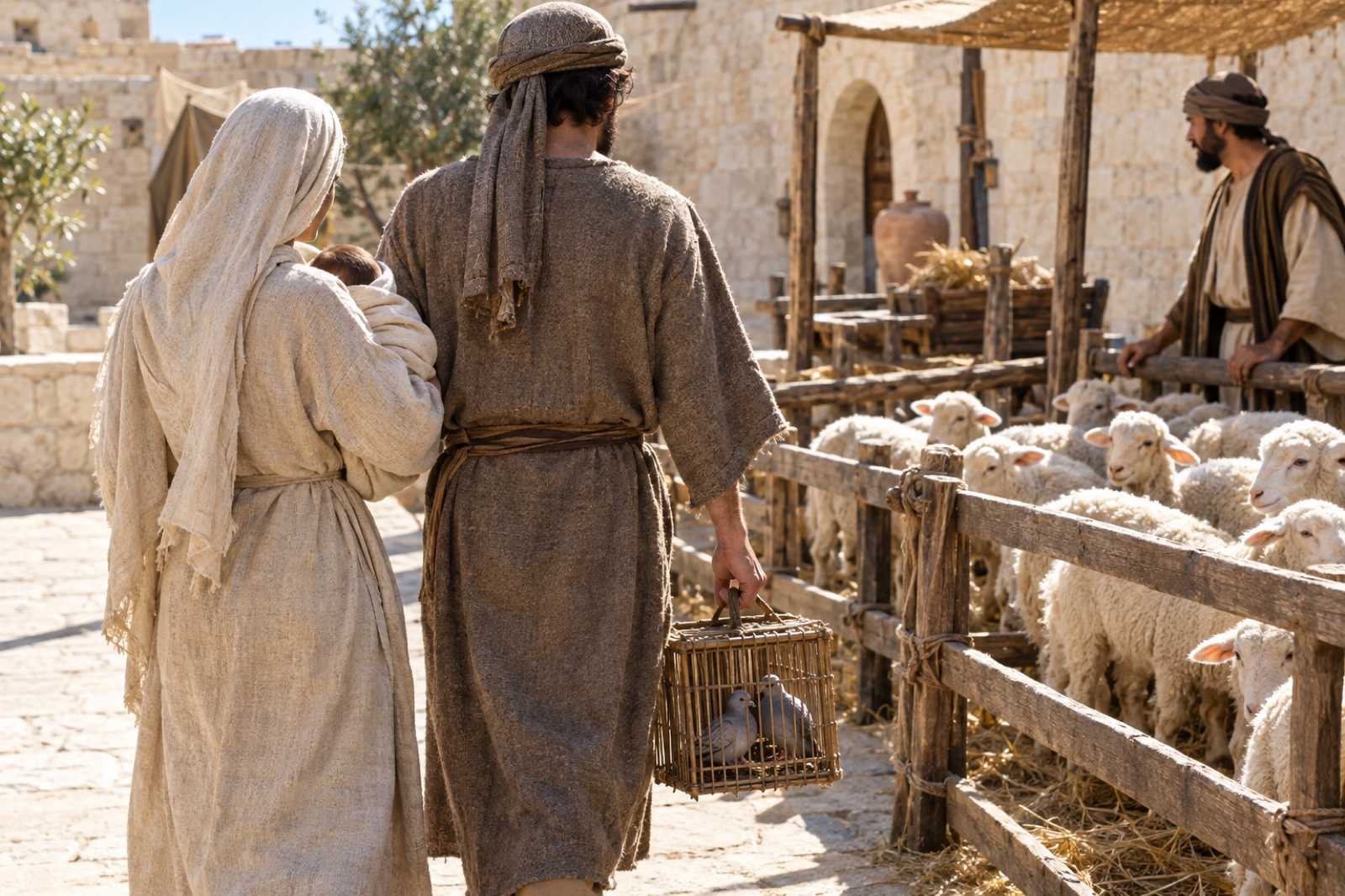
Now move forward to the Gospel of Luke. Mary has given birth. The days of recovery are over. And Luke tells us exactly what happened next:
“And when the days of her purification according to the law of Moses were accomplished, they brought him to Jerusalem, to present him to the Lord.” (Luke 2:22, KJV)
“And to offer a sacrifice according to that which is said in the law of the Lord, A pair of turtledoves, or two young pigeons.” (Luke 2:24, KJV)
That is the wording of Leviticus 12:8, the second option. Luke does not mention a lamb. Luke does not use the word “poor.” Luke does not need to. The offering he names is the one the law set out for a mother whose hand could not find enough for a lamb.
It is worth being careful here. Luke never tells us what was in Joseph’s purse. What Luke tells us is what they carried in. And what they carried in was the price set for people who could not pay the full price. Two small birds, the same kind of bird that the Bible uses for the dove that had nowhere to land.
Think about who was in that young mother’s arms. The household that raised Jesus stood in the line for the cheaper offering.
And there is one more line that is easy to miss. A few verses later, Luke closes the scene like this:
“And when they had performed all things according to the law of the Lord, they returned into Galilee, to their own city Nazareth.” (Luke 2:39, KJV)
All things. Not most things. Not the budget version of things. In Luke’s telling, the two birds counted as the whole law kept.
When you are the one who cannot afford the lamb
Money trouble comes with a second weight on top of the first one. It is the feeling that being short makes you less. Less responsible. Less blessed. Less welcome. You start to avoid the people and places where the money would show.
This passage pushes back on that feeling, quietly and firmly. The God of Leviticus did not write a law that only the comfortable could keep. God wrote a price for the person whose hand comes up short, and then gave that person the same atonement and the same “she shall be clean” as everyone else.
And when Jesus came, God did not place Jesus in the household that could easily afford the lamb. Jesus grew up in a family that used the provision made for the poor. If you are standing where they stood, you are not standing outside God’s plan. You are standing somewhere Jesus’ own family stood.
This is not a promise that the money will suddenly appear. The passage does not say that, and it would be wrong to pretend it does. Your hardship is not a test you are failing, and it is not a lesson you need to earn your way out of. What the passage gives is something steadier than a payout: you were never meant to be priced out. You are allowed to bring what your hand can find.
If debt is part of what you are carrying, it is worth reading what the Bible says about debt and the release in Deuteronomy 15, which is another place the law refuses to let money trouble become permanent. And if the holidays are making the sums worse, Christmas on a budget when the sums won’t work starts from exactly where you are.
Actions to take
- Write down the real number. Take the bill you were going to skip. Next to it, write what your hand can actually find for it this month, even if that is a very small amount or nothing at all. Naming the true number takes two minutes, and it is the first honest step.
- Ask for the lower line. Many lenders, landlords and utility companies have a hardship option, a payment plan or a delay they do not advertise. Search the company’s name with the words “hardship” or “payment plan,” or send one short message asking what they offer. You are asking for the two-bird line. It is worth asking whether it exists.
- Tell one person the truth. Send a message to one person you trust and tell them, plainly, that money is hard right now. You do not have to ask them for anything. The point is that you stop carrying it alone.
Journaling prompts
- Where in your life have you started staying away from people or places because you are afraid the lack of money will show?
- What would change in how you see yourself if you believed the smaller offering counts as “all things”?
- What can your hand actually find right now, not in money, but in time, attention or care, that you have been treating as not enough?
A prayer for financial hardship
God, I have added up the bills again and they still do not work. I am tired of feeling like I am less because my hand cannot reach what other people can reach. Thank you that you wrote a place for me into your law before I ever needed it, and that Jesus’ own family stood in that line. Help me bring what I actually have, without shame, and help me find the next small honest step. I am trusting that I am welcome here, exactly as I am.
Discussion question
Why do you think so many people feel that money trouble makes them less welcome at church or in faith communities, when the law itself went out of its way to make room for them? Share your thoughts in the comments below.
Share this
- The law had a cheaper offering written in for anyone who couldn’t afford a lamb. And Jesus’ own family brought it. I’m not less because my hand comes up short.
- Same priest. Same atonement. Same “she shall be clean.” The smaller offering never bought a smaller blessing. (Leviticus 12:7-8)
- I always thought the Bible was either promising me money or scolding me about it. Then I found out Luke 2:24 quietly records that Jesus’ family brought the offering set aside for people who couldn’t afford a lamb.
Questions people ask about financial hardship and the Bible
What does the Bible say about not being able to afford something God required?
The Old Testament law repeatedly made room for people who could not afford the standard offering. Leviticus 12:8 says a mother who “be not able to bring a lamb” could bring two turtledoves or two young pigeons instead. Leviticus 5:11 goes further and allows a small measure of fine flour for someone who cannot afford even the birds. In each case the person received the same atonement as someone who brought the more expensive offering.
Were Mary and Joseph poor?
Luke 2:24 records that Mary and Joseph offered “a pair of turtledoves, or two young pigeons” when they presented Jesus at the temple in Jerusalem. That matches the alternative in Leviticus 12:8, which the law gave to a mother who could not afford a lamb. Luke does not use the word “poor” and does not describe their finances directly, but the offering he records is the one set out for families who could not afford the full price.
Does the Bible promise that God will make me wealthy if I have enough faith?
No. The passages about the cheaper offering in Leviticus 12 and Leviticus 5 do not promise wealth. They show that people with very little money were fully welcome before God and received the same atonement as everyone else. The family of Jesus used that provision for the poor, which shows that lacking money is not a sign of lacking faith or lacking God’s favor.
What does “if her hand does not find enough” mean in Leviticus 12:8?
In Leviticus 12:8, the phrase the King James Version translates as “if she be not able to bring a lamb” reads in the Hebrew close to “if her hand does not find enough for a lamb.” In Hebrew, the hand often stands for a person’s means or ability. The phrase describes what a person can afford, without any judgment about why they cannot afford more.