 0
0
 0
0
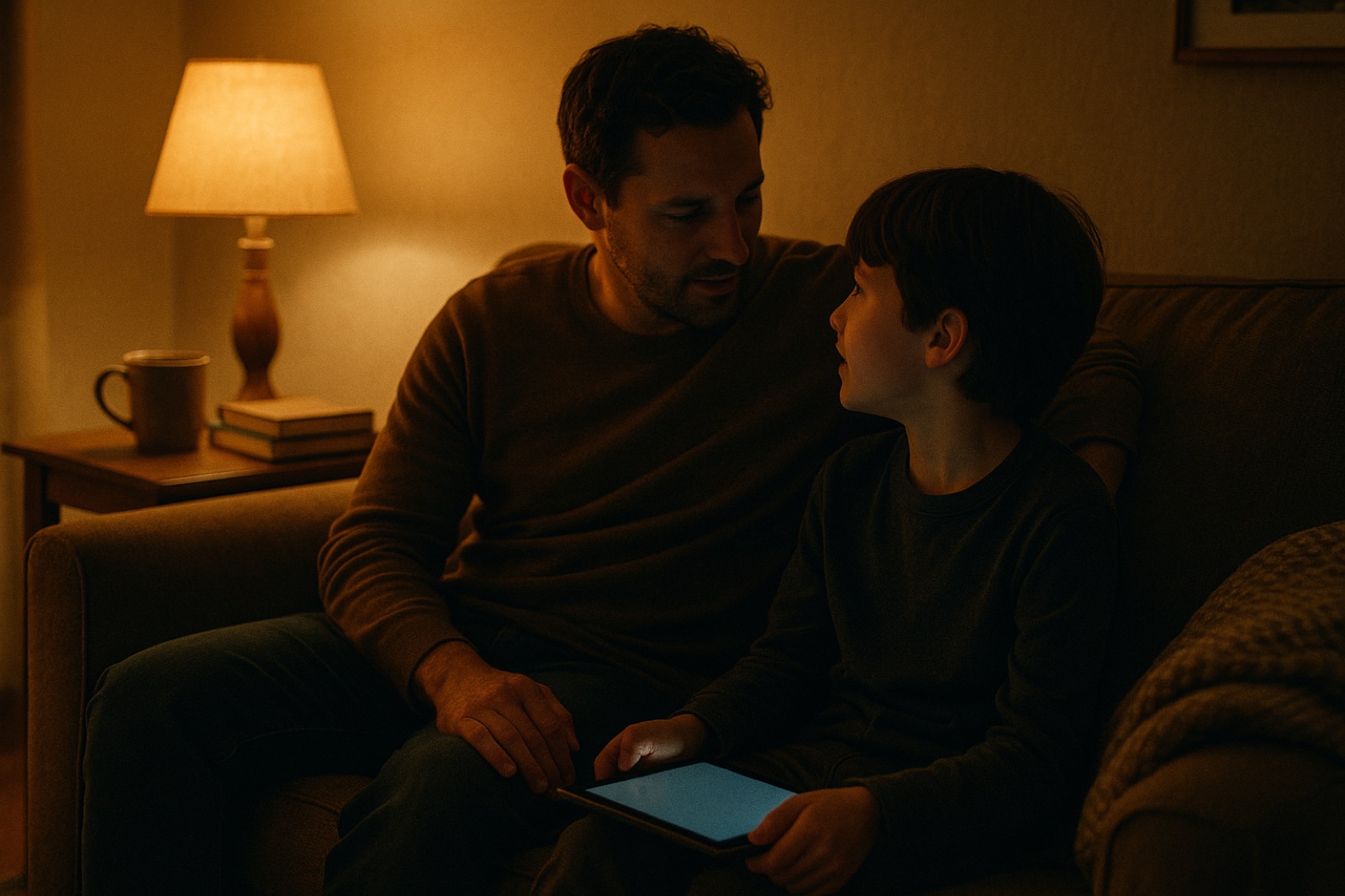
It is 9:14 on a Tuesday night. Your kid is on the couch with a tablet, and you are doing the math again. Twenty minutes in the car. An hour after school. However long this has been going on. You add it up, and you feel that small drop in your stomach.
Then the real question shows up. The one that has probably sent you to a search bar at midnight: is screen time bad for kids — and have I already done something I cannot undo?
If you have asked that, you are not a bad parent. You are a paying-attention parent. But for most of the last fifteen years, nearly every headline you have read has answered that question the same way, with the same certainty, before anyone had actually watched the same children grow up.
The Question Underneath the Question
Here is something worth knowing before we go further: most of what you have read about screens and kids came from studies that took a snapshot. Researchers asked a group of children how much time they spent on screens, gave them a test that same week, and looked for a pattern.
Snapshots are useful. They are also easy to misread. If a child who is already struggling reaches for a screen more often, a snapshot cannot tell you which came first — the struggling or the screen. It just sees them sitting next to each other.
So the honest answer to “have I already done damage” has always been softer than the headlines suggested. Not “no.” Just: nobody had watched long enough to say.
That worry has a way of running on a loop at night, long after the tablet is put away. If you recognize that loop, you might find our free How Anxious Am I? assessment useful — it takes about two minutes and it is surprisingly clarifying about which worries are actually yours to carry.
A Study That Followed the Same Kids for Eight Years
In Finland, researchers at the University of Jyväskylä and the University of Eastern Finland did the harder version of this work. Instead of a snapshot, they took a film.
Their project is called the PANIC study, and it has been following the same children since they were small. For this round, they looked at 260 of those kids — 124 girls and 136 boys — who had grown into teenagers, average age about 15.8 years old.
What makes this different is the measuring. They did not only ask families to guess at screen hours. The children wore a device that tracked heart rate and movement together, so activity and stillness got recorded rather than remembered. Then the teenagers sat down for a battery of cognitive tests called CogState, which measures things like learning, attention, and working memory — how quickly and accurately a brain takes in new information and holds onto it.
Eight years of data. The same kids the whole way through. Then the results came back.
The Result Nobody Ordered
The children who had spent more time on screens since childhood tended to show better cognitive processing as teenagers.
Not worse. Better.
The findings were published in the journal Pediatric Exercise Science, and they ran directly against the assumption almost everyone — parents, teachers, and plenty of scientists — had been working from.
There was more in there, too. Physical activity still mattered, and it mattered in different ways for different kids: among the girls, light everyday movement was linked to better working memory, while among the boys, it was guided, structured activity that showed the connection. The researchers’ own summary was not “screens are fine.” It was closer to: the balance between moving and sitting is what seems to support a thinking brain.
If you find this kind of thing fascinating, the brain keeps handing us surprises like it — researchers recently identified brain cells that appear to block distraction, which is not at all where anyone expected focus to live either.
Is Screen Time Bad for Kids? What This Study Still Cannot Tell You
Now the part that matters, and the part that a lot of coverage skipped.
This is one study. 260 teenagers, in one country, measured with one set of tests. An association is not a cause. The researchers said so plainly — one of them noted that intervention studies are still needed to sort out what actually causes what, and why the pattern differs between girls and boys.
And there is a limitation in the data itself that is almost poetic. The sensors could record that a child was sitting still. They could not record what the child was doing. A kid building something, a kid reading, a kid in a video call with a grandparent, a kid scrolling for four hours — to a heart-rate monitor, those are the same event. The researchers flagged this themselves, and were direct that the kind of screen use matters enormously.
So please do not let anyone hand you this study as permission, and do not let anyone hand it to you as proof. What it actually says is narrower and more interesting than either:
On this one measure — how fast and how well a teenage brain processes information — the alarm was not confirmed.
The Thing the Test Could Never See
Which brings us to what I think is the real finding, and it is not in the paper.
Read back through what was measured. Processing speed. Attention. Working memory. Heart rate. Movement. Every one of those is something you can attach to a machine.
Now think about what you are actually afraid of at 9:14 on a Tuesday. Be honest about it. It is probably not your child’s processing speed. It is that they are becoming someone you do not know. That they are being formed by something other than you, and you are not in the room for it. That there are fewer conversations than there used to be.
There is no sensor for that. There was never going to be. The study measured what it could reach, and the thing that keeps parents awake was always sitting just outside the instrument.
There is a very old piece of parenting advice — around three thousand years old, from a text most people have at least heard of — and the striking thing about it is what it does not say. It does not tell parents to control what surrounds their children. It tells them to talk with their children. When you sit at home. When you walk along the road. When you lie down and when you get up. The whole instruction is about presence: ordinary, repeated, in the room.
Whoever wrote that had no idea what a tablet was. But they had already put a child’s formation somewhere no device can measure — not in the hours, but in the conversation. It is the same reason so much of a child’s steadiness seems to trace back to who else is present in their life, which the research has been circling for years now.
Back to Tuesday Night
Here is what I would do with all of this, if it were my kitchen.
I would let go of the number. The hours were never the whole story, and eight years of careful data just made that harder to argue with. Counting them was mostly a way to feel like I had a lever to pull.
And then I would sit down on the couch.
Not to take the tablet. Not to deliver a talk about screens. Just to ask what they are looking at, and to actually listen to the answer, which will probably be about something you find deeply uninteresting.
That is not a lesser thing than a rule. It might be the only thing here that was ever really measured — just not by anyone with a sensor.
A Few Things You Can Actually Do This Week
- Trade one rule for one question. Instead of a new limit, ask your child to show you the thing they like most on that screen. You will learn more in five minutes than in a month of counting.
- Watch the swap, not the total. The Finnish data cared about the balance between sitting and moving. Ask what the screen time replaced — sleep and movement are the two worth protecting.
- Put one conversation in a fixed spot. The car, the table, the last ten minutes before lights out. It does not need a topic. It needs to be reliable.
- Give yourself the same grace you would give another parent. You have been making decisions with incomplete information, which is the only kind of information parenting has ever offered.
What Do You Think?
If a study found that screen hours were not the thing hurting kids, what would you say is? Is it the hours, the content, or something else entirely that has nothing to do with screens? Drop your take in the comments — this one is worth arguing about.
Share This
- Researchers in Finland followed the same 260 kids for eight years to see what screens were doing to them. The kids with more screen time scored better on cognitive tests. Not worse. Better. https://bgodinspired.com/index.php/relationships-and-family/is-screen-time-bad-for-kids-8-year-study/
- The best study we have on kids and screens measured processing speed, attention, and working memory. It could not measure the thing parents are actually scared of — and that gap says more than the results do. https://bgodinspired.com/index.php/relationships-and-family/is-screen-time-bad-for-kids-8-year-study/
- Eight years of data on kids and screens, and my favorite detail is a limitation: the sensors could tell that a child was sitting still, but not what the child was doing. Building something and doom-scrolling looked identical to the machine. https://bgodinspired.com/index.php/relationships-and-family/is-screen-time-bad-for-kids-8-year-study/
Questions People Ask
Is screen time bad for kids, according to the new Finnish study?
Not on the measure this study used. Researchers at the Universities of Jyväskylä and Eastern Finland followed 260 children for eight years as part of the PANIC study and found that more screen time since childhood was associated with better cognitive processing in adolescence, not worse. The findings were published in Pediatric Exercise Science. This is an association, not proof of cause, and it only speaks to cognitive test performance — not to sleep, mood, or relationships.
How many kids were in the study and how were they measured?
There were 260 adolescents — 124 girls and 136 boys, averaging about 15.8 years old. Their activity and sedentary time were tracked with a device combining heart rate and movement measurement, plus questionnaires. Their learning, attention, and working memory were tested using the CogState battery.
Does this mean I should stop limiting my child’s screen time?
No. The researchers did not conclude that screens are harmless. They emphasized that what a child does on a screen matters a great deal, and that the balance between physical activity and sitting still is what seems to support a thinking brain. The study also could not distinguish between a child creating something and a child scrolling — the sensors recorded stillness, not activity type.
Why do results like this contradict what I have read for years?
Most earlier research took a single snapshot in time, which cannot show whether screen use caused a problem or whether children already struggling were reaching for screens more often. Following the same children for eight years gives a clearer view of sequence, which is why long-term studies sometimes overturn what snapshots suggested.
What actually shapes a child, if not screen hours?
No single study can answer that, but it is worth noticing what these tests could and could not reach. They measured processing speed, attention, and working memory — things a machine can record. They could not measure whether anyone was in the room, whether conversations were happening, or whether a child felt known. Long before anyone measured anything, the oldest parenting wisdom we have put a child’s formation in exactly that place: ordinary, repeated presence and conversation, rather than control of the surroundings.