 0
0
 0
0
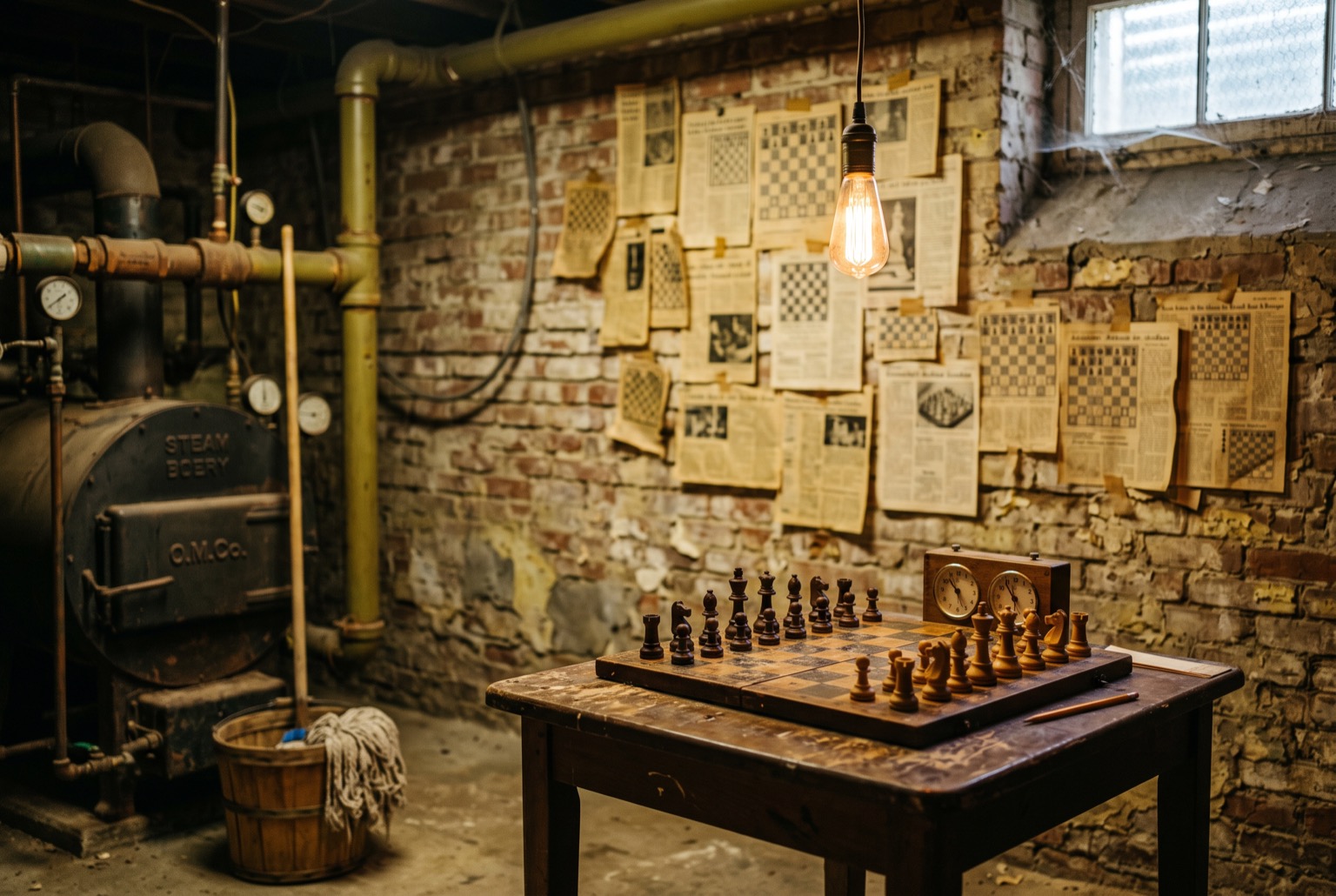
A little girl is sent down to the basement to clean the chalkboard erasers. The janitor is sitting there under a bare bulb, playing chess against nobody. He doesn’t want company. He tells her to go away. She comes back anyway.
That is how The Queen’s Gambit begins, and it is worth holding onto, because almost everything the series is about is already in that room. A man playing alone. A child who will learn, from him, to do the same. And a basement she will have to walk back into, years later, to find out what that man was really doing down there.
The Queen’s Gambit meaning is usually summed up as “a genius against the world.” That is how it looks for six episodes. The seventh turns it inside out.
What The Queen’s Gambit Seems to Be About
The Queen’s Gambit is a seven-episode Netflix limited series from 2020, created by Scott Frank and Allan Scott and adapted from Walter Tevis’s 1983 novel. Anya Taylor-Joy plays Beth Harmon, an orphan in Kentucky who becomes one of the best chess players in the world.
The show gives Beth one private gift, and it films that gift beautifully. At the Methuen Home for Girls, the children are handed green tranquilizer pills. Lying awake at night, Beth looks up and sees a chessboard on the ceiling, the pieces moving where she tells them. No one else can see it. It is the purest picture of a lonely mind the series has.
And the show ties that gift to the pills from the very first night. Beth grows up believing the two come as a pair. If she wants the ceiling, she needs the pills. Later, she adds the bottle.
Everything else about her life pushes in the same direction. Her mother is gone. Mr. Shaibel, the janitor, teaches her and then fades out of her story. Her adoptive mother, Alma, becomes a real friend and then dies in a Mexico City hotel room. Harry Beltik moves in to help her train and leaves when he sees he can’t keep up. Beth learns the lesson every lonely child learns: people go. The board stays.
The Line That Explains the Ending
Here is the thing most viewers file away as chess trivia. When Beth trains with Benny Watts in New York, he explains why the Soviet players are so hard to beat. They play as a team. When a game is adjourned overnight, they sit down together and work out the position. The Americans go home and work alone.
It sounds like a point about Cold War chess. It is really a point about Beth. Her whole method is the American one. She is the girl on her back, staring at a private ceiling.
That is why Paris goes the way it does. She loses to Vasily Borgov again after a night out, and she comes home and falls apart. Alone, the pills and the bottle are not a side story. They are what “alone” costs her.
Mr. Shaibel’s Wall: The Scene That Reframes Everything
In the last episode, Jolene, her old friend from the orphanage, turns up with news: Mr. Shaibel has died. The two of them drive back to Methuen for the funeral. And Beth, instead of going where she is told, goes down to the basement.
On the wall is her whole career. Newspaper clippings from every tournament, pinned up where he could see them while he worked. And a photograph of the two of them together at the board.
He never called. He never wrote to ask for anything. He never showed up at a tournament to be thanked. He just followed every move she made, from a basement in Kentucky, for years.
This is the gold in the whole series, and it is easy to miss what the scene does to episode one. We met Mr. Shaibel as the picture of a man playing alone. That is the image Beth copied her whole life. The wall shows that it was never true. The man in the basement was not alone at all. He had been watching her the entire time. The loneliest image in the show turns out to have been a love story she did not know she was in.
Beth goes back to the car and breaks down in Jolene’s arms. It is the first time we see her grieve like someone who was loved.
The Queen’s Gambit Ending Explained: The Phone Call in Moscow
Jolene lends Beth the money to get to Moscow. So Beth arrives at the biggest tournament of her life already carried there by someone else.
In Moscow she sees what Benny described. The Soviet players gather to go over an adjourned game together. Then her own final game against Borgov is adjourned, and she is facing the night alone in a hotel room. The old Beth would have reached for the pills.
Instead, the phone rings. It is Benny. He has gathered Harry and the other players who once trained with her, the same people she drifted away from, and they have stayed up through their own night working out the position for her. They have been doing what the Soviets do. For her.
The next day, Borgov plays a move none of them had prepared for. Beth is on her own at the board after all. She looks up, and the chessboard appears on the ceiling. No pills this time. The gift was never in the bottle.
Watch the order the show puts these things in. The wall comes first. Then Jolene’s money. Then the phone call. Only after all of that does the ceiling come back clean. The series never says it outright, but its structure does: the thing Beth thought she needed the pills for, she actually needed people for.
Borgov offers a draw. She turns it down, and wins. He stands, hands her his king and embraces her.
A Cloud of Witnesses
There is a very old picture of this. A runner in a stadium, straining toward the line, and the stands are full. Not full of rivals. Full of people who ran before, who know exactly what this costs, and who are watching every step. The letter to the Hebrews puts it this way: “we also are compassed about with so great a cloud of witnesses,” and so the runner can “lay aside every weight” and keep going (Hebrews 12:1, KJV).
That is Beth’s story almost beat for beat. She thought she was running an empty track. The finale fills the stands. A janitor with a wall of clippings. A friend with her savings. A crowd of former rivals on the phone in the middle of their night. And only once she sees them can she set down the weight she has been carrying since the orphanage.
The old idea underneath is simple and a little unsettling. Most of us are watched over far more than we know. Loved by people who never said so. Held up by prayers and quiet effort we never saw. The Bible’s claim is that this goes all the way up, that God has been paying that kind of attention the whole time. Beth doesn’t get that far, and the show doesn’t ask her to. But she gets as far as the basement wall, and that is a long way for someone who started out playing alone.
If you have ever felt like the only one in the room, the How Lonely Am I? check is a gentle place to start. And if you love stories about people who discover they were carried, our piece on My Mister and our reading of Ted Lasso are close cousins of this one.
The Last Board in the Park
The series could have ended on the trophy. It doesn’t. Beth gets out of the car that is meant to take her to the airport and walks into a Moscow park, dressed all in white, where old men are playing chess on the benches. They know who she is. They crowd around her, delighted. One of them, an old man with a look of Mr. Shaibel about him, asks her to play.
She sits down. The show that opened with a man playing chess alone in a basement ends with a woman choosing to play with strangers in the open air. That is the whole arc in two images. The Queen’s Gambit is not really about a girl who beat the world. It is about a girl who found out the world had been in her corner all along.
What Do You Think?
Which moment in The Queen’s Gambit hit you harder: Mr. Shaibel’s wall of clippings, or Benny’s phone call in Moscow? Tell us in the comments. We would love to know which one got you.
Questions People Ask About The Queen’s Gambit
What is The Queen’s Gambit really about?
On the surface, The Queen’s Gambit is about Beth Harmon, an orphan from Kentucky who rises to the top of world chess. Underneath, it is about a young woman who believes she has to win alone, and discovers in the final episode that she was supported the whole way by people like Mr. Shaibel, Jolene, Benny and Harry.
What does Mr. Shaibel’s wall of clippings mean in The Queen’s Gambit?
In the final episode of The Queen’s Gambit, Beth returns to the orphanage for Mr. Shaibel’s funeral and finds that the janitor who taught her chess had pinned newspaper clippings of her whole career on his basement wall, along with a photograph of them together. It shows that the man she thought had faded out of her life had quietly followed and cared about every step of it.
How does The Queen’s Gambit end?
The Queen’s Gambit ends with Beth beating Vasily Borgov in Moscow after her friends phone her with overnight analysis of the adjourned game. She sees the chessboard on the ceiling without pills, turns down Borgov’s draw offer, and wins. She then skips her ride to the airport and joins old men playing chess in a Moscow park, sitting down to play with one of them.
Is The Queen’s Gambit based on a true story?
No. The Queen’s Gambit is fiction. The Netflix series, created by Scott Frank and Allan Scott, is adapted from Walter Tevis’s 1983 novel of the same name. Beth Harmon is an invented character, though the world of tournaments, adjourned games and Soviet team analysis draws on real chess history.
Share This
- Rewatched The Queen’s Gambit and noticed: the show opens with Mr. Shaibel playing chess alone in a basement, and the wall of clippings proves he was never alone at all. He was watching Beth the whole time.
- The Queen’s Gambit is not about a lone genius. Beth only sees the ceiling board without pills after Shaibel’s wall, Jolene’s money and Benny’s phone call. She needed people, not the bottle.
- The Soviets beat everyone because they analysed adjourned games as a team. The Queen’s Gambit ends when Beth finally gets a team of her own.