 0
0
 0
0
A man kneels over a ten-year-old boy in a forest in 1953 and hits him in the head with a rock. He is doing it because he is trying to be a good father.
That is Ulrich Nielsen. He has travelled thirty-three years into the past to stop a child from disappearing, and the child is his own son. The boy under the rock is Helge Doppler, who is ten years old and has not done anything to anybody yet.
Anyone looking to get the Dark Netflix ending explained usually starts at the last episode. Start in that forest instead. Everything the series decides in its final hour is already lying there in the leaves.
Four families, one town, thirty-three years
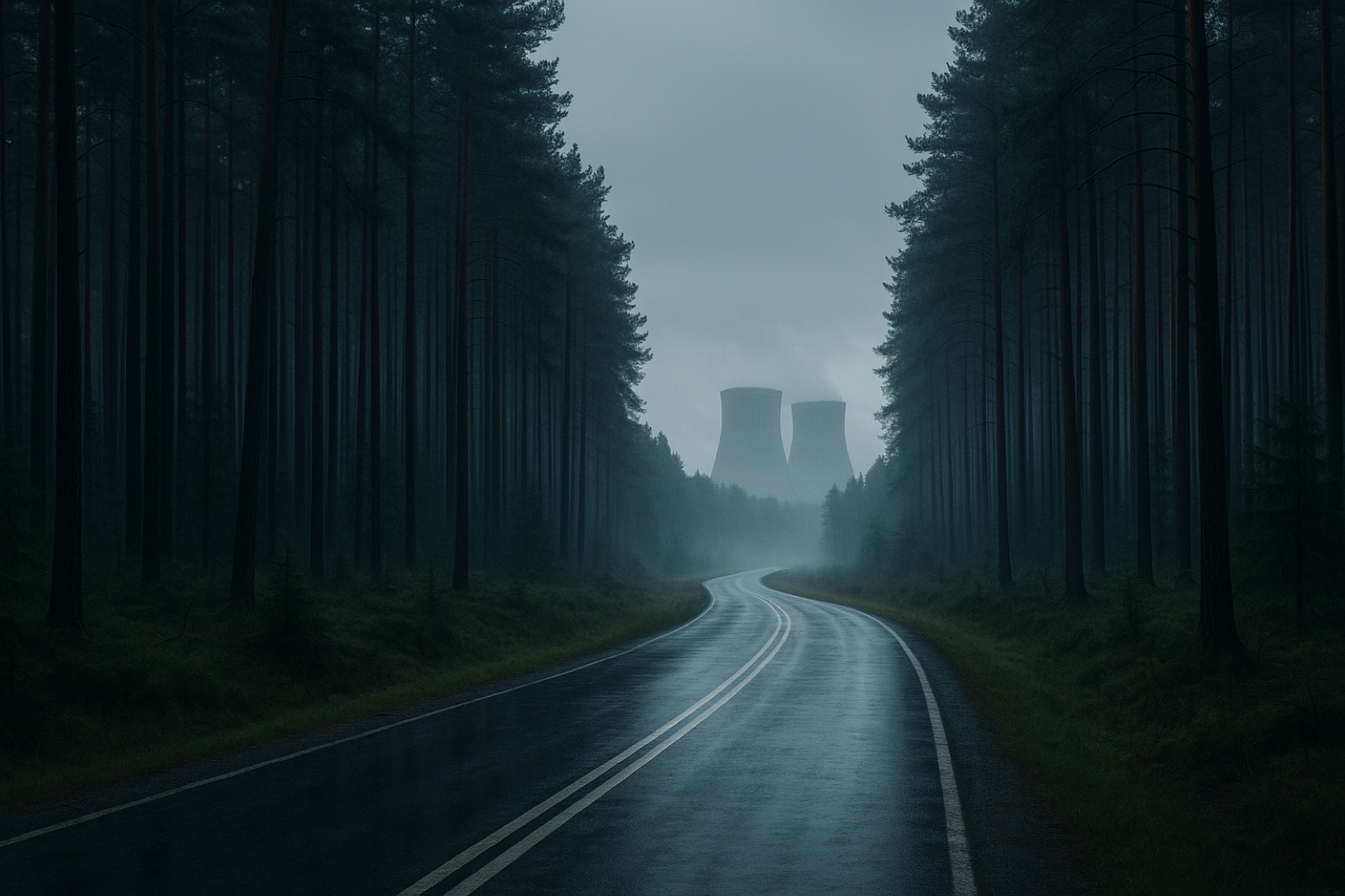
Dark is a German-language series created by Baran bo Odar and Jantje Friese. It arrived in 2017 as Netflix’s first German-language original and finished three seasons later, twenty-six episodes in total. It is set in Winden, a small town with a forest, a lake and a nuclear power plant. Four families live there — Kahnwald, Nielsen, Doppler and Tiedemann — and a wormhole in the caves under the plant moves people backwards and forwards in steps of thirty-three years: 1921, 1953, 1986, 2019, 2052.
The machinery matters less than what people use it for. And in this town, everybody uses it for exactly the same thing.
Every rescue in Dark causes the thing it was meant to prevent
Ulrich goes back to 1953 to kill Helge, because he has worked out that Helge is involved in the children who go missing from Winden — his brother Mads, who vanished in 1986, and his son Mikkel, who vanished in 2019. He does not manage to kill him. He beats him badly enough to mark him for life, is arrested on the spot, and spends the rest of his life locked in the Winden psychiatric hospital, decade after decade, in a past he cannot leave. In 1986, Helge takes Mads.
Katharina Nielsen goes back to 1987 to find Mikkel herself. She gets as far as that same hospital, where a member of staff blocks her at the door. The woman is Helene Albers — Katharina’s own mother, younger than Katharina is standing there. They fight. Helene beats her to death with a rock and puts her in the lake, and never understands that she has killed her daughter.
Claudia Tiedemann is the cleverest person in the series and spends the most years on the problem. Her daughter Regina has cancer. Claudia works across decades and worlds to arrange a version of events in which Regina lives — and part of that work is asking a man to end Regina’s suffering in a ruined 2020, and to do it quickly.
And H. G. Tannhaus, the Winden clockmaker, loses his son Marek, his daughter-in-law Sonja and his baby granddaughter Charlotte in a car accident in 1971, and builds a machine to bring them back. The machine does not do what he wants. It tears his world in half and produces the two worlds the entire series takes place inside. Every missing child, every loop, every apocalypse in Winden exists because one grieving old man could not accept a car accident — a private decision whose bill is paid by a whole town that never got a vote, which is the same arithmetic another great series about a reactor runs from start to finish.
Most viewers get this far. The show says it out loud more than once: the loop cannot be cut from the inside, and every attempt to cut it ties another knot. What almost nobody says out loud is the thing all four of those people have in common.
Nobody in Winden ever breaks time for a stranger
Go down the list of everyone in Dark who tears a hole in time, and check who they are doing it for.
Ulrich: his son and his brother. Katharina: her son. Charlotte Doppler: her daughters, and then her own missing parents. Claudia: her daughter. Noah: his daughter. Elisabeth: her daughter. Tannhaus: his son, his son’s wife, his son’s child. Jonas: Martha. Martha: her son.
Not one person in this series ever does it for somebody they do not already love.
That is the real engine of Dark, and it is not the thing in the cave. Nobody in Winden is greedy. Nobody wants money, or power, or to go and look at the pyramids. There is no tourism in this show and almost no crime in the ordinary sense. Every hole punched through time is punched by a decent person on behalf of their own family — and the sum of all that devotion is a town where children are strapped into a chair in a bunker and killed.
The series has a word for the shape this makes, and it repeats it constantly. It calls the tangle of worlds a knot. A knot is what you get when every strand pulls hard toward its own end.
Even the two people who become powers in this story never step out of the pattern. Adam is Jonas, decades older. Eva is Martha, decades older. Adam wants to destroy what he believes is the origin of the knot, which he takes to be the child he and Martha have. Eva exists to keep that child alive. They are set up as opposites and they genuinely are — but strip the philosophy off both of them and what is left is two parents having a custody argument at the scale of two universes. Neither is thinking about anybody outside the family.
This is not unique to Dark, and it is worth noticing where else the same motor shows up. Almost every player who walks back into the arena in another Netflix series told in another language is walking back in for a relative — a mother’s medical bills, a little brother in a children’s home, a wife and a baby waiting on wages that were never paid. Family devotion is the most reliable motor in fiction because it is the most reliable motor in people.
The Dark Netflix ending, explained by one road in 1971
Claudia is the one who finally gets outside the pattern, and what she works out is that Adam has the origin wrong. The knot did not start with a child. It started with a machine — Tannhaus’s machine, in a third world neither Adam nor Eva has ever seen, the world that existed before the split. She also works out where the door is: in the instant of the apocalypse, when time stands still.
So Jonas and Martha go through it. Not the old versions of them. The two teenagers, the two people whose whole lives have been spent trying to save each other and failing.
It is 8 November 1971, in a Winden where none of this has ever happened. A car is leaving town with a man, a woman and a baby in it, heading for a bridge. Jonas and Martha stand in the road in front of it and tell the driver the bridge is closed. He turns the car around. Marek, Sonja and Charlotte Tannhaus go home, and live.
Look carefully at what that is. Those three people are nothing to Jonas and Martha. No blood, no history, not even the same world. And the two of them will never be thanked, because there is no future in which anybody finds out. The accident does not happen, so the old man never builds the machine, so the two worlds are never made, so the two people standing in that road were never born. They watch it arrive at their own hands.
Twenty-six episodes of fierce, specific, family love pull the knot tighter every single time. The one act that unties it is aimed at strangers, paid for by the people doing it, and witnessed by nobody who benefits.
There is a very old line about exactly that distinction, and it is sharper than it usually sounds when it gets read out in a quiet room. Jesus put it as a question: if you love the people who already love you back, what is that actually worth? Anyone can manage that much. The tax collectors manage it (Matthew 5:46-47). It is not an attack on loving your own family. It is a claim that loving your own is the floor and not the ceiling — the part that needs no help from anybody — and that everything worth calling love starts one step outside the circle.
Dark does not offer that as a moral. It builds it into the physics. Love aimed inward: a knot that eats a town for a century and a half. Love aimed at someone outside it, at your own cost: the knot comes apart.
Then the series stops there, which is the honest thing for it to do. Jonas and Martha get nothing back. There is no version of them left over to see what they bought. The older story this rhymes with does not end where Dark ends — but Dark is under no obligation to follow it, and a finale that let those two survive their own sacrifice would have been telling a smaller truth.
The last scene is a dinner where nobody knows
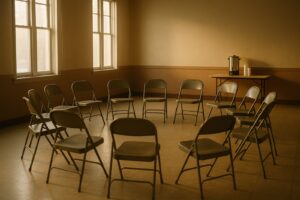
The origin world survives, and so do the people in it who were never products of the loop. The final scene of Dark is six of them around a table in Winden: Regina, Peter, Katharina, Hannah, Benni and Torben Wöller. The power flickers. The conversation is nothing much — the kind of talk nobody would remember the next morning.
Hannah is pregnant. There is a yellow raincoat near the stairs, the same yellow Jonas wore through three seasons of a world she has no memory of, and she looks at it a beat too long and says she is having déjà vu. Asked what she will call the baby, she says she thinks Jonas is a beautiful name.
Read that table properly. Nobody sitting at it is grateful, because gratitude requires knowing, and nobody knows. Two people gave up ever having existed so that this particular evening could be boring. The last image of Dark is the receipt: a dinner, a power cut, small talk, a woman who likes a name.
It is a cousin of the move another series about an afterlife nobody can win makes at the end of four seasons, where the characters who understand the most choose to stop existing and the show treats that as the good ending rather than the sad one. Dark is colder about it. It does not even let its two have a goodbye with anyone who will remember them.
The rock in the forest in 1953 and the road in 1971 are the same shot from opposite ends. A man saving his own boy. Two people saving somebody else’s. One of them is the reason Winden happens. The other is the reason it stops.
Questions people ask about Dark
What does the ending of Dark mean?
In the finale of Dark, Jonas and Martha discover that the two worlds they have been fighting over were both created by accident, when the Winden clockmaker H. G. Tannhaus switched on a machine built to undo the deaths of his son, daughter-in-law and granddaughter. They travel to the third, original world and stop that car accident from happening on 8 November 1971. Because the accident never happens, the machine is never built, the two worlds are never created, and Jonas and Martha — who only existed as products of those worlds — cease to exist. The ending means the loop was never broken by force or cleverness. It was broken by two people doing something for a family they had never met, at the cost of their own existence.
Why do Jonas and Martha disappear at the end of Dark?
Jonas and Martha disappear because they were only ever born inside the two worlds that Tannhaus’s machine created. Once they prevent the accident that made him build it, those worlds are never split off in the first place, so neither Jonas nor Martha is ever born. Dark shows them fading while they stand together, watching it happen. The series does not give them an escape or a reunion afterwards, and the people they save never learn their names.
What is the origin world in Dark?
The origin world in Dark is the third world — the one that existed before H. G. Tannhaus started his time machine. Adam’s world and Eva’s world are both fragments produced when that machine tore the original apart. Claudia Tiedemann is the character who finally works this out, and who realises that the knot’s true origin was never Jonas and Martha’s son, but Tannhaus’s grief. The origin world is the only one that survives at the end of the series.
Who are Adam and Eva in Dark?
Adam is Jonas Kahnwald as an old man, scarred and hardened after decades inside the loop, and Eva is Martha Nielsen as an old woman in the parallel world. Adam wants to destroy the knot by destroying what he believes to be its origin — the child he and Martha have. Eva devotes herself to preserving that child and the cycle around him. They are presented as opposing forces in Dark, but both are ultimately fighting over the same boy, and neither of their plans works.
Which characters still exist at the end of Dark?
Only the people who were never created by the time loop survive into the origin world at the end of Dark. The final scene shows six of them at dinner in Winden: Regina, Peter, Katharina, Hannah, Benni and Torben Wöller. Anyone whose existence depended on time travel — Jonas, Martha, Charlotte, Elisabeth and their son among them — is simply never born. None of the survivors has any memory of the other two worlds, though Hannah gets a flicker of déjà vu when she notices a yellow raincoat.
Your turn
Hannah says she likes the name Jonas, in a world where Jonas was never born and never will be. Is that Dark closing the circle for good, or the first frame of a brand new one? I think the flicker in the lights is the show deliberately refusing to answer. How do you read that last minute? Tell me in the comments.
If you want to share this
Everyone in Dark who breaks time does it for a relative. Ulrich for his son. Katharina for her son. Claudia for her daughter. Tannhaus for his. That is what builds the knot. The one act that unties it is done for a family they have never met, by two people who then stop existing.
The last scene of Dark is six people eating dinner in a town where nothing has ever happened. That is the payoff. Two people gave up ever having existed so that one boring evening could take place, and nobody at the table will ever know.
The rock in the forest in 1953 and the road in 1971 are the same shot from opposite ends of Dark. A man saving his own son starts everything. Two people saving a stranger’s family ends it.