 0
0
 0
0
There is a particular kind of invitation that makes your stomach drop.
Someone asks you to sit down at a table where everyone else clearly belongs. And instead of feeling honoured, you feel exposed. You keep waiting for the moment somebody looks up and asks who let you in. You rehearse an answer. You eat carefully. You do not reach for anything.
And underneath all of it, one sentence runs quietly: they do not know what I actually am.
If you know that feeling, you already understand Mephibosheth better than most people who have studied him. (The name is said roughly meh-FIB-oh-sheth — it looks far harder than it sounds.) He is one of the very few people in the Bible who says that feeling out loud. He called himself a dead dog. He said it to a king. And he said it while that king was in the middle of handing him everything.
Who Was Mephibosheth in the Bible?
He was the son of Jonathan and the grandson of King Saul. Which, in his moment in history, was not a title. It was a danger.
The Bible introduces him in a single crowded sentence in 2 Samuel 4:4. Word arrives that Saul and Jonathan have both been killed in battle. The household panics. And in the middle of that panic, this happens:
“and his nurse took him up, and fled: and it came to pass, as she made haste to flee, that he fell, and became lame.”
He was five years old.
Notice what that verse does not do. It does not explain the injury. It does not assign blame to the nurse, who was trying to save his life. And it never once suggests the injury was a punishment, a judgment, or a sign of anything about him. The Bible reports it the way it reports weather. It happened, in a bad hour, to a small boy who had no say in any of it.
The danger was real, though. When a new royal house replaced an old one in the ancient world, surviving heirs of the old one were not usually left alone. Mephibosheth grew up as a living reminder of a dead dynasty. That is the situation. Everything else in his story happens on top of it.
Why Did Mephibosheth Stay in Lo-Debar?
He turns up living east of the Jordan, in a place called Lo-debar, in the house of a man named Machir.
The name Lo-debar is generally taken to mean something like “no pasture” or “no thing” — a place of nothing. That reading is widely held rather than certain, so hold it loosely. But even held loosely, it is hard to miss: a man written out of the story is living in a town whose name sounds like an empty field.
And here is a detail almost nobody mentions. He did not get there by choice. He was carried there. A servant grabbed him at five and ran, and someone else’s house became the only home he had. Being hidden was not his plan. It was what was done to him, and then it was simply his life.
There is a quiet grace note here too. That same Machir of Lo-debar shows up much later, when David is fleeing from his own son Absalom, bringing beds and food to the king’s exhausted men. The man who sheltered Saul’s grandson also fed David in his worst hour. He was, apparently, just the kind of person who took in whoever arrived.
The Summons He Thought Was a Death Sentence
Years pass. David is secure on the throne. And out of nowhere he asks a question nobody asked him to ask:
“Is there yet any that is left of the house of Saul, that I may shew him kindness for Jonathan’s sake?”
A servant of Saul’s old household named Ziba is brought in. David asks again, and this time he raises it higher — he wants to show “the kindness of God” to whoever is left.
Ziba answers: “Jonathan hath yet a son, which is lame on his feet.”
Read that answer again. Ziba does not give the king a name. He gives him a condition. The first thing ever said about this man to the most powerful person in the country is not who he is. It is what is wrong with his body. That is what it is like to be discussed rather than known.
So they send for him. Picture that trip. Soldiers arrive at the house where you have been quietly hidden your whole adult life, and they say the king wants to see you. There is only one reason you can think of.
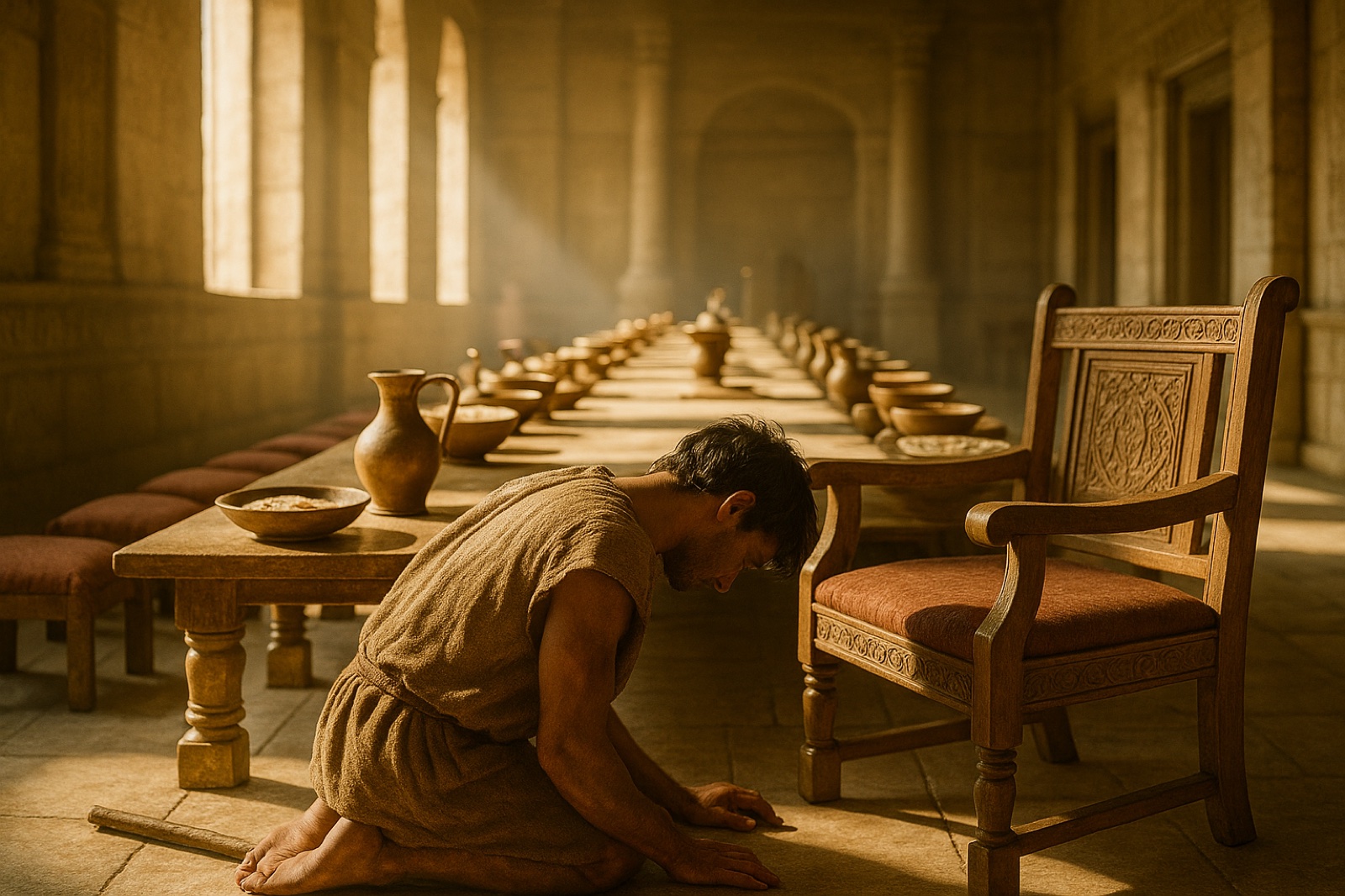
He arrives and falls on his face. And David’s first word to him is “Fear not” — which tells you exactly what David could see in front of him. Then David promises him his grandfather’s land back and says, “thou shalt eat bread at my table continually.”
And this is the moment Mephibosheth speaks. It is the anchor of the whole story:
“And he bowed himself, and said, What is thy servant, that thou shouldest look upon such a dead dog as I am?” — 2 Samuel 9:8
In that world, calling someone a dog was already an insult. A dead dog is beneath even that — worthless, unclean, not worth stepping over. He is not being politely humble. He is telling the king he is not worth the cost of the trip.
And notice when he says it. Not before the offer. After. The kindness has already been spoken out loud, and he still cannot receive it without first explaining what he really is. Most of us do the same thing with smaller words.
The Detail the Story Refuses to Erase
David does not argue with him. He does not give a speech about self-worth. He just gives an order, and the order includes this line: Mephibosheth will eat at the king’s table “as one of the king’s sons.”
Not as a pensioner. Not as a mercy case parked in a side room. As family.
Then the chapter ends. And how it ends is the whole point:
“So Mephibosheth dwelt in Jerusalem: for he did eat continually at the king’s table; and was lame on both his feet.” — 2 Samuel 9:13
The story had every chance to finish on the table. It finishes on the feet.
He is not healed. Nobody in the chapter suggests he should be. His legs are exactly as they were on the day the nurse dropped him, and the writer puts that fact in the last line, right next to the word continually, as if the two belong in the same sentence. Because they do.
Did Mephibosheth Betray David?
This is the part people argue about, and the honest answer is: the Bible does not tell us.
Years later, Absalom’s revolt drives David out of Jerusalem. As David flees, Ziba meets him on the road with supplies and reports that Mephibosheth stayed behind because he thinks the kingdom is about to be handed back to Saul’s family. David, running for his life with no way to check the story, hands Ziba everything.
Then the revolt collapses and David comes home. And Mephibosheth comes down to meet him:
“and had neither dressed his feet, nor trimmed his beard, nor washed his clothes, from the day the king departed until the day he came again in peace.” — 2 Samuel 19:24
He is carrying every visible sign of mourning, and has been, the entire time the king was gone. He tells David that Ziba deceived him — that he asked to have a donkey saddled so he could go with the king, because he cannot walk, and was left behind instead.
David, worn out, does not investigate. He just splits the property: you and Ziba divide the land.
Half of everything, gone, on an accusation never tested. And Mephibosheth’s reply is this:
“let him take all, forasmuch as my lord the king is come again in peace unto his own house.” — 2 Samuel 19:30
So who was lying? Scripture never says. David never rules on it. Anyone who tells you the case is closed is telling you more than the text does, in either direction. What the text does give us is a man whose body had been in mourning for weeks, and whose answer to losing half his inheritance was that he did not much care, as long as the king was home.
The Reason He Lived Was Never About Him
Here is the part that changed how I read this whole story, and it is two chapters further on, where nobody looks.
In 2 Samuel 21, there is a reckoning against the house of Saul, and it is grim. Descendants of Saul are handed over. And in the middle of that list, the text stops to say one thing:
“But the king spared Mephibosheth, the son of Jonathan the son of Saul, because of the LORD’S oath that was between them, between David and Jonathan the son of Saul.” — 2 Samuel 21:7
Read the reason again. Not because he had been loyal — that was still an open question. Not because the Ziba matter had been settled in his favour; it never was. Not because he had made himself useful, or grateful enough, or finally believed he was worth something.
He was spared because of a promise two other people made to each other before he was old enough to walk.
That is the thing the table was standing on the whole time. It was never his behaviour holding his seat in place. It was a covenant he was not present for, made by people who were not thinking about his usefulness, and it held when his own record was messy and unresolved and half his land was gone.
There is one more layer, in the strangest place. First Chronicles lists Jonathan’s son under a different name — Merib-baal — and says Merib-baal was the father of Micah, which matches the son Samuel says Mephibosheth had. Same man, two names. Scholars generally understand that the ending bosheth, the Hebrew word for shame, was substituted into these names in place of the original element. That reading is widely accepted rather than provable, so take it as the best available explanation and not a settled fact.
But sit with it for a second anyway. The name most of us know him by has the word shame built into it. And that is the name the record keeps — attached to a table, a son, and a family line that continues for generations afterward.
His shame is right there in the text. It just is not the last word about him.
This is a very different picture of grace than the one we usually preach. We tend to tell it as a repair job: God finds you broken, fixes what is wrong, and then you take your seat as an improved person. That is not what happens here. Nothing about Mephibosheth’s body, his family history, or his reputation gets resolved. He is simply seated, permanently, in the condition he was already in. If you have ever quietly assumed that God is waiting for you to be less of a mess before God will really want you close, this story never once agrees with you. It is the same thing Ephesians 2 says about love arriving before you could earn it — and the same instinct you can see in the four women Matthew refused to cut out of Jesus’ family tree. The record could have been tidied. It never is.
What to Do With This on an Ordinary Day
The useful question is not “do I believe God accepts me.” Most of us would say yes to that and still feel like a guest.
The useful question is smaller and much more specific: what is the sentence you use?
Mephibosheth had a phrase ready. “A dead dog.” It was sitting there, fully formed, waiting for the moment someone was kind to him. You almost certainly have one too, and it is probably shorter and blunter than anything you would say about another human being.
Find it. Not to fight it. Just to notice that you did not receive that sentence from God, and that it has been doing a lot of work in your life without ever being examined. If you are not sure what yours sounds like, this short Do I Have Imposter Syndrome? assessment is a quick way to hear yourself say it out loud.
Actions to Take Today
- Write down your sentence. The exact words you use about yourself when someone is unexpectedly kind to you. Handwrite it. Two minutes. Then look at it and ask who taught it to you, because it was not God.
- Send one message with the apology removed. Find a message you are about to soften — “sorry to bother you,” “this is probably a silly question,” “no worries if not” — and delete that part before you send it. One message. You are allowed to simply be at the table.
- Accept one thing today you would normally refuse. The offered help, the shared meal, the lift, the seat. Not because you have earned it. That is the whole exercise, and it is the hardest one on this list.
Journaling Prompts
- Where in your life are you still eating carefully — sitting at a table you have every right to, but behaving like a guest who might be asked to leave?
- Mephibosheth was described to the king by his condition instead of his name. Who has described you that way? And whose description did you end up believing?
- What would actually change about tomorrow if the seat you are in was never being held by your performance in the first place?
A Prayer for the Table
God, I have a sentence I say about myself, and I have said it so many times I stopped hearing it. I keep waiting for someone to find out what I really am, even when nothing is wrong and nobody is asking. Thank you that the seat was never mine to earn and is not mine to lose. Help me sit down today without apologising for being here. And when the old sentence comes back, remind me who wrote it, and who did not.
A Question Worth Discussing
Why do you think the writer of 2 Samuel chose to end the chapter on “and was lame on both his feet” instead of on the king’s table? Share your take in the comments — this one genuinely reads differently depending on where you stop.
Share This
- He called himself a dead dog. The king called him a son. Neither of them was talking about his feet.
- 2 Samuel 9 ends on “and was lame on both his feet.” It could have ended on the king’s table. It chose the feet. Grace did not fix him. It seated him — permanently, exactly as he was.
- The reason he was spared was a promise made by two other people before he could walk. Some seats were never being held in place by you.
Questions People Ask About Mephibosheth
Who was Mephibosheth in the Bible?
Mephibosheth was the son of Jonathan and the grandson of King Saul. He became lame in both feet at age five when his nurse fled with him after news arrived that Saul and Jonathan had been killed in battle, and she dropped him (2 Samuel 4:4). He lived in obscurity in Lo-debar until King David sought him out and gave him a permanent place at the royal table (2 Samuel 9).
How old was Mephibosheth when David found him?
The Bible does not give his age at that point. It states only that he was five years old when he became lame (2 Samuel 4:4). By the time David sent for him, he was an adult with a young son named Micha (2 Samuel 9:12), so a substantial number of years had passed — but any specific figure is an estimate, not something scripture records.
What does Lo-debar mean?
Lo-debar was a settlement east of the Jordan River where Mephibosheth lived in the house of Machir before David summoned him. The name is generally taken to mean something like “no pasture” or “no thing,” though this reading is a widely held interpretation rather than a certainty.
Did Mephibosheth betray David?
Scripture never resolves it. During Absalom’s revolt, the servant Ziba told the fleeing David that Mephibosheth had stayed in Jerusalem hoping to regain Saul’s throne (2 Samuel 16). When David returned, Mephibosheth said Ziba had deceived him, and he had visibly been in mourning the entire time the king was away (2 Samuel 19:24). David did not investigate; he simply divided the land between them. The Bible offers no verdict, and neither should anyone reading it.
Was Mephibosheth ever healed of his lameness?
No. The Bible never records any healing. 2 Samuel 9:13 deliberately closes the account by noting that he ate continually at the king’s table “and was lame on both his feet.” His place at the table was never conditional on his physical condition changing.