 0
0
 0
0
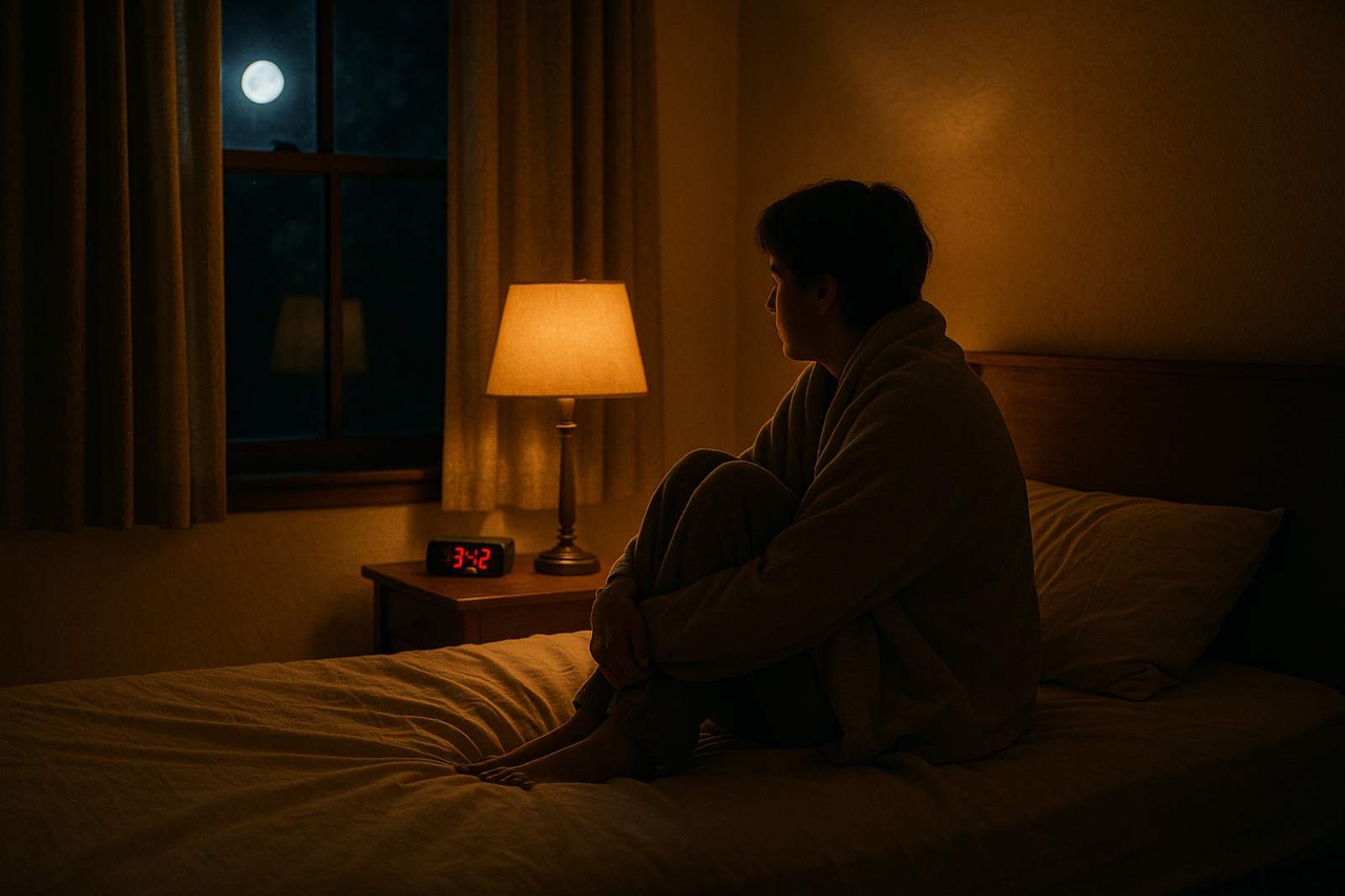
It’s 2 AM and you’re staring at the ceiling. The thing that’s bothering you — the bill, the diagnosis, the conversation you keep replaying — didn’t feel this heavy at 2 PM. You thought about it then too. But somehow, in the dark, it grew.
If that’s ever happened to you, you’re not imagining it, and you’re not weak for feeling it. There’s a real reason fear gets louder after the lights go out. And long before anyone had a word for cortisol, someone wrote it down.
The Real Reason Fear Feels Bigger After Dark
Your body runs on a 24-hour rhythm called the circadian clock, and it doesn’t just control when you feel sleepy. It also controls cortisol — the hormone your body releases when it senses a threat. Cortisol naturally dips in the evening, which should calm things down. But here’s the catch: while cortisol is dropping, so is activity in your prefrontal cortex, the part of your brain that reasons things out and talks you down from a spiral.
Meanwhile, your amygdala — the part of your brain wired to sense danger — doesn’t get the same memo. Sleep researchers have found it actually stays more reactive at night, not less. So the part of you built to sound the alarm keeps running, while the part of you built to reason with the alarm quiets down. Nothing about the fear itself is bigger. The part of your brain that could talk you out of it is just offline.
Add darkness and silence — nothing else competing for your attention — and a worry that was background noise all day suddenly has the whole stage to itself. People are noticing this pattern enough that cortisol testing has become its own trend, everyone trying to measure a feeling they can’t quite explain.
Psalm 91:5 — The Verse That Named This 3,000 Years Ago
Psalm 91 doesn’t name its author directly, though Jewish tradition places it right alongside Psalm 90 — the one explicitly titled “A Prayer of Moses, the man of God” — and connects the two. Whoever wrote it was someone who had lived through real, physical danger, not abstract fear.
Look closely at verse 5, and then keep reading into verse 6:
“Thou shalt not be afraid for the terror by night; nor for the arrow that flieth by day; Nor for the pestilence that walketh in darkness; nor for the destruction that wasteth at noonday.” (Psalm 91:5-6, KJV)
Read that again slowly. The psalm isn’t listing random dangers. It’s walking through an entire 24-hour cycle — night, day, darkness, noon — and naming a specific fear for each part of it. “The terror by night” comes first, ahead of the arrow that flies by day. In the world this was written in, night carried its own named category of dread: raiders who struck under cover of darkness, wild animals that hunted after sundown, sickness that seemed to creep in while a household slept. Nighttime fear wasn’t a footnote to daytime fear. It was its own thing, serious enough to name first.
The psalm doesn’t tell the reader their nighttime fear is irrational or overblown. It names it specifically — gives it its own line — before it ever offers the answer.
The Turn: Scripture Already Understood What Your Brain Is Doing
Here’s what’s easy to miss on a fast read: the writer of Psalm 91 had no idea what a circadian rhythm was. No concept of cortisol, no data on amygdala activity after dark. And yet the psalm structures itself exactly the way your body actually experiences fear across a day — different dangers, different times, night named as its own distinct threat.
That’s not a coincidence you need science to validate. It’s evidence that whoever inspired this psalm understood something true about being human, long before there was language to explain the mechanism behind it. Your 2 AM fear isn’t a modern malfunction. It’s an old, named, expected part of being human — which is exactly why scripture already had an answer waiting for it.
The promise in Psalm 91:5 isn’t “this fear won’t come.” It’s “you don’t have to be afraid when it does.” That’s a different kind of comfort than pretending the 2 AM spiral won’t happen. It’s permission to name it, and Someone who already named it first, waiting there with you.
What to Do the Next Time Fear Hits at 2 AM
- Say Psalm 91:5 out loud, not just in your head. Speaking it into the dark room engages your brain differently than silently reading it. It takes ten seconds and it’s the easiest place to start.
- Write the specific fear on a notecard by your bed, then write “God” next to it. Naming the actual fear — not the vague dread, the actual thing — takes it out of the loop in your head and puts it somewhere you can see it. Five minutes, tonight, before you turn off the lamp.
- Take the free “Why Can’t I Sleep?” assessment to find out what’s actually driving your nighttime pattern. Not every 2 AM fear has the same root, and knowing yours changes what actually helps.
A Few Questions Worth Sitting With
- What is the specific fear that visits you most often after midnight — and when did you first notice it showing up?
- If God already knows about this fear before you even name it, what does it look like to stop carrying it alone tonight?
- Where else in your life do you feel more afraid in isolation than you do around other people — and what might that be telling you?
A Prayer for the 2 AM Moments
God, You already know what visits me before I even open my eyes to check the clock. I don’t fully understand why the fear feels so much bigger in the dark than it does at noon, but You named this exact pattern long before I ever felt it. Help me actually believe Psalm 91:5 tonight instead of just reading it. Quiet the part of my mind that keeps running the same worry on a loop, and let me rest knowing I’m not facing the night alone. Amen.
Tell Us What You Think
Do you think fear actually gets worse at night, or does it just feel that way because there’s nothing else competing for your attention? Tell us in the comments.
Share This
- “Just learned Psalm 91:5 literally names ‘the terror of night’ — 3,000 years before science figured out why 2 AM fear hits different. Wild.”
- “Turns out my 2 AM anxiety has a name in the Bible. Psalm 91:5 called it ‘the terror by night’ — and the psalm covers a full day/night cycle of fear, not just this one line. #Psalm91”
- “Science says cortisol drops and your rational brain goes quiet at night, which is why fear feels bigger after dark. Psalm 91:5 already knew that. Reading this verse differently now.”
Questions About Fear at Night and Psalm 91:5
What does Psalm 91:5 actually say?
In the King James Version, Psalm 91:5 reads: “Thou shalt not be afraid for the terror by night; nor for the arrow that flieth by day.” It’s part of a longer passage naming specific dangers across a full day-and-night cycle and promising God’s protection through each one.
Why do fears feel worse at night than during the day?
As cortisol naturally drops in the evening, activity in the prefrontal cortex — the part of your brain that reasons through worry — drops with it, while the amygdala, your brain’s threat-detection center, stays reactive. The part of you that could talk you down goes quiet while the alarm keeps ringing, and with fewer daytime distractions to compete for attention, a background worry can suddenly feel like the only thing in the room.
Who wrote Psalm 91?
The psalm itself doesn’t name an author. Jewish tradition connects it to Moses, largely because it sits directly after Psalm 90, which is explicitly titled “A Prayer of Moses, the man of God.”
Is being anxious at night a sign of weak faith?
No. Psalm 91 doesn’t shame the reader for feeling “the terror by night” — it names the fear specifically and then offers comfort for it. Feeling afraid in the dark is a normal, expected part of being human, named in scripture long before it was explained by science.
What can I actually do if I’m anxious at 2 AM right now?
Start small: speak Psalm 91:5 out loud instead of just reading it silently, write down the specific fear so it’s not just looping in your head, and if this is a recurring pattern, take a few minutes to figure out what’s actually driving it with a free tool like the Why Can’t I Sleep? assessment.