 0
0
 0
0
You know that feeling when you finish something huge and nobody notices? No confetti. No group chat blowing up. Just you, quietly closing the laptop, and moving on to the next thing.
Somewhere on Mars right now, a six-wheeled robot just had that exact moment.
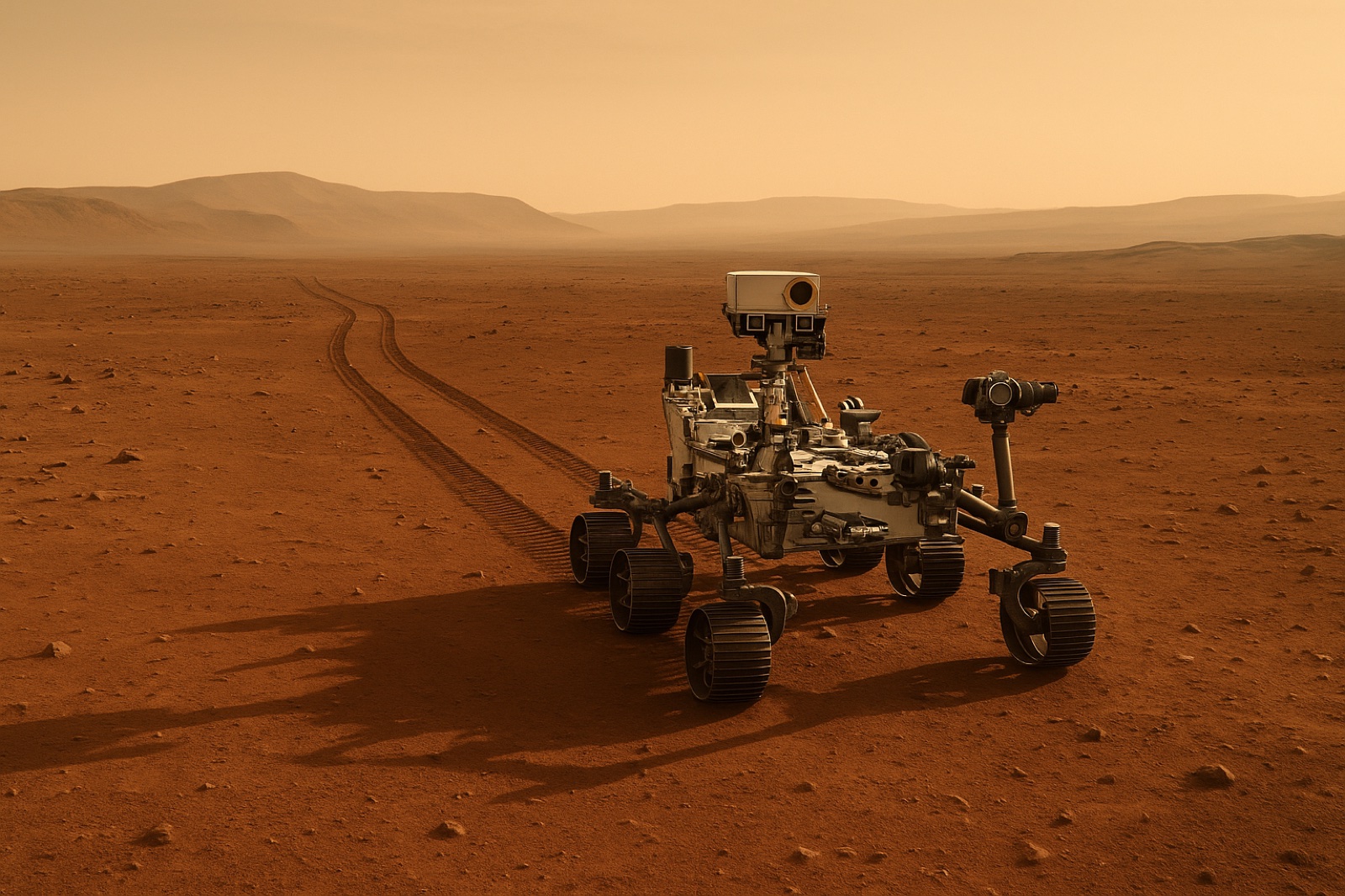
NASA’s Perseverance rover has officially driven the distance of a marathon — 26.2 miles — across the floor of Jezero Crater. It crossed the mark on the 1,890th Martian day of its mission, after five years and four months of driving. No crowd. No finish-line tape. Just tire tracks in red dust, photographed from orbit by a satellite that happened to be looking down at the right moment.
Inside Perseverance’s Marathon Milestone
NASA’s Mars Reconnaissance Orbiter caught the whole thing almost by accident. Using its HiRISE camera — the same high-resolution imager that’s mapped Martian craters and dust storms for two decades — the orbiter snapped a picture of Perseverance as a tiny green speck, one day before the rover crossed the marathon mark. Around it, you can see the winding trail of tracks it left behind, curling across a region nicknamed “Arbot,” just west of Jezero Crater.
It’s a strange kind of photograph. A rover, alone, on a planet with no witnesses, caught mid-stride by a camera 150 miles overhead. Nobody was watching in real time. Nobody could have been. The image only exists because someone, months later, pointed a satellite in the right direction and pieced it together.
That’s basically the whole story of the Perseverance rover marathon: an enormous accomplishment that happened one slow, unglamorous drive at a time, with no one there to see it happen.
Why This Rover Beat Opportunity by Six Years
Here’s the detail that makes engineers sit up: Perseverance isn’t the first rover to hit the marathon mark. NASA’s Opportunity rover did it too — back in 2015. But Opportunity needed 11 years and 2 months to cover that same 26.2 miles.
Perseverance did it in 5 years and 4 months. Less than half the time.
Same distance. Same brutal terrain — sand traps, jagged rock fields, dust that can bury a solar panel and end a mission for good. But a completely different result, because Perseverance was built differently from the start. It runs on a nuclear power source instead of solar panels, so it doesn’t have to stop and wait out dust storms the way Opportunity did. Its autonomous navigation software plans routes on its own instead of waiting for a full command from Earth every time. It was engineered, from the ground up, to keep moving.
Nobody would have blamed Perseverance for taking 11 years too. Mars doesn’t get easier. The ground doesn’t get softer. But it was built for endurance instead of just built to survive, and the difference showed up in the math: half the time, same finish line.
The Quiet Math of Getting There
There’s something almost unremarkable about how the milestone actually happened. No single dramatic drive covered some huge distance in one heroic day. It was thousands of small moves — a few dozen feet here, a cautious crawl around a boulder there — stacked on top of each other for five years until, eventually, they added up to a marathon.
That’s not really a Mars story. That’s every hard, worthwhile thing anyone has ever finished. Nobody claps for the fortieth ordinary Tuesday in a row where you just kept doing the work. There’s no orbital camera checking in on the version of you that showed up again after a bad week, or kept the promise nobody was tracking, or stayed steady in a season that had zero applause built into it. And yet — somehow — the miles still add up. Ancient wisdom has always pointed at this exact pattern: that the people who go the distance are rarely the ones who move the fastest, but the ones who were built, or who built themselves, to keep going when nothing was watching.
If you’ve ever wondered why some seasons of exhaustion feel different from others — why “tired” isn’t always the same thing as “burned out” — it’s worth reading how that distinction gets untangled in the story of the word Jesus actually used for weariness. It turns out the difference matters more than most people realize.
And it’s not just an old idea holding up. Researchers keep finding the same pattern showing up in the body itself — like the recent discovery that certain brain cells are quite literally strengthened by the friction of getting where they’re going. The friction isn’t a design flaw. It’s part of how the distance gets covered at all.
A Few Small Ways to Keep Going
You don’t need a nuclear battery or an autonomous navigation system to borrow the same strategy. A few things Perseverance’s design quietly teaches, translated into a Tuesday:
- Don’t wait out every storm. Perseverance keeps moving through conditions that would have stopped a solar-powered rover cold. You won’t always have ideal conditions either — sometimes the move is just a smaller, more cautious step forward, not a full stop.
- Plan the next few feet, not the whole marathon. The rover’s software doesn’t map all 26.2 miles at once. It reads the ground right in front of it and adjusts. Most long things get finished the same way — one visible stretch at a time.
- Let the mileage be invisible for a while. Nobody photographed Perseverance’s first four years of driving. The marathon mark only became a headline once enough ordinary days were already banked.
Every long, quiet stretch eventually adds up to something. If this one made you think about the mileage you’ve already put in — the kind nobody’s been clapping for — you’re not the only one who’s noticed a pattern like it before. Endurance has a way of showing up in old, unexpected places, too.
Discussion Question
Perseverance beat Opportunity’s marathon time by six years — not by moving faster, but by being built to keep going without stopping for every obstacle. Where in your own life do you think “built for endurance” would actually get you further than “built for speed”? What would you have to change to make that trade?
We’d genuinely like to hear your answer — drop it in the comments below.
Share This
- “NASA’s Perseverance rover just beat Opportunity’s Mars marathon time by SIX YEARS. Not because it’s faster — because it’s built to never stop for the small stuff. There’s a lesson in there somewhere. 🚀”
- “A rover on Mars just finished a marathon and nobody clapped. Five years, thousands of tiny moves, one photo from orbit that happened to catch it mid-stride. That’s basically how every hard thing actually gets done.”
- “Perseverance: 5 years, 4 months. Opportunity: 11 years, 2 months. Same 26.2 miles on Mars. The difference wasn’t speed — it was what each one was built to survive without stopping.”
Questions People Are Asking
How far has the Perseverance rover traveled on Mars? As of July 2026, NASA’s Perseverance rover has driven 26.2 miles (42.195 kilometers) across Mars — the exact distance of a marathon. It reached that mark on the 1,890th Martian day (sol) of its mission, after roughly five years and four months of driving.
Why did Perseverance finish its Mars marathon faster than the Opportunity rover? Opportunity, NASA’s earlier rover, took 11 years and 2 months to cover the same 26.2-mile distance before its mission ended in 2018. Perseverance did it in less than half that time — about 5 years, 4 months — mainly because it runs on a nuclear power source instead of solar panels, so it isn’t forced to power down during Martian dust storms, and it uses more advanced autonomous navigation to choose safe routes without waiting on constant commands from Earth.
What camera took the photo of Perseverance’s marathon milestone? The image was captured by HiRISE (High-Resolution Imaging Science Experiment), a camera aboard NASA’s Mars Reconnaissance Orbiter, which has been photographing the Martian surface from orbit since 2006. The photo, taken June 13, 2026, shows Perseverance as a small speck with its trail of tracks visible in a region nicknamed “Arbot,” near Jezero Crater.
Where is the Perseverance rover exploring right now? As of its marathon milestone, Perseverance was operating west of Jezero Crater, the ancient lakebed it has been exploring since landing in February 2021, in a region mission scientists have nicknamed “Arbot.”
Is Perseverance rover still active in 2026? Yes. As of July 2026, Perseverance remains fully operational on Mars, continuing to collect rock samples and search for signs of ancient microbial life as part of its ongoing mission in Jezero Crater.