 0
0
 0
0
A team of scientists just made an ancient human sacrifice discovery by pulling DNA out of bones that had been buried for 4,000 years — and what it told them explains how one of the ancient world’s biggest cities actually worked.
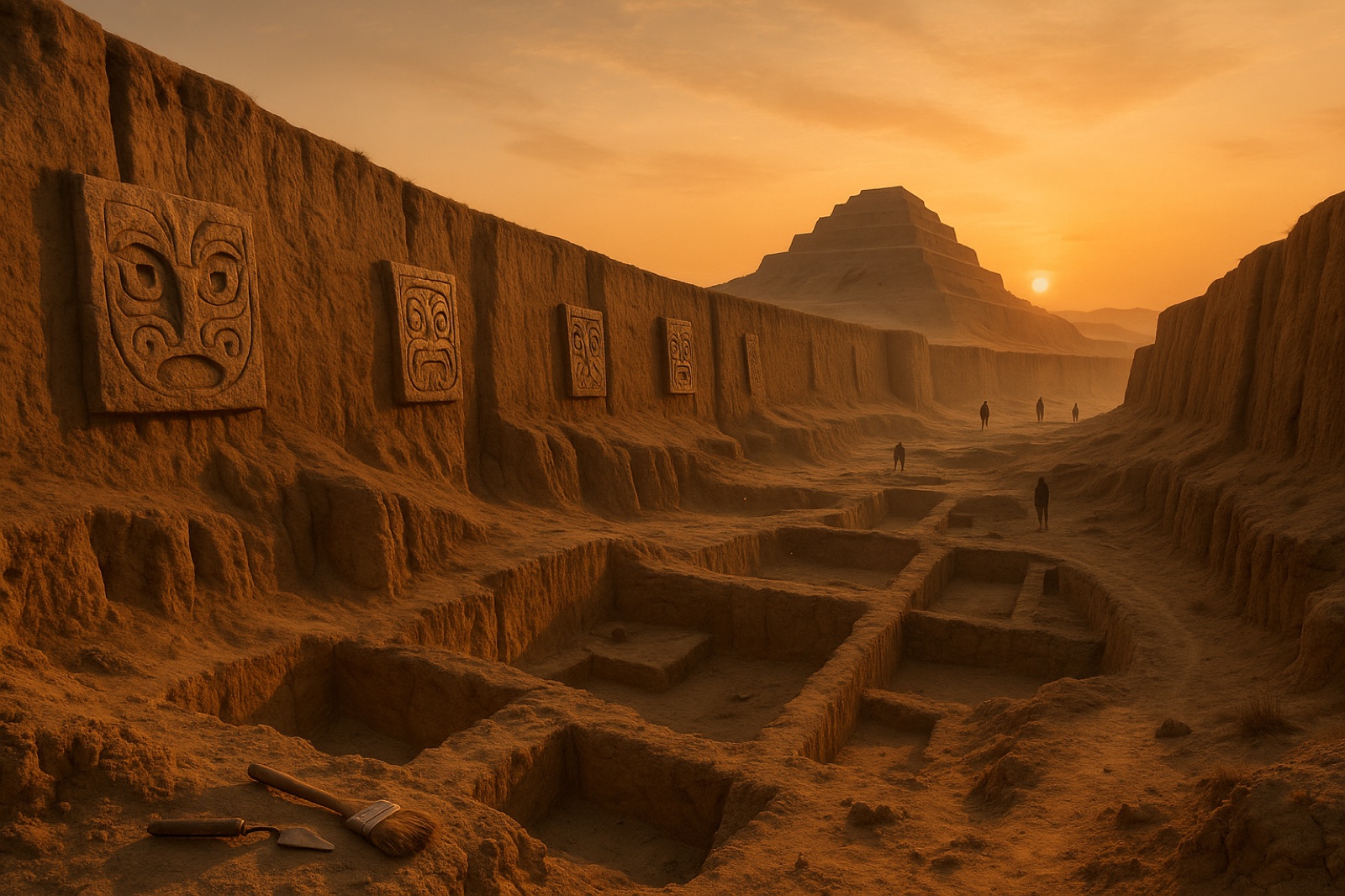
The city is called Shimao, and until fairly recently, almost nobody outside a small circle of archaeologists had heard of it. It sits in a dry, wind-carved stretch of northern China, and when it was thriving, around 2300 to 1800 BC, it was enormous — nearly four square kilometers, ringed by massive stone walls, with a stepped pyramid at its center that still rises more than 70 feet out of the ground today. For scale, Shimao was being built around the same time Stonehenge was going up on the other side of the world, and it was already old by the time the Great Pyramid of Giza was finished.
For decades, nobody knew who actually ran the place, or how a settlement that size stayed organized without writing, without coins, without any of the tools we usually assume a “real” civilization needs. The ancient human sacrifice discovery at Shimao is what finally started answering that question — not through pottery or inscriptions, but through the genomes of the people who lived and died there.
A City Built to Impress — and to Frighten
Shimao’s builders didn’t just want shelter. They wanted a statement. The outer wall alone stretched for miles, faced with carved stone plaques of eyes and monster-like faces, staring out at anyone approaching. Inside, the city was split into deliberate zones — an elite core on the highest terrace, workshops and storage in the middle ring, and satellite settlements spreading out from there. Every part of it reads like a society that had already worked out, in remarkable detail, who was in charge and who wasn’t.
Archaeologists have known for years that Shimao’s foundations and walls contained something disturbing: pits of human skulls, dozens of them, deliberately placed rather than dumped. What they didn’t know was who these people were, or what their deaths were actually for.
What the DNA Actually Revealed
A research team led by geneticist Fu Qiaomei sequenced DNA from 144 individuals recovered from Shimao’s core and its outer settlements, and the picture that emerged was strikingly specific. Most of Shimao’s population descended from local farming communities that had lived in the region for roughly a thousand years already — this wasn’t a city of newcomers. But the DNA also picked up genetic threads reaching south and out toward steppe populations, suggesting Shimao sat at a real crossroads of ancient contact, trade, and movement long before anyone wrote any of it down.
Inside the elite burial areas, the pattern was just as clear. Power ran through the men. High-status male tomb owners sat at the center of every kinship network the researchers could reconstruct, while their wives were consistently traced back to different, outside family lines — brought in, not born into the core lineage. It’s a textbook signature of a patrilineal power structure: descent, land, and status all moving down through fathers and sons, with marriage used to build alliances rather than simply love or chance.
And the mass burials tied to sacrifice? Overwhelmingly men — likely captives or outsiders, used to consecrate the walls and structures of a city that belonged to someone else entirely.
Put together, the genetics describe a place that didn’t just happen to be violent. It was organized around the idea that a stable, ordered, prosperous society had a cost, and that cost was occasionally paid in other people’s lives.
Shimao Wasn’t Unusual — That’s the Uncomfortable Part
Here’s the thing that makes Shimao worth sitting with instead of just filing away as ancient trivia: it wasn’t an outlier. Scaled-up societies with a taste for ritual violence show up again and again in the archaeological record, on nearly every continent, in eras that had no contact with each other whatsoever. Different landscapes, different gods, different languages — and yet, over and over, the same underlying instinct: if you want the harvest to come in, if you want the city to stand, if you want the gods or the ancestors or fate itself to stay on your side, something has to be given up. Usually something — or someone — of real value.
It’s the same instinct behind a lot of history’s stranger discoveries — the same impulse that led people to bury objects with the dead they believed mattered for the next life, the kind of thing archaeologists keep turning up in unexpected places. It shows up in lost cities still being pulled out of the jungle a world away from Shimao. And it stretches back further than most people assume — all the way to some of the earliest evidence we have of abstract human thought. Wherever ancient people built something they wanted to last, the logic tends to look the same: order isn’t free, and the highest bidder pays in blood.
One Ancient Story Broke the Pattern
Which is what makes one specific story from a different ancient world so strange, when you actually sit with it instead of skimming past it as a “Bible story.” It comes from roughly the same broad era as Shimao — a father in the ancient Near East is told to offer his own son, the most extreme version of the same logic every other culture around him already assumed: the highest cost, paid in the person who mattered most. He goes through with the preparations. He raises his hand. And then, at the very last second, the story stops him — not with a bigger demand, but with a substitute. A way out that he didn’t provide for himself.
That’s the detail worth pausing on. Nearly every ancient culture we’ve ever dug up operated on the same math: the gods, the ancestors, the order of things — they take, and you pay. This one story, sitting in the middle of that same ancient world, quietly flips the equation. Instead of a god who needs to be paid, it describes one who provides the payment Himself. It’s a strange thing to find sitting in the middle of a Bronze Age, blood-priced world — an idea that order might not run on what we hand over, but on what’s given to us instead.
What We Do With That Now
Nobody today is building cities on sacrificed skulls. But the underlying logic — the sense that safety, success, or belonging has to be earned through what we’re willing to give up, sacrifice, or sacrifice of ourselves — hasn’t exactly disappeared. It just changed shape. We still talk about “paying our dues,” about people who “gave everything” to get somewhere, about feeling like we owe the universe something for the good things that happen to us.
Maybe that’s why that one old story still gets told 4,000 years after a city like Shimao went quiet and got buried under its own dust. Being handed a way out you didn’t earn is a strange enough idea that it’s never quite stopped being interesting — whatever you make of where it came from.
What do you think — does the idea that ancient societies felt they had to “earn” order and safety still show up in how we think today?
Drop your take in the comments — even a quick reaction counts.
Share This
- “Archaeologists just found out how a 4,000-year-old Chinese city kept order for centuries: human sacrifice. Wild how far back this instinct goes. https://bgodinspired.com/index.php/bible-resources/bible-and-science/ancient-human-sacrifice-discovery-shimao/”
- “Every ancient civilization we dig up seems to run on the same math — order costs something, and it’s usually paid in blood. Except for one very old story that flips that script entirely. Worth a read. https://bgodinspired.com/index.php/bible-resources/bible-and-science/ancient-human-sacrifice-discovery-shimao/”
- “TIL a Chinese city from 4,000 years ago was basically built on the idea that the gods need to be paid in people. Then there’s this one ancient story that goes the completely opposite direction. https://bgodinspired.com/index.php/bible-resources/bible-and-science/ancient-human-sacrifice-discovery-shimao/”
Frequently Asked Questions
What is Shimao and why are scientists studying its DNA?
Shimao is a massive walled Neolithic city in northern China, active from roughly 2300 to 1800 BC and covering nearly four square kilometers, making it one of the largest settlements in the ancient world at the time. Scientists sequenced ancient DNA from 144 individuals buried at the site to understand who built and ran the city, since Shimao left no writing behind. The genetic study, led by researcher Fu Qiaomei, was published in 2026 and revealed a strongly patrilineal power structure along with evidence tying human sacrifice to the city’s elite construction projects.
Did ancient Shimao really practice human sacrifice?
Yes. Archaeologists have long known that pits of human skulls were deliberately placed within Shimao’s walls and foundations. The new DNA analysis found that the individuals in these mass burials were overwhelmingly male and genetically distinct from the city’s ruling lineages, suggesting they were captives or outsiders used in ritual sacrifices tied to the city’s construction and social order rather than members of the elite families themselves.
Was human sacrifice common in ancient civilizations?
Ritual human sacrifice tied to power, construction, or maintaining social and cosmic order shows up repeatedly across ancient civilizations on multiple continents, including in Mesoamerica, parts of ancient China, and other early complex societies, even when those cultures had no contact with one another. Archaeologists generally interpret this as evidence of a widespread ancient belief that social stability and divine favor required a costly, often violent, payment.
What ancient story is being compared to the Shimao discovery?
The comparison is to an ancient near-Eastern story, from roughly the same broad era of history as Shimao, in which a father is instructed to offer his own son as a sacrifice — the same underlying logic found at Shimao and in many other ancient cultures. What makes the story unusual is its ending: at the last moment, a substitute is provided instead, breaking the pattern of a god who demands payment in favor of one who supplies it.
Why does this ancient discovery matter today?
The Shimao discovery matters because it gives modern researchers rare, direct genetic evidence of how an early complex society organized power and used ritual violence to reinforce it — filling in a picture that writing alone never left behind. It’s also a striking reminder of how widespread and ancient the instinct is to believe that order and safety must be earned through sacrifice, which is part of why an old story that reverses that logic still gets told thousands of years later.