 0
0
 0
0
Nobody on that hillside was looking for a tomb. The team was moving rubble.
On Luxor’s west bank, in a stretch of ancient cemetery called Lower Sheikh Abd el-Qurna, archaeologists had been clearing old debris for a very practical reason. When a hard burst of rain hits the mountain above, the water comes down fast, and it has to go somewhere. The job was to give it a path that did not run through anyone’s grave.
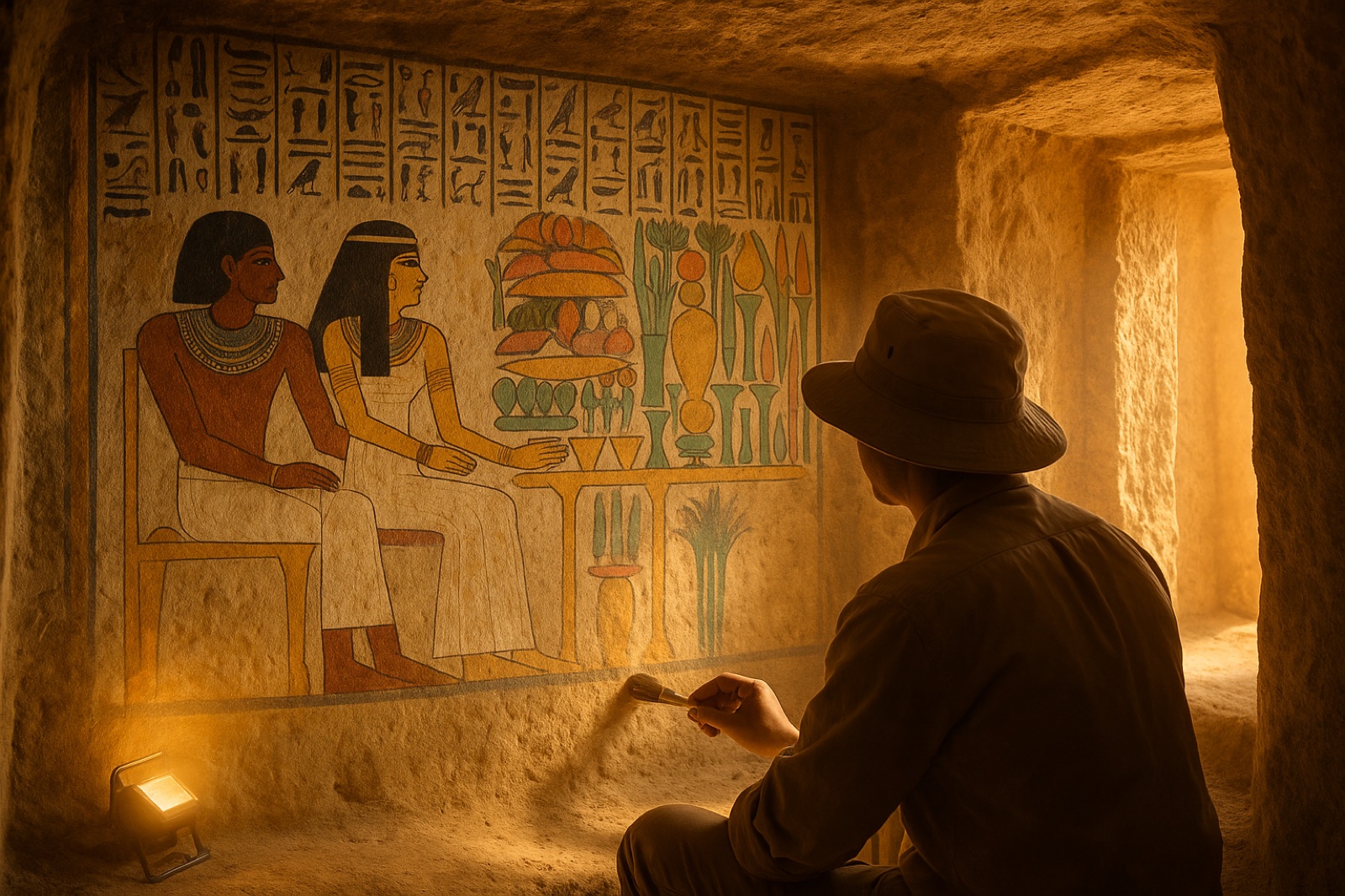
Then the digging reached a doorway nobody had ever recorded. Behind it was a 3,000-year-old tomb near Luxor, with painted walls, belonging to a man named Paser. On one of those walls, Paser had himself painted sitting at a table of bread, so the meal would never end.
The same water the team was working to hold back is now the biggest threat to that paint.
How the 3,000-Year-Old Tomb Near Luxor Was Found
The site sits in the Theban necropolis, the huge spread of burial ground across the Nile from modern Luxor, where the officials of ancient Thebes were buried in tombs cut into the rock. These hills keep giving up surprises. Not far away, Egypt recently confirmed a royal tomb belonging to the pharaoh Thutmose II.
The work at Sheikh Abd el-Qurna is run by an international mission led from Leiden University and the Netherlands Institute for the Near East, working with Egypt’s antiquities authorities. Its director, Egyptologist Carina van den Hoven, has written about the moment the team first went in. She called it “at once exciting and terrifying.”
They had no idea what was waiting. The ceiling might have fallen in. Robbers might have got there first. There might be nothing left at all.
Something was left. The chapel still had its colour.
The tomb has an open courtyard with mudbrick walls, a staircase flanked by ramps, a chapel cut into the rock in the shape of a T, a niche for a carved memorial stone, and burial chambers underneath. From the style of its painted inscriptions, the team dates it to the Ramesside period, Egypt’s 19th and 20th dynasties, roughly 1292 to 1069 BC. That is where the “3,000 years” comes from.
Who Was Paser?
Honestly, not much is known yet. The inscriptions repeat his name again and again, which is how the team identified him as the tomb’s main owner. But a layer of dirt still covers much of the painting, and more details may only come out once conservators clean the walls.
One thing is worth being careful about. Paser was not a rare name in that era. A much more famous Paser served as vizier, the top official under the king, in the reigns of Seti I and Ramesses II. Nothing published so far links that man to this tomb. If you see the two blended together online, be cautious.
A Meal Painted to Last Forever
The painted scenes are the heart of it. In some, Paser stands in worship before gods in their shrines. In another, he sits beside his wife in front of an offering table piled with bread, beer, fruit, meat and flowers.
To us, it looks like a nice dinner.
To Paser, it was a plan.
Why Did Ancient Egyptians Paint Food on Tomb Walls?
This is the part that makes the scene far more human than it first looks.
Ancient Egyptians believed that part of a person, the ka or life force, lived on after death and still needed feeding. The first plan was simple. The family, or a paid priest, would bring real bread and real beer to the tomb chapel. Very often that duty fell to the eldest son.
But Egyptians knew families don’t last forever. Sons die. Money runs out. Priests stop coming.
So they built in a backup. Food painted on a wall was believed to be able to stand in for the real thing. And a written prayer, known today as the offering formula, listed what the dead person needed: bread, beer, oxen, birds, linen, “every good and pure thing.” If anyone read those words out loud, the gifts were believed to be provided.
So a painted offering table is not really a picture of a feast. It is an insurance policy against being forgotten. The thinking behind a scene like Paser’s went something like this: if my family stops coming, the paint will feed me. And if the paint is not enough, maybe one day a stranger will walk in and say my name.
About 3,000 years later, strangers did walk in. They are reading his name out loud right now.
The Water Is Coming for the Paint
Luxor almost never sees rain, which is a big part of why so much ancient paint has survived there. But dry places do not get gentle rain. When a storm does break over the Theban hills, water races off the bare rock, picks up debris, and pours into whatever sits low. Including tombs.
Van den Hoven puts the danger plainly. Flooding can cause “moisture-activated growth of salt crystals, loss of painted decoration and, potentially, structural collapse.”
In simple words: water soaks into the rock and carries salt with it. As the rock dries, the salt grows into tiny crystals that push the paint off the wall from behind. With enough water, the roof itself can come down.
She also warns that climate change is expected to make these flash floods more frequent and more intense in the coming years. That is why the team works the way it does, clearing debris slowly and excavating properly as they go, so floodwater can be steered away from the tombs without destroying the history lying in the rubble.
And here is the strange twist. The flood threat is the reason Paser was found at all. The very thing that could erase his paintings is the thing that brought them back into the light.
Egypt’s dry ground is famous for keeping fragile things far longer than seems possible. This is the country where the oldest dress in the world still has creases in it. But “far longer” is not “forever.” Everything made by human hands is on a clock.
What Paser Was Really Afraid Of
It is easy to smile at a man who thought painted bread could feed him. But look past his method to the fear underneath it, because that fear has not changed at all.
Paser was not really afraid of being hungry. He was afraid of being forgotten.
And every part of his plan leaned on something that could not hold. Family that would one day stop coming. Priests who would one day stop being paid. Paint that would one day meet water. Strangers who might never walk in.
We do the same thing with different tools. Photos. Savings. A good reputation. A name on a building. Something we made that people might still find in ten years. None of it is foolish. But all of it is paint.
There is an old hope, held by people for thousands of years, that sits underneath all of that. It says you do not have to hold yourself in existence. Being kept does not depend on whether anyone remembers you, because God does the remembering, and what God keeps does not wash away.
That is not a reason to stop caring for what we build. It is a reason not to be terrified when it starts to fade.
What Happens to Paser’s Tomb Now
The team plans to stabilise the structure, conserve the walls and restore the painted scenes over the coming seasons. The dirt will come off, and more of Paser’s story will probably come with it. The researchers also hope the site will help them understand how tombs in this area were reused over the centuries.
And somewhere on that hillside, a man who hoped someone would one day say his name has had it said again. First by a team of strangers from another continent. And now, by you.
Questions People Ask About the Tomb of Paser Near Luxor
Who was Paser, the owner of the newly found tomb near Luxor?
Paser was an ancient Egyptian official whose previously unknown tomb was found in Lower Sheikh Abd el-Qurna, part of the Theban necropolis on the west bank of the Nile at Luxor. The tomb dates to the Ramesside period, roughly 1292 to 1069 BC. Its inscriptions repeat his name many times, and its paintings show him worshipping gods and sitting with his wife at an offering table. Much of the painting is still under a layer of dirt, so further details about his life may emerge after conservation. He should not be confused with the better-known vizier Paser who served Seti I and Ramesses II.
How was the 3,000-year-old tomb near Luxor discovered?
The tomb of Paser was discovered by an international archaeological mission led from Leiden University and the Netherlands Institute for the Near East, directed by Egyptologist Carina van den Hoven, working with Egypt’s antiquities authorities. The team was clearing debris in Lower Sheikh Abd el-Qurna so that flash floodwater could be diverted away from ancient tombs. During that work they reached a tomb that had never been recorded. The discovery was announced in July 2026.
Why did ancient Egyptians paint food on tomb walls?
Ancient Egyptians believed part of a person, the ka or life force, survived death and needed ongoing food and drink. Living relatives or paid priests were expected to bring real offerings to the tomb, but families and payments could not be relied on forever. Painted offering tables showing bread, beer, meat, fruit and flowers acted as a permanent substitute, and a written prayer called the offering formula listed the gifts the dead person needed. Egyptians believed that reading the formula aloud provided those gifts to the dead.
How do flash floods damage ancient Egyptian tombs?
Flash floods in the hills around Luxor send water rushing into tombs cut into the rock. According to the archaeologists working at Sheikh Abd el-Qurna, the water can trigger the growth of salt crystals inside the rock, which pushes painted plaster off the walls, and it can also cause parts of a tomb to collapse. Archaeologists expect climate change to make these floods more frequent and more intense, which is why debris is being cleared so floodwater can be steered away from vulnerable tombs.
Where is Sheikh Abd el-Qurna?
Sheikh Abd el-Qurna is an area of ancient cemetery on the west bank of the Nile, across the river from the city of Luxor in southern Egypt. It is part of the Theban necropolis, the burial ground of ancient Thebes, and it is best known for the rock-cut tombs of officials and nobles from Egypt’s New Kingdom. The newly found tomb of Paser lies in the lower part of the hill, known as Lower Sheikh Abd el-Qurna.
Over to You
Here is the question this one leaves behind: should archaeologists fight hard to save painted tombs like Paser’s from floods, even at great cost, or is it more honest to record them well and accept that nothing made by people lasts forever? Tell us where you land in the comments. We read them.
Worth Passing On
- Archaeologists near Luxor were clearing rubble to stop flash floods and found a 3,000-year-old tomb nobody knew existed. The owner painted himself a meal to last forever. https://bgodinspired.com/index.php/bible-resources/bible-history/3000-year-old-tomb-near-luxor-paser/
- Ancient Egyptians painted food on tomb walls as a backup plan, in case their families stopped bringing the real thing. It was never really about hunger. It was about not being forgotten. https://bgodinspired.com/index.php/bible-resources/bible-history/3000-year-old-tomb-near-luxor-paser/
- The floods that led archaeologists to Paser’s tomb are the same floods that could wash his paintings away. A strange, beautiful story from the hills of Luxor: https://bgodinspired.com/index.php/bible-resources/bible-history/3000-year-old-tomb-near-luxor-paser/