 0
0
 0
0
You’ve heard it before — maybe in a Pentecostal service, maybe just once at a friend’s home group, maybe only in a movie scene played for shock value. Someone closes their eyes and starts speaking fast, in a rhythm that isn’t English and isn’t any language you recognize. Everyone else in the room either nods peacefully or bows their head, like this is completely normal. You wanted to ask what was actually happening, but the question felt risky — like it might mark you as not spiritual enough to already know, or as the skeptic in the room who doesn’t really believe any of it.
Here’s the part almost nobody tells you: the Bible itself describes two different things under the same name. Speaking in tongues isn’t one experience with one explanation — it’s a phrase that covers two distinct moments in scripture, about twenty-five years apart, serving two different purposes. Once you see that, most of the confusion — and most of the argument — starts to resolve on its own.
What Happened at Pentecost Was a Real Language Miracle
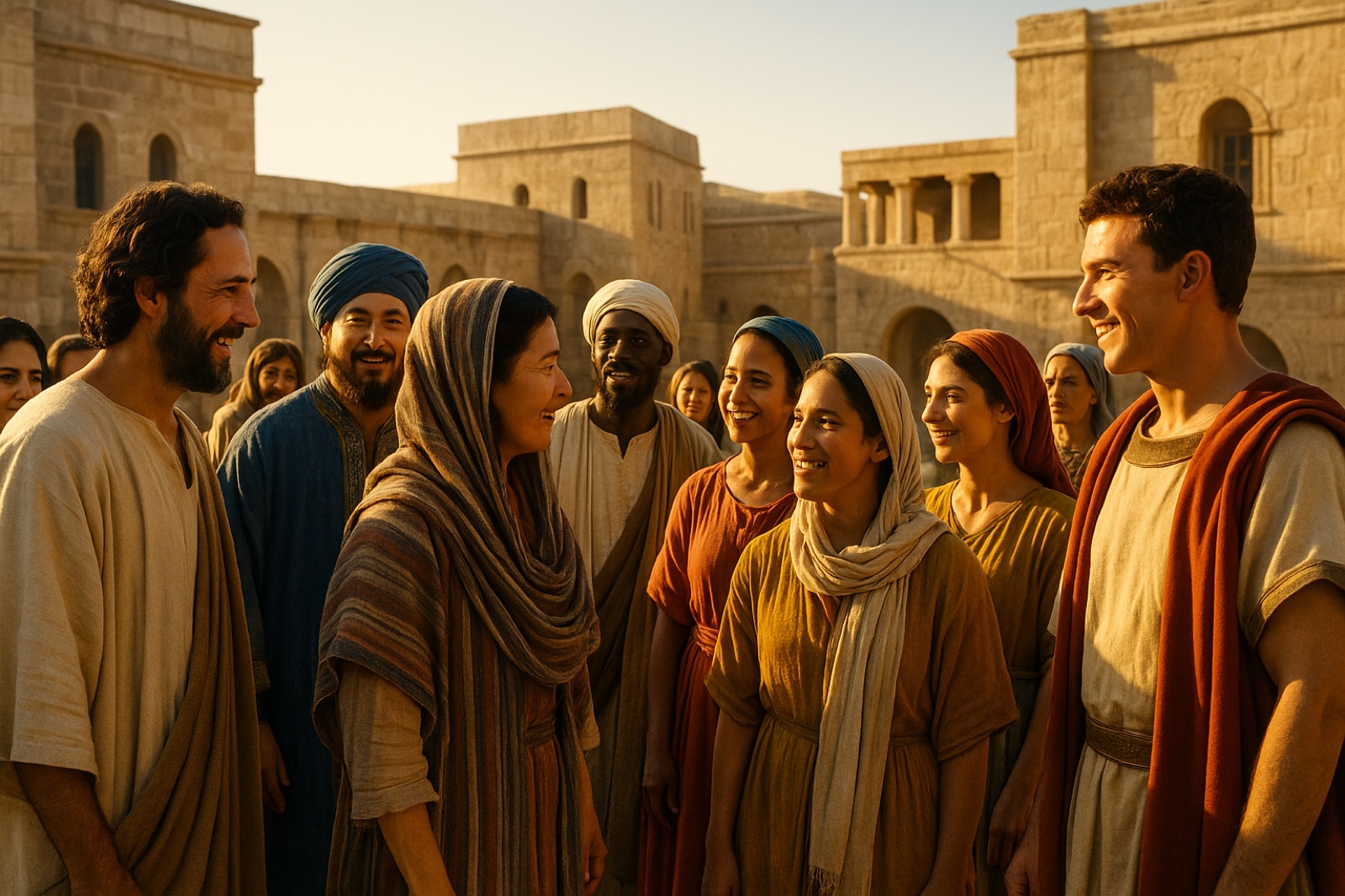
The first mention comes in Acts 2, at the Jewish festival of Pentecost, about fifty days after Jesus’s resurrection. A crowd of Jesus’s followers — roughly 120 of them — were gathered together in Jerusalem when something happened that none of them expected: “And they were all filled with the Holy Ghost, and began to speak with other tongues, as the Spirit gave them utterance” (Acts 2:4).
Jerusalem at that moment was packed with Jewish pilgrims from all over the ancient world — Rome, Egypt, Persia, Asia Minor, Arabia — people who had grown up speaking dozens of different native languages. And when the disciples started speaking, the crowd’s reaction wasn’t confusion. It was recognition. Each person heard the disciples declaring the wonders of God in their own native tongue — the language they’d grown up with, the one they spoke at home. The Greek word used here, glōssa, means exactly what it looks like: language, in the ordinary linguistic sense. This wasn’t ecstatic gibberish. It was real, structured human speech that the disciples had never learned, being understood in real time by people who had.
If you’ve ever wondered what it actually means to be “filled with the Holy Ghost” in the first place, that phrase carries its own rich backstory — the specific word Jesus used for the Holy Spirit is worth its own look. There’s a detail here that’s easy to skip past but changes everything about how you read it: this was the reversal of Babel. Back in Genesis 11, humanity tried to build a tower to make a name for itself, and God confused their one shared language into many, scattering people across the earth. At Pentecost, God did the opposite — took people who spoke many different languages and let them all hear the same message, each in the language that already belonged to them. The miracle wasn’t showing off. It was making sure nobody in that crowd needed a translator to hear that God was for them.
Why 1 Corinthians 14 Describes Something Different
Now jump about twenty-five years forward, to a letter the apostle Paul wrote to a young, chaotic church in the Greek city of Corinth. Paul is still using the word “tongues” — but the context has completely changed. He’s not describing a public sign for a crowd of foreign visitors. He’s addressing something happening inside the church’s own gatherings, something personal and private: “For he that speaketh in an unknown tongue speaketh not unto men, but unto God: for no man understandeth him; howbeit in the spirit he speaketh mysteries” (1 Corinthians 14:2).
That single verse is doing a lot of work. Paul says this kind of tongue is spoken to God, not to people — it isn’t meant to be understood by the room the way Pentecost’s tongues were instantly understood by that crowd in Jerusalem. He calls it “mysteries,” language that bypasses the speaker’s own understanding and goes straight to God as a kind of Spirit-led prayer. A few verses later, Paul says that if this gift is used publicly in the church, it needs an interpreter — otherwise it edifies only the person speaking, not the people listening (1 Corinthians 14:13, 14:27-28). That instruction alone tells you this isn’t the same experience as Acts 2. Nobody at Pentecost needed an interpreter. The whole point there was that everyone understood immediately.
So why does English use the same word — “tongues” — for both? Because the underlying Greek word, glōssa, was broad enough to cover both a known human language and this other, Spirit-led form of prayer speech that bypasses ordinary language altogether. Two real things. One shared word. That single overlap in vocabulary is most of what’s fueled centuries of church arguments that didn’t need to happen — Acts itself even shows this gift showing up again later in a much smaller, quieter setting (a small group in Acts 19:6), a reminder that this was never meant to be a one-time spectacle.
You Don’t Have to Pick a Side to Understand What’s Actually There
Here’s where it gets interesting. Most explanations of speaking in tongues you’ll find online pick a side in a long-running denominational argument — either insisting every believer should experience this gift as proof of the Holy Spirit’s presence, or dismissing the whole subject as outdated and irrelevant. But the text itself isn’t asking you to pick a side. It’s describing two different gifts, given for two different reasons: a public sign meant to authenticate God’s power to outsiders who could verify it on the spot, and a private form of communication meant to strengthen one believer’s own connection with God, most often used personally.
Once you see that distinction, the real question stops being “is speaking in tongues real” and starts being something closer to what you actually came here with: is there something in the Bible I’ve been afraid to look at closely, because I assumed someone had already decided the answer for me? Scripture rewards a second look far more often than it rewards picking a team.
Three Things You Can Actually Do With This Today
- Read Acts 2:1-13 in one sitting, today. Notice that the crowd’s reaction was understanding, not confusion — that detail is the whole point of the miracle, and it’s easy to miss if you’ve only ever heard the story summarized.
- Ask a real question to a real person. If you’re genuinely curious how your own church or tradition understands this gift, ask a pastor or a mature believer you trust directly — rather than piecing together an answer from clips and comment sections.
- Look at your own gifts, not just this one. Tongues is one gift listed among many in 1 Corinthians 12 — not a required sign of a Spirit-filled faith. If you’re curious where your own gifts might lie, BGodInspired’s free Spiritual Gifts Assessment is a simple starting point.
Something to Sit With
Where else have you let a topic stay confusing simply because you were afraid to ask the real question underneath it? And which matters more to you right now — being right about a doctrine, or being close to the God the doctrine is actually pointing to?
God, I don’t need to have every mystery about the Spirit fully figured out to trust you. Thank you for giving good gifts to your people, even the ones I don’t completely understand yet. Give me wisdom instead of certainty, and curiosity instead of judgment, whenever I run into something in your word I haven’t really sat with before. Keep me close to you, however you choose to show up in my life and in the lives of people who experience this differently than I do. Amen.
Discussion Question
Do you think churches spend more time arguing about tongues than actually reading what Acts 2 and 1 Corinthians 14 each say for themselves? What would change if more people read both passages before picking a side? Share your take in the comments.
Share This
- I always thought “speaking in tongues” meant one thing. Turns out the Bible describes two completely different experiences — a real language miracle in Acts 2, and something else entirely in 1 Corinthians 14. Wish someone had explained this to me years ago.
- Twenty-five years apart, two different purposes, one shared word. The Bible’s actual explanation of speaking in tongues is way more interesting than the debate everyone’s stuck having about it.
- You don’t have to pick a side on speaking in tongues to understand what the Bible actually says about it. Turns out it’s describing two different things the whole time.
Common Questions About Speaking in Tongues
What does speaking in tongues mean in the Bible?
Speaking in tongues refers to two related but distinct experiences in scripture. In Acts 2, it describes a real, understandable human language spoken by the disciples at Pentecost without having learned it — a miracle authenticated by the crowd who heard it in their own native languages. In 1 Corinthians 14, it describes a different, Spirit-led form of prayer spoken directly to God rather than to people, which Paul says requires interpretation if used publicly in church.
Is speaking in tongues in Acts 2 the same as in 1 Corinthians 14?
Not exactly. Acts 2 describes tongues as real human languages, immediately understood by listeners who already spoke them, used as a public sign to a diverse crowd. 1 Corinthians 14 describes tongues as a private, Spirit-led prayer language directed to God, which the speaker themselves may not understand and which needs interpretation to benefit anyone else listening.
Do you have to speak in tongues to be a Christian?
No. The New Testament describes tongues as one spiritual gift among several listed in 1 Corinthians 12, given to some believers and not others, the same way not every believer is given the gift of teaching or healing. It is never presented as a requirement for salvation or as proof that someone’s faith is genuine.
Why did the crowd at Pentecost understand what the disciples were saying?
Because what the disciples spoke were real, structured human languages that the listeners already knew from their own upbringing. Jerusalem was filled with Jewish pilgrims from many different regions for the festival, and each heard the disciples declaring the wonders of God in their own native language, without any translator involved.
What is the Greek word behind “tongues” in the Bible?
The Greek word is glōssa, which can mean either a known human language or, in some New Testament contexts, a Spirit-led form of speech that isn’t a standard language at all. That single word covering both meanings is a large part of why English translations use “tongues” for what are actually two distinct spiritual experiences.