 0
0
 0
0
You got the email. The job went to someone else. Or the offer fell through, or the relationship ended, or the door you were sure God had opened slammed shut in your face.
And somebody, meaning well, said it: “When one door closes, another opens.”
It helps a little. It’s hopeful. It feels like it ought to be in the Bible. So is it? Is “when one door closes another opens” in the Bible?
No, it isn’t. But there’s a chapter in the Bible where God closes two doors on a man in a row, and what came next was not what the saying promises. It was better, and it was harder. If you’re standing in front of a shut door right now, this chapter was written for your kind of week.
Is “When One Door Closes Another Opens” in the Bible?
The saying is not a Bible verse, and it isn’t in any book of the Bible under another wording. It’s a proverb, and it’s much older than most people think.
Quote researchers have traced it to Lazarillo de Tormes, a Spanish story published by 1554 by an unknown author. Its English translation in 1586 reads: “when one doore is shut the other openeth.” A few decades later, the 1620 English translation of Don Quixote has: “Where one door is shut another is opened.” (You can follow the full trail at Quote Investigator.)
You’ve probably seen it credited to Alexander Graham Bell, usually in the longer form about looking “so long” at the closed door that we miss the open one. That credit is shaky. The earliest version pinned to Bell that researchers have found is from a 1935 newspaper, and that passage mixed in words from a speech by Wendell Phillips in 1859, when Bell was twelve years old. Both the short and long versions are best treated as anonymous.
And the version with the window? That one comes from the movies. In The Sound of Music (1965), Maria tells the Captain: “The Reverend Mother always says, when the Lord closes a door, somewhere He opens a window.” Even in the film, it’s a saying passed along, not a verse.
So the honest answer is: Spanish proverb, Hollywood polish, not scripture. But that isn’t the end of it, because the Bible does have something to say about closed doors. It’s just more surprising than the proverb.
Two Doors Shut in a Row: Acts 16
Here’s the moment. The apostle Paul is on his second big journey, with his friend Silas and a young man named Timothy. They have a plan. They want to go preach in the Roman province of Asia (the western part of what’s now Turkey, not the continent). It’s a good plan. Big cities. Lots of people. Exactly the kind of place a missionary should go.
Then this:
“Now when they had gone throughout Phrygia and the region of Galatia, and were forbidden of the Holy Ghost to preach the word in Asia,”
— Acts 16:6 (KJV)
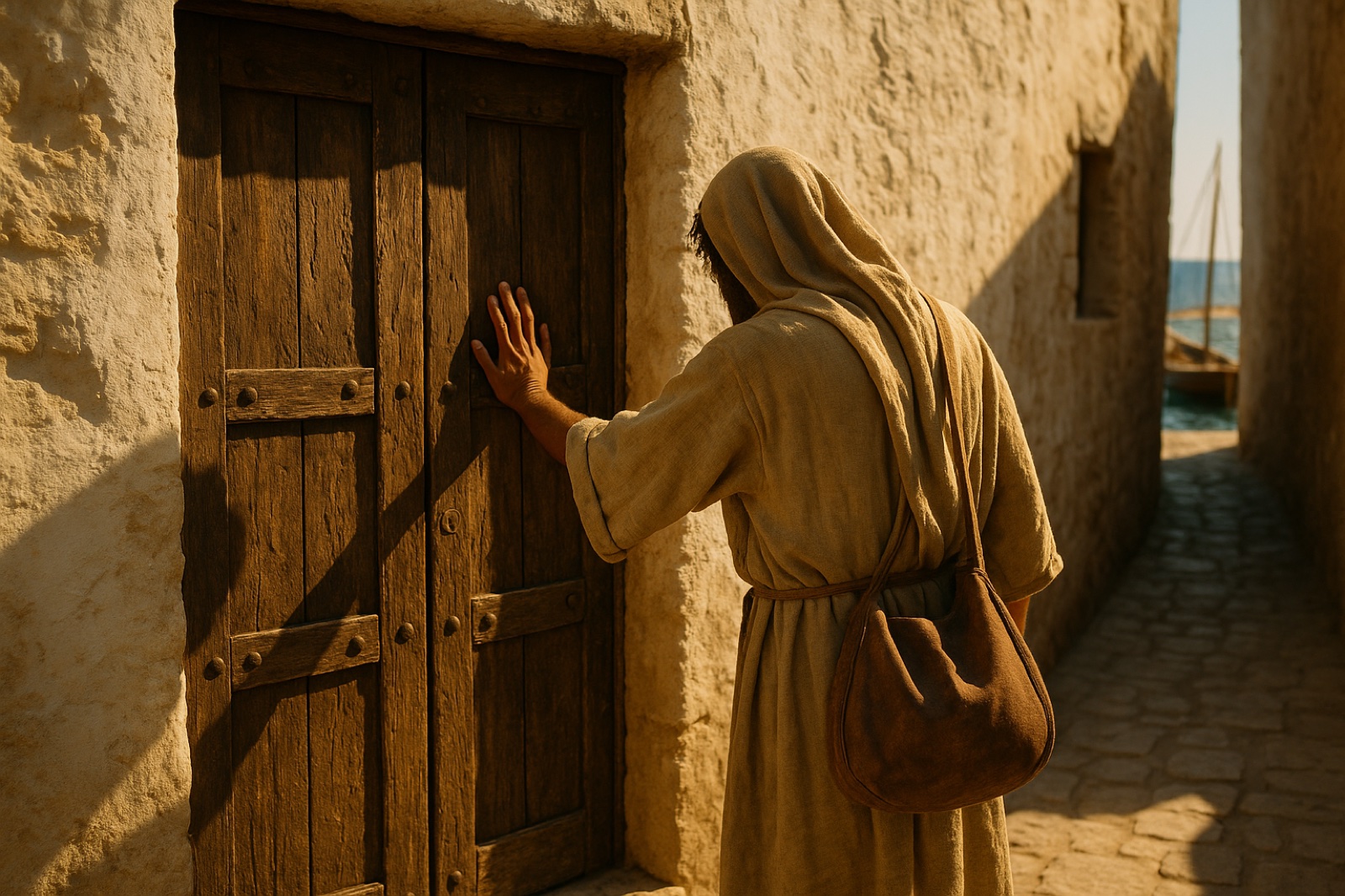
Door one: shut. The writer doesn’t tell us how. No explanation. Just “forbidden.”
So they turn north and try the next good option:
“After they were come to Mysia, they assayed to go into Bithynia: but the Spirit suffered them not.”
— Acts 16:7 (KJV)
Door two: shut. “Assayed” means they tried. They were already walking. And again, no.
Stop there for a second, because this is where most of us live. Paul wasn’t doing anything wrong. He wasn’t chasing money or running from God. He was trying to do exactly what he was made for, and the answer was still no. Twice.
Verse 8 is almost painfully short: “And they passing by Mysia came down to Troas.” Troas was a port town on the coast. They’d run out of land. Nowhere left to walk.
What Came Next Wasn’t a Window
If the proverb were true to this story, the next line would be something like “and a better opportunity opened in Troas.” It isn’t. Here’s what it says:
“And a vision appeared to Paul in the night; There stood a man of Macedonia, and prayed him, saying, Come over into Macedonia, and help us.”
— Acts 16:9 (KJV)
Look at what Paul got. Not a door. Not a window. Not a better job offer. He got a person asking for help.
That’s the big difference between the saying and the Bible. The proverb promises you a replacement: something for you, to make up for what you lost. Acts 16 gives Paul a request: someone else, somewhere else, who needs what he has.
The closed doors weren’t a punishment and they weren’t a consolation-prize setup. They were steering. God was pointing Paul toward people he didn’t even know were waiting.
The small word everyone reads past
Read verses 8 and 10 side by side and something quiet happens in the text.
Verse 8: “they passing by Mysia came down to Troas.”
Verse 10: “And after he had seen the vision, immediately we endeavoured to go into Macedonia, assuredly gathering that the Lord had called us for to preach the gospel unto them.”
“They” becomes “we.” The writer, traditionally Luke, is suddenly in the story. Somewhere in that dead-end port town, while Paul was stuck with two shut doors behind him, a new companion joined the team. The place that looked like the end of the road is where the book of Acts gets its eyewitness.
You don’t always see who you’ll meet at your Troas. But the dead end is rarely empty.
What Was on the Other Side
Here’s the part that should change how you think about closed and open doors. Paul crosses the sea, expecting a man of Macedonia. What does he actually find?
“And on the sabbath we went out of the city by a river side, where prayer was wont to be made; and we sat down, and spake unto the women which resorted thither.”
— Acts 16:13 (KJV)
Not a man. A small group of women praying by a river. One of them is a businesswoman named Lydia:
“…whose heart the Lord opened, that she attended unto the things which were spoken of Paul.”
— Acts 16:14 (KJV)
Notice the only thing that “opens” in this whole story. It isn’t a door for Paul. It’s a heart in someone else. (We wrote more about who Lydia was and her one scene in the Bible if you want to go deeper.)
And then it gets hard. A few days later Paul and Silas are beaten and thrown in prison in Philippi. The “yes” after the two “no’s” led straight into a jail cell. If the proverb were the whole truth, this would be the point where Paul decides he misread the signs.
Instead:
“And at midnight Paul and Silas prayed, and sang praises unto God: and the prisoners heard them.”
— Acts 16:25 (KJV)
The right direction and the easy direction are not the same thing. Paul was exactly where God sent him, and it still hurt.
Two More Surprises About Doors
The closed door wasn’t closed forever. Remember Asia, door number one? A few years later, Paul spends two years in Ephesus, right in that province, “so that all they which dwelt in Asia heard the word of the Lord Jesus, both Jews and Greeks” (Acts 19:10). “Not now” turned out to mean “not yet.” A no today isn’t always a no for life.
Paul once walked away from an open door. This is the detail almost nobody quotes. Years later Paul writes about returning to Troas, the same port town: “a door was opened unto me of the Lord,” he says. And then, in the very next verse: “I had no rest in my spirit, because I found not Titus my brother: but taking my leave of them, I went from thence into Macedonia” (2 Corinthians 2:12-13).
An open door, opened by God, and Paul left it because his heart was heavy about a friend. So an open door isn’t automatically a command, and a closed door isn’t automatically a verdict. Paul used door language more than once, but never as a promise that life hands you a replacement. Once he even wrote, “a great door and effectual is opened unto me, and there are many adversaries” (1 Corinthians 16:9). Open doors came with opposition built in.
What This Means When Your Door Just Closed
The proverb asks you to scan the hallway for the next door that’s going to open for you. Acts 16 suggests a different question: who near me needs help?
That’s not a way to shrink your loss or pretend it doesn’t hurt. Paul’s no’s were real, and yours are too. But it moves your eyes. A closed door makes you stare at yourself and what you don’t have. A call for help makes you look up.
Sometimes the next step after a no isn’t an opportunity at all. It’s a person. And sometimes, like with Luke at Troas, the person God sends is the one who joins you.
If you’re not sure how to even pray right now, try our free Bible Verse for How I Feel tool: pick what you’re feeling and it’ll give you a verse for exactly that. And if this closed door is less about direction and more about grief, this piece on how to deal with disappointment without hoping less is worth your next five minutes.
“After a closed door, God doesn’t always hand you a window. Sometimes God hands you someone to help.”
Actions to Take
- Name the door. Write one sentence: “The door that closed is ___.” Paul’s story names both closed doors plainly. Naming yours stops it from being a vague cloud.
- Look for one “man of Macedonia.” Think of one person in your life right now who could use something you have: time, a skill, a listening ear. Send them a message today, even just “How are you really doing?”
- Swap the question. The next time you catch yourself asking “What’s going to open for me?”, ask instead, “Who needs help that I can give?” Try it once before you go to sleep tonight.
Journaling Prompts
- What did you think the closed door was going to give you? Is there another way that need could be met?
- Where is your Troas, the place where it feels like you’ve run out of road? Who is already there with you?
- If God said “not yet” instead of “no,” what would change about how you’re carrying this?
A Prayer for When the Door Just Shut
God, I really wanted that door. I’m not going to pretend it doesn’t hurt that it closed. I don’t need You to explain it right now, but please don’t let me spend the next season staring at it. Turn my eyes toward the people around me who need help, and give me the courage to go when You call. Even if the next step is hard, help me trust that You’re steering me and not just shutting me out. Amen.
Discussion Question
Do you think “when one door closes another opens” does more good or more harm to someone who’s hurting? Tell us what you think in the comments.
Share This
- “When one door closes another opens” isn’t in the Bible. In Acts 16 God closes two doors on Paul, and what came next wasn’t a window. It was a man saying “Come over into Macedonia, and help us.”
- I always thought a closed door meant a better one was coming for me. Acts 16 flipped it: after two no’s, Paul didn’t get an opportunity. He got someone who needed help.
- The only thing that “opens” in Acts 16 isn’t a door for Paul. It’s Lydia’s heart. That changed how I read my own closed doors.
Questions People Ask
Is “when one door closes another opens” in the Bible?
No. “When one door closes another opens” is not a Bible verse. It is an old proverb traced to the Spanish story Lazarillo de Tormes, published by 1554, whose 1586 English translation says “when one doore is shut the other openeth.” The closest Bible story is Acts 16:6-10, where Paul is stopped from preaching in Asia and Bithynia and then sees a vision of a man asking him to come to Macedonia and help.
Who said “when the Lord closes a door, somewhere He opens a window”?
The line “When the Lord closes a door, somewhere He opens a window” is spoken by Maria in the 1965 film The Sound of Music, who says the Reverend Mother always said it. It is a line from the film’s screenplay, not a quotation from the Bible.
Did Alexander Graham Bell say “when one door closes another opens”?
There is no good evidence that Alexander Graham Bell said “when one door closes another opens.” The earliest known credit to Bell appeared in a 1935 newspaper, and that passage borrowed from an 1859 speech by Wendell Phillips, when Bell was only twelve. Quote researchers treat both the short and long versions of the saying as anonymous.
What does the Bible say about God closing doors?
In Acts 16:6-7, the Holy Spirit stops the apostle Paul from preaching in Asia and then in Bithynia. After those two closed doors, Paul sees a vision of a man from Macedonia saying “Come over into Macedonia, and help us” (Acts 16:9). In the Bible, a closed door is often God redirecting a person toward people who need help, not simply swapping one opportunity for a better one.
What does “I have set before thee an open door” mean?
“I have set before thee an open door, and no man can shut it” comes from Revelation 3:8, a message to the church in Philadelphia. The same verse says “thou hast a little strength,” and praises that church for keeping God’s word with only a little strength. The open door is not a reward for being strong; it is a promise that small, steady faithfulness is enough for God to work through.