 0
0
 0
0
Mars has a reputation, and the reputation is: finished.
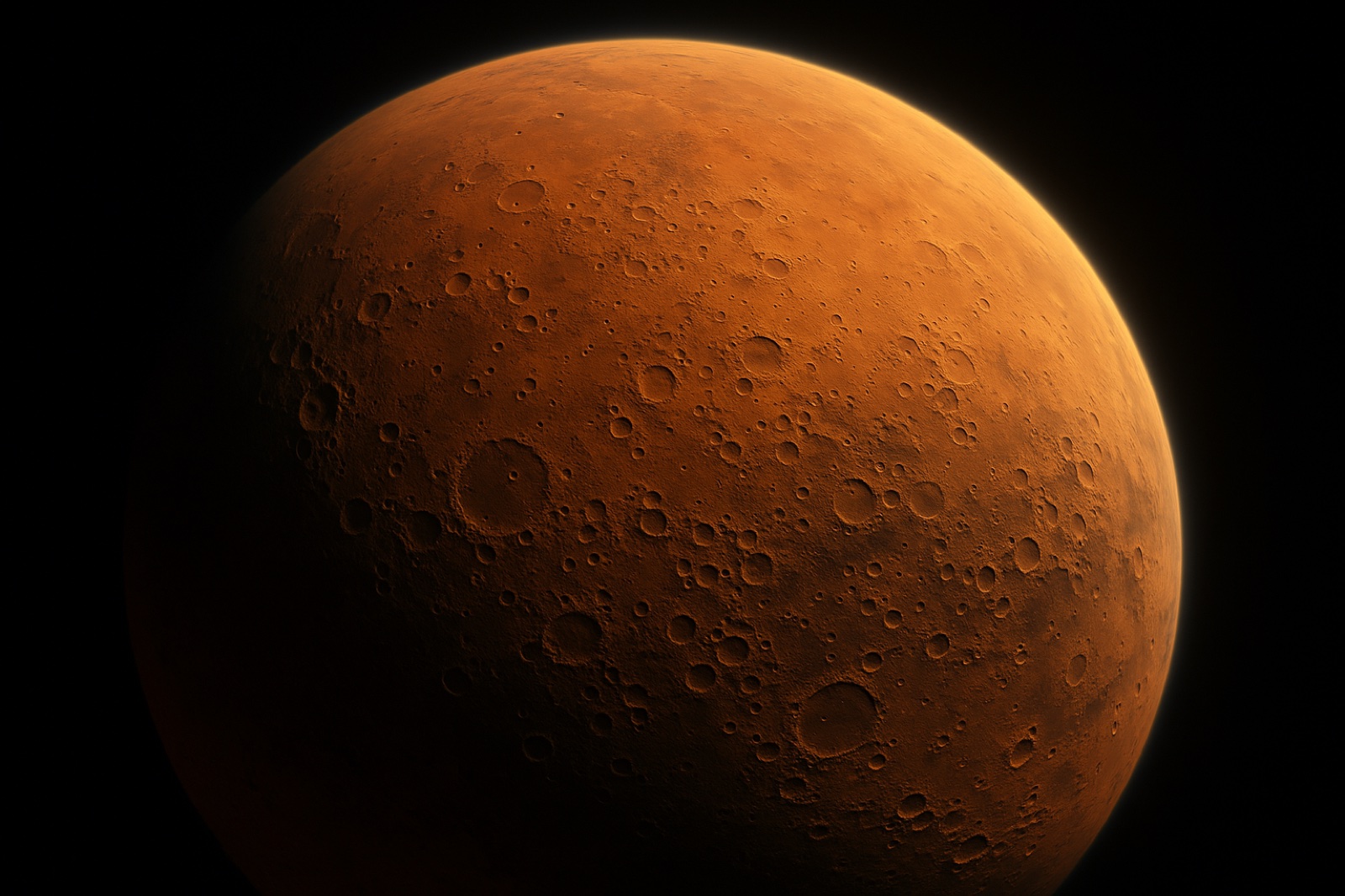
Cold. Dry. Rust-coloured rock as far as any camera can see. A planet that had its moment — running water, a thicker sky, maybe something like weather — and then lost all of it. Every image we get back tells the same story, even the strange ones, like the day a rover watched Earth vanish behind a Martian moon. Mars used to be alive. Mars is not alive now.
Then a team went looking at the planet’s gravity, and found something that does not fit that story at all. Deep under the southern half of Mars there is a heat anomaly — a stretch of the interior running 200 to 400 degrees Celsius warmer than the matching depth in the north. Warm enough that part of it is not solid rock at all. Part of it is still molten.
The planet everyone filed as over is, underneath, still running.
What the Mars heat anomaly actually is
The work was led by Alexander Berne, who did the research at Caltech and is now a postdoctoral associate at the University of Arizona. It was published in the journal Nature on 27 August 2026.
What the team found is a thermal split. Not a hot spot the size of a city — a difference between one entire hemisphere’s interior and the other’s. The southern interior is hundreds of degrees hotter, and partially molten, meaning some share of the rock down there is soft and liquid rather than set.
That is a strange thing for a planet to do. And it quietly breaks an assumption that almost everyone, scientists included, had been carrying around without examining it.
“Scientists usually assume that the interiors of planetary bodies are generally spherically symmetric, but this is not necessarily true,” Berne said.
Read that again slowly. The assumption was not that Mars was cold. The assumption was that Mars was the same all the way around. Nobody checked, because there was no reason to think otherwise.
Nobody flew a new mission to find this
Here is the part that got very little attention, and it may be the most interesting thing in the whole story.
No new spacecraft went to Mars for this. No new instrument was built. No landing, no drill, no rover.
The team used gravity data that had already been collected — decades of it, from three missions that have been quietly circling Mars for years: Mars Global Surveyor, Mars Odyssey, and Mars Reconnaissance Orbiter.
The method works like this. As a spacecraft loops around a planet, the planet’s uneven gravity tugs at it, and the craft’s speed changes by tiny amounts. Measure those tiny changes carefully enough, across enough orbits, and you can work backwards to what the inside of the planet is doing. The technique is called tidal tomography.
So the heat was not discovered in the sense of newly arriving. It was in the numbers the whole time. What changed is that somebody read the numbers a different way.
That is worth sitting with. For years, the evidence that Mars still holds a molten region under one hemisphere sat in an archive, available, gathered for other reasons entirely. The planet was never as finished as the file said. The file was simply the best reading anyone had done yet.
The half that looks deadest is the half that is hot
Mars has an obvious split, visible from orbit, that has puzzled people for a long time. It is called the crustal dichotomy.
The northern half is low, smooth, flat plains. The southern half is high, rugged, and hammered with craters — by a wide margin the older and more beaten-up looking half of the planet.
Look at the surface and you would guess the south is the dead part. It is the half that took the hits. It is the half that looks like it stopped changing a very long time ago.
The heat is in the south.
The interior does not match the exterior. The most battered-looking hemisphere is the one with molten rock still underneath it. Whatever that surface has been through, it turns out not to be a readout of what is happening below.
It also explains something that had been sitting unexplained
NASA’s InSight lander, which listened to marsquakes from the surface, had already noticed something odd: seismic waves lose energy faster passing through the southern part of Mars than the northern part.
That had been a loose thread. Waves fading faster is exactly what you would expect if the rock they are moving through is hotter and softer. The new gravity finding does not prove the connection, but it offers a clean explanation for a measurement that had been sitting there without one.
Researchers also raise the possibility that a hotter southern mantle relates to the difference in magnetism between the two hemispheres. That link is proposed, not settled — and the team is careful to say so.
Nobody knows why yet
This is the honest part of the story, and the researchers state it plainly: they do not know what caused it.
Three possibilities are on the table. A giant impact early in the planet’s history. Convection in the mantle that simply organised itself this way. Or thick geological structures acting like a blanket, trapping heat that would otherwise have escaped.
All three are plausible. None is confirmed. The finding is that the heat is there — not why.
Planets keep doing this to us. Our own has an unexplained interior too: Earth’s molten core reversed direction beneath the Pacific and scientists still cannot fully say why. Standing on a planet is not the same as understanding one.
The surface is not the report
There is something in this that goes past Mars.
We do the same filing on ourselves. A season goes badly, then goes badly long enough that we stop calling it a season and start calling it a fact. The evidence looks conclusive. Nothing has moved in a while. The surface shows every mark of what it has been through. So we write the summary — that part of my life is over — and we get on with managing the aftermath.
But a summary is a reading. It is not a measurement. And the thing about Mars is that the measurement had been sitting available for decades before anyone thought to take it.
There is an old idea, far older than any of these instruments, that God does not read a life the way we read one — that what looks spent from the outside can still be carrying heat, and that being battered on the surface is not the same as being finished underneath.
It is an odd place to find that echoed. But there it is, in the gravity data of a planet nobody lives on. The most damaged-looking half is the one that is still molten.
What you do with a planet that is not finished
Nothing, immediately. That is more or less the point.
Nobody is flying to Mars to check on the heat. The finding will sit in the literature, other people will build on it, and in ten or twenty years somebody may understand the cause. Slow work. The heat does not need anyone to notice it in order to go on being there.
If you want to sit with the scale of this sort of thing for a minute, our free How Old Is the Universe? Explorer lays the timeline out in plain language — it is a good place to put a number like “decades of orbital data” in perspective.
And then there is the smaller version of the question. Not what is under Mars. What is under the thing you already closed the file on.
You do not have to answer that today. It is enough to notice that the file was a reading.
Questions People Are Asking
What is the Mars heat anomaly?
The Mars heat anomaly is a large thermal difference discovered inside Mars, where the interior of the southern hemisphere is roughly 200 to 400 degrees Celsius warmer than the interior of the northern hemisphere and is partially molten. It was described in a study led by Alexander Berne, published in the journal Nature on 27 August 2026.
How did scientists find heat inside Mars without going there?
They used gravity measurements already gathered by three spacecraft orbiting Mars: Mars Global Surveyor, Mars Odyssey, and Mars Reconnaissance Orbiter. A planet’s uneven gravity slightly changes an orbiting spacecraft’s speed, and those tiny changes, measured across decades of orbits, can be worked backwards into a picture of the planet’s interior. The technique is called tidal tomography. No new mission was required.
Is Mars still geologically active?
The study found that part of the Martian interior beneath the southern hemisphere is partially molten, which means it is hotter and softer than solid rock. That is different from saying Mars has active volcanoes or plate tectonics at the surface today. The finding concerns the deep interior, not present-day surface activity.
Why is the southern half of Mars hotter than the northern half?
Nobody knows yet. Researchers have proposed three possible causes: a giant impact early in the planet’s history, mantle convection that organised itself into this pattern, or thick geological structures trapping heat that would otherwise escape. None of the three has been confirmed.
Does the Mars heat anomaly mean there is life on Mars?
No. The study is about temperature and the physical state of rock deep inside the planet, not about habitability or biology. Researchers have noted the finding may help explain the history of water on Mars, but it makes no claim about life.
A Question Worth Arguing About
Which is the more useful assumption when you are looking at something you do not fully understand — that it is basically uniform until proven otherwise, or that it is probably uneven and you just have not measured it yet? Scientists went with the first one about planetary interiors for a very long time. Which would you default to, and why? Leave a comment — this one has no correct answer, only better arguments.
Share This
- Scientists found a region inside Mars that is 200 to 400C hotter than the other side, and partly molten. The wild part: no new mission. The data had been sitting in an archive for decades. Somebody just read it differently. https://bgodinspired.com/index.php/bible-resources/bible-and-science/mars-heat-anomaly-still-molten-inside/
- The most cratered, beaten-up, oldest-looking half of Mars is the half that is still hot underneath. The surface was never a readout of the interior. https://bgodinspired.com/index.php/bible-resources/bible-and-science/mars-heat-anomaly-still-molten-inside/
- Reminder from an entire planet: “nothing has changed here in a long time” is a reading, not a measurement. https://bgodinspired.com/index.php/bible-resources/bible-and-science/mars-heat-anomaly-still-molten-inside/
Sources: Caltech, reporting the study published in Nature, 27 August 2026.