 0
0
 0
0
Imagine losing every word you know. You can’t ask for coffee. You can’t follow a simple sentence. A stroke has wiped out the part of your brain that handles language, and it isn’t coming back the way it was.
Now imagine sitting down at that same moment and solving a hard math problem without any trouble. Or beating a friend at chess. Or working out, step by step, why one plan makes more sense than another.
That shouldn’t be possible. Logic and language feel like the same skill wearing two hats — you think in words, so how could you reason without them? But a team of neuroscientists just proved that’s exactly what happens, and the discovery is rewriting what we thought we knew about how the mind works.
The Study That Split Logic and Language Apart
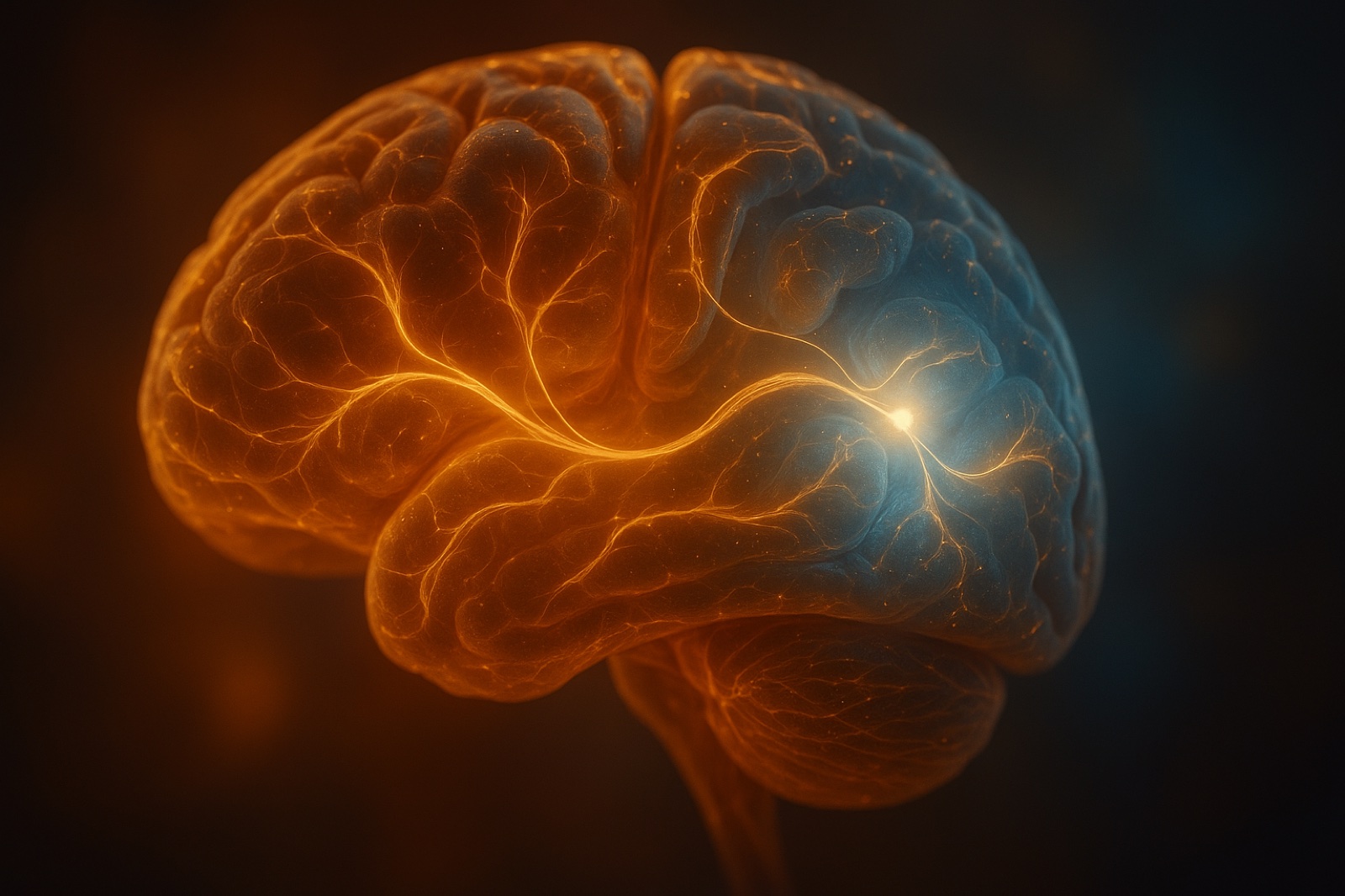
Researchers Evelina Fedorenko and Rosemary Varley, working out of MIT’s McGovern Institute, spent years studying people with severe aphasia — a condition, usually caused by a stroke or brain injury, that strips away the ability to produce or understand language, sometimes almost completely. Their findings, published in the Proceedings of the National Academy of Sciences, are still making the rounds in science coverage a month later, and it’s easy to see why.
People who had lost nearly all their language ability could still solve multi-step logic problems, work through arithmetic, plan ahead, and reason about cause and effect. Their words were gone. Their reasoning wasn’t. And the reverse turned out to be true as well — some patients with damage to different brain regions kept fluent, grammatical speech while losing the ability to reason through a problem that required real logical thought.
In neuroscience, that back-and-forth pattern has a name: a double dissociation. It’s about as close as brain research gets to solid proof that two abilities don’t just feel different — they run on genuinely separate systems. Logic and language, it turns out, are not the same brain function pretending to be two things. They’re two things.
What This Actually Means About How You Think
This settles something scientists have argued about for a long time: do you need language to think? The old assumption was that words are the vehicle for reasoning — that you can’t really “do” logic without narrating it to yourself in sentences. Fedorenko’s work, including this study, keeps landing on the opposite answer. Thought comes first. Language is more like a reporting system that gets bolted onto it afterward, useful for communicating what you’ve already figured out, but not the thing doing the figuring.
It’s a quiet explanation for things you’ve probably noticed without naming them. Why some of the sharpest logical thinkers you know struggle to explain themselves out loud. Why someone can be eloquent, quick, persuasive — and still not especially rigorous underneath the delivery. Language and reasoning are graded on two different curves, running through two different neighborhoods of the brain, and most of us just assumed it was one neighborhood the whole time.
It also reframes what aphasia actually is. A person who has lost language hasn’t lost their mind — their capacity to reason, plan, and understand is often fully intact behind a door they can no longer open with words. That distinction matters far beyond a lab. It’s the same kind of humbling discovery behind the brain circuit scientists found that makes loneliness feel physically unbearable — proof, again and again, that what looks like a single feeling or a single skill is usually two or three systems working in the dark, and we only notice once one of them goes quiet.
A Word Older Than the Study That Already Held Both Together
Here’s the strange part. Long before anyone had a brain scanner, one word already carried both of these ideas at once — word and reason, language and logic, folded into a single term with no English equivalent.
The Greek word is logos. It’s where we get “logic” and the “-ology” ending on half our sciences. To the ancient Greeks, logos meant speech, an account, an explanation — and it also meant the rational order underneath everything, the reason things make sense at all. One word. Not two words that happened to look alike. The same word, doing both jobs, because nobody thought to separate them.
Then the opening lines of the Gospel of John reach for that exact word and do something bold with it: they call Jesus “the Word” — logos — and describe that Word as the source, the explanation, the reasoning behind everything that exists. Not a metaphor stretched thin. A deliberate choice of a term that already meant both language and logic at once, applied to a person, thousands of years before anyone could put a name to why those two things live in different rooms of the brain.
Modern neuroscience just spent a decade proving, carefully and rigorously, that word and reason are separable. An ancient text opened by insisting they were, in the deepest sense, one — held together in a single Word. It’s not a scientific claim and it doesn’t need to be. It’s just a strange kind of poetry that got there first.
Maybe that’s part of why it feels so good when you finally say the thing you’ve been turning over in your mind and it comes out exactly right — for one brief moment, the two systems that spend most of their time working separately, quietly, in different neighborhoods of your brain, line up. Words were never just data being transferred. Something in us has always known that, long before a scanner could show it.
What Do You Think?
If your reasoning and your words really do run on separate systems, what does that change about how you’d describe your own mind — are you more of a “thinker” or a “talker,” and do you think one is actually smarter than the other? Drop your take in the comments.
Share This
“Scientists just proved logic and language run on completely different systems in the brain. And there’s a 2,000-year-old word that already said they were one. Wild.”
“Wait — you can lose almost all your language ability and still be a perfectly sharp thinker underneath it? New MIT research says yes. Reading this differently now.”
“The ancient Greek word for ‘word’ also meant ‘logic.’ Same word. No separation. Science just spent years proving those two things actually live apart in the brain. Made me stop and think.”
Quick Questions
Is it really true that you can lose language but keep your logical reasoning?
Yes. Research out of MIT’s McGovern Institute, led by Evelina Fedorenko and Rosemary Varley and published in the Proceedings of the National Academy of Sciences, found that people with severe aphasia — a language loss usually caused by stroke or brain injury — can still solve complex logic problems, do arithmetic, and reason through multi-step decisions. Their words were gone, but their reasoning wasn’t.
What is a “double dissociation” in neuroscience?
A double dissociation is when researchers find two groups of patients with opposite patterns of damage and ability: one group loses ability A but keeps ability B, while another group loses B but keeps A. It’s strong evidence that A and B are handled by genuinely separate brain systems rather than being two sides of the same function.
Do you need language to think?
Based on this research, the answer looks like no. Thought and reasoning appear to happen independently of language, which functions more like a reporting system for communicating conclusions you’ve already reached rather than the tool you use to reach them.
What does the Greek word “logos” mean?
Logos is the ancient Greek word behind English terms like “logic” and the “-ology” ending in words like biology or theology. It meant speech, an account, or an explanation — and at the same time, the underlying rational order of things. The opening of the Gospel of John uses this word to describe Jesus, calling Him “the Word.”
Why does this discovery matter for how we understand intelligence?
It suggests that being articulate and being logical are two different strengths, not one skill in disguise. Someone can be a brilliant reasoner without being a smooth talker, or an eloquent communicator without being especially rigorous — and neither says anything about a person’s underlying intelligence.