 0
0
 0
0
Take two magnets and push the matching ends together. You know the feeling. The closer they get, the harder they shove back.
Your DNA has the same problem. Every strand of it carries a negative electric charge along its whole length. Put two pieces of DNA side by side and they should push each other away. And yet inside your cells, DNA has to line up with other DNA all the time.
For more than 20 years, scientists had a good guess about how that works. This month, for the first time, a team actually watched DNA strands zipping together. What they found holding them is smaller than anything you could picture. And the way it works is worth thinking about long after you close this page.
What scientists saw: DNA strands zipping together
The work comes from researchers at the University of Sheffield and the University of York in the UK. It was announced on 9 September 2026 and published in the journal Nucleic Acids Research. The team included Dr Thomas Catley and Dr Victor Velasco-Berrelleza at Sheffield and Professor Agnes Noy at York.
They used a tool called an atomic force microscope. Instead of taking a photo with light, it runs an incredibly fine tip across a surface and feels its shape, a little like reading with your fingertips. That gave them pictures sharp enough to follow the twists of a single DNA molecule.
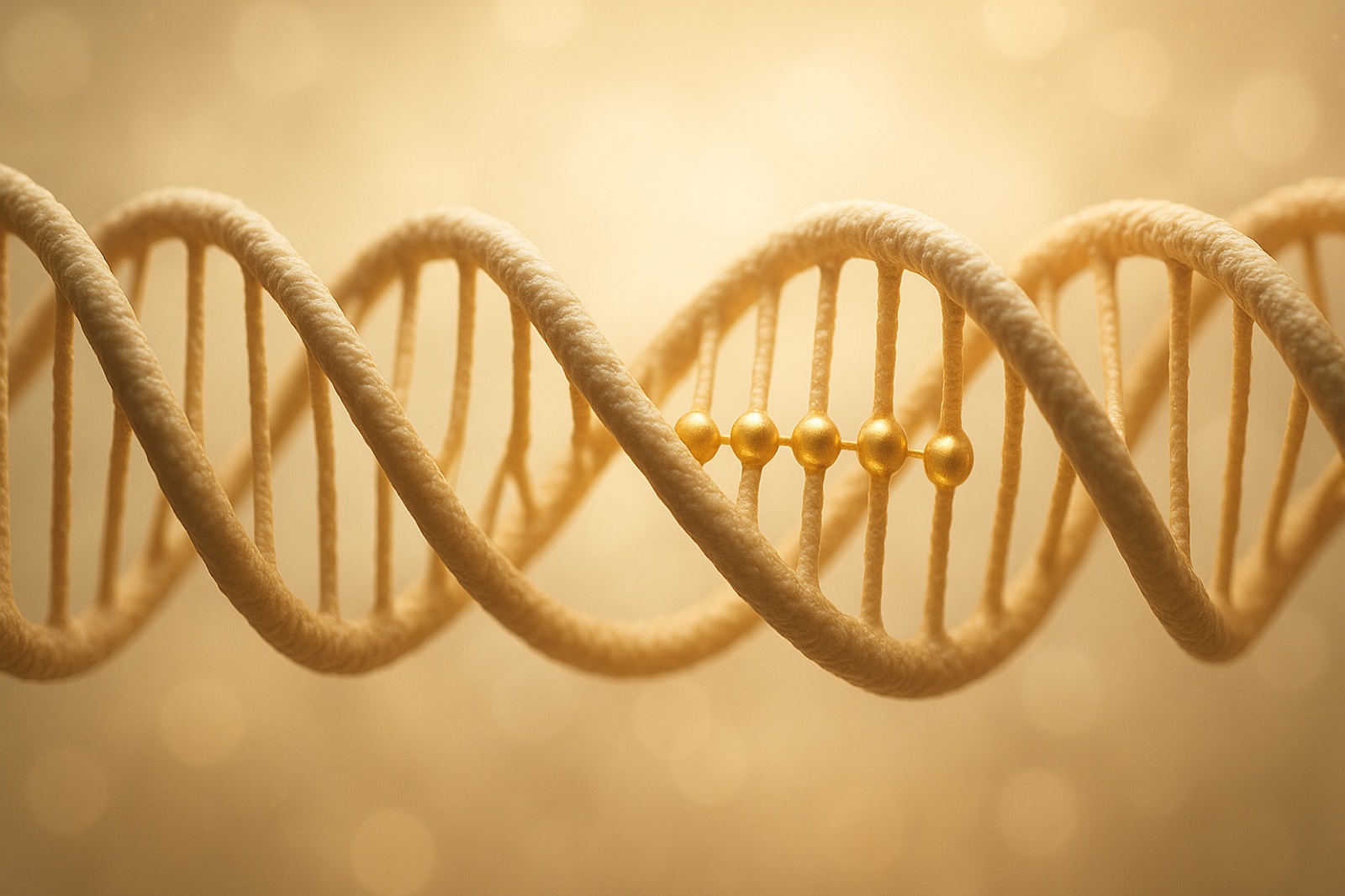
DNA is shaped like a twisted ladder. The twist leaves two grooves winding around the outside, one wide and one narrow. When the team caught short pieces of DNA paired up, the two pieces were lined up groove to groove. Wide groove with wide groove. Narrow with narrow. Like two spiral staircases slotted neatly into each other.
“It was incredible to be able to directly visualise the long-hypothesised mechanism for the first time,” Catley said.
So what holds two things that should push apart?
Seeing it was half the work. The other half was computer simulations that track every atom around the DNA. As Velasco-Berrelleza put it, “Microscopy shows us what happens, but the simulations allows us to uncover the molecular mechanism behind it.”
Here is what the simulations showed. Floating around DNA are metal ions: single atoms of things like magnesium and calcium that carry a positive charge. Both are found in your own body. The team also worked with nickel, which proved especially useful in the lab.
These ions settle into the grooves. And the ones that did the job carry a double positive charge. The researchers describe them as having “two charged arms.” One arm holds on to one piece of DNA. The other arm holds on to the other piece. At the same time.
Notice what does not happen. The two strands never stop being negative. They never become less alike. What changes is that something is now sitting in the gap between them, holding on to both.
That confirms an idea first put forward more than two decades ago by physicist Alexey Kornyshev at Imperial College London and colleagues, often called the “DNA zipper” model.
The detail most reports skipped
The news releases say the double-charged ions did it. The paper itself adds something they barely mention.
The team also ran simulations with potassium. Your body is full of it, and it is a positive ion too, but it carries only a single charge. One arm, not two. They ran it again and again. In none of those runs did the DNA pair up.
Potassium can take some of the edge off the push between two strands. What it cannot do is reach both of them at once. Easing the tension was not enough. Something had to take hold of both sides.
A few more honest details from the paper, because they matter:
- Even with the right ions, pairing was not common. Only about 10 to 14 percent of the DNA pieces imaged were caught paired, and each pairing held along a very short stretch, around 15 nanometres. A nanometre is a billionth of a metre.
- In simulations using a mix closer to the inside of a real cell, potassium plus some magnesium or calcium, side-by-side pairing happened in only a few runs: two out of six with calcium, one out of six with magnesium.
- Pairing was not the same all along the DNA. Some short stretches worked as hotspots, where ions stayed put longer and the two helices were more likely to line up. One four-letter sequence, GTAC, was an especially steady meeting point.
- This was short, purified DNA resting on a flat mineral surface in a lab, not whole chromosomes inside a living cell. It shows a real mechanism. It does not yet show exactly how your cells use it.
Why DNA pairing matters
This is not just a pretty picture. Cells need DNA to find and line up with other DNA when they swap genes, when they switch genes off, and when they pack DNA tightly away into a very small space.
“This discovery could help researchers identify regions of the genome specially involved in DNA pairing,” Noy said. “These regions may become particularly important when mutations disrupt normal cellular processes and contribute to cancer.”
It is the second time in a few weeks that a new image has shown life’s smallest parts leaning on each other. Earlier this month, scientists photographed two microbes in an Australian bay that cannot survive apart. And if you have ever wondered how much of who you are is written in DNA at all, researchers recently found more than a thousand genes linked to personality.
Two people who are too alike
Most of us know a pair like those two strands. Two brothers who argue about everything because they are the same stubborn person twice. A mother and daughter with the same temper. Two friends who both need to be right. Too alike to get close without sparks.
When that happens, the usual advice is to lower the charge. Calm down. Give it space. Let it cool off. And that helps, the way potassium helps.
But the DNA hints that calm on its own is rarely what brings two people back together. What joins them is someone willing to stand in the middle and hold on to both. Not picking a side. Not asking either one to stop being who they are.
If your family ever had that person, you know how rare they are. The aunt who could talk to both brothers. The friend who kept inviting both of you. It is not an easy job. You feel the pull from both directions at once.
It is also one of the oldest pictures people have of God. Not a referee who picks a winner, but the one who stands in the gap between people who cannot stand each other, and breaks down the wall between them by holding on to both.
If you are usually one of the two strands, it can help to know how you fight. Our free What Is My Conflict Style? quiz takes a few minutes.
Back in the lab
Somewhere in Sheffield there are images of two tiny twisted ladders lying side by side on a slab of mineral, grooves lined up. Two things that should push apart, held together for a moment by something with two arms.
Most of the time, the pieces did not pair. The pull was real, but fragile. People are like that too.
But when it did work, it was never because one strand gave up its charge. It was because something reached out and held both. The next time you are in a room with two people who cannot get along, it might be worth asking whether that something could be you.
Questions people ask about DNA pairing
Why don’t DNA strands repel each other?
DNA carries a negative charge along its backbone, so two DNA double helices naturally push each other away. A 2026 study by the Universities of Sheffield and York, published in Nucleic Acids Research, found that positively charged metal ions with a double charge, such as magnesium, calcium and nickel, settle into the grooves of DNA and bridge the gap between two helices. Because each of these ions can hold on to both helices at once, they partly cancel the repulsion and let the two molecules line up side by side.
What is the DNA zipper model?
The DNA zipper model is an idea proposed more than 20 years ago by physicist Alexey Kornyshev at Imperial College London and colleagues. It suggests that charged ions around DNA create a repeating pattern that lets two double helices fit together like interlocking spiral staircases, with their grooves lined up. In September 2026, researchers from the University of Sheffield and the University of York reported the first direct images of DNA pairing this way, confirming the model.
How did scientists see DNA strands zipping together?
Researchers at the University of Sheffield and the University of York used atomic force microscopy, a technique that scans a surface with an extremely fine tip to map its shape at the scale of single molecules. They imaged short pieces of purified DNA in the presence of nickel, calcium or magnesium ions and saw paired helices lined up groove to groove. They then used detailed computer simulations of individual atoms and ions to work out what was holding the helices together.
Can potassium make DNA strands pair?
In the 2026 Sheffield and York study of DNA pairing, computer simulations with potassium chloride alone never produced DNA pairing across multiple repeated runs. Potassium carries only a single positive charge, while the ions that did cause pairing, magnesium, calcium and nickel, carry a double charge and can bridge two DNA helices at once. In mixtures closer to conditions inside a cell, potassium combined with magnesium or calcium, pairing happened in only a minority of simulation runs.
Does this show how chromosomes pair inside cells?
Not yet. The 2026 DNA pairing study from the Universities of Sheffield and York imaged short, purified DNA fragments on a flat mineral surface in the lab, not whole chromosomes inside living cells. It shows a real physical mechanism by which divalent ions can help two DNA helices align, and the authors say it has implications for how DNA is packed and organised. How cells use this mechanism in practice still needs further research.
One question worth arguing about
Is it harder to get along with someone who is very different from you, or someone who is a lot like you? Tell us which, and why, in the comments.
If you want to pass this on
- Two pieces of DNA should push each other apart. Scientists just watched them zip together anyway, held by tiny ions with “two charged arms” that grab both sides at once. https://bgodinspired.com/index.php/bible-resources/bible-and-science/dna-strands-zipping-together/
- The detail nobody’s talking about: ions with only one charge never got DNA to pair. Calming things down wasn’t enough. Something had to hold on to both sides. Kind of true of people, too. https://bgodinspired.com/index.php/bible-resources/bible-and-science/dna-strands-zipping-together/
- If you’ve got two people in your life who are too alike to get along, this little bit of DNA science might be the best thing you read today: https://bgodinspired.com/index.php/bible-resources/bible-and-science/dna-strands-zipping-together/