 0
0
 0
0
There is a shallow bay on the western edge of Australia where the water is too salty for most life to bother with. In the shallows sit lumpy dark shapes that look like wet rocks. They are not rocks. They are living mats of microbes, layer on layer, still building themselves the way their ancestors did long before anything had eyes.
Scientists went looking inside one of them. What they found there is changing how we talk about how complex life began — and the surprise is not what most of us were taught.
The story we all learned is a story about eating. One cell swallowed another cell. The swallowed one never got digested, and that accident became every plant, every animal, every person. A takeover with a happy ending.
The picture scientists finally managed to take does not show a takeover at all.
What scientists actually found at Shark Bay
The site is Shark Bay in Western Australia, a World Heritage area where these microbial mats and their stony cousins are still forming today. A team led by Associate Professor Brendan Burns at UNSW Sydney, working with researchers from the University of Technology Sydney and the University of Melbourne, pulled samples from those mats and looked at them using electron cryotomography — a way of freezing a sample and imaging it at a scale small enough to see individual cells and the threads between them. Their work was published in the journal Current Biology in 2026.
They found a microbe nobody had described before. It belongs to a group called the Asgard archaea — a family of single-celled organisms that turn out to be the closest known relatives of the ancestors of complex cells. Yours included.
They named it Nerearchaeum marumarumayae. The first half comes from Nereus, a sea god from Greek stories. The second half is a Malgana word meaning “ancient home,” used with the permission of Malgana elders and with the help of a Malgana language expert.
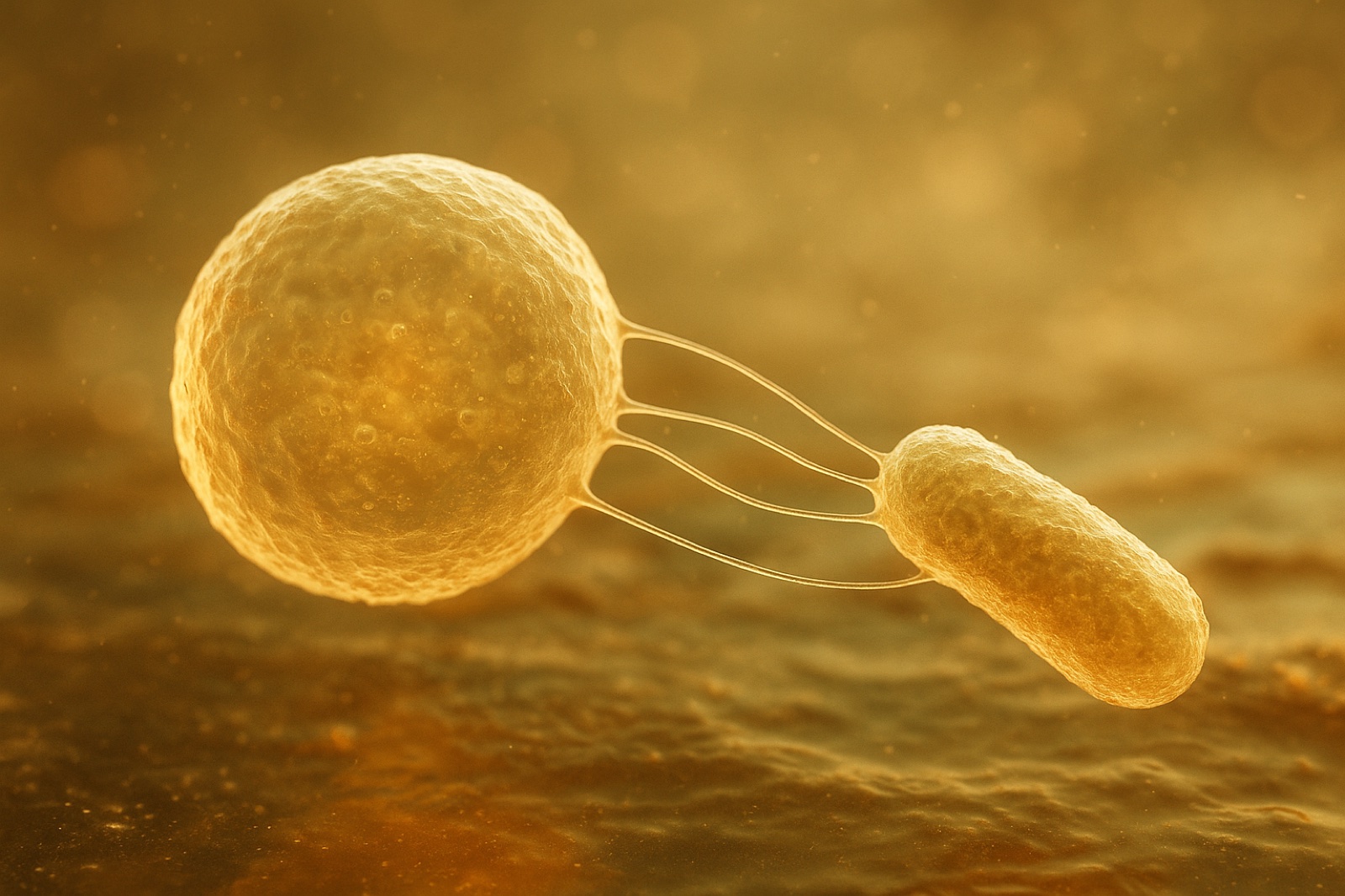
And it was not alone. In the images, the archaeon is physically joined to a sulphate-loving bacterium by nanotubes — connections so fine you need that freezing-and-imaging technique to see them at all. The two cells were passing things back and forth through those tubes. Each one was making compounds the other one needed, including vitamins, nutrients and hydrogen.
Then comes the detail that sticks. The team could never get either organism to grow on its own. Not once. As Burns put it, the reason they could never get these organisms into pure culture is probably that they always depend on other organisms to survive.
Not “grew better together.” Could not be separated and stay alive.
Why “one cell ate another” was never the whole story
Here is the honest version of what this does and does not prove, because the difference matters.
The long-standing idea is that complex cells began when an ancient archaeon and an ancient bacterium formed a very close partnership, and the bacterium eventually became the mitochondrion — the compartment that makes energy inside your cells right now. That idea has enormous support from comparing the genes of living things.
What the Shark Bay images show is a partnership happening today, between two modern microbes, in a setting that resembles very old ones. It is evidence that this kind of arrangement is real and workable. It is not a photograph of an event that happened around two billion years ago. Nobody has that photograph. Nobody has watched one cell take another one in and keep it.
What has now been photographed is not swallowing. It is reaching.
Two cells, still two cells, holding a line open between them.
Archaea and bacteria are two of the oldest and most separate branches on the tree of living things, which is part of why this pairing is so striking — we have written before about the strange finding that free-living cells may have appeared twice on the early Earth, once on each branch. If the numbers involved start to feel unreal, our free How Old Is the Universe? explorer is a good way to get a feel for how much time we are actually talking about.
The part of the story that usually gets left out
If the merger really was a conquest, you would expect the winner to have absorbed the loser — one set of instructions, one identity, the other one dissolved into it.
That is not what the genes say.
In 2026, a team of researchers published an analysis in the journal Nature asking where the core genes of the last common ancestor of all complex cells actually came from. Their answer: most of them trace back to the Asgard archaeal side. The bacterial partner’s contribution was real but narrow — mostly the systems that transform energy, plus one specialised piece of chemical machinery.
Read that again slowly. The partner that came inside did not take over. It also did not get erased. It kept one job, and it has been doing that job ever since.
And it kept something else. The mitochondria in your cells still carry their own DNA, separate from the DNA in the nucleus. After roughly two billion years of living inside someone else, that DNA is still there, still its own. A permanent guest that never stopped being distinct.
The researchers are careful about the limits of their own work, and it is worth being careful with them. Most Asgard genomes we have are incomplete, assembled from environmental samples rather than from organisms grown in a lab, and the sampling is uneven. They say plainly that this leaves real uncertainty in exactly how large the Asgard contribution was. The direction is clear. The precise size is not.
What this changes about needing people
Strip away the technical language and one thing keeps surfacing.
The cells that made complex life possible could not be grown apart. Their dependence was not a stage they were meant to pass through. It was the architecture.
Most of us were raised to think of needing as something you outgrow. You need people when you are small, and then, if things go well, you become self-sufficient. Needing someone starts to feel like an admission — a gap in your setup, a thing to manage quietly.
But nothing that is alive and complex has ever been self-contained. Not one thing. The whole category began with two separate things that could not manage alone, and it has kept the receipt ever since, tucked inside every cell you have.
The oldest stories people tell about how the world was made call almost everything in it good. The very first thing they call not good is a person being alone. Whatever you make of those stories, they and the microbes in Shark Bay are pointing in the same direction — that being made for each other is not a flaw in the design. It may be the design. It is worth noticing that when people who study this measure loneliness, feeling genuinely loved by God seems to do more for someone living alone than belief on its own does.
Then the microbes go back to trading hydrogen, and we can leave it there.
Back at the bay
There is one more small thing about this discovery that is easy to read past.
The name. Marumarumayae — “ancient home.” Borrowed from a language, with permission asked and given, from people whose ancestors have lived beside that water for a very long time. Two parties, neither absorbed into the other, something real handed across the gap between them.
Which is, more or less, the shape of the thing they found.
You are not a self-contained system. You never were. Nothing complex ever has been — and the evidence for that is not a slogan on a wall. It is sitting in the salty shallows of a bay in Western Australia, holding on with tubes too thin to see, and it is also sitting inside you, quietly, keeping its own name.
Questions people ask about this
What did scientists find in Shark Bay?
Researchers led by Associate Professor Brendan Burns at UNSW Sydney, with colleagues at the University of Technology Sydney and the University of Melbourne, found a previously unknown single-celled organism in the microbial mats of Shark Bay, Western Australia. They named it Nerearchaeum marumarumayae. Using electron cryotomography, they imaged it physically connected to a sulphate-loving bacterium by extremely fine tubes called nanotubes, through which the two appeared to exchange vitamins, nutrients and hydrogen. Neither organism could be grown separately in pure culture. The work was published in the journal Current Biology in 2026.
What are Asgard archaea?
Asgard archaea are a group of single-celled microbes that are the closest known relatives of the ancestors of eukaryotes — the type of cell that makes up all plants, animals, fungi and people. They are not bacteria; archaea are a separate ancient branch of life. Asgard archaea are studied closely because their genes include many systems previously thought to exist only in complex cells, which makes them the leading candidate for the kind of organism that gave rise to the eukaryotic lineage.
Did scientists watch one cell swallow another?
No. No one has observed or photographed the original merger that is thought to have produced the first complex cell around two billion years ago. The Shark Bay images show two modern microbes living side by side and connected by nanotubes, not one engulfing the other. Researchers describe it as a possible model for how such partnerships could begin, not as a recording of the event itself.
Why do mitochondria have their own DNA?
Mitochondria are widely understood to descend from a free-living bacterium that entered into a permanent partnership with an ancient host cell. They kept a small, separate genome of their own rather than handing everything over to the host cell’s nucleus. That leftover DNA is one of the strongest lines of evidence that mitochondria began as an independent organism, and it is why the mitochondrial genome is inherited differently from the rest of your DNA.
What is a nanotube between cells?
A nanotube is an extremely thin tube-like bridge that forms between two cells, allowing them to pass molecules directly to each other. They are far too small to see with an ordinary microscope, which is why the Shark Bay team used electron cryotomography — freezing the sample and imaging it at very high resolution — to observe them. In this case the nanotubes appeared to carry compounds each organism needed and could not make for itself.
One question worth sitting with
We tend to treat independence as the finish line and needing people as a phase. If the base layer of biology is built the other way round — two things that could never survive apart — should we be rethinking what we call strength? Tell us what you think in the comments; we read them.
If you want to pass this on
- Scientists finally photographed the partnership that may have started all complex life. It isn’t one cell eating another. It’s two cells holding on to each other with tubes, trading food — and neither can survive alone. https://bgodinspired.com/index.php/bible-resources/bible-and-science/how-complex-life-began-two-cells/
- The mitochondria in your cells still carry their own separate DNA, two billion years after moving in. Whatever happened back then, it wasn’t a takeover. Nothing complex has ever been self-contained: https://bgodinspired.com/index.php/bible-resources/bible-and-science/how-complex-life-began-two-cells/
- Two microbes in a salty Australian bay could never be grown apart. Not “did worse alone” — could not be kept alive alone. And they may be the closest thing we have to a picture of how complex life began. https://bgodinspired.com/index.php/bible-resources/bible-and-science/how-complex-life-began-two-cells/