 0
0
 0
0
At the end of August 2026, a robot the size of a small car quietly passed a number nobody planned for. NASA’s Curiosity rover finished its 5,000th day on Mars.
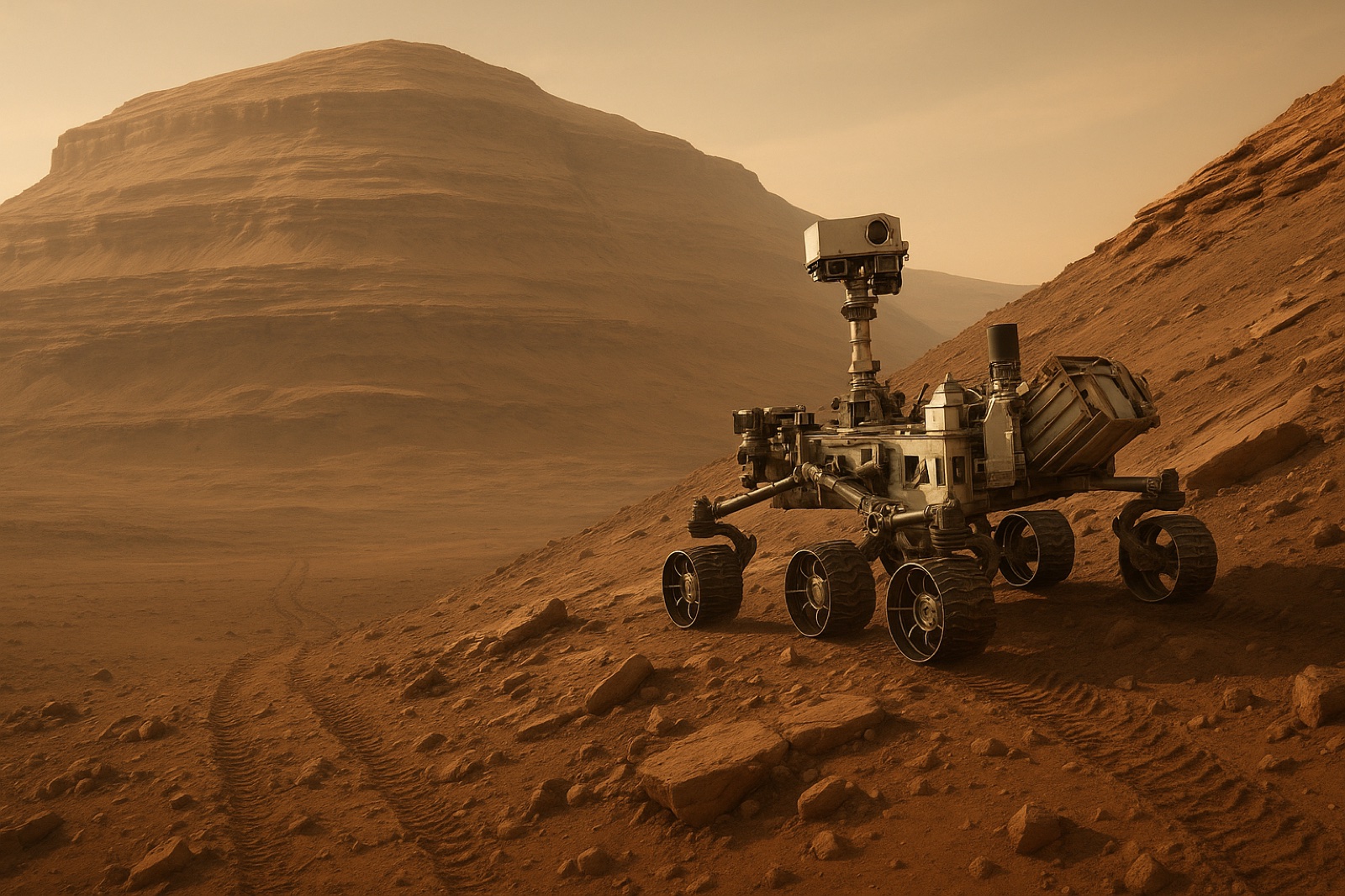
It was sent there for a job of about two years. It has now been working for more than fourteen. Its wheels have holes in them. It has no one to fix it. And it is still climbing the same mountain it started climbing years ago, a little higher at a time.
To mark the day, NASA sent home a kind of postcard. It is worth looking at closely, because it is not quite what it seems. Neither is the milestone.
Curiosity Rover: 5,000 Days on Mars
A “day” on Mars is called a sol. It is a little longer than a day on Earth, about 24 hours and 40 minutes. So 5,000 sols is more than 5,000 Earth days. NASA’s mission team puts it at more than 5,137 Earth days, which is more than fourteen years.
Curiosity left Earth in late 2011 and landed inside Gale Crater on August 6, 2012. Its main mission was planned to last one Mars year. That is 687 Earth days, a little under two years. It finished that job in June 2014.
Everything since then has been extra. Over the years it has driven roughly 37 kilometres (about 23 miles), mostly uphill. That does not sound like much for fourteen years. But this is a machine picking its way over sharp rock on another planet, with every move planned by a team on Earth millions of kilometres away. Speed was never the point.
If stories like this make you feel there is something more behind the ordinary world, this free guide was made for that feeling.
The Postcard Isn’t What It Looks Like
The picture NASA released for the milestone shows a wide sweep of Martian ground, washed in blue and gold. It looks almost like Earth. Some people online took the blue for water.
It is not water. The image is two black-and-white panoramas from the rover’s navigation cameras, stitched together. One was taken on the morning of sol 5,000. The other was taken on the evening of sol 5,003, from the same spot. NASA added the colour by hand: blue for the morning view, yellow for the evening one.
So the postcard is really a picture of time. Morning and evening, laid on top of each other, from a machine that has been standing on that planet through thousands of both.
Where was it standing? Next to a wind-built sand ridge the team nicknamed “Chocolatal.” Curiosity was there to study the grains in it, to see if sand this high up the mountain is made of the same stuff as the ridges it passed lower down. That is the kind of work it does. Patient. Close up. One ridge at a time.
Why Curiosity Is Still Climbing
Here is the part the milestone headlines mostly skipped.
Curiosity landed next to a huge mountain in the middle of Gale Crater. It is called Mount Sharp, and it rises about 5 kilometres (3 miles) above the crater floor. The mountain is built from layers of rock stacked on top of each other, like pages in a very thick book. The lowest layers were laid down first. The higher you go, the later in Mars’ history you are reading.
That means the rover’s slow climb is also a trip forward through time. Each step up the slope is a step into a later chapter of the planet’s story. Lower down, Curiosity found signs of an ancient lake whose water could once have supported tiny life, if any was there. Higher up, it has been reading how that wetter world changed.
In the same week it reached sol 5,000, the team reported a second milestone that got far less attention. Curiosity has now climbed more than 1 kilometre (about 0.62 miles) in height since it landed. The team compared it to an older Mars rover, Spirit, whose famous climb up a hill in 2005 gained about 106 metres. Curiosity’s climb is nearly ten times that.
None of it happened in one big push. It happened in short drives, long stops, careful measurements, and a great many days when it did not move far at all.
Worn Wheels, Same Work
Curiosity’s wheels are made of thin aluminium, to save weight on the trip to Mars. Within its first couple of years on the ground, the team noticed dents, holes and tears opening up in them. The sharp rocks were chewing through the metal much faster than expected.
They did not have a spare. There is no mechanic on Mars. So they changed how the rover drives instead. They plan routes around the worst rocks. They taught it new software to ease the pressure on its wheels as it climbs over stones. Photos from recent years show wheels with big gaps in them. It keeps rolling on them anyway.
It also does not run on sunlight. Curiosity carries a nuclear power source that turns heat into electricity, so dust storms cannot cover its power the way they can with solar panels. That is a big part of why it has lasted this long. But that power slowly weakens over time, so the team has to budget what it does each day more carefully than it once did.
When you feel worn out, it can be easy to believe you are only useful while everything works. Curiosity is a small, strange argument against that. Much of its best work has come after the damage showed up. If you are running low yourself, this piece on why emotional exhaustion needs rest more than once is worth a few minutes.
What 5,000 Ordinary Days Add Up To
Most of those 5,000 days would bore you. Park. Take pictures. Zap a rock with a laser to see what it is made of. Wait for orders. Drive a short way. Do it again.
Almost nobody remembers most of those days. People remember the landing in 2012. People will remember the day it finally stops. The days in between are the ones that actually climbed the mountain.
There is an old line of wisdom, far older than any rocket, that says not to grow tired of doing good, because the harvest comes in its own season for the one who does not give up. It has always been a strange promise, because it asks you to keep going before you can see any result. People who trust God have leaned on it for a very long time, through work that nobody noticed and years that felt like standing still. A rover on Mars cannot know what its small days add up to. But the people watching it can see that they add up to a mountain.
Your own ordinary days might be worth counting that way. It is a strange feeling to see the number. If you are curious, try the free How Many Days Have I Been Alive? calculator. Most of them looked a lot like sol 4,999. They still got you here.
There is a Finnish word, sisu, for the strength that turns up after you think you are done. Curiosity does not have feelings, but it does have a team who keep choosing to drive it one more day. At the milestone, they wrote that they are looking forward to “the next 5000 sols.”
That is not a bad way to look at tomorrow.
Sources: NASA’s Curiosity mission blog for sols 4995 to 5001, and reporting from ScienceDaily and EarthSky.
Questions People Ask About the Curiosity Rover
How long has the Curiosity rover been on Mars?
NASA’s Curiosity rover landed in Gale Crater on Mars on August 6, 2012. It passed 5,000 Martian days, called sols, at the end of August 2026. That is more than 5,137 Earth days, or more than fourteen years on Mars.
How long was the Curiosity rover supposed to last?
The Curiosity rover’s main mission was planned for one Mars year, which is 687 Earth days, or a little under two years. The rover completed that main mission in June 2014 and has kept working on extended missions ever since.
Is the Curiosity rover still working in 2026?
Yes. In 2026 the Curiosity rover is still working on the lower slopes of Mount Sharp, a mountain about 5 kilometres high inside Gale Crater on Mars. Around its 5,000th sol it was studying a wind-built sand ridge nicknamed Chocolatal, and NASA’s team reported it had climbed more than 1 kilometre in height since landing.
Why are there holes in the Curiosity rover’s wheels?
The Curiosity rover’s wheels are made of thin aluminium to save weight. Driving over sharp Martian rock slowly punctured and tore them, and the damage became clear within the rover’s first couple of years on Mars. NASA engineers responded by planning gentler routes and adding software that reduces stress on the wheels, and the rover has kept driving.
How is the Curiosity rover powered?
The Curiosity rover is powered by a radioisotope power system, which turns heat from decaying plutonium into electricity. Because it does not rely on solar panels, dust storms on Mars cannot block its power supply. Its power output slowly declines over the years, so the mission team plans each day’s activities within a tighter energy budget.
Discussion Question
Which do you think matters more in a long project: the big launch moment, or the thousands of ordinary days after it? Tell us what you think in the comments.
Share This
“NASA sent the Curiosity rover to Mars for about two years. It just passed 5,000 Martian days, on wheels with holes in them, and it is still climbing. https://bgodinspired.com/?p=117461”
“The blue in NASA’s new Mars ‘postcard’ is not water. It is morning and evening from the same spot, laid on top of each other. A picture of time from a rover that has seen 5,000 of both. https://bgodinspired.com/?p=117461”
“I did not expect a Mars rover to make me think about my own ordinary days. Most of Curiosity’s 5,000 sols were boring. They still climbed a mountain. https://bgodinspired.com/?p=117461”