 0
0
 0
0
For as long as engineers have been building things out of metal, they’ve been stuck with the same annoying trade-off. A metal can be strong, or a metal can be flexible. Rarely both.
Strong metals — the kind that can hold up an airplane engine or spin inside a jet turbine without snapping — tend to be brittle. Push them past their limit and they don’t bend. They shatter, all at once, like a dropped plate. Flexible metals bend just fine, but they give out under real pressure. For over a century, that’s just been the deal: pick one.
A team at Purdue University just broke that deal. And the way they did it is the strange part.
The Metal That Wasn’t Supposed to Work
The material in question is called cobalt-aluminum, or CoAl for short — two metals fused into a tightly ordered crystal structure. On paper, CoAl has always looked incredible. Lab tests going back years have shown it can handle enormous stress. The problem is that it’s what materials scientists call an intermetallic compound, and those are notoriously brittle. CoAl could take a hit, but it couldn’t take a bend. One overload and it would crack straight through, the same way a wine glass cracks instead of denting.
That brittleness has kept CoAl out of the very machines that could use it most — jet engines, gas turbines, the kind of high-heat, high-speed equipment where a strong-but-shatterproof metal would be a huge deal.
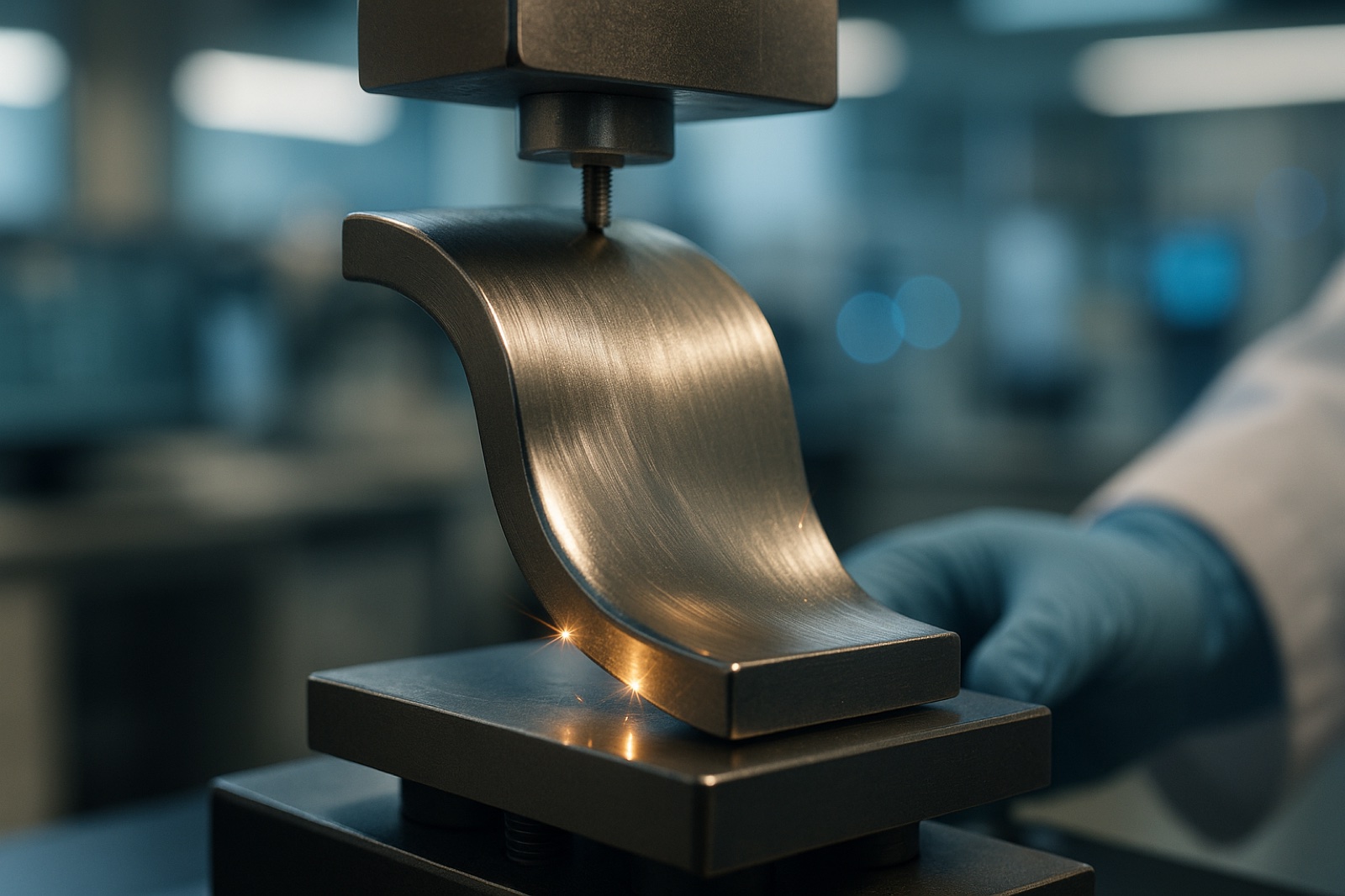
Led by researchers Xinghang Zhang, Haiyan Wang, and Ke Xu, with collaborators Yashashree Kulkarni and Anand Mathew at the University of Houston, the Purdue team set out to fix CoAl’s one weakness. Their results were published July 30 in the journal Science Advances — and the numbers are hard to believe. The alloy they built has a yield strength of about 6 gigapascals, roughly six to ten times higher than high-strength structural steel. And unlike earlier versions of CoAl, this one didn’t just hold — it visibly deformed under compression, absorbing 15% strain at room temperature without snapping in two.
They Didn’t Perfect the Metal. They Wrecked It — On Purpose
Here’s the part that surprises even people who aren’t into materials science. The team didn’t get this result by making CoAl more pure or more perfectly structured. They did the opposite.
Instead of casting the metal the traditional way — melting it down and pouring it into a mold — they built it up from vapor, atom by atom, using a process called magnetron sputtering. That gave them an unusual amount of control over the material’s internal structure. And with that control, they did something metallurgists don’t normally do on purpose: they introduced defects.
Specifically, they seeded the metal with dislocations — tiny places where the orderly rows of atoms are intentionally thrown out of alignment — while also building in what the researchers call a “framework of amorphous interfaces.” Those are flexible internal boundaries, pockets that aren’t locked into the rigid crystal pattern like the rest of the metal. Under stress, those boundaries partially reorganize themselves, which creates new dislocations on the spot and lets the whole structure absorb the pressure instead of cracking under it.
In plain terms: a “perfect” crystal has nowhere for stress to go, so it snaps. A crystal built with the right kind of internal give has somewhere to put that stress, so it holds — and keeps holding, even after it’s been pushed and reshaped.
The applications aren’t small. A metal this strong and this forgiving could reshape turbine blades, jet engines, energy storage systems, automotive parts, aerospace components, and defense technology. Researchers note that turbines built from the new alloy could spin faster and handle far higher centrifugal force without the catastrophic, all-at-once failure that has always been the risk with brittle metals. It’s the kind of quiet materials-science breakthrough that eventually shows up in things millions of people rely on without ever knowing why they got safer — the same way a 60-year-old diabetes drug turned out to be hiding a previously unknown control center in the human brain, discovered almost by accident once someone finally looked closely enough.
The Part Nobody Expected
What’s stayed with people who’ve read about this study isn’t really the gigapascals. It’s the method.
The instinct, if you wanted a metal to be stronger, would be to make it more flawless — tighter, cleaner, more perfectly ordered. That’s how strength usually works in the physical world. Instead, the fix here was to go looking for the right kind of imperfection and build it in on purpose, because a material with zero give has nowhere to absorb a hit, and a material with the right kind of give can take one and keep its shape.
This isn’t actually a new idea — people have been noticing some version of it for thousands of years, long before anyone had the equipment to sputter atoms into place. Ancient wisdom keeps coming back to the same observation: what looks like a crack or a weak point is sometimes the exact spot where something becomes able to hold far more than it could before. Not despite the flaw. Because of how the flaw was used.
It shows up outside the lab, too. The artist Betye Saar spent 70 years turning discarded, broken-down junkyard scraps into work that now hangs in major museums — objects other people had already written off as ruined, repurposed into something with more presence than they’d ever had whole. It’s the same underlying pattern the Purdue team found in a metal alloy: the “damaged” version turned out to be the strong one.
A Metal With Somewhere to Put the Pressure
None of this makes the last thing you went through feel good. A crack is still a crack while it’s happening. But there’s something worth sitting with in the fact that the strongest version of this metal isn’t the one with no flaws in it — it’s the one engineered with exactly the right flaws, placed where they could actually do something.
If you’ve ever wondered whether the parts of you that got reshaped by pressure were actually weaker for it, the materials science says: not necessarily. Sometimes that’s just what holding more looks like from the inside.
Purdue’s team is already looking at how to scale the process up for real manufacturing. The paper is out. The applications are coming. And somewhere, a jet engine or a turbine blade is going to be a little harder to break — because someone decided, on purpose, not to make it perfect.
Something to Think About
Do you think the moments that shaped you most were the smooth ones, or the ones that put you under real pressure? We’d genuinely like to know — tell us in the comments.
Share This
- “Scientists just made a metal 10x stronger than steel — by deliberately breaking it first, not by making it more perfect. Wild trade-off to solve. Read how they did it.“
- “The strongest version of this new metal alloy isn’t the flawless one. It’s the one engineers deliberately built flaws into. There’s something to that. Full story here.“
- “Purdue just published a metal alloy that’s up to 10x stronger than steel — and the trick wasn’t perfection, it was the right kind of imperfection, on purpose. Worth the read.“
Frequently Asked Questions
What is the new cobalt-aluminum alloy Purdue engineers created?
It’s a metal called CoAl (cobalt-aluminum), an intermetallic compound built by Purdue University’s School of Materials Engineering. Researchers used a process called magnetron sputtering to build the metal atom by atom from vapor, rather than casting it from molten metal, which let them precisely control its internal structure.
How much stronger is this new alloy than steel?
The new CoAl alloy has a yield strength of about 6 gigapascals, which researchers say is roughly six to ten times higher than high-strength structural steel. It also held up under 15% plastic strain (meaning it visibly bent and deformed) at room temperature without cracking, which is unusual for a metal this strong.
How did researchers make a brittle metal both strong and flexible?
Instead of trying to make the metal more perfectly ordered, the team deliberately introduced microscopic defects called dislocations, along with flexible internal boundaries they call a “framework of amorphous interfaces.” Under stress, those boundaries partially reorganize and create new dislocations on the spot, which lets the metal absorb pressure instead of shattering.
What will this new metal alloy be used for?
Researchers point to turbine blades, jet engines, gas turbines, energy storage systems, automotive parts, aerospace components, and defense technology as likely applications — anywhere a metal needs to handle extreme stress without failing catastrophically.
Who conducted this research and where was it published?
The study was led by Xinghang Zhang, Haiyan Wang, and Ke Xu at Purdue University’s School of Materials Engineering, with collaborators Yashashree Kulkarni and Anand Mathew from the University of Houston. It was published July 30, 2026, in the journal Science Advances.