 0
0
 0
0
You notice it in small moments first.
A name that used to come instantly now takes a beat too long. A parent who tells the same story twice in one visit, each time like it’s new. A grandfather who stops mid-sentence, looks at you, and you can see him searching for something that used to just be there.
Alzheimer’s is the disease more people say they fear than cancer. Not because of what it takes from the body — because of what it seems to take from the person while the body is still standing right in front of you. The particular cruelty of it is that the outside stays familiar even as the inside changes into something you don’t fully recognize anymore.
For a long time, scientists could describe that it happens. They couldn’t fully explain exactly how Alzheimer’s kills brain cells — the mechanics, cell by cell, at the level small enough to actually watch it occur. That gap just got smaller.
The Discovery Nobody Had a Name For
In late June 2026, researchers at King’s College London, publishing in Nature Communications, identified a process they didn’t have a name for before — so they gave it one: karyoptosis.
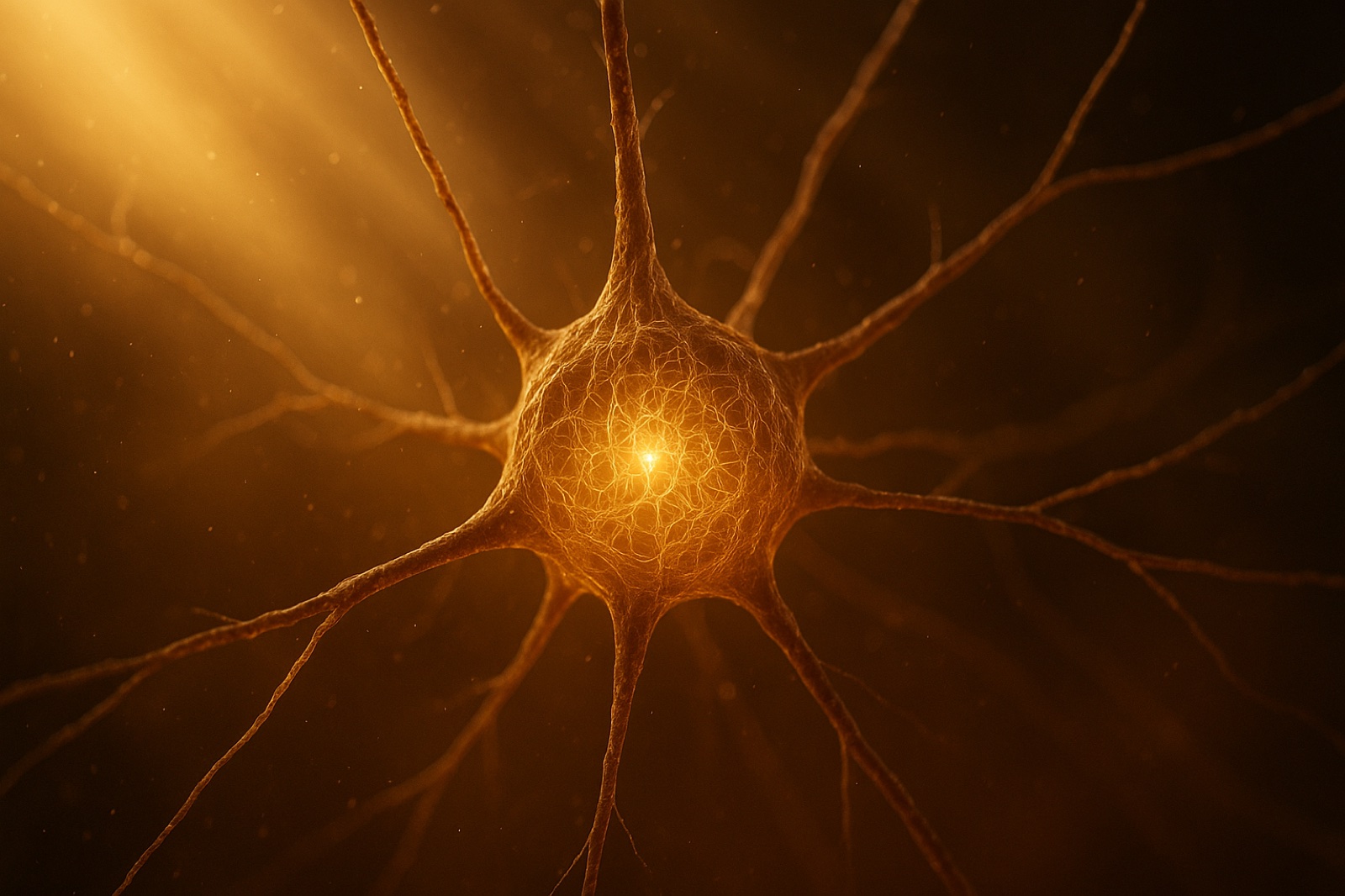
It describes something happening inside individual brain cells that nobody had isolated this precisely before. Every cell in your body has a nucleus — a protective membrane holding the cell’s DNA, its instructions, the part of the cell that makes it what it is. In healthy aging, that membrane stays intact. In the brains of Alzheimer’s and frontotemporal dementia patients, the researchers found something different: the membrane itself was shrinking and disintegrating, cell by cell, as toxic protein buildup destabilized it from the outside.
The numbers are stark. In the frontal cortex tissue researchers examined, 35% of cells in Alzheimer’s patients showed signs of this breakdown — compared to 15% in healthy aged brains. That’s more than double the rate, in the exact region of the brain responsible for judgment, personality, and the sense of who a person is.
What Karyoptosis Explains About Brain Cells in Alzheimer’s
This matters because it fills in a piece neuroscience has been missing. Researchers have known for years that neurons die in Alzheimer’s brains. What karyoptosis offers is a mechanism at the most fundamental level available — not just “the cell died,” but a specific, observable process of the cell’s own protective core failing under pressure, membrane by membrane.
It’s a finding that joins a growing body of research trying to understand brain resilience from the inside out. Other recent studies have looked at how some brains resist Alzheimer’s altogether by protecting their most vulnerable young neurons under the same hostile conditions, and a long-running study that tracked nearly 4,000 people into their 90s and found many of them getting cognitively sharper, not worse. The pattern across all of it: brain aging isn’t one uniform slide. It’s a collection of individual cellular stories, some of which end in protection, and some of which — as this new study shows — end in the nucleus itself giving way.
Researchers are already looking at karyoptosis as a potential treatment target — if the mechanism destabilizing the nuclear membrane can be identified early enough, it may be possible to intervene before the damage compounds. That’s the practical, hopeful edge of this discovery: a new, more precise thing to aim at.
But there’s another detail in this finding worth sitting with, separate from the treatment implications.
The Part That Doesn’t Show Up Under a Microscope
What karyoptosis describes, at its core, is an outward structure failing while something at the very center — the nucleus, literally the innermost part of the cell — is what actually breaks down first. The outside of the cell can look intact for a while. The real deterioration is happening inside, at the core, before it becomes visible everywhere else.
It’s worth noticing that someone described almost the exact opposite of that process, in writing, about the human person, nearly two thousand years before anyone could see a cell nucleus at all.
Writing to a struggling community in the ancient world, a man named Paul described two things happening in a person at the same time — one outward, one inward, moving in completely different directions. The outward part of a person, he wrote, is wasting away. But the inward part — the part no instrument of his time (or arguably ours) could locate or measure — is being renewed, day by day, even as the outward one fades.
He wasn’t writing about neuroscience. He didn’t have the vocabulary for a nucleus, let alone a membrane disintegrating under protein stress. But the shape of what he described — an outward decline paired with an inward process running in the opposite direction — is a structure that keeps showing up whenever people try to describe what a self actually is, and whether all of it is located in the tissue that eventually fails.
Nobody has to resolve that question to find it interesting. It’s simply there: the oldest description we have of a person is already assuming that whatever is happening on the outside isn’t the whole story of what’s happening on the inside.
What This Means for the Rest of Us
Watching someone you love lose pieces of themselves to Alzheimer’s is one of the loneliest kinds of grief there is, because the person is still there. You’re grieving someone while they’re still in the room.
This new research doesn’t undo that grief, and it doesn’t promise a cure. What it offers is something smaller and maybe still worth having: a more precise name for what’s happening, which is its own kind of comfort. Uncertainty is its own weight. Knowing the actual mechanism — even a hard one — is easier to carry than not knowing at all.
And for anyone sitting with a parent or a spouse whose outward self is changing faster than anyone wants, there’s an old idea worth having somewhere in the back of your mind: that whatever is failing on the outside was never assumed to be the entire person to begin with. Some part of what makes someone who they are may not be running on the same timeline as the tissue that’s struggling.
That’s not a scientific claim. It’s just an old observation that turned out, this month, to describe something science can finally see.
Discussion Question
This research suggests the visible, outward decline in a disease like Alzheimer’s may not be the full picture of what’s happening to a person. Do you think there’s a meaningful difference between what a disease does to someone’s body or brain and who that person still is underneath it? Share your take below.
Share This
“Scientists just named the exact mechanism that kills brain cells in Alzheimer’s — and it’s the precise opposite of something written about the human soul 2,000 years ago. Wild parallel: https://bgodinspired.com/index.php/bible-resources/bible-and-science/alzheimers-brain-cells-karyoptosis-discovery/”
“New research found the specific process (they’re calling it ‘karyoptosis’) that breaks down brain cells in Alzheimer’s. An ancient letter described the exact inverse happening in a person at the same time. https://bgodinspired.com/index.php/bible-resources/bible-and-science/alzheimers-brain-cells-karyoptosis-discovery/”
“Watching someone’s memory fade is one of the loneliest griefs there is. This new brain science — and a much older idea about what doesn’t fade — gave me something to sit with today: https://bgodinspired.com/index.php/bible-resources/bible-and-science/alzheimers-brain-cells-karyoptosis-discovery/”
Common Questions
What is karyoptosis?
Karyoptosis is a newly identified mechanism of brain cell death, described by King’s College London researchers in a June 2026 study published in Nature Communications. It refers to the protective membrane around a cell’s nucleus shrinking and disintegrating as toxic protein buildup destabilizes it — a process found significantly more often in the brains of Alzheimer’s and frontotemporal dementia patients.
How common is karyoptosis in Alzheimer’s brains?
In the frontal cortex tissue researchers examined, 35% of cells in Alzheimer’s patients showed signs of karyoptosis, compared to 15% in healthy aged brains without dementia — more than double the rate, in the region of the brain most associated with personality and judgment.
Does this discovery lead to a treatment for Alzheimer’s?
Not yet, but researchers see it as a promising treatment target. Because karyoptosis describes a specific, observable mechanism rather than general cell death, it gives scientists a more precise process to try to interrupt or slow — which is considered a meaningful step for future drug development.
Why are people connecting this discovery to an ancient religious text?
The new research describes an outward structure (the cell) failing while its innermost part (the nucleus) is what actually deteriorates first. Almost two thousand years ago, a man named Paul wrote about the opposite pattern in a person — an outward decline paired with an inward renewal happening at the same time. The parallel isn’t a scientific claim; it’s an observation people have found worth sitting with as this research becomes public.
What can someone do if a loved one is showing early signs of Alzheimer’s?
Early conversations with a doctor about memory changes remain the most important first step, since some causes of memory decline are treatable. Beyond the medical path, many people watching a loved one change find comfort in older ideas about identity and personhood — the sense that who someone is may not be fully defined by what a disease can measure or take.