0
0
 0
0
On the morning of June 19, 1865, Union soldiers arrived in Galveston, Texas with news that was already two and a half years old.
They read General Order No. 3 aloud — a short announcement by Union General Gordon Granger that all enslaved people in Texas were free. The Emancipation Proclamation had been signed by Abraham Lincoln on January 1, 1863. The Civil War had ended in April. But in the geographic and political isolation of Texas, the word had not arrived. Historians still debate exactly why the delay happened — whether it was geographic distance, deliberate suppression, or some combination of both. What is not debated is the fact that it did.
The freedom was real. The soldiers were just late with the news.
That moment — the announcement of a freedom already declared — became what Americans now call Juneteenth. It marks its 161st anniversary today, June 19, 2026, as a federal holiday, alongside the opening of the Obama Presidential Center in Chicago’s Jackson Park. Across the country, families will gather, history lessons will be shared, and one of the most significant moments in American history will be marked.
Most of the attention will go, rightly, to the injustice of the delay.
But Juneteenth carries a companion story that is much older than 1865. It is the story that enslaved Africans in America reached for long before the Galveston morning — the framework they found not because someone handed it to them, but because they recognized it. From inside their own suffering. From inside the same kind of waiting.
That companion story is older than the republic. Older than the transatlantic slave trade. Older than almost everything.
A People in a Foreign Land
The third chapter of Exodus opens with a scene in the wilderness. A man is tending sheep near a mountain. A bush is burning without being consumed. A voice comes from the fire and says something that would travel across three thousand years of human history and find a people in the American South who had been waiting for it:
“I have indeed seen the misery of my people in Egypt. I have heard them crying out because of their slave drivers, and I am concerned about their suffering. So I have come down to rescue them.”
The people described in that passage are enslaved in a foreign land. Their labor is extracted by force. Their cries have been rising for generations. And the God speaking those words describes himself in three specific ways: he sees. He hears. He enters.
Enslaved Africans in America did not discover this text through a missionary visit or a seminary lecture. They recognized it. The geography was different. The names were different. The centuries were different. But the shape of it — a people stripped of freedom in a foreign land, whose cries were rising, who needed to know someone above the suffering could hear — was not a metaphor they had to construct.
It was a mirror. And they had been looking at it for a long time before anyone thought to call the connection significant.
The Songs They Sang
The first evidence of this recognition is musical — and it is some of the most powerful music ever composed on American soil.
“Way down in Egypt land / Tell old Pharaoh / Let my people go.”
“Go Down Moses” was not written in a seminary library. It was composed and sung by enslaved men and women who were mapping their situation directly onto the Exodus narrative — not because someone told them the connection existed, but because they could see it without being told. The Israelites in bondage under Pharaoh. Moses as the voice of a God who had noticed the suffering. The demand for release in a world where no demand had any legal weight.
The other spirituals carried the same geography. “Swing Low Sweet Chariot” — the heavenly chariot that carried Elijah beyond the reach of his enemies. “Wade in the Water” — the passage through water that stood between bondage and freedom, a path a God had made before and might make again. Historians have documented that “Wade in the Water” served a practical purpose beyond worship: its instruction to move through running water was coded guidance for those escaping north, since moving streams would erase a fleeing person’s scent from pursuing trackers’ dogs.
These songs were not composed for white observers to hear on Sunday mornings. Many were sung late, in the quarters, in the only language fully available to people who had been legally denied access to literacy. The Exodus story had become their primary language for describing what was happening to them — because nothing in contemporary life fit as precisely. A people in bondage. A God on record as the one who heard. A promise of release that was real before it arrived.
The Woman They Called Moses
Harriet Tubman was born into slavery around 1822 in Dorchester County, Maryland. She escaped alone in 1849, traveling by night through the Eastern Shore to reach Philadelphia and freedom. Then she did something almost incomprehensible: she came back. Thirteen documented rescue missions along the Underground Railroad. Approximately 70 people led to freedom. Not a single passenger lost.
The enslaved community gave her a name.
They called her Moses.
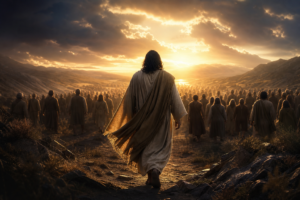
That title did not come from historians writing decades later, looking for a resonant comparison. It came from the people who were led out — from those who understood, through direct experience, that they were living inside the Exodus story. The woman walking ahead of them through the dark was Moses. The paths north through the wilderness were the same paths. The promised land was real and was north.
The name was theological before it was historical. It placed Harriet Tubman inside a narrative that said: someone like this appears. Someone hears the crying. Someone comes down. The people she led weren’t borrowing a metaphor. They were recognizing a pattern.
They were not alone in finding themselves woven into the biblical narrative across its full span — Simon of Cyrene, a North African man from what is now Libya, appears in the Gospels at one of the most significant moments in the story, called to carry a weight that was not his in a moment none of us would choose. The enslaved community understood something that careful readers of the text have always understood: people from Africa were never outside the biblical story. They were in it, across centuries and testaments, recognized or not.
What Frederick Douglass Read
Frederick Douglass was born into slavery in Maryland in 1818. He taught himself to read in secret, escaped at age 20, and became one of the most important voices in American history — abolitionist, orator, author, statesman, and U.S. Marshal. His writing is among the most carefully reasoned work of the 19th century.
Douglass returned repeatedly in his career to Exodus 3:7. Not as a proof text borrowed for rhetorical effect. As a description of his people that he found in the oldest layers of the text and recognized.
“I have indeed seen the misery of my people. I have heard them crying out. I am concerned about their suffering. I have come down to rescue them.”
Douglass read those words and recognized something that pre-dated any commentary on them: a God who did not observe from a safe distance. The God of Exodus is described with verbs. He sees. He hears. He is moved. He enters. This was not the God of the theology that told enslaved people to accept their station as divinely ordained — that particular theological position required ignoring Exodus 3 in order to maintain itself. Douglass knew the text. He knew what it said. And he knew what it meant that the God described in that text took a consistent position toward the suffering of people who cried out in bondage.
The thread runs through the prophets and into the New Testament: Isaiah’s announcement of “freedom for the captives and release from darkness for the prisoners” — the passage Jesus chose to read in the synagogue at Nazareth as the description of his own work. The enslaved community didn’t need a scholar to find the thread. They had already followed it.
The Gold Nugget
Here is what separates the Juneteenth-Exodus connection from all the ways religious texts have been applied to human suffering from the outside.
The enslaved community did not receive this connection from theologians who had surveyed their situation and decided the Exodus analogy was apt. They did not need a framework built by academics studying their experience from a comfortable distance. They recognized the story themselves, from inside their own experience, before liberation theology existed as an academic field, before anyone had written a commentary specifically tracing the connection.
When they sang “Go Down Moses,” they were not drawing on someone else’s interpretation of their situation. They were reporting what they could see directly. The shape of the Exodus story matched the shape of what they were living with a precision that required no translation. A people enslaved in a foreign land. Identity suppressed. Labor extracted. Cries rising. An ancient text, which they were legally forbidden to read, that said a God had noticed people in exactly this condition and had come down.
This self-recognition — not external application — is what gives the Juneteenth-Exodus connection its staying power across 160 years. The connection was not assigned to the enslaved community by well-meaning observers with access to libraries. It was claimed by them, from the inside, by people who were still inside the story when they made the claim.
That is the gold nugget that most coverage of this connection misses: the enslaved community did not need the Exodus applied to them. They applied it themselves. First. From within the experience. That is a different claim — and it is the true one.
The Galveston Moment, Revisited
The Hebrew Scriptures have a word for the kind of waiting that does not break a person — a form of endurance that contains strength rather than consuming it. The enslaved community in America was not simply waiting in silence. They were waiting with a story — a story that said freedom had come before, to people in exactly their condition, from a God who had put his position on record: he sees, he hears, and he enters.
That story did not make the suffering lighter. But it gave the suffering a shape. And it gave the waiting a name.
On June 19, 1865, in Galveston, Texas, the next verse of the story arrived.
The freedom had been declared since January 1, 1863. The soldiers arrived late with the delivery. And that gap — the space between the declaration and the announcement, between the promise and the arrival — is the space Juneteenth inhabits. It is not the celebration of a perfect or immediate arrival. It is the acknowledgment that freedom was declared, that it was waited for, and that it came.
The Exodus story had prepared them for exactly this: a freedom that is real before it is fully experienced. A promise that precedes its fulfillment. Forty years between Egypt and Canaan. Two and a half years between the Emancipation Proclamation and the soldiers in Galveston.
The freedom came. However delayed. It came.
What the Evidence Points Toward
There is something worth sitting with today, on the 161st anniversary of that Galveston morning.
The people who first recognized the Juneteenth-Exodus connection were not theologians looking for a useful illustration. They were people in the middle of their own Egypt — and they found in an ancient text a description of a God who was not abstract, not neutral, not watching from a comfortable position above the suffering. The text said he saw the misery. Heard the crying. Was moved by it. Came down.
That claim — if it is true — has implications that extend well beyond 1865. The particular longing in human beings for freedom, for arrival, for something that holds — is something the Exodus story speaks to directly, not as metaphor but as the account of what a specific God was on record as doing in a specific moment of human suffering.
The people who recognized that pattern first were the people most qualified to see it. They were in the story. They knew what it felt like to need exactly the God that text described. They sang about it in the dark, in the quarters, in language their captors couldn’t always decode. They named their leaders after it. They held it through decades of waiting.
And on June 19, 1865, in Galveston, Texas, the soldiers arrived with news of a freedom that had already been declared.
It was late. But it came.
If the God described in the Exodus account — the one who sees, hears, and enters — is one you want to explore more, the Beginner’s Guide to Feeling God’s Presence is a free resource built for exactly that first step. Not a theology course. A practical starting point for anyone who encountered something in this history and wants to follow the thread further. You can access it at bgodinspired.com/FeelingGod.
Three Things Worth Doing Today
- Listen to “Go Down Moses” today — the version by Mahalia Jackson, Louis Armstrong, or any recording you find. Listen to it knowing what you now know about who composed it, what they were saying, and why they were saying it. The song means something different on the other side of this history.
- Read Exodus 3:7-8 — just those two verses. Read them the way Frederick Douglass read them: as a description of a God who sees specific people in specific suffering and takes a position. Not as a religious exercise. As a historical document that millions of people found before you did, and recognized.
- Tell one person something you learned about Juneteenth today that they might not know. The history spread the same way the songs did — person to person, in the dark, long before it had a holiday or a name. That chain of telling is still the right method.
A Moment of Honesty
God — if You’re the one the oldest texts describe as looking into specific suffering and saying, “I have noticed” — I don’t need anything dramatic today. I just want to know the noticing is real. That people who waited in the dark and held onto that ancient story were not holding onto something empty. That would be enough.
What Do You Think?
Most people know that enslaved Americans connected deeply with the Exodus story — but did you know the connection was made by the enslaved community itself, from inside their own experience, before historians or theologians named it? Does that shift in framing change anything for you? I’d love to hear your take in the comments.
Share This If It Helped
For X (under 280 characters):
June 19, 1865: freedom arrived late. Enslaved Americans had already named it — they called their leaders Moses, sang about Egypt’s Pharaoh, and recognized the Exodus as their own story. Not because someone told them. Because they knew. https://bgodinspired.com/index.php/bgodinspired-news/juneteenth-exodus-story-bible-delayed-freedom/
For Facebook / LinkedIn:
The Juneteenth-Exodus connection is usually framed as a metaphor borrowed from the Bible. But that’s not what happened. The enslaved community recognized the Exodus as their own story — from inside their own experience — before anyone applied it to them from outside. Frederick Douglass read Exodus 3:7 and said: this is describing my people. Harriet Tubman was called Moses by the people she led — not by a historian decades later. That self-recognition is what makes the connection so powerful. Worth reading today. https://bgodinspired.com/index.php/bgodinspired-news/juneteenth-exodus-story-bible-delayed-freedom/
Short version:
They called her Moses. Not as a metaphor. Because they knew what story they were in. https://bgodinspired.com/index.php/bgodinspired-news/juneteenth-exodus-story-bible-delayed-freedom/ #Juneteenth
Common Questions About Juneteenth and the Exodus Story
What is the connection between Juneteenth and the Exodus story in the Bible?
Juneteenth marks June 19, 1865, when Union soldiers announced in Galveston, Texas that enslaved people were free — more than two years after the Emancipation Proclamation. The Exodus connection runs much deeper than most people know: enslaved Africans in America recognized the Exodus story as their own before historians or theologians named the connection. They sang “Go Down Moses” in the slave quarters, called Harriet Tubman “Moses,” and read Exodus 3:7 — “I have indeed seen the misery of my people” — as a description of their own situation. The connection was made from inside the experience, not applied from outside.
Why did enslaved Americans call Harriet Tubman “Moses”?
The title “Moses” was given to Harriet Tubman by the enslaved people she led north along the Underground Railroad — not by historians after the fact. The enslaved community recognized that they were living inside the same story as the Israelites in Egypt: a people in bondage, led through dangerous wilderness toward freedom by someone who had escaped and then came back. Tubman made thirteen documented rescue missions and led approximately 70 people to freedom. The community gave her the name because the pattern was unmistakable. This was theological recognition before it was historical comparison.
What does “Go Down Moses” mean and where does it come from?
“Go Down Moses” is one of the oldest Negro spirituals, composed and sung by enslaved Africans in America. Its central lyric — “Way down in Egypt land / Tell old Pharaoh / Let my people go” — maps the Exodus story directly onto the American slavery experience. The song was not composed in a church or seminary; it was sung in the slave quarters by people who recognized the biblical narrative as a description of their own condition. “Pharaoh” represented slaveholders. “Egypt land” represented the South. “Let my people go” was both a cry to God and a political statement the system couldn’t legally punish because it was framed as scripture.
What does the Exodus story say about God’s view of slavery and suffering?
Exodus 3:7-8 contains one of the most explicit statements in ancient literature about a deity’s position toward forced labor and suffering: “I have indeed seen the misery of my people in Egypt. I have heard them crying out because of their slave drivers, and I am concerned about their suffering. So I have come down to rescue them.” The God of the Exodus is described with active verbs — sees, hears, is moved, enters. This is the text Frederick Douglass identified as describing his own people, and it is the text that runs through the prophets and into the New Testament as the basis for the announcement of freedom for captives. The enslaved community in America recognized this consistent thread and held onto it.
Why is Juneteenth important beyond being a federal holiday?
Juneteenth is important because it captures something that goes beyond the political event of June 19, 1865: the experience of a freedom that was real before it was announced, and a people who waited for its arrival while holding onto a story that said it would come. That pattern — delayed freedom, sustained hope, eventual arrival — is embedded in the Exodus story that the enslaved community recognized as their own. Juneteenth honors not just the moment the soldiers arrived in Galveston, but the decades of waiting, the songs sung in the dark, and the people who held onto the story long before anyone arrived to confirm it.