 0
0
 0
0
There’s a moment most people know — the one where life hands you something you never signed up for.
Not the hard thing you chose. Not the difficult path you walked into with your eyes open. The other kind. The kind that just lands on you. A diagnosis. A phone call. A responsibility that appeared on your doorstep and stayed. A season you never saw coming, with weight you weren’t prepared to carry.
You didn’t raise your hand. You didn’t volunteer. But here it is, and it’s heavy, and you’re carrying it anyway.
Simon of Cyrene knows exactly what that feels like.
Who Was Simon of Cyrene Who Carried the Cross?
The story is told in less than one verse. Mark 15:21:
“They forced a certain man, Simon of Cyrene, the father of Alexander and Rufus, who was passing by on his way from the country, to carry his cross.”
One sentence. One man. One forced decision made by Roman soldiers that Simon had nothing to say about.
Let’s start with who Simon was.
He was from Cyrene — a city in what is now Libya, on the North African coast. Cyrene had a large and well-established Jewish diaspora community, settled there for centuries. Simon was almost certainly in Jerusalem for Passover — a pilgrim who had traveled from North Africa to the holy city for one of the most sacred weeks of the Jewish year.
He wasn’t a follower of Jesus. There’s nothing in the text to suggest he knew who this condemned man was, or what had been happening in Jerusalem over the past several days. Mark says he was “passing by on his way from the country” — the Greek word is agros, the fields, the outskirts. He was heading in toward the city, not away from it.
And then Roman soldiers stopped him.
The word used for what they did to Simon — angareú&omacron;, to conscript — was a legal term for a Roman military right: any occupying soldier could compel a non-citizen to carry a load for up to one mile. You couldn’t refuse. There was no appeal. You put it on your shoulders and you walked.
Interestingly, Jesus used a form of this same word in the Sermon on the Mount: “If anyone forces you to go one mile, go with them two” (Matthew 5:41). The word for forces is angareú&omacron; — the same kind of conscription Simon experienced. Jesus was describing something his listeners already knew from daily life under Roman occupation. And then, hours after saying it, one of his followers carried the cross he died on.
But Simon wasn’t a follower yet. He was a pilgrim from North Africa who was in the wrong place at the wrong time — or the right one, depending on what you know about what happened next.
This wasn’t an invitation. This wasn’t a spiritual moment he sought out. This was public humiliation at the hands of an occupying force. A Jewish pilgrim, a father, a man who had traveled hundreds of miles to worship at the temple — grabbed in the street and handed the execution instrument of a condemned man.
He didn’t choose this.
The Detail Mark Includes That Most People Read Right Past
Now here is the detail that changes everything.
Mark names Simon’s sons.
Matthew tells the Simon story. Luke tells it too. But only Mark says: the father of Alexander and Rufus.
In the ancient world, you didn’t name someone’s children in a written text unless your audience already knew them. Mark wasn’t writing a historical archive for readers two thousand years in the future. He was writing to a community — the early church in Rome, by most scholarly accounts — and he named Alexander and Rufus because the people receiving this letter already knew who they were.
They were part of the community.
Think carefully about what that means. Mark’s Gospel was written in the early 60s AD — roughly thirty years after the crucifixion. By that point, Alexander and Rufus were not just remembered names from a strange day in Jerusalem. They were known. Present. Named without explanation because no explanation was needed.
Simon of Cyrene’s sons became followers of Jesus.
A man was pulled from a crowd and forced to carry a cross. Three decades later, his sons are named in the founding text of Christianity — named because the community reading it already knew them.
That is not a small detail.
What Paul Writes in Romans, and What It Confirms
But the story doesn’t stop with Mark.
Paul’s letter to the Romans, chapter 16, verse 13:
“Greet Rufus, chosen in the Lord, and his mother, who has been a mother to me, too.”
Paul calls Rufus chosen in the Lord — not a casual descriptor. He singles him out by name in a letter addressed to an entire church.
And then Paul says something that stops you if you’re paying attention: Simon’s wife had become, at some point in Paul’s life, a mother figure to him. She was present in Paul’s life the way a mother is present — providing care, shelter, presence, the kind of support that earns a name in a letter. The wife of the man who was grabbed from a crowd and conscripted to carry a condemned man’s cross became significant enough to the apostle Paul that he calls her out in Romans 16.
The whole family was transformed by a moment Simon never chose.
Let that settle for a moment. Not just one son — both sons, named in Mark. The wife, named in Paul. A man forced to carry the cross of someone he may not have even recognized had an entire family whose trajectory changed because of a road he was dragged onto against his will.
The Pattern in the Evidence
Pause here.
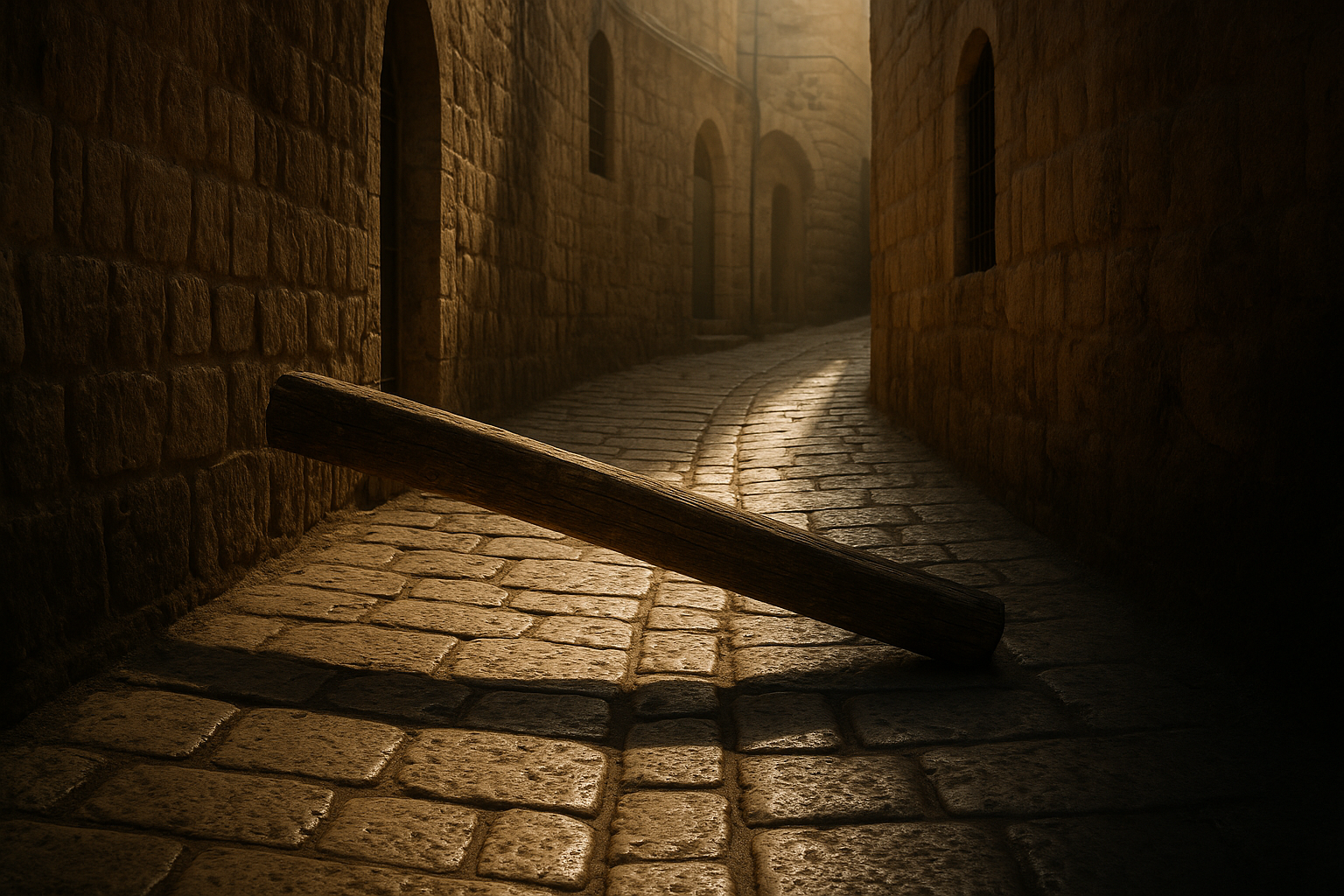
Simon didn’t volunteer. He was conscripted. The cross was placed on his shoulders by soldiers, not by faith. He didn’t kneel down and ask God what he was supposed to learn from this. He didn’t have a devotional moment at the side of the Via Dolorosa. He picked up the weight because he had no other option.
We don’t know exactly what Simon experienced on that road. We don’t know what he saw at the foot of the cross, or whether he stayed until the end, or whether he walked back to his lodging in silence trying to make sense of what had just happened. The text doesn’t tell us. What the text does tell us — if you read the whole thing carefully across two different books of the New Testament — is what happened after.
His sons were in the early church. Named without explanation because the community already knew them.
His wife was a pillar in Paul’s life. Present enough, significant enough, that she earns a line in a letter to Rome.
The thing Simon was forced to carry appears to have carried him somewhere. And it carried his family somewhere too.
That is not a metaphor layered over a story to make it more inspiring. That is the historical record. A man was seized from a crowd, handed something terrible, and required to walk with it. Thirty years later, his sons are named in the Gospel that carries the story. His wife has a relationship with Paul deep enough to be called a mother.
The unchosen burden became the doorway.
Not because Simon made it one. Not because he had the right attitude about it. Not because he found meaning in it in the moment. But because something happened on that road — something Simon couldn’t have predicted and didn’t initiate — that opened a door his family walked through for the rest of their lives.
You Don’t Know Where It’s Going Yet
This is for the person carrying something they never asked for.
You don’t have to perform acceptance of it. You don’t have to find the meaning while you’re still in the middle of it. Simon didn’t know what that road would mean. He just walked it.
Nothing said here is intended to wrap a bow on pain you’re actually carrying. Unchosen burdens are real burdens. The weight is real weight. The humiliation of having something placed on you that you didn’t choose is real humiliation. The story doesn’t skip over any of that — Simon was conscripted, not invited. His moment was public and hard and not particularly dignified.
But here’s what the evidence keeps showing: the most transformative moments in this story were not the ones Simon chose.
The thing he was grabbed and handed became the thing his sons built their lives around.
You’re not Simon. Your situation is not his situation. But if you’re carrying something today that you never would have have chosen — a role, a circumstance, a weight someone else placed on your shoulders — you don’t know yet what it’s making you into. You don’t know who’s watching. You don’t know what it will mean for the people closest to you. You can’t see the whole road from where you’re standing.
Simon couldn’t either.
And in Romans 16, his wife is being greeted by Paul as a mother.
The gold nugget in this story isn’t a platitude. It’s an observation from the record: He was forced to carry a cross. His sons chose to carry a faith.
Whatever you’re carrying that you didn’t sign up for — you don’t know yet where it’s going. The road Simon was dragged onto had a destination he never could have seen from the moment of conscription. The weight might be going somewhere.
Three Things You Can Do With This Today
- Name it. Write down the thing you’re carrying right now that you didn’t choose. Not to analyze it, not to find the silver lining — just to name it honestly. There’s something true about saying: I didn’t ask for this. I’m carrying it anyway.
- Read Romans 16:13 today. Slowly. Paul is greeting people he loves in a church in Rome, and one of them is the son of the man who carried the cross. His mother is there too — present enough that Paul calls her his own. That community was real. Those people were real. Let that land.
- If you know someone carrying something they didn’t choose — say it out loud to them. You don’t have to fix it. Just witness it. Simon had someone walking in front of him on that road. You can be that for someone today in a way that costs you almost nothing but might matter more than you know.
A Few Questions Worth Sitting With
If you want to go deeper:
- What are you carrying right now that you never would have chosen? Have you named it honestly — to yourself, or to God — or have you been moving through it without stopping to acknowledge the weight?
- Looking back: is there a hard season you endured, not by choice, that changed you — or someone close to you — in ways you couldn’t have predicted at the time? What did that season open that might not have opened otherwise?
A Prayer for What You’re Carrying
God, there’s something on my shoulders that I never asked for. I’m not pretending it feels light or that I understand where it’s going. But I’m asking you to be in it with me — the way you were somehow in that road with Simon, though he couldn’t have known it. I don’t need to see the whole picture. I just need to know you’re somewhere in this weight. Whatever it’s making, whatever it’s opening that I can’t see yet — I’m trusting you with that. Amen.
If you want to spend thirty days walking more closely with Jesus — through his actual words, his actual life, and what that changes about the way you live yours — 30 Days Walking with Jesus is worth the time. It’s a daily practice built for the person who wants more than occasional contact.
What Do You Think?
Do you think the most significant moments in a person’s life tend to be the ones they chose — or the ones they didn’t? Share your thoughts in the comments below.
Frequently Asked Questions About Simon of Cyrene
Who was Simon of Cyrene?
Simon of Cyrene was a Jewish man from Cyrene (modern-day Libya) who was in Jerusalem, likely for the Passover festival, when Roman soldiers forced him to carry Jesus’ cross to the crucifixion site. His story is recorded in Matthew 27:32, Mark 15:21, and Luke 23:26. He was not a known follower of Jesus at the time — he was simply a pilgrim who was conscripted by Roman soldiers as they passed him in the street.
Why does Mark name Simon of Cyrene’s sons, Alexander and Rufus?
In the ancient world, naming someone’s children in a written text carried a specific social meaning: the audience already knew them. Mark wrote primarily to the early church in Rome, and he named Alexander and Rufus without explanation because the community reading his Gospel recognized those names. They were members of the early church — which tells us that Simon’s sons became believers, likely as a result of what their father experienced on that road.
Is the Rufus in Romans 16:13 the same person as Simon of Cyrene’s son?
Most scholars believe so, though it cannot be proven with certainty. Paul’s letter to the Romans was written to the church in Rome — the same community most scholars identify as Mark’s audience. Paul calls Rufus ‘chosen in the Lord’ and describes his mother as a woman who had been a mother figure to Paul himself. This level of personal familiarity suggests she was a woman of significant presence in the early church — consistent with the family of a man whose story was woven into the foundational Gospel.
What does angareúō mean, and why does it matter for Simon’s story?
Angareúō is the Greek word for Roman military conscription — the legal right of an occupying soldier to compel any non-citizen to carry a load for up to one mile. Simon was not asked. He was legally conscripted. What makes this word especially meaningful is that Jesus used it in the Sermon on the Mount — ‘If anyone forces you to go one mile, go with them two’ (Matthew 5:41). The word Jesus used for ‘forces’ is angareúō — the same kind of forced conscription that Simon experienced on the road to Calvary.
What can we learn from Simon of Cyrene carrying the cross?
The most striking thing about Simon’s story is that the most significant moment of his life — and apparently his family’s life — was not one he chose. He was conscripted. He didn’t volunteer, didn’t seek it out, and didn’t understand what he was being pulled into. And yet the historical record suggests that what he carried on that road opened a door that changed his family’s entire trajectory. His sons became early Christians, named in the Gospels. His wife became a meaningful figure to Paul. Sometimes the most transformative moments aren’t the ones we walk into by choice.