 0
0
 0
0
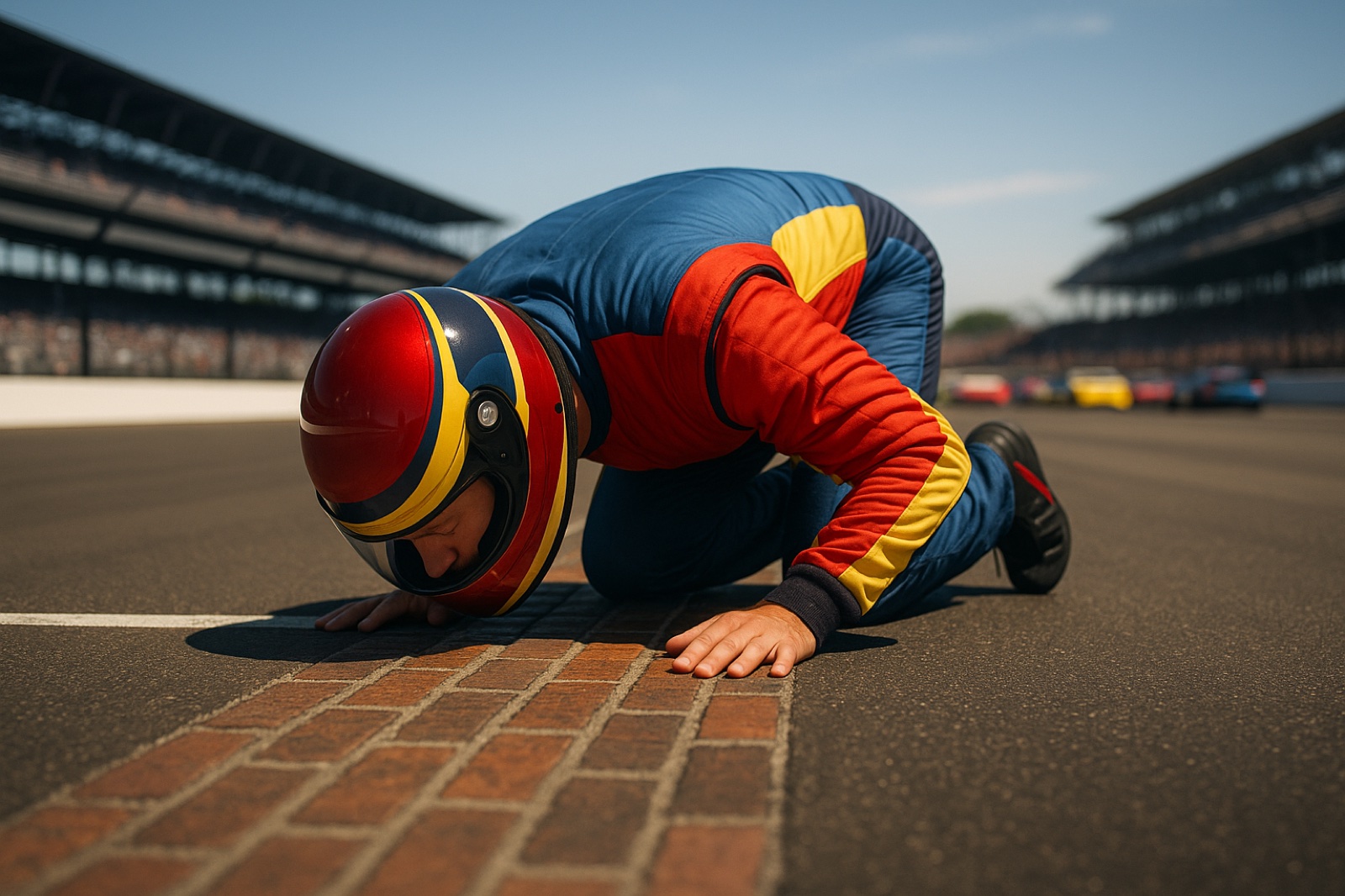
Sunday afternoon at Indianapolis Motor Speedway, somebody is going to win the Brickyard 400 — and the very first thing they do afterward won’t be spraying champagne or waving to the crowd. It’ll be getting down on their knees, in a firesuit, on national television, to kiss the bricks.
Not the whole track. Just one specific strip: a 36-inch-wide band of the original 1909 brick surface, preserved at the start/finish line and left exposed while the rest of the 2.5-mile oval was paved over in asphalt decades ago. Everyone in racing calls it the Yard of Bricks. And for nearly thirty years now, it’s been tradition — Indy 500 winners do it, Brickyard 400 winners do it, sports car winners do it — kneel down, plant a kiss on 116-year-old clay, stand back up.
It looks a little strange if you’ve never seen it before. Grown adults, some of the fastest and most competitive people alive, treating a strip of brick like it’s sacred ground. So why do they do it?
The Yard of Bricks: Indianapolis’s Strangest Tradition
Indianapolis Motor Speedway opened in 1909 as a crushed-stone-and-tar track, and it was a disaster — the surface broke apart almost immediately, and cars crashed. So the owners tore it out and rebuilt the entire oval with 3.2 million paving bricks, laid by hand, packed tight in sand and mortar. It worked. It held. For decades, “The Brickyard” wasn’t a nickname — it was a literal description of the track’s surface.
Racing has never fully outrun the danger that first rebuild was meant to solve — even with modern safety technology, the sport has produced some of the most harrowing crashes in motorsport history. But the bricks themselves stayed exactly as they were built, one of the few constants in a sport built on speed and change.
Asphalt eventually replaced most of the bricks for safety and smoothness, patch by patch, until by 1961 the entire track was paved over — except for one three-foot strip at the start/finish line, left exposed on purpose. It’s the same brick a car crossed under in the speedway’s earliest years. It hasn’t moved since.
Why NASCAR Drivers Kiss the Bricks
The kissing tradition itself is younger than the bricks by almost ninety years. In 1996, NASCAR driver Dale Jarrett won the very first Brickyard 400, and his crew chief, Todd Parrott, suggested they get down and kiss the bricks in celebration — half joke, half tribute to the track’s history. It stuck. Now it’s not written into any rulebook, but it’s expected. It’s part of what winning at Indianapolis means.
Here’s the part worth sitting with: a trophy is portable. A checkered flag is portable. A winner’s purse is very portable. But the bricks stay exactly where they are, and every driver who wants to honor a win there has to go to them. You can’t take the moment home in your hands — you have to physically kneel down inside it.
Psychologists who study memory and ritual point out that humans don’t actually trust memory very much — not our own, and not each other’s. Stories get retold, details drift, and eventually “I won at Indy” is just a sentence in a record book next to a hundred other sentences. But a physical object — something you can touch, something that’s still there decades later exactly where it always was — carries a different kind of weight. It doesn’t ask to be believed. It’s just there. You can go put your hand on it.
An Old Instinct, Older Than Racing
Humans have been doing some version of this for a very long time — long before anyone paved a speedway. Ancient wisdom is full of moments where people stopped after something enormous happened to them and built something physical to mark it: a pile of stones on a riverbank, a name carved into rock, a monument raised at the exact spot a crossing was made. The Bible itself tells one such story — a river crossing so significant that the people were told to gather stones from the riverbed and stack them into a monument on the bank, specifically so that generations later, a child who’d never seen the crossing could point at the stones and ask what they meant — and get the whole story in return.
The instinct was never really about the stones. It was about making sure memory had a place to live, somewhere sturdier than a story that gets a little different every time it’s told.
That’s the same instinct at Indianapolis. Nobody needs a brick to prove a race happened; the record books already do that. But a body needs a place to kneel. Gratitude, it turns out, wants a location — a physical spot where you stop, get low, and let something bigger than the achievement itself sink in for a second before the moment moves on. It’s the same pull that draws fans back, year after year, to honor the drivers the sport has lost — some things aren’t meant to just be remembered in passing. They’re meant to be visited.
What the Bricks Are Really Asking
You probably don’t have a Yard of Bricks in your own life. But you likely have something like it, if you look — a hospital hallway, a kitchen table, a mile marker on a road you drove a thousand times during a hard year. Most people walk past those places without stopping. The ones who don’t — the ones who pause, even for a second, to acknowledge what happened there — tend to carry their gratitude further than the ones who just keep moving.
Sunday, someone is going to win a race and immediately drop to their knees to kiss a piece of 116-year-old clay in front of the whole world. It’ll look a little silly to anyone who doesn’t know the history. But it’s really just an old, good instinct wearing a firesuit: some moments deserve more than a memory. They deserve a place you can go back to.
A Question Worth Sitting With
Is there a “Yard of Bricks” somewhere in your own life — a specific place tied to a moment you’re genuinely grateful for? What would it take to actually go back and stand in it, instead of just remembering it in passing? Tell us in the comments.
Share This
- “Every Brickyard 400 winner kneels down and kisses a 116-year-old strip of brick before they do anything else. There’s a reason that hits different than raising a trophy.”
- “NASCAR’s ‘kiss the bricks’ tradition started as a joke in 1996. Almost 30 years later, it’s the most sincere five seconds of the whole race. Here’s why a piece of old pavement means more than the win itself.”
- “Gratitude wants a location. That’s basically what NASCAR’s kissing-the-bricks tradition has been trying to tell us for almost 30 years.”
Quick Questions About the Yard of Bricks
What is the Yard of Bricks at Indianapolis Motor Speedway?
The Yard of Bricks is a 36-inch-wide strip of the track’s original 1909 brick paving surface, preserved and left exposed at the start/finish line even after the rest of the 2.5-mile oval was paved over with asphalt by 1961.
Why do NASCAR drivers kiss the bricks at Indianapolis?
The tradition began in 1996 when Dale Jarrett won the first Brickyard 400 and, at the suggestion of his crew chief Todd Parrott, knelt down and kissed the bricks in celebration. It caught on and is now an expected tradition for winners across NASCAR, IndyCar, and IMSA sports car races held at the speedway.
How many bricks were originally used to pave Indianapolis Motor Speedway?
The speedway was repaved with 3.2 million bricks in 1909, after the original crushed-stone-and-tar surface proved dangerous in the track’s opening race weekend.
When is the Brickyard 400 in 2026?
The Brickyard 400 at Indianapolis Motor Speedway runs this Sunday, July 26, 2026.
Why do people build physical monuments to remember important moments?
Human memory fades and stories drift with retelling, but a physical object or place — something that can be touched and returned to — carries a kind of permanence that memory alone doesn’t. That’s why ancient traditions and modern rituals alike often mark meaningful events with something solid: a stone, a marker, a strip of brick.