 0
0
 0
0
For nearly 60 years, almost every serious search for alien life has listened to the same tiny sliver of the radio spectrum. It’s called the “water hole” — a narrow band between 1.42 and 1.66 gigahertz, sitting between the frequencies where hydrogen and hydroxyl naturally emit signals. Astronomers picked it decades ago for a good reason: it’s quiet, it’s a logical meeting point for any civilization doing the math, and it became the default. So default, in fact, that almost nobody checked anywhere else.
Louisa Mason wanted to know what happens if you do.
The Frequency Nobody Was Listening To
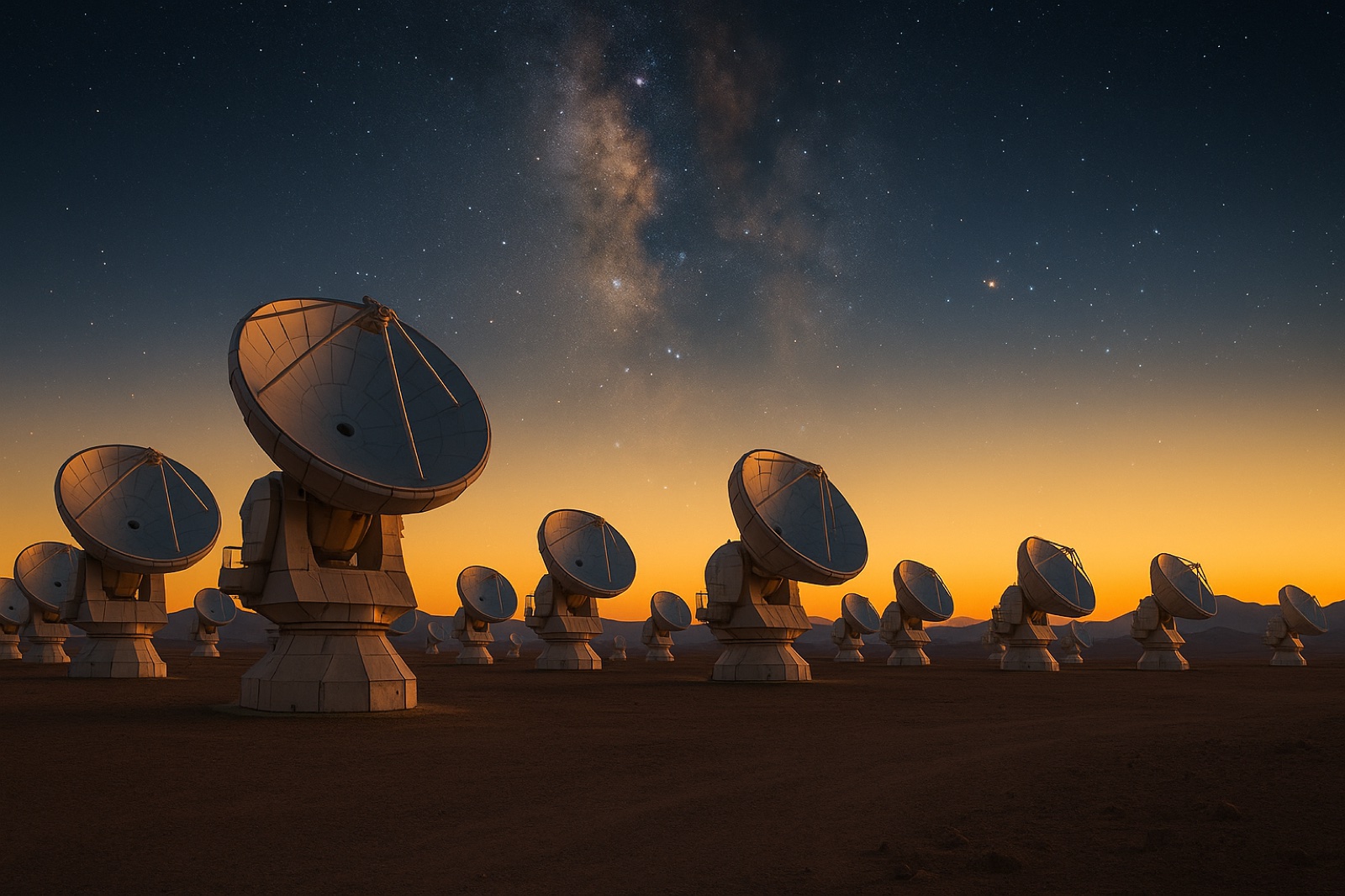
Mason, a PhD researcher at the University of Manchester, presented her findings this July at the Royal Astronomical Society’s National Astronomy Meeting in Birmingham. Her project used ALMA — the Atacama Large Millimeter/submillimeter Array, a set of radio dishes spread across the high desert plateau of northern Chile — to search two narrow ranges inside a completely different part of the spectrum: the millimeter and submillimeter bands, well above where SETI has traditionally looked.
“The millimeter and submillimeter radio bands remain almost completely unexplored for SETI,” Mason said. It’s a strange thing to say about a search that’s been running, in one form or another, since 1960. But it’s true. For six decades, the overwhelming majority of alien-signal searches have functionally been looking through one keyhole, in one direction, at one narrow slice of what’s technically possible to detect.
That’s not a criticism of the scientists who came before her. The water hole was a smart bet with limited telescope time. But a smart bet is still a bet — and nobody had gotten around to checking what else might be out there until Mason pulled four archived ALMA observations and pointed them at a question almost no one had asked.
The Search Was Bigger Than Anyone Realized
Here’s where the story gets genuinely strange. Mason didn’t just search a new frequency — she also discovered that the searches everyone already trusted had been undercounting, badly, what they’d actually covered.
Using something called the Besançon Galactic Model, Mason’s team re-examined 1,327 earlier telescope pointings to count how many stars had actually passed through the observing beam — not just the stars catalogued nearby, but every star that happened to sit in the telescope’s field of view, whether or not anyone had bothered to log it. The old estimate, based on the Gaia star catalog, put the number at roughly 288,000 stars searched. The real number, once you counted every star actually inside the beam, was over 6.1 million.
That’s not a rounding error. That’s twenty times more stars than the official record showed — sitting there the entire time, inside data astronomers already had, simply never counted. It’s not the first time science has found something that was always in the frame — just never in the part of the frame anyone thought to look at.
The millimeter survey itself turned up no candidate signals — no technosignatures crossed the detection threshold in this round. Mason and her collaborators, including Michael Garrett, Andrew Siemion, and Kelvin Wandia, are clear that this isn’t a discovery. It’s a correction. A whole frequency range, and millions of stars inside it, had simply never been asked the question.
Six Million Stars and an Old Story About Listening Wrong
There’s something in this that reaches further back than radio astronomy. Long before anyone built a telescope, there’s an old story about a man who went looking for God in exactly the way you’d expect — in the loud, unmistakable places. He waited for a windstorm strong enough to tear apart mountains. Nothing. He waited through an earthquake. Still nothing. He waited through a fire. Nothing there either. And then, after all the places he was sure God would be, something quieter arrived — a voice so soft it’s often translated simply as a whisper — in the one place he hadn’t thought to listen.
It’s a strange kind of comfort, six decades and one enormous star-count later, to realize scientists have been running into a version of the same lesson. Not that God is hiding in a frequency band. Just that the loudest, most obvious place to look is rarely the only place worth checking — and sometimes the real signal, if it’s there at all, has been waiting in the quiet range the whole time. People have been asking some version of “how would I even know if I heard it” for a very long time — long before anyone had a radio telescope to ask it with.
What This Doesn’t Prove — and What It Might
To be clear: no one found aliens. No one found God in a spreadsheet. What Mason’s work actually proves is narrower and, in its own way, more interesting — that the tools we already trust can be undercounting the very thing we’re searching for, simply because we assumed we already knew where to point them.
Silence in a search has always been easy to mistake for an answer. Sixty years of quiet on the water hole frequency felt, to a lot of people, like evidence of something — maybe that we’re alone, maybe that the whole search was misguided. It might just have meant the search was aimed at one small window out of many. The universe didn’t get any quieter this July. It just got twenty times bigger, and a little more honest about how much of it we hadn’t actually checked yet.
Mason isn’t finished. Millimeter and submillimeter SETI is, by her own account, barely started — four observations, out of what could eventually be thousands. If there’s a signal out there, in any sense of the word, the odds of catching it just went up, simply because someone finally thought to check a frequency everyone else had walked past.
Discussion Question
If sixty years of searching one narrow frequency band turned out to be missing twenty times more territory than anyone realized — where else in life do you think we’ve been listening in the wrong place, just because it’s the place everyone always looks first?
Share This
- Scientists just found out a 60-year alien search was quietly undercounting its own results by 20x. We weren’t looking in the wrong place — we just weren’t looking everywhere. 👀🔭
- For six decades, SETI checked almost one radio frequency. A new survey checked a different one — and it turns out the “quiet” data already had 6 million more stars in it than anyone counted. Wild.
- New research: a SETI team re-checked old telescope data and found 20x more stars in the frame than the official count said. Sometimes the answer isn’t missing. It’s just outside where we were looking.
Questions People Are Asking
What is the “water hole” frequency in SETI research?
The water hole is the radio frequency range between 1.42 and 1.66 gigahertz, sitting between the natural emission frequencies of hydrogen and hydroxyl. Since the 1970s, it’s been the default range most SETI (Search for Extraterrestrial Intelligence) surveys have searched for alien signals, because it’s a relatively quiet part of the spectrum and a logical meeting point any civilization doing similar math might also choose.
What did Louisa Mason’s new SETI survey actually search?
Louisa Mason, a PhD researcher at the University of Manchester, used the ALMA telescope array in Chile to search two narrow ranges within the millimeter and submillimeter radio bands — frequencies well above the traditional water hole range that most SETI research has focused on for decades. She presented the findings at the Royal Astronomical Society’s National Astronomy Meeting in July 2026.
Did the new SETI survey find any signs of alien life?
No. The survey found no candidate technosignatures above its detection threshold. The significance of the study isn’t a discovery of alien signals — it’s the discovery that an entire frequency range had gone almost completely unexplored, and that earlier survey data had significantly undercounted how many stars were actually being searched.
How many stars were actually included in the SETI search?
Using the Besançon Galactic Model to re-examine 1,327 earlier telescope pointings, Mason’s team found that the observations actually covered more than 6.1 million stars — far more than the roughly 288,000 stars previously estimated using the Gaia star catalog alone.
What is ALMA and why was it used for this search?
ALMA, the Atacama Large Millimeter/submillimeter Array, is a set of radio telescope dishes located in the Atacama Desert of northern Chile. It’s built to observe millimeter and submillimeter wavelengths — the same range Mason’s team searched for potential alien signals, using existing archived observations rather than new dedicated search time.