 0
0
 0
0
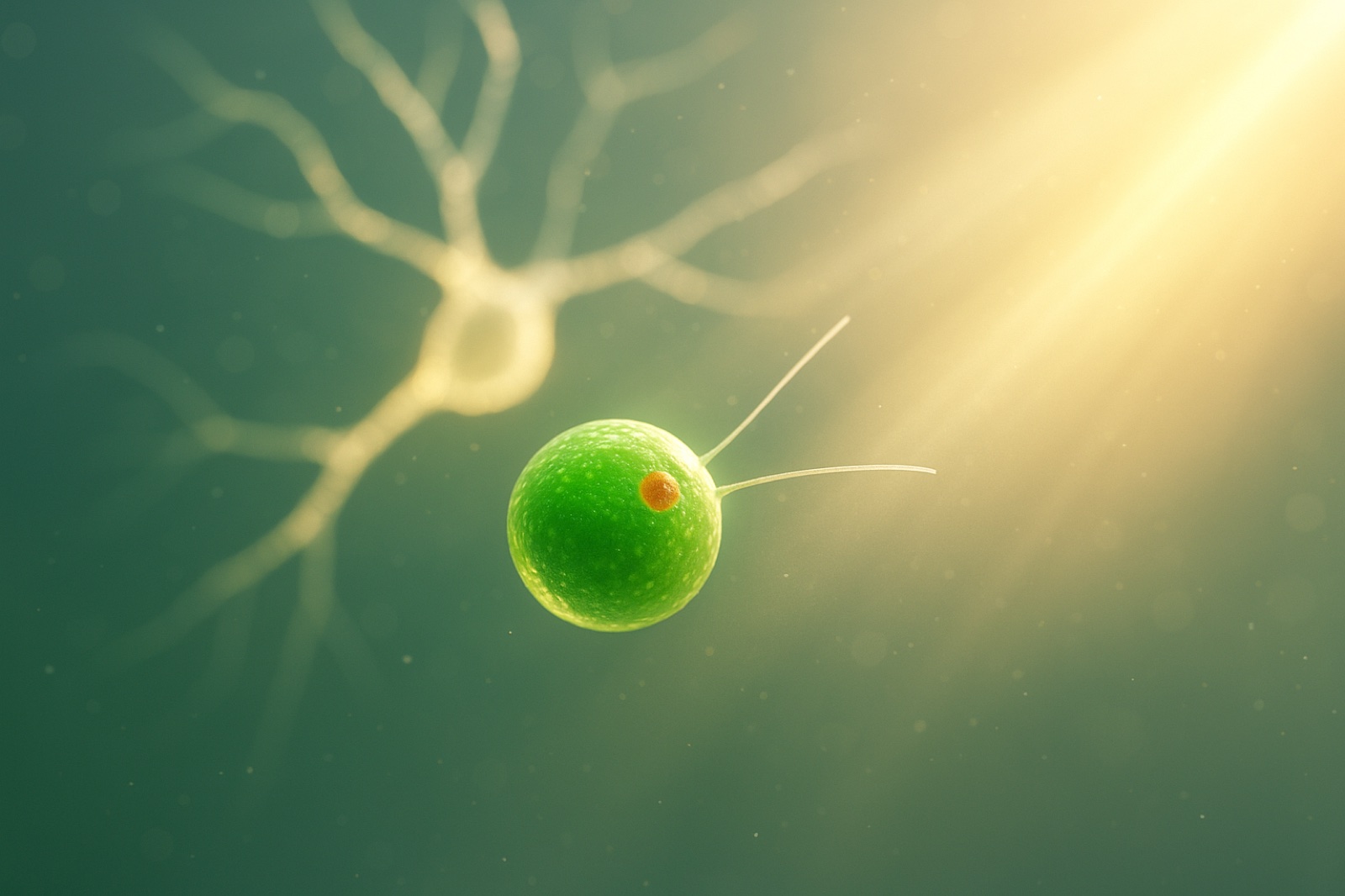
Somewhere in a pond near you, there is a living thing too small to see. It is one green cell. It has two thin tails it uses like oars, and a tiny orange-red spot near its front. All day long, it does one thing well. It finds the light and swims toward it.
On Monday, October 5, 2026, that little cell helped win the Nobel Prize in Medicine 2026.
The prize went to three scientists: Karl Deisseroth of Stanford University, Peter Hegemann of Humboldt University in Berlin, and Georg Nagel of the University of Würzburg in Germany. They were honored for light-gated ion channels and a method called optogenetics. In plain words, they found a way to switch single brain cells on and off with a flash of light.
And the key part did not come from a brain. It came from algae.
What Is Optogenetics? The Nobel Prize in Medicine 2026, Explained Simply
Your brain runs on billions of nerve cells. They talk to each other with tiny bursts of electricity. For a long time, scientists who wanted to learn what one kind of brain cell does had blunt tools. Drugs reach many cells at once. Electrodes zap everything nearby.
Optogenetics is different. Here is the simple version, in three steps:
- Borrow a gene. Scientists take the instructions for a light-sensitive protein from algae.
- Put it in chosen cells. They add that gene only to the brain cells they want to study, so only those cells build the protein.
- Shine a light. When light hits those cells, the protein opens like a tiny gate. Charged particles rush in, and the cell fires. Light off, and it goes quiet.
That is the whole trick. It turns a light switch into a brain switch, one chosen cell type at a time.
The Nobel committee said the method “is now being used in laboratories around the world to reveal the brain’s mysteries.” Per Svenningsson, who chairs the committee, put it this way, as reported by STAT: “Optogenetics provides opportunities for mapping the brain in a way that we could once only dream of.”
It Started With a Green Alga That Swims Toward the Sun
The alga in this story is called Chlamydomonas. It is a single cell that lives in soil and fresh water. Like a plant, it makes its food from sunlight. So it needs to find light to live.
That orange-red dot near its front is called an eyespot. It works a bit like a very simple eye. When light hits it, the alga turns and swims toward the bright side.
Peter Hegemann started studying how this alga senses light in the 1980s. Nobody was trying to fix a brain. He wanted to know how a one-celled creature with no eyes and no nerves could “see.”
The answer came in 2002 and 2003. Working with Georg Nagel and the biophysicist Ernst Bamberg, the team showed something odd about the alga’s light proteins. In most living things, sensing light and opening a gate are two jobs done by two separate parts. In this alga, one single protein did both. Light hit it, and it opened straight away. They named these proteins channelrhodopsins.
Then, in 2005, Karl Deisseroth’s team at Stanford, including Ed Boyden and Feng Zhang, put one of these algae genes into nerve cells from a rat brain. They shone blue light on them. The nerve cells fired, right on cue.
A tool for swimming toward the sun had become a tool for reading the brain.
What Optogenetics Can Do, and What It Can’t Yet
Most of what optogenetics does today happens in labs, not clinics. Scientists use it in animals to ask very exact questions. Which cells matter in fear? In memory? In movement? In wanting something? Turn one group of cells on, turn another off, and watch what changes.
That is a big deal on its own. But there has been a first, careful step toward people.
In 2021, a team led by José-Alain Sahel and Botond Roska reported in Nature Medicine on a 58-year-old man who had been blind for 40 years from an eye disease called retinitis pigmentosa. Doctors put the gene for another algae light protein into cells at the back of one eye. Wearing special goggles that turned the world into the right kind of light, he could find, count, and touch objects on a table.
It is important to be exact here. That was one patient, with partial sight, and only with the goggles on. Without them, he could not see the objects. It is a beginning, not a cure. Most of the honest promise of optogenetics is still the slow work of understanding the brain first.
There is one more honest detail. A Nobel Prize can go to no more than three people. The story of optogenetics has more names than that, like Bamberg and Boyden above. Big discoveries are almost never one person’s work. Even so, the committee’s secretary, Thomas Perlmann, said all three winners told him the same thing: they were glad to share it, and they called the other two “my friends.”
That moment had its own sweet edge. Alfred Nobel’s will is the reason any of this exists, and the story people tell about why he wrote it is not quite what the newspapers really said.
Made to Turn Toward the Light
Here is the part that stays with me.
For millions of years, that little alga was not useful to anyone. It did not cure anything. It did not help any lab. It just lived the way it was made to live, turning toward light, again and again, in ponds no one was looking at.
We did not give it its worth when we found a job for it. It already had it. The care built into that one tiny protein was there the whole time, long before anyone thought to ask what it was “for.”
A lot of us quietly worry that we only matter for what we can do. Our output. Our use. Our job title. There is a very old idea, older than any lab, that says it is the other way round. You were made with care and on purpose before you were ever useful to anyone. Your worth was never something you had to earn. It was put there. And like the alga, you were made to turn toward the light.
The scientists did not create that design. They noticed it. Maybe that is the real gift of a day like this one. It reminds us to notice too.
A good place to start: The Beginner’s Guide to Feeling God’s Presence Every Day. A short video guide and companion PDF that help you notice something bigger in the ordinary moments of a normal day. Get the free guide. Free.
What Happens Next
The prize comes with 12 million Swedish kronor, shared between the three winners. The work goes on. Labs will keep switching cells on and off to learn how fear, memory, and movement really work. Doctors will keep testing, slowly and carefully, whether light can help with sight and other conditions.
If you like stories where a strange little pattern in nature turns out to matter years later, you may enjoy how an AI recently found a CRISPR-like system nobody understands yet. And if the blind patient’s story moved you, the novel Blindness by José Saramago asks what it means to be the one who can see.
The next time you walk past a pond, look at the green on the water. Some of it is alive, and turning toward the light. It always was.
What Do You Think?
Which matters more for big breakthroughs like this one: chasing a clear goal, or studying something just because it is interesting? Tell us where you land in the comments.
Share This
“The Nobel Prize in Medicine 2026 started with a tiny green alga that swims toward the sun. Its light-sensing protein now switches brain cells on and off.” https://bgodinspired.com/?p=118002
“Scientists spent years asking how a one-celled alga with no eyes could ‘see.’ The answer just won a Nobel Prize. Curiosity is underrated.” https://bgodinspired.com/?p=118002
“The alga had worth long before it had a use. This explainer on the 2026 medicine Nobel stuck with me.” https://bgodinspired.com/?p=118002
Common Questions About the Nobel Prize in Medicine 2026
Who won the Nobel Prize in Medicine 2026?
The 2026 Nobel Prize in Physiology or Medicine was awarded on October 5, 2026, to Karl Deisseroth of Stanford University, Peter Hegemann of Humboldt University in Berlin, and Georg Nagel of the University of Würzburg in Germany. They were honored for discoveries about light-gated ion channels and for developing optogenetics, a method for controlling nerve cells with light.
What is optogenetics in simple terms?
Optogenetics is a method that lets scientists switch chosen nerve cells on or off with light. They add a gene for a light-sensitive protein, first found in green algae, to specific cells. When light shines on those cells, the protein opens a tiny gate, and the cell fires. This lets researchers test what each kind of brain cell does.
What do algae have to do with the 2026 Nobel Prize in Medicine?
The key proteins behind optogenetics, called channelrhodopsins, come from a single-celled green alga named Chlamydomonas. The alga uses them to sense light so it can swim toward it. In 2002 and 2003, Georg Nagel, Peter Hegemann and Ernst Bamberg showed that a single one of these proteins both senses light and opens an ion channel, which made it possible to use them in nerve cells.
Is optogenetics used to treat people?
Mostly not yet. Optogenetics is mainly a research tool used in laboratory animals to study the brain. In 2021, researchers reported in Nature Medicine that a 58-year-old man blind from retinitis pigmentosa regained partial vision in one eye after a gene for an algae light protein was added to his retina. He could locate and count objects only while wearing special goggles.
Why weren’t other optogenetics scientists included in the Nobel Prize?
Nobel Prize rules allow no more than three people to share a single prize. Other scientists also contributed to the early work, including biophysicist Ernst Bamberg, who co-authored the channelrhodopsin discoveries, and Ed Boyden and Feng Zhang, who were part of the 2005 Stanford experiment that first used an algae light protein to make nerve cells fire.