 0
0
 0
0
Somewhere 41 light-years from here, there’s a planet where the ground is an ocean, and the ocean is lava.
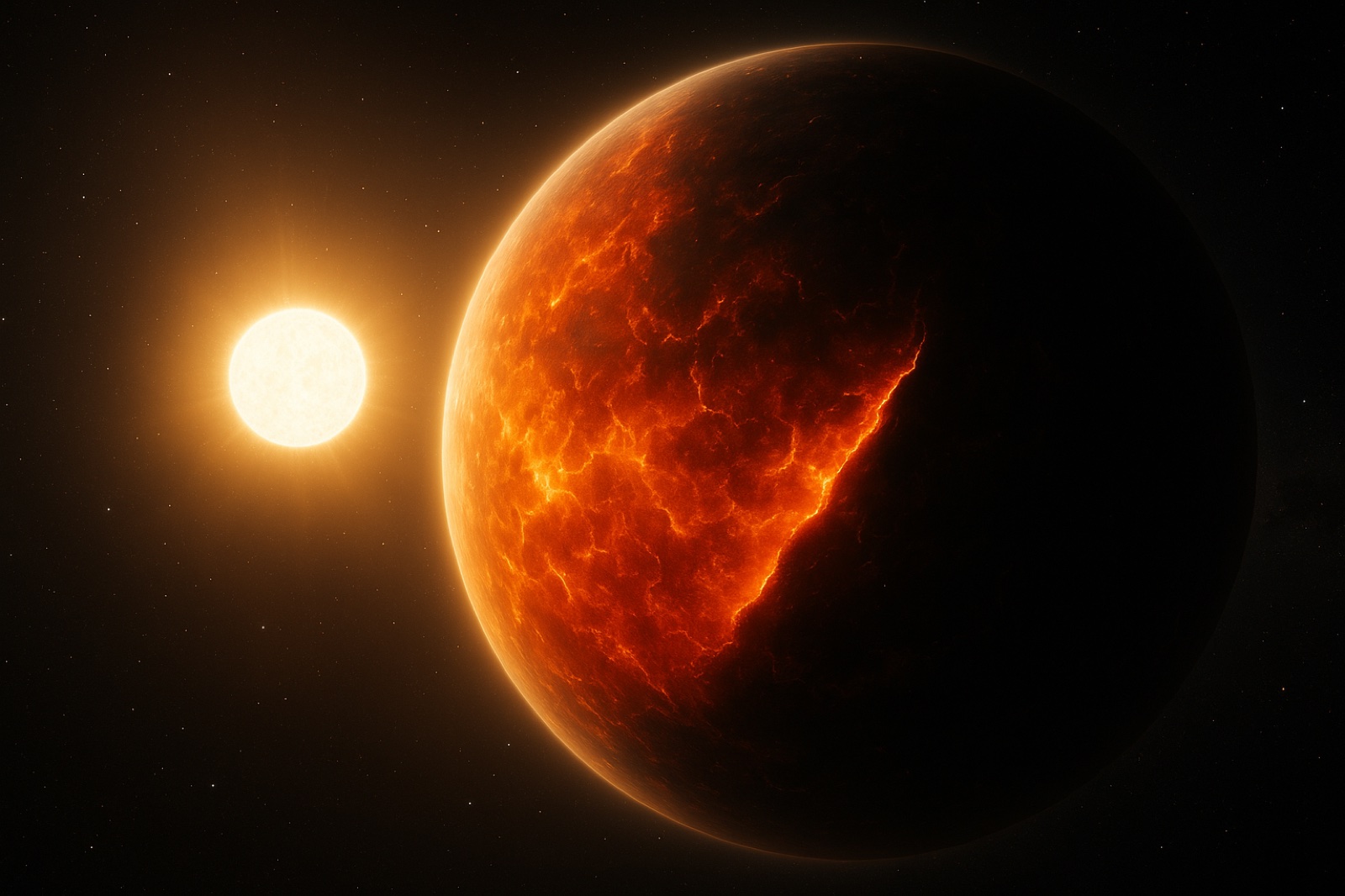
Its name is 55 Cancri e, and for years scientists weren’t even sure it could hold onto an atmosphere at all — not with a surface hot enough to melt rock and a star close enough to strip away anything gaseous within days. Then, this year, NASA’s James Webb Space Telescope looked closer than anyone ever had. What it found is rewriting what astronomers thought they knew about how a planet like this survives.
A World That Shouldn’t Work
55 Cancri e is what astronomers call a super-Earth: about 1.88 times Earth’s size, roughly eight times its mass. On paper, that’s not so strange — researchers have catalogued thousands of exoplanets by now, and plenty are bigger than ours.
What makes 55 Cancri e different is where it sits. It orbits its sun-like star so closely that a full year there lasts just 0.7 days — under seventeen hours. Mercury, the closest planet to our own sun, takes 88 days to do the same lap. 55 Cancri e is tidally locked, meaning one side always faces its star in permanent, blistering daylight while the other stays in permanent dark.
The dayside temperature averages around 2,573 Kelvin — about 4,200 degrees Fahrenheit. That’s hot enough to vaporize rock. Scientists have long suspected the entire sunlit hemisphere is covered in a standing ocean of molten lava, not the occasional volcanic vent, but a permanent, planet-wide sea of it.
For a long time, the working assumption was simple: nothing that extreme should be able to hold an atmosphere. Whatever gas escaped the surface would just get blasted away by stellar radiation. Case closed — or so it seemed.
What James Webb Actually Found
Researchers, including Isabel Angelo at UC Berkeley and Renyu Hu at NASA’s Jet Propulsion Laboratory and Caltech, used Webb to observe five separate eclipses of 55 Cancri e passing behind its star. Comparing that data against existing planetary models, they found something unexpected: real evidence of an atmosphere, made up of large amounts of carbon monoxide, smaller amounts of carbon dioxide, and a surprising abundance of hydrogen.
That hydrogen-rich mix tells scientists something specific — the planet’s interior is chemically “reduced,” relatively low in oxygen, which points toward the atmosphere being fed directly from below. The leading theory now is that the lava ocean itself is outgassing, constantly bubbling fresh gas up from the molten interior even as radiation strips the top layer away. The atmosphere isn’t a static shell wrapped around the planet. It’s a living exchange between a molten core and the vacuum of space, replenished as fast as it’s lost.
It’s one of the strongest pieces of evidence yet that a rocky world — not a gas giant, but a planet with an actual solid-ish surface like ours — can sustain an atmosphere shaped entirely by its own internal chemistry, even in conditions that should strip everything away. The findings, submitted for publication in Nature Astronomy, are already reshaping how scientists model the early lives of rocky planets, including, quite possibly, our own.
The Search for the Opposite of 55 Cancri e
Here’s what’s easy to miss in a headline about a lava planet: this discovery is part of a much bigger hunt. Astronomers aren’t just cataloguing extreme worlds for their own sake — they’re using every one of them, however hostile, to sharpen their search for the rare kind of planet that isn’t. NASA’s next major space telescope alone is expected to survey as many as 100,000 new worlds, and just this year, astronomers identified a nearby planet some are already calling Earth’s next-door neighbor — a candidate that might, unlike 55 Cancri e, actually be capable of holding liquid water.
That search matters because of just how rare habitability turns out to be. Even our own solar system offers a preview of how easily a planet can end up hostile — scientists recently confirmed a massive underground lava tube on Venus, a world close enough to Earth in size to once be called our twin, and now studied mainly as a warning about what a runaway greenhouse effect can do to a planet over billions of years.
Every rocky world discovered so far falls into roughly the same handful of categories: boiling, frozen, airless, crushed by its own gravity, or scorched by its star. 55 Cancri e is simply one of the more dramatic entries in a very long list of near-misses.
The Math Nobody Talks About
Step back from the chemistry for a second and look at the numbers. 55 Cancri e sits close enough to its star that a year lasts sixteen hours. If Earth sat that close to the sun, its surface would look almost exactly like 55 Cancri e’s — a standing ocean of molten rock, no exceptions. Move a planet too far in the other direction, and you get something more like Mars: thin, cold, and essentially airless.
Earth sits in the narrow middle distance where none of that happens. Not close enough to boil. Not far enough to freeze. Close enough to a star that actually behaves the way ours does, in a system stable enough to not have been disrupted by a wandering gas giant, spinning at a tilt that gives it seasons instead of permanent extremes. Every one of those has to land in a fairly narrow range at the same time, and for most planets astronomers find, at least one of them badly misses.
Scientists have a term for this: the “Goldilocks zone.” It’s usually said a little jokingly — not too hot, not too cold. But there’s something worth sitting with in how narrow that zone actually turns out to be, once you’ve seen enough of the alternative. Long before anyone had a telescope capable of finding a planet 41 light-years away, ancient wisdom described the world not as a coincidence that happened to work out, but as something set in place on purpose — foundations laid with intention, not luck stacked on luck. Standing next to a planet like 55 Cancri e, that description stops sounding like poetry and starts sounding like an observation.
What This Actually Changes
None of this means the search for habitable worlds is over, or that scientists have found some grand proof of anything. What it does mean is that every lava world, every frozen moon, every airless rock adds to a growing, very precise picture of just how much has to go right for a planet to end up like this one — livable, breathable, ordinary in a way that turns out to be anything but.
The next time a headline announces another distant, hostile world, it’s worth remembering what that headline is actually measuring against: a planet, 41 light-years closer to home, that somehow got the placement right.
Discussion Question
If astronomers eventually confirm a planet that’s genuinely Earth-like — right distance, right atmosphere, right everything — do you think that would feel like the universe getting a little less special, or a lot more so? Drop your take in the comments.
Share This
- A planet 41 light-years away is covered in an ocean of lava, and scientists just found it has an atmosphere anyway. The reason why is wild. bgodinspired.com
- Earth sits in a window so narrow that if our planet were even a little closer to the sun, it would look exactly like this lava world scientists just studied with James Webb. Worth a read.
- Every “new Earth” headline is really being measured against one number: how rare it actually is for a planet to get everything right. This lava-planet discovery makes that number a lot more real.
Questions People Are Asking
What is 55 Cancri e?
55 Cancri e is a rocky “super-Earth” exoplanet located about 41 light-years from Earth. It’s roughly 1.88 times Earth’s size and 8 times its mass, and it orbits its star so closely that one full orbit takes less than 17 hours.
Does 55 Cancri e really have an ocean of lava?
Scientists believe so. The planet is tidally locked, meaning one side permanently faces its star with a dayside temperature around 2,573 Kelvin (about 4,200°F) — hot enough to keep the entire sunlit surface molten.
What did NASA’s James Webb Space Telescope discover about it?
In 2026, researchers using James Webb observed five eclipses of 55 Cancri e and found evidence of an atmosphere made up largely of carbon monoxide, along with carbon dioxide and hydrogen — one of the strongest signs yet that a rocky exoplanet outside our solar system can sustain an atmosphere.
How does a planet that hot keep an atmosphere?
Scientists think the atmosphere is being continuously replenished by outgassing from the planet’s molten interior — gas bubbling up from the lava ocean as fast as radiation strips it away, rather than sitting as a fixed layer.
Why does a lava planet matter to the search for habitable worlds?
Every extreme world scientists study — too hot, too cold, too airless — sharpens the picture of exactly how narrow the conditions for a habitable planet like Earth really are, which helps astronomers know what to look for as they search thousands of other star systems.