 0
0
 0
0
You’ve run the numbers again tonight — for maybe the third time this week — and they still don’t work. The bills are due before the paycheck lands. Someone you owe money to has stopped being patient. And somewhere in the back of your mind is a fear you don’t say out loud: what if there’s nothing left to lose?
A woman in the Bible knew that fear in a form most of us will never face. What’s become known as the story of the widow’s oil begins with her husband — a man who feared the LORD, who served among the company of prophets under Elisha — dying and leaving her with debt she couldn’t pay. Under the law of her time, an unpaid debt could be settled with a person. A creditor was on his way to take her two sons as payment. Not their labor for a season. Them.
She didn’t go to Elisha for sympathy. She went because she was out of options. And what he said back to her wasn’t what she expected — and it’s not what most of us expect either, when we finally admit how bad things have gotten.
A Widow, Two Sons, and a Debt She Couldn’t Pay
The story is tucked into 2 Kings 4:1-7, easy to skip past on the way to more famous Elisha miracles. But it opens with a gut-punch: “Now there cried a certain woman of the wives of the sons of the prophets unto Elisha, saying, Thy servant my husband is dead; and thou knowest that thy servant did fear the LORD: and the creditor is come to take unto him my two sons to be bondmen” (2 Kings 4:1).
This wasn’t a wealthy household falling on hard times. “The sons of the prophets” were a community of men who served under Elisha’s ministry — closer to a school of prophets than a group of landowners. They didn’t live comfortably. When this man died, he apparently left nothing but debt, and in that world, debt didn’t stay abstract. A creditor could legally take a debtor’s children into servitude until the debt was worked off — you can see the same practice addressed elsewhere in the law, in passages like Exodus 21:7 and Leviticus 25:39. This widow wasn’t facing foreclosure. She was facing the loss of her sons.
If you’ve ever lain awake doing math that doesn’t work, you already know part of what she felt. Maybe you’ve never feared losing a child to a debt collector — but you know the particular helplessness of watching something you love get threatened by numbers you can’t make add up.
“What Hast Thou in the House?”
Here’s where the story stops being predictable. Elisha doesn’t reach for his own resources. He doesn’t organize a collection from the other prophets. He asks her a question instead: “What shall I do for thee? tell me, what hast thou in the house?” (2 Kings 4:2).
It’s an odd thing to ask a woman who just told you she’s about to lose her children. She answers honestly, and her answer tells you exactly how desperate the situation was: “Thine handmaid hath not any thing in the house, save a pot of oil” (2 Kings 4:2). Not gold. Not grain. Not livestock. One small jar of oil — the kind of ordinary household item you’d use for cooking or for lighting a lamp, worth almost nothing on its own.
She wasn’t hiding a solution. She genuinely believed she had nothing. And in a sense, she was right — what she had wasn’t enough, by itself, to pay a debt that could cost her two sons. But Elisha didn’t ask what she had because it was enough on its own. He asked because it was where God intended to start.
The Miracle Was as Big as Her Faith to Prepare For It
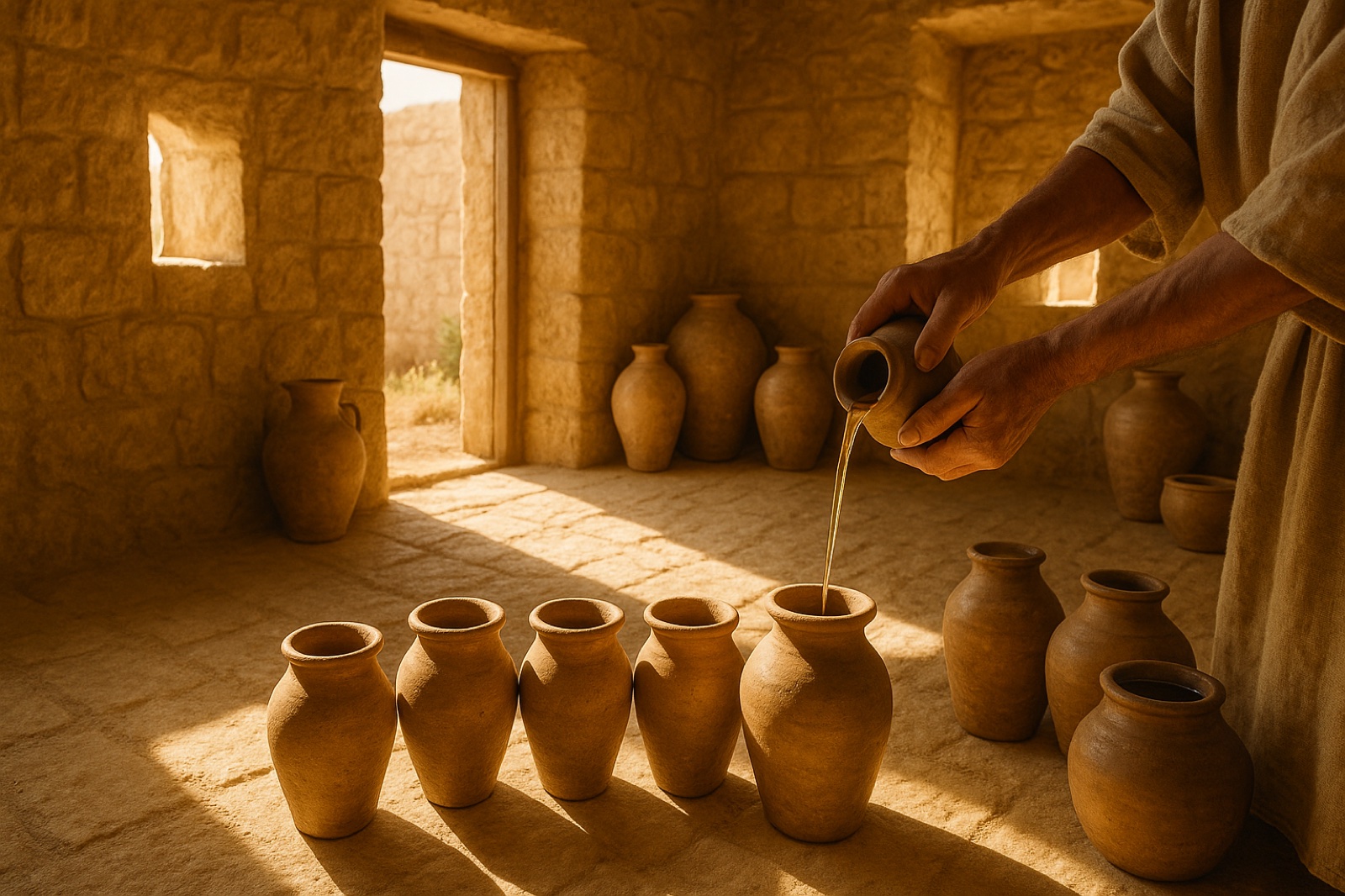
What Elisha tells her to do next is strange, and it required her to move before she saw a single drop multiply. “Go, borrow thee vessels abroad of all thy neighbours, even empty vessels; borrow not a few” (2 Kings 4:3). Then: shut the door, pour the oil from her one jar into all those borrowed containers, and set the full ones aside.
She obeyed exactly. She and her sons gathered vessels — likely more than a few homes’ worth — shut themselves in, and started pouring. The oil kept flowing. Jar after jar filled. Finally her son told her there wasn’t a vessel left to fill — “and the oil stayed” (2 Kings 4:6). The miracle didn’t run out because God’s provision ran dry. It stopped because she ran out of containers to receive it.
Elisha’s instruction was simple after that: “Go, sell the oil, and pay thy debt, and live thou and thy children of the rest” (2 Kings 4:7). Her sons were saved. Her family had more than enough to live on. And it started with a pot of oil she’d almost forgotten to mention.
The Question That Comes Before the Provision
Read that story enough times, and something shifts. This wasn’t a story about God producing something from nothing. It was a story about God multiplying something the widow already had — something she’d dismissed as too small to matter. The miracle didn’t begin with a delivery from outside her house. It began with a question about the inside of it.
That’s easy to read past when the crisis is ancient history and someone else’s. It’s harder to sit with when it’s your own. Because if you’re staring at debt tonight, or a financial fear that won’t let you sleep, the instinct is to look outward — for a raise, a windfall, a rescue that arrives from somewhere else. And sometimes that rescue does come from outside. But this story suggests God’s first move is often quieter: what hast thou in the house? What skill, relationship, hour, or small resource have you already written off as not enough to count?
Notice, too, what the size of the miracle depended on: not how much oil she started with, but how many empty vessels she was willing to go collect. Her faith wasn’t measured by what she already had — it was measured by how far she was willing to prepare for more than she could yet see. The oil didn’t stop because God stopped giving. It stopped because she stopped gathering containers to hold it.
What This Looks Like on a Tuesday, Not Just in 2 Kings
You probably don’t have a widow’s oil jar sitting in your kitchen. But you likely have something you’ve mentally filed under “doesn’t count” — a skill nobody’s paying you for yet, a relationship you could ask for help through but haven’t, a small asset just sitting there, an hour a day you’ve written off as too little to matter. This story isn’t permission to wait for a miracle instead of doing the work. It’s an invitation to stop assuming your starting point has to be impressive before God can use it.
It also gives you a hint about a piece nobody wants to hear: the widow had to ask her neighbors for empty vessels. She had to be honest, out loud, that she needed help — and gather more capacity than she currently had before she saw what God would do with it. If you’re facing your own financial fear right now, part of your “pot of oil” moment might be a phone call you’ve been avoiding — to a creditor, a financial counselor, a friend, or your church — because it feels too small, too embarrassing, or too vulnerable to make.
If debt itself has you wondering what the Bible actually says about it beyond one famous verse, this look at what the Bible really says about debt goes deeper into that. If the “what do I already have” question resonates, this piece on how Luke 6:38 quietly multiplies what you give follows the same thread from a different angle. And if the anxious math-at-midnight feeling is the part you relate to most, this piece on why money worry doesn’t quit even when the bills are paid unpacks why your mind won’t let it go.
Three Things to Do in the Next 10 Minutes
1. Take your own “pot of oil” inventory. Open your notes app right now and write down three things you already have — a skill, a relationship, a possession, a spare hour — that you’ve been treating as too small to matter.
2. Ask for a “vessel.” Send one text or make one call today asking for something specific you’ve been avoiding — advice, a referral, a deadline extension, prayer, or simply someone to sit with the numbers alongside you.
3. Shut the door and write the real number. Sit down and write out exactly what you owe — the full, honest total, the way the widow finally told Elisha the truth about what was, and wasn’t, in her house. You can’t pour into vessels you haven’t gathered, and you can’t get free of a number you won’t look at.
Once you’ve done even one of those, the next step usually gets clearer — which is exactly how it worked for her, too. Nobody told her the whole plan up front. She just obeyed the next instruction.
A Prayer for When the Math Doesn’t Work
God, I don’t have much I feel confident handing You tonight — just what’s really in the house, not what I wish were there. I’m scared of these numbers, and I’m tired of carrying them alone. Show me what I’ve been dismissing as too small to matter, and give me the courage to ask for help instead of hiding the truth about what I owe. I don’t know exactly how this gets paid off, but I trust You more than I trust my own math. Amen.
Something to Think About
What’s one thing in your life right now — a skill, a relationship, a resource — that you’ve quietly decided is “too small” to be part of the answer? We’d love to hear it in the comments.
Share This
- “I keep waiting for God to send something new. Today I found out God might just want me to look at what’s already in the house.” — 2 Kings 4:1-7
- “Turns out the miracle doesn’t always start with more. Sometimes it starts with the one thing you almost forgot to mention.”
- “Read the story of the widow’s oil today and realized I’ve been calling my ‘pot of oil’ worthless instead of asking what it could become.”
Questions People Ask
What is the story of the widow’s oil in 2 Kings 4?
In 2 Kings 4:1-7, a widow whose husband served among the prophets under Elisha faces losing her two sons to a creditor as payment for debt. She tells Elisha she has nothing in her house except a small pot of oil. Elisha instructs her to borrow empty vessels from her neighbors and pour the oil into them. The oil miraculously keeps flowing until every borrowed vessel is full, giving her enough to sell, pay off the debt, and live on what remains.
Why did the creditor want to take her sons?
In the ancient Near East, unpaid debt could legally be settled by taking a debtor’s children into servitude until the debt was worked off — a practice referenced elsewhere in the Bible, such as Exodus 21:7 and Leviticus 25:39. This wasn’t unusual cruelty; it was how debt was often handled at the time, which is part of what makes the widow’s desperation so real.
Why did Elisha ask what she had instead of just giving her money?
Elisha’s question wasn’t a test to see if she deserved help — it pointed her toward the resource God intended to use. Throughout Scripture, provision often starts with what’s already present rather than something delivered from outside. Asking “what hast thou in the house?” set up a miracle that multiplied what she had instead of replacing it.
Why did the oil stop flowing?
The oil stopped only when the widow ran out of empty vessels to pour it into (2 Kings 4:6) — not because the supply itself ran out. It’s often read as a picture of how provision can be limited less by what God is willing to give and more by how much we’ve prepared to receive.
What can this story teach about financial fear today?
It suggests looking honestly at what you already have — a skill, a relationship, a resource — before assuming your only hope is something new arriving from outside. It also shows that asking for help, the way the widow had to ask her neighbors for vessels, is often part of the process, not a sign of failure.