 0
 0
Greek Word for Vine: What Does ‘Ampelos’ Really Mean?
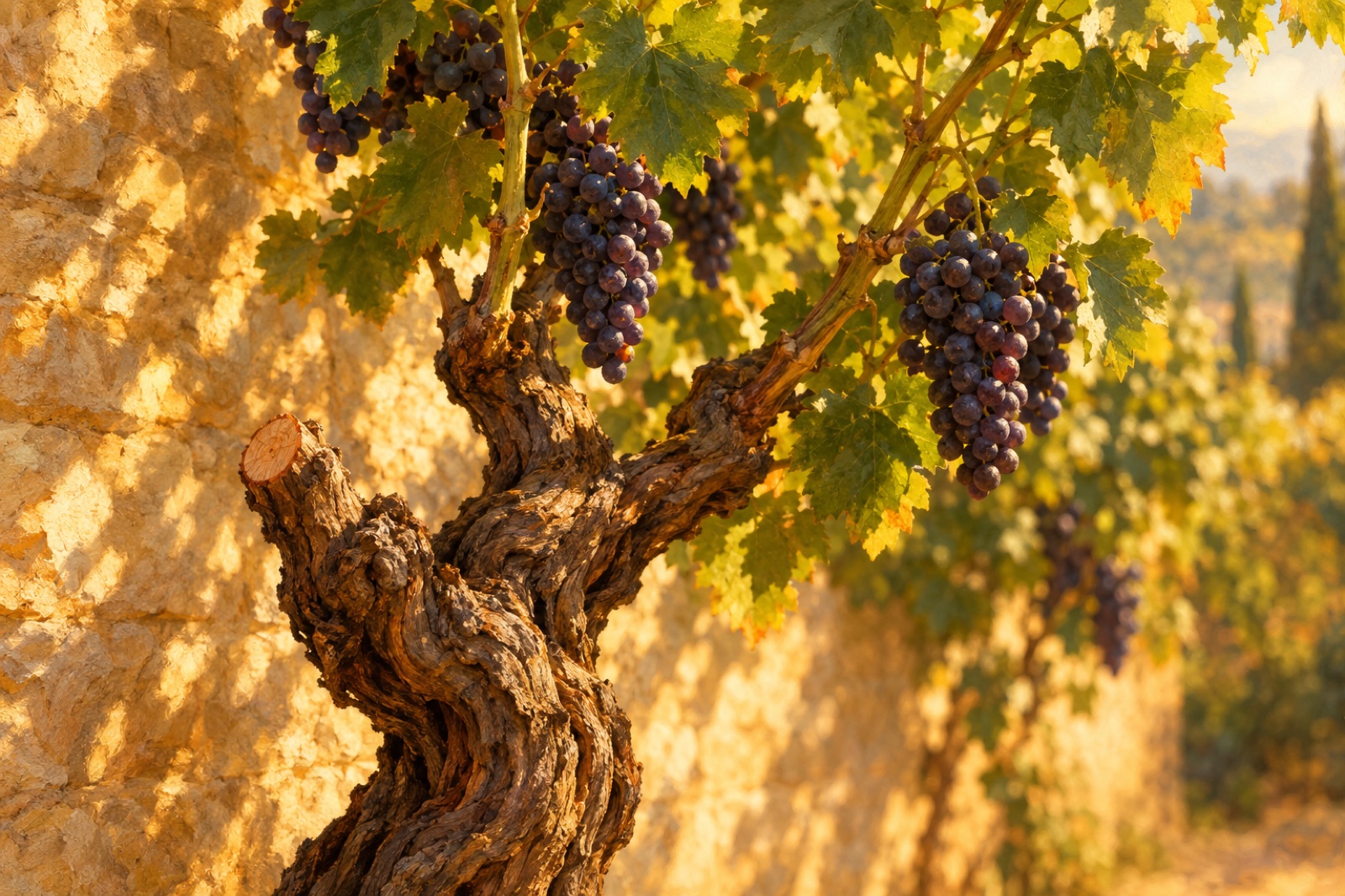
Quick answer: The Greek word for vine is ἄμπελος (ampelos), pronounced AM-peh-loss — Strong’s G288. It means a vine, and in practice always the cultivated grapevine. It appears just nine times in the New Testament, and six of those nine are on Jesus’ lips. It is also the word the Greek Old Testament uses every time a prophet calls Israel a vine — which is why “I am the true vine” (John 15:1) is not a gardening illustration. It is a claim about who the vine turned out to be.
Word Study: Where “Ampelos” Comes From
Most Greek words can be taken apart. You can watch them being built out of smaller pieces — a preposition fused to a verb, a root with a familiar ending bolted on. Ampelos resists that, and the reason is interesting: the etymological dictionaries generally class it as pre-Greek. It is one of a small set of words for Mediterranean plants and crops that Greek speakers appear to have inherited rather than coined, picked up from people who were already growing grapes in that soil before Greek was spoken over it.
You will often see ampelos explained as “that which winds around,” from a supposed root meaning to coil or twist. It is a tidy story and it fits the plant, but it is not secure — it reads more like a later attempt to make sense of a word already there than a derivation anyone can demonstrate. Hold it loosely. The honest summary is that the word for the vine is older than the language that carries it, which is a fitting sort of problem for this particular plant.
Three things about the word are worth knowing before the big passage:
- It is the Septuagint’s word for Israel. When Jewish scholars translated the Hebrew Scriptures into Greek, the Hebrew gephen became ampelos — including in every passage where the vine is the nation. “Thou hast brought a vine out of Egypt” (Psalm 80:8). “Yet I had planted thee a noble vine” (Jeremiah 2:21). “Israel is an empty vine” (Hosea 10:1). Anyone who had sung Psalm 80 knew exactly what an ampelos stood for, and knew that the story attached to it had not ended well. (The Hebrew side of this word has its own study: Hebrew Word for Vine: What Does “Gephen” Really Mean?)
- It is grammatically feminine — h̄ ampelos, one of the small group of Greek nouns that take the -os ending but a feminine article. This carries no theological weight whatsoever; Greek assigns gender to tables and ships too. It is simply a thing worth knowing if you ever read the verse in Greek and wonder why the article looks wrong.
- It generated a whole vocabulary. From ampelos Greek built ampelōn, a vineyard, and ampelourgos, a vine-worker — the “dresser of his vineyard” in Luke 13:7 who asks for one more year before the fig tree is cut down. Those are different words doing different jobs, and English flattens all of them into “vine” and “vineyard.” More on that below.
One more piece belongs in the etymology, because it is the adjective that does the real work in John 15:1. “True vine” is ampelos alēthinē, and alēthinos (G228) does not mean truthful as opposed to lying. It means genuine, real, the original rather than the copy. John uses it this way again and again: the true light (John 1:9), the true bread from heaven (John 6:32), the true vine. In every case the contrast is not with something false but with something that was only ever a shadow of it.
Which means John 15:1 is doing something sharper than it sounds in English. It is not “I am the honest vine.” It is “I am the one all of those were pictures of.”
Take a Moment With This
A branch’s entire job is to stay attached. If that is the part you find hardest, this free guide is about exactly that — the ordinary, daily staying.
Where This Word Appears in the Bible
Nine appearances, and they cluster in two places: the night before the cross, and the end of the world.
| Reference | Text (KJV) | What’s happening |
|---|---|---|
| Matthew 26:29 | “But I say unto you, I will not drink henceforth of this fruit of the vine, until that day when I drink it new with you in my Father’s kingdom.” | Spoken over the cup — hours before John 15, the same night |
| John 15:1 | “I am the true vine, and my Father is the husbandman.” | The claim: not a vine, the vine, the real one |
| John 15:4 | “Abide in me, and I in you. As the branch cannot bear fruit of itself, except it abide in the vine; no more can ye, except ye abide in me.” | The one instruction a branch is given |
| John 15:5 | “I am the vine, ye are the branches: He that abideth in me, and I in him, the same bringeth forth much fruit: for without me ye can do nothing.” | The branches are named — and so is the arithmetic |
| James 3:12 | “Can the fig tree, my brethren, bear olive berries? either a vine, figs? so can no fountain both yield salt water, and fresh.” | A plant can only hand over what it actually is |
| Revelation 14:18-19 | “Thrust in thy sharp sickle, and gather the clusters of the vine of the earth; for her grapes are fully ripe.” | The word’s last two appearances in Scripture — a harvest, but not Christ’s |
That first row is easy to read past. At the table, Jesus takes the cup and calls what is in it “this fruit of the vine” — tou genēmatos tēs ampelou. Within hours, on the way out, he says: I am the ampelos. The same word, twice in one evening, pointing first at a cup and then at himself.
Verse Deep Dive: John 15:2 — Two Words That Sound Almost the Same
“I am the true vine, and my Father is the husbandman. Every branch in me that beareth not fruit he taketh away: and every branch that beareth fruit, he purgeth it, that it may bring forth more fruit” (John 15:1-2).
In English, “taketh away” and “purgeth” have nothing in common. They do not rhyme, they do not share a letter, and they describe two outcomes a reader will instinctively sort into bad and good. In Greek they are airei (αἴρει) and kathairei (καθαίρει). One is the other with a syllable on the front. Said aloud, they rhyme.
That is almost certainly deliberate, and three things follow from it.
- From inside the vine, the two sound nearly identical. A listener hearing this in Greek hears what is very close to the same word twice, and has to attend closely to tell which branch is being described. That is not a flaw in the sentence — it is an accurate description of how pruning feels. The blade does not announce which of the two it is doing. Both involve a cut; both involve losing something you were carrying.
- “Purgeth” is not primarily a word about cutting. Kathairei is built on katharos, the ordinary Greek word for clean. It is the verb you would use for clearing away what does not belong. The KJV’s “purgeth” is a fair translation of that, but four centuries have narrowed the English word into something closer to expel. What the Greek says about the fruitful branch is gentler and stranger: God cleans it.
- And “taketh away” might be “lifts up.” Airō is the plain Greek verb for raising or picking something up — it is what the healed man does with his bed in John 5:8, and what a disciple does with a cross. Some translators argue John 15:2 should be read that way: a vinedresser does not open the season by amputating the unfruitful shoots but by lifting the ones trailing in the dirt up off the ground, where they have a chance. That reading is contested and the traditional one is well defended, so do not build a doctrine on it. But it is genuinely available in the word, and worth knowing it is there.
Now the line that makes the whole passage land, and that most readers skip because it looks like an aside. The very next sentence:
“Now ye are clean through the word which I have spoken unto you” (John 15:3).
“Clean” there is katharoi — the same root as kathairei one verse earlier. Jesus describes the pruning, and then, immediately, names the tool. Not circumstance. Not hardship in the abstract. Not whatever happens to be going wrong this year. The word which I have spoken unto you.
That reframes the whole image. Verse 2 sounds like something done to you by events. Verse 3 says the pruning in verse 2 is being done by the talking in verse 3 — that the cutting instrument in this metaphor is what Jesus says. Which also means the place to go and stand if you want to be pruned is not a crisis. It is a conversation.
Not All “Vine” Is the Same: Ampelos, Ampelōn, Klēma and Klados
English uses “vine,” “vineyard” and “branch” loosely. The Greek of these passages does not, and two of the distinctions change what you are reading.
- ἄμπελος (ampelos, G288) — the plant. The living stock itself: root, trunk, sap. This is the word Jesus applies to himself.
- ἀμπελών (ampelōn, G290) — the vineyard. The estate: the ground, the hedge, the winepress, the tower, the tenants. Jesus tells several parables about an ampelōn (Matthew 20:1, Matthew 21:33), and it is worth noticing that in those he is not the vine at all — in Matthew 21 he is the owner’s son, killed outside the property. Vineyard parables are about stewardship: who is minding the estate and what they owe. John 15 is about life support: what is flowing into a branch. Same crop, two completely different pictures, and the Greek never confuses them.
- κλῆμα (klēma, G2814) — a vine shoot. Not a generic branch. A klēma is specifically the green cane a grapevine throws out, and in the whole New Testament it appears only here — four times, all in John 15. The choice is pointed, because a vine shoot is the most dependent thing in the vineyard: it is no use as wood, it cannot be made into anything, and cut loose it does not become a smaller plant. It becomes kindling (John 15:6).
- κλάδος (klados, G2798) — a tree branch. This is the word Paul uses in Romans 11 for the olive branches: “if some of the branches be broken off, and thou, being a wild olive tree, wert graffed in among them” (Romans 11:17). Hold the two together and you get something precise. A klados can be cut from one tree and grafted into another — Paul’s entire argument depends on that being possible. A klēma has nowhere else to go. There is no second vine.
- γεωργός (geōrgos, G1092) — the husbandman. Literally an earth-worker, a farmer. The KJV’s “husbandman” in John 15:1 is this word, and it is not a hired hand passing through. In the vineyard parables the geōrgoi are the tenants. Here, the one with the knife is the owner.
Why the Original Word Changes the Meaning
Read “I am the true vine” in English and it sounds like a warm image somebody chose because grapes were nearby. Read it as ampelos and it is a sentence with a thousand years of history behind it, and an argument inside it.
Israel was the vine. That was not an insult; it was a calling, and the prophets kept coming back to it precisely because it was true — planted deliberately, tended at cost, fenced, watched. The complaint in Isaiah, Jeremiah and Hosea is never that the vine was the wrong plant. It is that the harvest kept going the wrong way.
So notice what Jesus does not say on that last night. He does not say the vine failed and a better nation will be planted. He does not tell the vine to try harder. He says: I am the vine — stepping into the position Israel held and could not hold — and then, in the next breath, ye are the branches. The role was not reassigned to someone more promising. It was absorbed by a person, and then shared out to anyone willing to stay attached to him.
That is what makes the last clause of John 15:5 something other than a put-down. “Without me ye can do nothing” is not a low opinion of you. Said of a klēma, it is a plain botanical fact — a vine shoot detached from the stock does not underperform, it dies — and the whole point of the sentence is the first half, where you are told which vine you are on. The arithmetic only sounds cruel if you missed being grafted in.
Living It Out
There is one verb Jesus repeats in this chapter more than any other: menō, to abide, to remain, to stay — more than ten times in John 15 alone. It is worth sitting with how unspectacular that instruction is. Not produce. Not strive. Stay. A branch is never asked to manufacture grapes; it is asked not to detach.
So try this for a week, and let verse 3 set the method. If the pruning comes “through the word which I have spoken unto you,” then the knife is not your circumstances — it is Scripture, read slowly enough to disagree with you. Take one short passage of Jesus’ own words, the same passage every day, and read it until it says something inconvenient. Then do the one small thing it asks. That is the whole of it: stay attached, and let the words cut. Growth, as Jesus described it, mostly happens where you cannot watch it — and it is not your job to pull on the fruit.
Journal Prompts
- In John 15:2 the two verbs airei and kathairei sound almost identical, and from inside the vine they feel it. Name one loss in the last few years that you filed under “taken away.” Write out what it would change if it were in fact the other word — a cleaning, on a branch that was bearing.
- John 15:3 says the cleaning comes “through the word which I have spoken unto you.” Find one sentence of Jesus that has actually removed something from your life — a habit, an ambition, a grudge you were feeding. Write the sentence down, then write what it took out.
- A klēma cannot be grafted into another plant the way Romans 11’s olive klados can; there is no second vine to go to. Where are you quietly keeping a backup plan that assumes otherwise — something you would attach yourself to if this did not work out? Name it plainly, with no verdict attached.
Prayer
Lord Jesus, you called yourself the true vine, and you did it on the worst night of your life, with a cup in your hand. I have spent a long time trying to be my own stock — producing, propping myself up, keeping a quiet alternative in reserve in case the sap ran out. Thank you that you never asked me for grapes. You asked me to stay. Where I have read the knife as rejection, teach me to tell airei from kathairei, and to hold still either way. Let your words do the cutting; I would rather be cleaned by what you say than left alone and leafy. Keep me attached, through dull seasons and slow ones, and bear whatever fruit you intend through a branch that is doing nothing clever at all. Amen.
Share This
In John 15:2 the words for “taketh away” and “purgeth” are airei and kathairei — one is the other with a syllable on the front. Said aloud they rhyme. From inside the vine, the two cuts sound almost the same. [Post URL]
“I am the true vine” uses ampelos — the Greek Old Testament’s word for Israel. Jesus didn’t say the vine failed and a better one would be planted. He said he was it, and then called us the branches. [Post URL]
FAQ
What is the Greek word for vine?
It is ἄμπελος (ampelos), Strong’s G288, meaning the cultivated grapevine. It appears nine times in the New Testament, six of them spoken by Jesus — three at the Last Supper table and three in John 15. The vineyard the plant grows in is a separate word, ampelōn (G290).
What does “true vine” mean in John 15:1?
“True” is alēthinos (G228), which means genuine or real rather than truthful. The contrast is not with a lying vine but with a copy — the same way John speaks of the true light (John 1:9) and the true bread (John 6:32). Jesus is saying he is the original that every earlier vine pictured.
Is ampelos the same as the Old Testament word for vine?
Not the same language, but the same word in translation. The Septuagint renders the Hebrew gephen (H1612) as ampelos, including in Psalm 80:8, Jeremiah 2:21 and Hosea 10:1, where the vine is Israel. The Hebrew word has its own emphasis — it is named for bending, for a plant that cannot hold itself up — which is covered in the companion study, Hebrew Word for Vine: What Does “Gephen” Really Mean?
What is the difference between the vine and the branches in John 15?
The vine is ampelos, the living stock. The branches are klēma (G2814), a word used nowhere else in the New Testament and meaning specifically a grapevine shoot — the green cane, not a woody limb. That matters: a vine shoot has no use as timber and cannot be grafted into another plant, which is why John 15:6 says a detached one is only good for burning.
What does it mean to abide in the vine?
The verb is menō (G3306) — to remain, stay, or dwell — and Jesus repeats it more than ten times in John 15. It is the only instruction given to a branch. Notably, John 15:3 locates the pruning “through the word which I have spoken unto you,” so abiding is bound up with staying under what Jesus actually said rather than with producing a result. On what the fruit itself looks like, see What Are the Fruits of the Spirit?
Take This Further
A branch is not asked to produce. It is asked to stay attached. The Beginner’s Guide to Feeling God’s Presence Every Day is a free, simple guide to experiencing God in ordinary moments — even when life feels chaotic — with a 3-step rhythm that turns your daily routine into a divine connection.