 0
0
 0
0
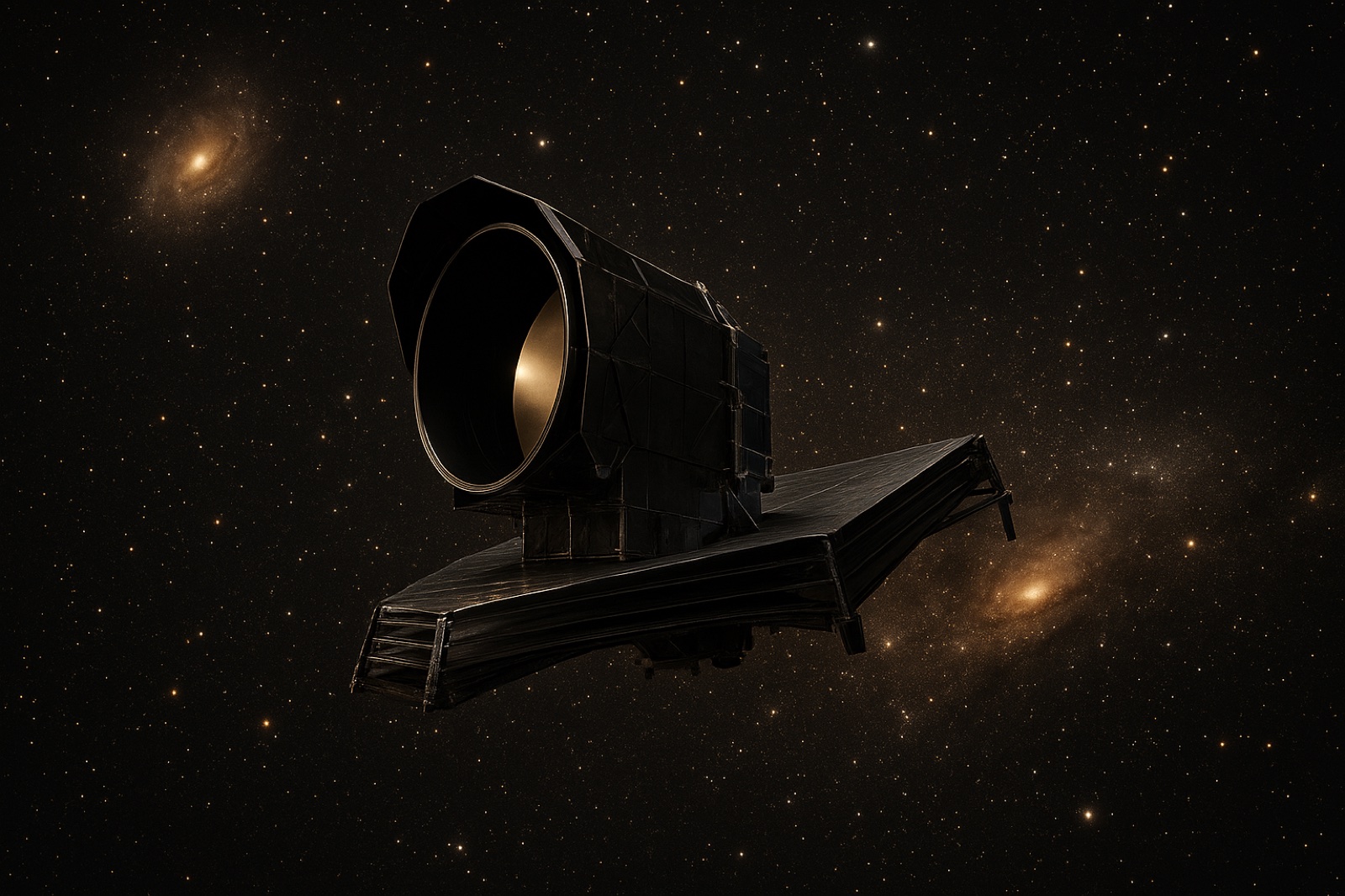
On August 30, 2026, a rocket will lift off from Kennedy Space Center carrying a machine that does something no human instrument has ever done before: photograph a slice of sky wide enough to hold a hundred times more of the universe in a single frame than the Hubble Space Telescope ever could.
It’s called the Nancy Grace Roman Space Telescope, and it’s not launching to look closer. It’s launching to look wider — wide enough to catch billions of galaxies in one shot, cataloged, mapped, and measured, almost like the universe is finally getting counted.
A Telescope Built to See 100 Times Wider Than Hubble
Here’s the part that’s easy to miss: Roman’s mirror is roughly the same size as Hubble’s. Same light-gathering power, same sharpness. But NASA engineers paired that mirror with a camera sensor so large it can capture a field of view about 100 times wider than Hubble’s — while holding onto Hubble-level detail across the whole thing.
Think of it like this. Hubble takes breathtaking close-up portraits — one galaxy, or a small cluster, filling the frame in stunning detail. Roman takes a group photo of the whole class, the whole school, the whole town — and somehow every single face is still in focus.
That single design choice is why Roman is expected to produce more data in its first few weeks than every NASA astrophysics mission before it, combined. One image from Roman could contain hundreds of millions of galaxies. Not “visible in the frame” — individually resolved, cataloged, measured for brightness, distance, and shape.
What NASA Actually Expects to Find
Roman isn’t just flexing resolution for the sake of it. The wide field of view exists to answer two questions that have quietly obsessed astrophysicists for decades.
The first is dark energy — the mysterious force that’s causing the universe’s expansion to accelerate rather than slow down. To even begin measuring it, scientists need to track how hundreds of millions of galaxies are distributed and moving across enormous stretches of sky. A narrow telescope, no matter how sharp, can’t do that. You need width. Roman was built for exactly this — a survey instrument as much as a camera.
The second is exoplanets. Roman will use a technique called gravitational microlensing, watching for the tiny, temporary brightening that happens when a planet’s gravity bends the light of a star behind it. Over its mission, Roman is expected to discover somewhere around 100,000 new exoplanets — more than every telescope in the history of astronomy has found combined, in one mission.
It’s a strange kind of instrument. Not built to zoom in on one thing, but to take in almost everything at once, and still see each individual piece clearly. If you’re curious just how vast the canvas Roman is about to survey really is, it’s worth sitting with the numbers behind how old the universe actually is — the scale gets stranger the longer you look at it.
It’s the latest entry in a run of discoveries that keep stretching what we thought we understood about deep space — from stardust older than our own sun found inside a decades-old meteorite, to black holes that may predate the Big Bang itself. Every new instrument seems to make the universe bigger and older than the last one did.
The Strange Comfort of Being Counted, Not Just Photographed
There’s something that happens to most people when they hear numbers like “billions of galaxies in one photo.” It doesn’t usually make you feel bigger. It makes you feel smaller — one person, on one planet, orbiting one ordinary star, about to get lumped into a dataset with hundreds of millions of others that look nothing like it and don’t know it exists.
But there’s an old idea — older than telescopes, older than the concept of a galaxy — that pushes back on that feeling in a way worth sitting with. Long before anyone could see past the naked eye, someone wrote down the claim that whoever made the stars didn’t just fling them out in bulk and walk away. That this same source counts them. Names them. One at a time. Not as a crowd. As individuals.
It’s a wild thing to say about the sky, honestly. And it gets wilder the more you learn about how many stars there actually are. But that’s the claim — not that we’re too small to be noticed in a universe this size, but that the one who made a universe this size still bothers to notice the small things in it. Including, it turns out, us.
Roman is going to spend the next several years counting galaxies by the hundreds of millions. And somewhere in the middle of that number, there’s still room — according to a much older kind of counting — for you to be known by name.
Maybe that’s the real reason a photo like this stops people in their tracks. Not because it makes us small. Because, somehow, it doesn’t.
Discussion Question: If a single photograph could hold billions of galaxies, would that make you feel more lost in the universe — or more amazed to still matter inside it? Tell us in the comments.
Share This
- NASA is about to launch a telescope that can photograph billions of galaxies in ONE image. My brain cannot process this. 🌌 Here’s what it’s actually built to find: https://bgodinspired.com/index.php/bible-resources/bible-and-science/nasa-roman-space-telescope-billions-of-galaxies/
- Roman’s mirror is the same size as Hubble’s — but it sees 100x more sky at once. It’s expected to find more exoplanets in one mission than every telescope in history combined. https://bgodinspired.com/index.php/bible-resources/bible-and-science/nasa-roman-space-telescope-billions-of-galaxies/
- A telescope that photographs billions of galaxies at once made me feel small. Then I read this. https://bgodinspired.com/index.php/bible-resources/bible-and-science/nasa-roman-space-telescope-billions-of-galaxies/
Questions People Are Asking
When does NASA’s Nancy Grace Roman Space Telescope launch?
The Nancy Grace Roman Space Telescope is scheduled to launch on August 30, 2026, aboard a SpaceX Falcon Heavy rocket from Launch Complex 39A at NASA’s Kennedy Space Center in Florida.
How is the Roman Space Telescope different from Hubble or the James Webb Space Telescope?
Roman’s primary mirror is roughly the same size as Hubble’s, giving it similar image sharpness, but it’s paired with a much larger camera sensor that captures a field of view about 100 times wider than Hubble’s. That means Roman can photograph huge swaths of sky — including hundreds of millions of galaxies in a single image — while still resolving fine detail, something no previous NASA telescope could do at that scale. James Webb, by contrast, is built for close-up infrared detail on individual objects rather than wide survey imaging.
Who was Nancy Grace Roman, and why is the telescope named after her?
Nancy Grace Roman was NASA’s first chief astronomer and one of the driving forces behind getting the Hubble Space Telescope funded and built, earning her the nickname “Mother of Hubble.” NASA named this new observatory after her in recognition of her role shaping how the agency does space-based astronomy.
How many galaxies will the Roman Space Telescope actually be able to see?
A single Roman image is expected to capture hundreds of millions of galaxies at once, individually resolved rather than just visible as background light. Over its full mission, the telescope will survey large regions of sky to build one of the most detailed maps of the universe ever created.
What is the Roman Space Telescope’s main scientific mission?
Roman has two primary goals: mapping the distribution of galaxies across vast regions of space to study dark energy — the force accelerating the universe’s expansion — and using a technique called gravitational microlensing to search for exoplanets. It’s expected to discover around 100,000 new exoplanets over its mission, more than every previous telescope combined.