 0
0
 0
0
For fifty years, physicists have been trying to answer a question that sounds almost too basic to still be unsolved: what actually holds an atom together?
You probably learned the textbook version in school. A proton is made of three quarks, stuck together, end of story. Except that answer was never quite complete — and this month, using data from one of the most powerful particle colliders ever built, a team of physicists finally showed why.
The Mystery Nobody Could See Inside
Every proton and neutron in your body carries something called baryon number. Think of it as matter’s ID card — the property that marks a particle as “real stuff” instead of antimatter, the mirror-image material that annihilates ordinary matter on contact. For decades, physicists assumed baryon number was split evenly across a proton’s three quarks, like three roommates each paying a third of the rent.
There was just one problem. That model never fully matched what particle collisions actually showed. It’s part of a bigger pattern — other recent research has already been upending long-held assumptions about how quarks behave — and this particular gap in the math went unexplained for half a century.
So a team from Rice University and Brookhaven National Laboratory, working with the STAR Collaboration at the Relativistic Heavy Ion Collider (RHIC) in New York, went looking for the missing piece. Led by physicist Nicole Lewis, the team smashed atomic nuclei together at nearly the speed of light and tracked exactly where baryon number ended up after the collision.
What they found rewrites the textbook.
It’s Not the Quarks. It’s the Space Between Them.
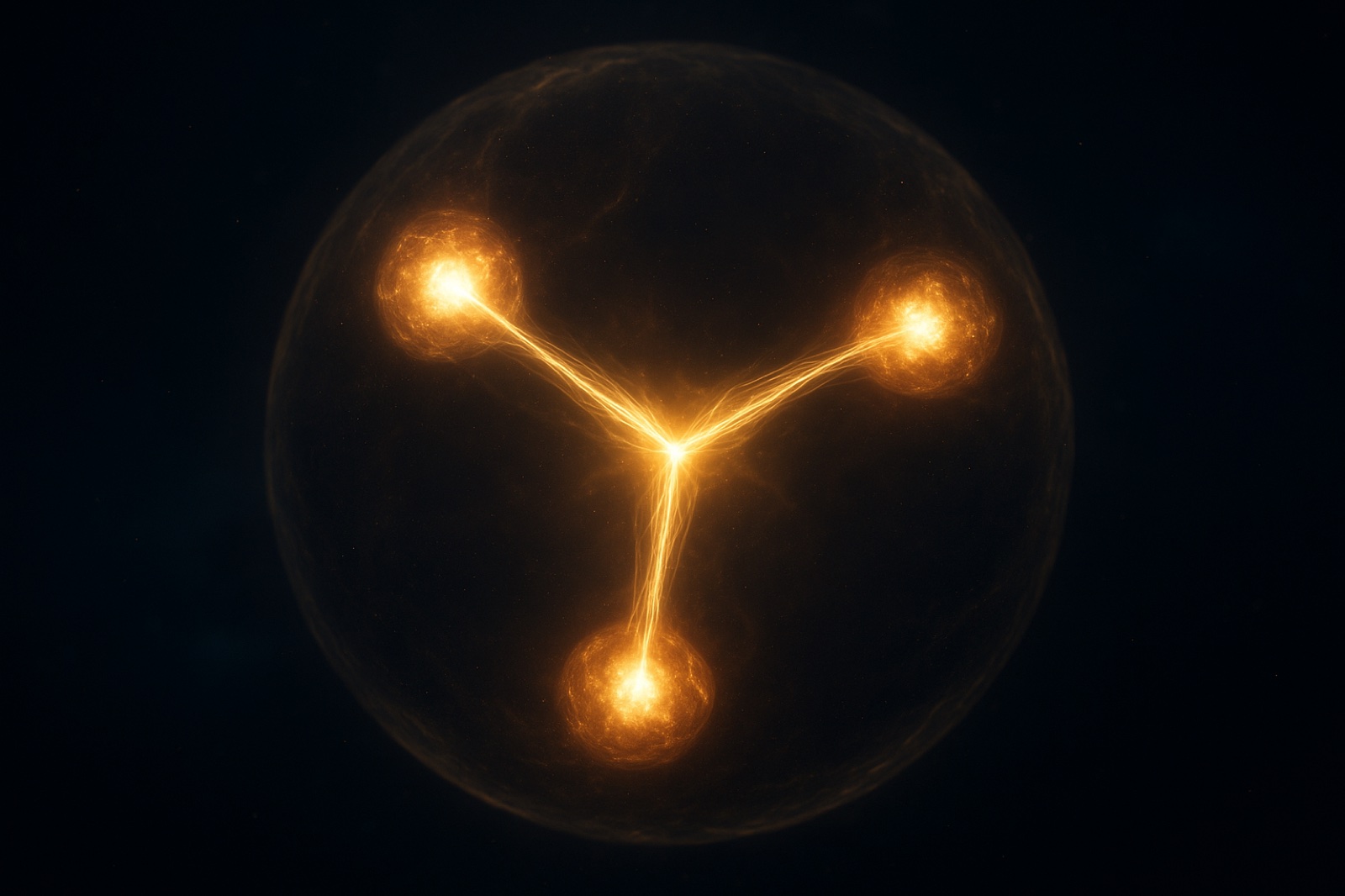
The three quarks inside a proton aren’t just floating next to each other — they’re bound by gluons, the particles that carry the strong nuclear force. Picture three points connected by lines meeting in the middle, forming a rough Y shape. That center point, where all three lines meet, is called the gluon junction.
For fifty years, one theory said this junction — not the quarks themselves — might be the true carrier of baryon number. It was a real idea, but nobody had the tools to test it directly.
Lewis’s team finally did. When they collided nuclei at RHIC, they tracked how far baryon number traveled from the collision point compared to how far the electrically charged quarks traveled. If the quarks carried the baryon number, it should travel with them. It didn’t. The baryon number showed up farther out, in places the quarks alone couldn’t explain — consistent with an unseen, uncharged junction carrying it independently.
“We designed experiments to interrogate this,” Lewis said, “and found that they supported this alternative gluon junction model instead.”
In plain terms: the thing holding a proton together, and marking it as matter instead of antimatter, isn’t really the three particles you’d point to. It’s the invisible structure connecting them.
Why This Isn’t Just a Physics Trivia Fact
Here’s where it stops being academic. One of the biggest open questions in cosmology is why the universe is made of matter at all. If you want to see just how far back that question goes, this quick universe-age explorer is a fun rabbit hole — but the short version is that the Big Bang, by the leading models, should have produced equal amounts of matter and antimatter, which would have annihilated each other completely, leaving nothing. No stars. No planets. No you.
Instead, matter won. Something tipped the scales early in the universe’s history, and physicists have spent decades trying to find what. A baryon number carried by a structural junction — rather than by particles that could theoretically flip identity — gives researchers a new, testable thread to pull on. It doesn’t answer the matter-antimatter mystery outright, but it hands scientists a real foothold they didn’t have before this year.
So the thing keeping your body from unraveling at the subatomic level, right now, as you read this, turns out to be something nobody could directly observe until 2026. Not the particles. The connection between them.
An Idea That’s Older Than the Microscope
There’s something quietly striking about that finding if you sit with it. Long before anyone had a particle collider, or even a microscope powerful enough to imagine a proton, an ancient text made a claim that sounds almost like a preview: that something holds everything together, and that something isn’t visible to the eye.
It’s the same shape of idea researchers stumbled into when they mapped the hidden fungal network feeding every forest floor earlier this year — life quietly sustained by a connective structure nobody could see until they went looking for it. Nobody in the ancient world had a word for gluons or baryon junctions. They didn’t need one. The claim wasn’t a scientific prediction — it was a different kind of confidence, arrived at a completely different way, pointing at the same basic shape of reality: the universe isn’t held together by the parts you can point to. It’s held together by something underneath the parts, something you have to trust is there before you can ever prove it.
Whatever you believe put that connection there, it’s worth noticing that the deeper physicists look, the more the universe looks less like scattered pieces and more like something intentionally, invisibly held.
What This Means the Next Time You Feel Unsteady
There’s a reason “holding it together” is a phrase we reach for on hard days — it turns out to be literally true, all the way down to the smallest matter in your body. The atoms in your hands aren’t secured by force of habit. They’re bound by something real, something structural, something that was there before anyone could see it and will keep doing its job whether or not you ever think about it again.
Maybe that’s worth carrying with you the next time your own life feels like it’s coming apart at the seams. The visible pieces aren’t always what’s actually holding things up.
What do you think — does it change anything to learn the “glue” holding matter together is something science only just proved exists, fifty years after it was first theorized? Drop your take in the comments.
Share This
- Physicists just found proof that the “glue” holding your atoms together isn’t the particles — it’s the invisible connection between them. Took them 50 years. bgodinspired.com
- Wild fact for your Sunday scroll: matter exists because of a structure inside protons nobody could prove was there until this year. The parts aren’t what’s holding it together — the connection is.
- They finally found what’s actually holding matter together, and it’s not what your high school textbook said. 50 years to prove it. Worth the read.
Frequently Asked Questions
What did physicists just discover about what holds matter together?
A team from Rice University and Brookhaven National Laboratory, using the STAR Collaboration’s data from the Relativistic Heavy Ion Collider (RHIC), found strong evidence that baryon number — the property that identifies a particle as matter rather than antimatter — is carried primarily by a Y-shaped structure of gluons connecting a proton’s three quarks, rather than by the quarks themselves.
What is baryon number?
Baryon number is a quantum property that marks a particle as ordinary matter, as opposed to antimatter, which annihilates matter on contact. It’s part of why the physical world holds together instead of erasing itself.
What is a gluon junction?
A gluon junction, sometimes called a baryon junction, is the point where the three gluon “strings” binding a proton’s three quarks meet, forming a rough Y shape. Research led by physicist Nicole Lewis found evidence that this junction, not the quarks, is what carries baryon number.
Why did this take 50 years to prove?
The gluon junction theory has existed since the 1970s, but testing it required tracking baryon number’s exact location after high-speed particle collisions, something that only became possible with newer detector technology at colliders like RHIC.
Could this discovery explain why the universe exists?
Not on its own, but it’s a meaningful step. One of physics’ biggest open questions is why the universe ended up with far more matter than antimatter after the Big Bang, when the two should have annihilated each other completely. Understanding exactly how and where baryon number is carried gives researchers a new, testable angle on that mystery.