 0
0
 0
0
Tuesday morning, a little after 8:30, a man named David Flores was driving along a road outside Sabinal, Texas, when he saw something that didn’t make sense at first: a man clinging to a tree in the middle of what used to be Elm Creek. What happened in the next few minutes is exactly the kind of thing people mean when they use the phrase “good samaritan” — usually without thinking about where it actually came from.
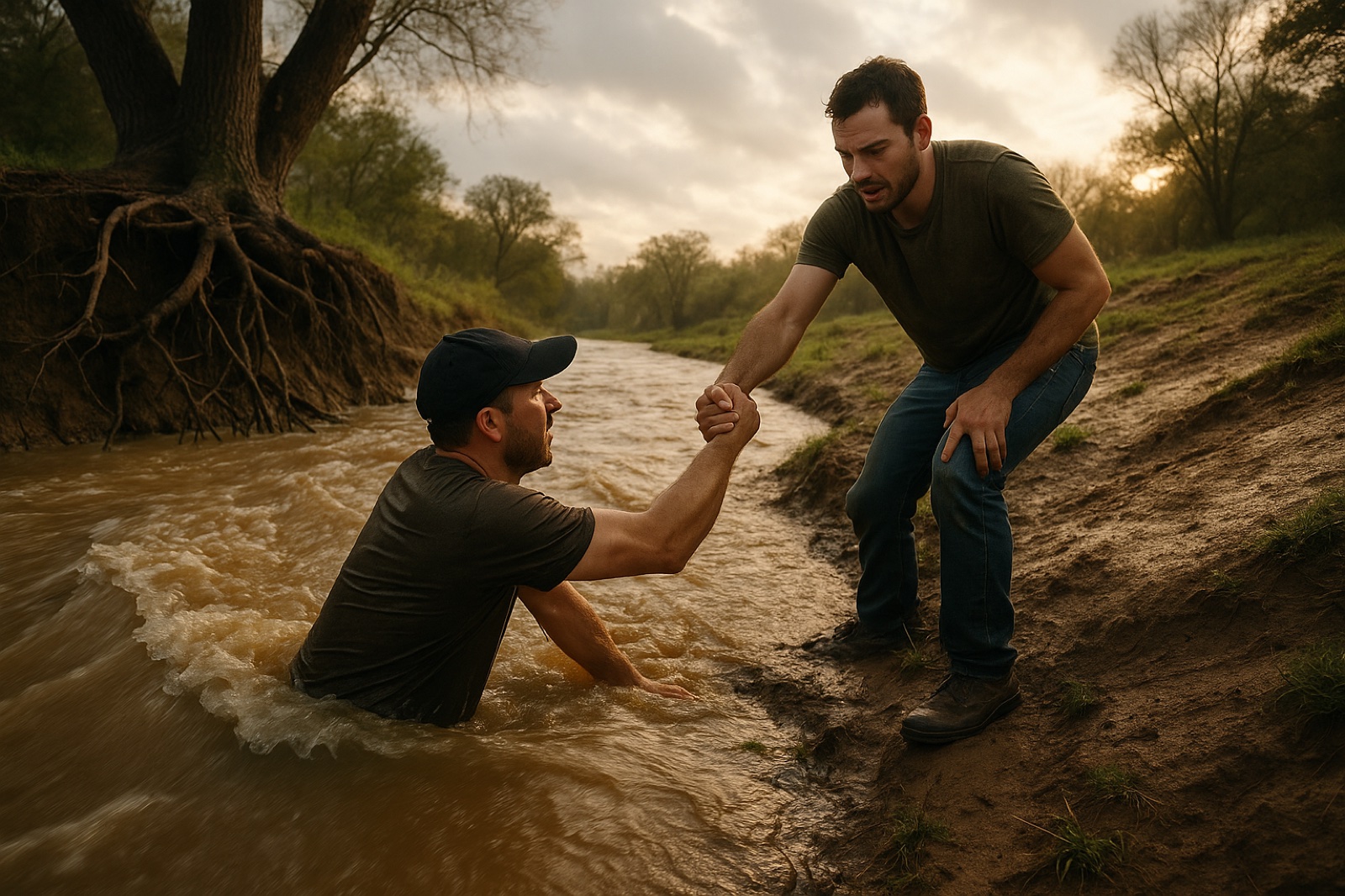
It wasn’t a creek anymore. Overnight, more than 12 inches of rain had fallen on Uvalde County — more than half a normal year’s worth in a matter of hours — and the water had gone from a trickle to a brown, churning current in the time it takes to make coffee. The man, later identified only as Nathan, had been swept off the road and into the flood. He wasn’t going anywhere on his own. The water was moving too fast, and there was nothing solid between him and the current except the trunk he was holding onto with both arms.
Flores didn’t call it in and wait. He didn’t stand on the bank and film it, though a dashcam did capture what happened next. He got out of his car, walked to the edge of the water, and waded in.
What It Actually Took to Do That
By the time Flores reached Nathan, the water was at his chest. Floodwater moving at even a few miles an hour can knock an adult off their feet — six inches of fast-moving water is enough to sweep a person away, according to the National Weather Service. Flores had no rope, no life vest, no backup. He had a stranger holding onto a tree and a closing window before that tree gave out or Nathan’s grip did.
He got to him. He got an arm around him. And step by step, fighting a current that was actively trying to take both of them downstream, he got them both back to solid ground.
Neither man knew the other’s name before that morning. They do now.
This is one rescue inside a much bigger emergency — Texas Hill Country was already reeling from catastrophic flooding that has killed at least two people and triggered water rescues across the region, a gut-punch of déjà vu for a part of the state that lived through devastating floods almost exactly a year earlier. Most of what happened this week was recorded in official numbers: rainfall totals, rescue counts, disaster declarations across 28 counties. Flores and Nathan are two names inside that math. But the video of what happened between them is the part that stopped people scrolling.
Why the Person Who Acts Is Rarely the Person You’d Expect
Psychologists have a name for the opposite of what Flores did. It’s called the bystander effect — the well-documented pattern where the more people who witness someone in danger, the less likely any single one of them is to step in. Everyone assumes someone else will act, or is better equipped to, or already has. Responsibility gets diffused across the crowd until it belongs to no one.
The flip side of that research is just as consistent: people who are alone with the emergency — no crowd to hide inside, no one else to defer to — intervene far more often. There’s no one to wait on. The decision lands entirely on you, in real time, before your brain has finished calculating the risk.
That’s most likely what happened on that creek bank. There wasn’t a crowd. There was one driver, one man in the water, and about as much time as it takes to decide. Flores didn’t have the luxury of a debate with himself. He just moved.
It’s worth sitting with how rare that actually is, statistically and personally. Most of us have imagined the moment — what we’d do if we saw someone in real trouble and no one else around to help. Fewer of us have actually been tested on it. Fewer still, tested, wade in.
It’s the same instinct behind a stranger’s airport conversation that ended up changing a struggling veteran’s life — nobody required it, nobody was owed it, and the person on the receiving end had done nothing to earn it beyond simply needing it.
Where the Phrase “Good Samaritan” Actually Comes From
Long before flood cams and dashcam footage, a man once asked Jesus a pointed question: who, exactly, counts as my neighbor? He wanted a boundary. A defined circle of people he was obligated to help, so he’d know where the obligation ended.
Jesus didn’t give him a boundary. He told him a story instead — about a traveler beaten and left for dead on the side of a road, and the string of respectable people who saw him and kept walking. The one who finally stopped, bandaged his wounds, and paid for his recovery was a man from a group his listeners had been raised to look down on. Someone with every social permission to keep driving, so to speak, and none of the relationship that would have obligated him to stop.
The story wasn’t really about geography or bloodline. It was about proximity to someone else’s need, and what you do with it. Jesus’s answer to “who is my neighbor” was, in effect: whoever you happen to find in the water.
Two thousand years and a Texas flash flood later, the question still gets answered the same way — not in a sermon, but in a dashcam video of a man wading chest-deep into a current for someone whose name he didn’t know yet.
What This Actually Means for You
Most of us aren’t going to be tested by a flooded creek. But the underlying test shows up constantly, in far smaller versions: the coworker struggling alone with something you could help carry, the stranger stuck on the roadside, the neighbor who’s clearly not okay. The bystander effect research suggests the biggest predictor of whether you’ll act isn’t your character in the abstract — it’s whether you let yourself be the one, right now, instead of waiting for someone else to be.
If you’re the only one who’s noticed, that’s usually the signal, not the excuse.
It doesn’t have to be dramatic to count. Most of what actually gets asked of us never looks like wading into a flood — it looks a lot smaller and a lot more frequent than that. And it’s worth asking, honestly, what obligation we actually carry toward people who are, technically, strangers to us.
Flores and Nathan are on solid ground now. The water’s still rising for a lot of other people this week. Somewhere nearby, someone else is about to be the only one who notices.
Discussion Question
Have you ever been the only person who noticed someone needed help — no crowd, no one else to defer to? What did you do, and what do you think you would do now? Drop your answer in the comments.
Share This
- A man waded chest-deep into a flooded Texas creek to pull a total stranger to safety. No hesitation, no crowd, no one telling him to. This is what “neighbor” actually looks like. bgodinspired.com
- Someone asked Jesus 2,000 years ago who counts as their neighbor. This week, a stranger in floodwater answered the question again without saying a word. bgodinspired.com
- The bystander effect says the more people watching, the less likely anyone acts. This story is what happens when there’s no crowd to hide in — just one person and a decision. bgodinspired.com
Questions People Are Asking
What happened in the Texas flood rescue video?
On July 16, 2026, David Flores waded chest-deep into floodwater in Elm Creek near Sabinal, Texas, to rescue a man named Nathan who had been swept into the current and was clinging to a tree. Both men made it safely to shore. The rescue happened during a major flash-flooding emergency across Texas Hill Country that triggered a disaster declaration in 28 counties.
What is the bystander effect?
The bystander effect is a well-documented psychological pattern where the presence of other witnesses to an emergency makes any individual witness less likely to intervene, because responsibility feels diffused across the group. People are significantly more likely to act when they’re alone with the situation and no one else to defer to.
What is the story of the Good Samaritan about?
It’s a story Jesus told in response to being asked who counts as a “neighbor.” A traveler is beaten and left on the roadside, several respected people pass him by, and the one who finally stops to help is someone from a group the listeners had been taught to view as an outsider. The point was that “neighbor” isn’t defined by group membership — it’s defined by who actually stops to help.
How much floodwater does it take to sweep a person away?
According to the National Weather Service, as little as six inches of fast-moving water can knock an adult off their feet, and about a foot can carry away most vehicles. This is why floodwater rescues, even in what looks like a small creek, are genuinely dangerous for both the person in the water and the person going in after them.
Why do some people help strangers in danger while others hesitate?
Research points to several factors: whether other bystanders are present (fewer witnesses generally means faster action), how clearly the danger registers as an emergency, and whether the person feels a personal sense of responsibility in the moment rather than assuming someone else is better positioned to help.