 0
 0
Quick Answer
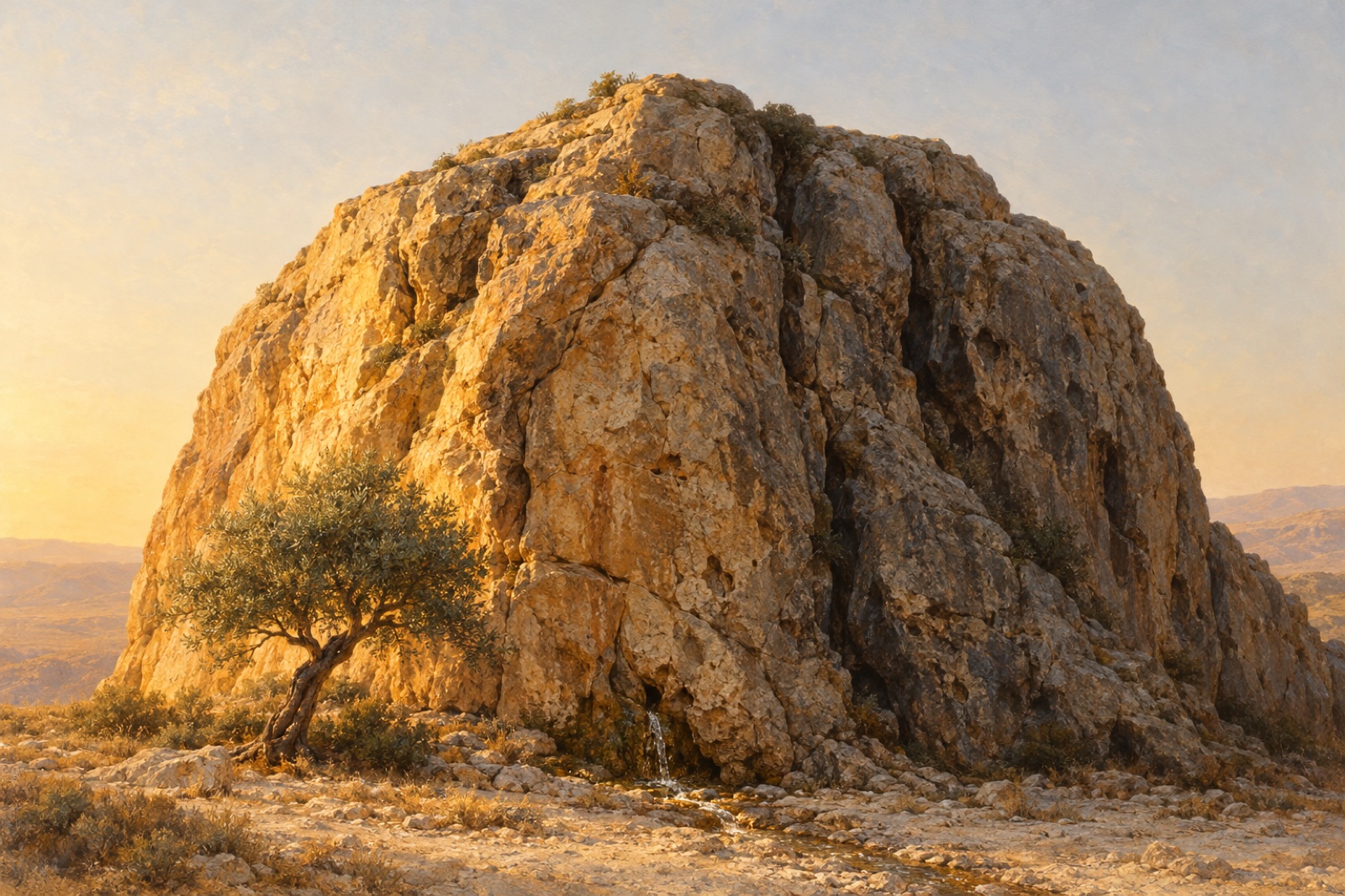
Tzur (צוּר), pronounced tsoor, Strong’s H6697, is the Hebrew word for rock. It is a masculine noun meaning a boulder, a cliff face, or a mass of bedrock, and you will also see it transliterated tsur or ṣûr. It appears 77 times in the Hebrew Bible. Most of those are ordinary stone. Ten of them are a title for God.
That ratio is the whole word study. Scripture does not reach for a special, holy, abstract word when it wants to say something about God’s reliability. It reaches for the most unremarkable thing in the landscape, the rock that was there before anyone arrived and will be there after everyone leaves, and uses it as a name.
Word Study: Where It Comes From
Strong’s traces tzur back to the verb tsuwr (H6696), meaning to bind, to besiege, to confine, to cramp, and so defines the noun as “properly, a cliff (or sharp rock, as compressed).” Brown-Driver-Briggs and the NAS concordance are more cautious, listing the root behind tzur as unused, which would make the noun older than any verb surviving in the text.
Either way, the sense that comes through is pressure. A tzur is compressed stone. Not a pebble, not a decorative stone set on a shelf, but the dense mass that pressure made and pressure does not move.
Scripture backs that up in an unexpected place. In Joshua 5:2, God tells Joshua to “Make thee sharp knives” before circumcising Israel a second time. The word behind “sharp knives” is tzur: knives of flint. Strong’s lists “edge” and “sharp” among its glosses for exactly this reason. A tzur is not soft, and it is not round. It is hard enough to strike a blade from.
Here is how one modern translation (NASB) renders its 77 appearances, which is a useful x-ray of the word:
- rock — 54 times
- Rock, capitalised, as a title for God — 10 times
- rocks — 7 times
- rocky — 1 time
- stones — 1 time
- strength — 1 time
Hold onto that last line. It is small, and it turns out to matter.
The same God who spoke to Moses wants to speak with you today. The Beginner’s Guide to Feeling God’s Presence Every Day is a simple, practical guide to experiencing God in ordinary moments, even when life feels chaotic, with a 3-step rhythm you can start this week. It’s free above.
Where This Word Appears in the Bible
| Reference | KJV Text | What Tzur Is Doing |
|---|---|---|
| Exodus 17:6 | “Behold, I will stand before thee there upon the rock in Horeb; and thou shalt smite the rock, and there shall come water out of it, that the people may drink.” | Literal bedrock, and the word’s first appearance in the Bible |
| Deuteronomy 32:4 | “He is the Rock, his work is perfect: for all his ways are judgment: a God of truth and without iniquity, just and right is he.” | The first time tzur becomes a title |
| 1 Samuel 2:2 | “There is none holy as the LORD: for there is none beside thee: neither is there any rock like our God.” | Hannah’s song, measuring God against every other tzur |
| Psalm 19:14 | “Let the words of my mouth, and the meditation of my heart, be acceptable in thy sight, O LORD, my strength, and my redeemer.” | Tzur, translated “strength” — the rock is hidden in English |
| Isaiah 26:4 | “Trust ye in the LORD for ever: for in the LORD JEHOVAH is everlasting strength.” | Tzur olamim, literally “Rock of ages” |
Two of those five do not contain the word “rock” in English at all.
Verse Deep Dive: Deuteronomy 32, Where the Rock Became a Name
If you read the Hebrew Bible straight through, tzur is just scenery for a long while. The first five times it appears, it is stone and nothing more: the rock Moses strikes at Horeb (Exodus 17:6), the rock Moses is set in (Exodus 33:21-22), the rocks Balaam looks down from (Numbers 23:9), the flinty rock of the wilderness (Deuteronomy 8:15).
Then comes the Song of Moses, and the word changes jobs. Deuteronomy 32:4 is the first place in Scripture where tzur is used as a title for God, and once Moses picks it up he will not put it down. Tzur appears in seven verses of that one chapter: 32:4, 13, 15, 18, 30, 31 and 37.
Watch what Moses does with it. In verse 4 it is praise: “He is the Rock, his work is perfect.” In verse 15 it is indictment, as Israel “forsook God which made him, and lightly esteemed the Rock of his salvation.” In verse 18 it goes somewhere strange:
“Of the Rock that begat thee thou art unmindful, and hast forgotten God that formed thee.” (Deuteronomy 32:18)
A rock that gives birth. Moses jams together two images that cannot both be literal, and the collision is the point: the thing that does not move is also the thing you came from.
But the sharpest move is verse 31:
“For their rock is not as our Rock, even our enemies themselves being judges.” (Deuteronomy 32:31)
The Hebrew uses tzur twice in that one line: once for the idols, once for God. Moses does not say the nations around Israel have no rock. He says they have one, that it is a tzur too, and that it will be compared. Verse 37 presses the point in: “Where are their gods, their rock in whom they trusted?”
That is the argument of the entire song, and it is not the argument most of us expect. It is never whether you are leaning your weight on something. Everyone is leaning. The only live question is whether the thing you have chosen can take the weight.
Not All “Rock” Is the Same
Hebrew has more than one word here, and the differences are real:
- Tzur (צוּר, H6697): a mass of bedrock, a boulder, a cliff. Dense, immovable, hard enough to make a blade from. This is the one used as a title for God.
- Sela (סֶלַע, H5553): a cliff or a crag. Sela leans toward the high, inaccessible rock, the kind with clefts in it, the kind you hide in rather than stand on.
- Eben (אֶבֶן, H68): a stone. Something a person can lift, carry, build with or throw. Its other main meaning is a weight, the stone in a merchant’s scale.
Psalm 18:2 is worth slowing down over, because the KJV quietly uses two of these in a single verse: “The LORD is my rock, and my fortress, and my deliverer; my God, my strength, in whom I will trust.” The word printed there as “my rock” is sela. The word printed as “my strength” is tzur. David stacks a hiding place and a foundation in one breath, and English flattens the second one into an abstraction.
The two water-from-rock miracles split the same way. At Horeb, Moses strikes a tzur (Exodus 17:6). Years later at Meribah in the wilderness of Zin, the rock he is told to speak to, and strikes instead, is a sela (Numbers 20:8-11). Same miracle, different stone, different word.
Why the Original Word Changes the Meaning
Go back to that one-line statistic: tzur gets rendered as “strength.” It is rare in modern translations, but the KJV does it in some of the most-quoted verses in the Bible.
- Psalm 19:14 — “O LORD, my strength, and my redeemer” → my Rock
- Psalm 18:2 — “my God, my strength” → my Rock
- Isaiah 26:4 — “in the LORD JEHOVAH is everlasting strength” → tzur olamim, the Rock of ages
It is not a mistranslation. “Strength” captures something true. But look at what happens to the picture.
Strength is a quality. It belongs to whoever has it, it can be handed out, and it can run low, which is why we ask God for strength, as though drawing down a supply.
A rock is a place. You do not ask a rock for anything. You stand on it. You put your weight down and stop holding yourself up.
Those are two different prayers. One is a request. The other is a decision to stop bracing. When Isaiah calls God tzur olamim, “the Rock of ages,” the claim is not that God has a great deal of strength available this year. It is that the ground has been there for ages and will not be renegotiated. And when David, “overwhelmed” in Psalm 61:2, prays “lead me to the rock that is higher than I” — tzur again — he is not asking to be made stronger. He is asking to be put somewhere that does not depend on him being strong.
Living It Out
Pick the thing you are currently bracing against: the outcome you keep checking, the problem you re-solve at two in the morning. Then ask Moses’ question from Deuteronomy 32:31 honestly. Is that my tzur? Not “is it bad,” but: can it take my weight?
Most of the things we lean on are eben, not tzur. They are stones: real, useful, liftable, and far too small to stand on. Naming one of them out loud this week is not a defeat. It is how you find out where the bedrock actually is.
Journal Prompts
- Deuteronomy 32:31 assumes everyone has a rock: “their rock is not as our Rock.” Write down what you have actually been standing on this month — a plan, a person, your own competence. What would it take to find out whether it holds?
- Psalm 19:14 calls God tzur, but the KJV prints “strength.” Which of the two have you been praying for: more strength to carry something, or a place to set it down? Write out that second prayer in your own words.
- Deuteronomy 32:18 calls God “the Rock that begat thee” — immovable, and also the source you came from. Where have you treated God’s unchangingness as distance rather than as the reason anything about you is possible?
Prayer
Lord, I have been holding myself up again, and I am tired of pretending that is faith. You are tzur: not a supply of strength I have to keep asking for, but ground that was here before me and will be here after me. Deuteronomy says Your work is perfect and all Your ways are judgment, and I would like to believe that about the parts of my life I cannot see the end of. Be the Rock of ages for me today, not a rock I admire from a distance. Lead me to the rock that is higher than I am, and when I get there, teach me how to put my weight down. Amen.
Share This
- “The Hebrew word for rock, tzur, shows up 77 times in the Bible — and in Psalm 19:14 the KJV translates it ‘strength.’ But strength is something you ask for. A rock is something you stand on. Those are two very different prayers. [Post URL]”
- “In Deuteronomy 32:31 Moses says ‘their rock is not as our Rock,’ using the same Hebrew word, tzur, for the idols and for God. His point wasn’t that other people have nothing to lean on. It’s that everyone is leaning, and only one rock holds. [Post URL]”
FAQ
What does tzur mean in Hebrew?
Tzur (צוּר, Strong’s H6697) is a masculine noun meaning a rock, boulder, cliff or mass of bedrock. It appears 77 times in the Hebrew Bible, usually of literal stone, but ten times as a title for God. The emphasis is on hardness and immovability rather than size: the same word is used for the flint knives in Joshua 5:2.
Is tzur the same as the rock in Psalm 18:2?
Not the word printed there. In Psalm 18:2, the phrase the KJV renders “my rock” is sela (H5553), a cliff or crag, the high rock you shelter in. Tzur does appear in that same verse, but the KJV translates it “my strength.” Both words are in one breath, and English keeps only one of the two pictures.
Why do some Bibles translate tzur as “strength”?
Because the figurative sense of an immovable rock is strength, and some translators carried the meaning across rather than the image. The KJV does this in Psalm 18:2, Psalm 19:14 and Isaiah 26:4, where tzur olamim, literally “Rock of ages,” becomes “everlasting strength.” Nothing false is introduced; the metaphor just goes invisible.
Where is God first called “the Rock” in the Bible?
Deuteronomy 32:4, in the Song of Moses: “He is the Rock, his work is perfect.” Every earlier use of tzur — Exodus 17:6, Exodus 33:21-22, Numbers 23:9 and Deuteronomy 8:15 — refers to actual stone. Moses then uses the word in seven verses of that single chapter, including twice in verse 31, where one of the two is Israel’s idols.
God is not far off. The Beginner’s Guide to Feeling God’s Presence Every Day shows you a simple 3-step rhythm for noticing God in ordinary moments, even when life feels chaotic. It’s free, and you can start today.