 0
 0
In the spring of 2011, somebody carried a small turtle out to a marsh in Concord, Massachusetts, set her down at the edge of the water, and walked away.
She had a number, 144, and a nickname, Ivy. She had spent the winter indoors, warm and fed. The people who raised her had marked her shell so they would know her again if they ever met her.
Then nobody saw her for twelve years.
Not twelve days. Not twelve months. Twelve years of people walking that wetland with notebooks, and not one of them turned up turtle 144.
Here is what makes the story worth telling: in June 2026, two of her own hatchlings were carried out to the same marsh and set down in the same water. It was the first time in the program’s history that a turtle raised by human hands had produced a generation that went back into the wild.
What a Blanding’s Turtle Head Start Actually Is
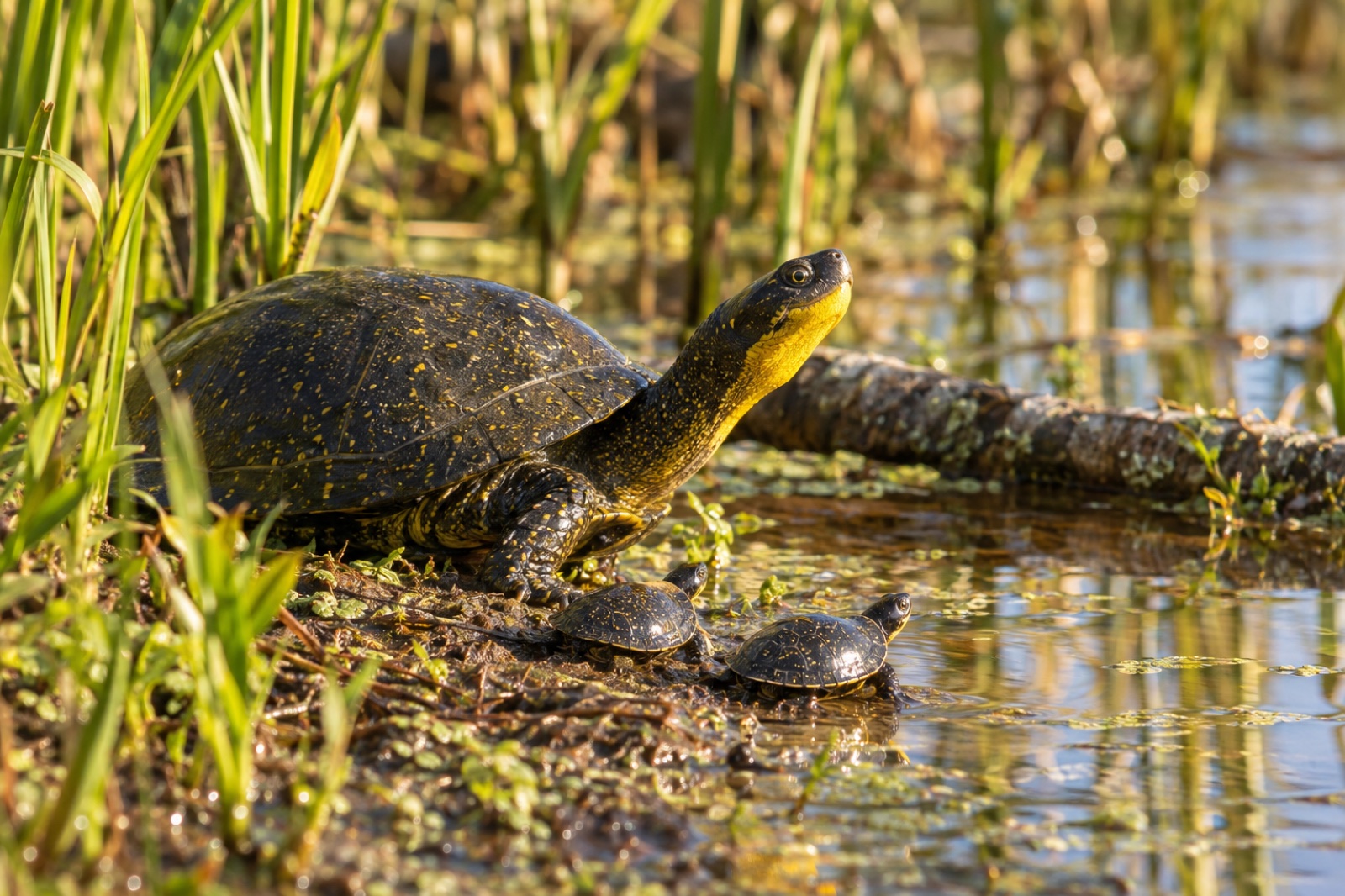
Ivy is a Blanding’s turtle. If you have never seen one, the throat is the giveaway — a bright lemon-yellow chin and neck under a high, domed shell flecked with pale yellow. Massachusetts lists the species as Threatened. It is not federally listed.
She hatched in 2010, from a nest her mother laid about two kilometres (around 1.2 miles) away from the refuge wetlands. That walk is normal for the species; females travel a long way over dry land to find soil they like. The nest produced eleven hatchlings. Ivy was one of them, and she weighed seven grams. Small enough to sit in a spoon.
That is the problem the whole program exists to solve. A hatchling that spends its first winter outside is still, by spring, small enough to sit on a thumbnail. Almost everything in a marsh can eat something that size.
So Zoo New England does something called head-starting. Hatchlings are collected in early autumn and spend the winter in warm water with as much food as they want, instead of hibernating. Ivy spent ten months with the animal care staff at Stone Zoo before she was released in 2011. The two hatchlings released this June each weighed about a third of a pound — roughly 150 grams. Twenty times what their mother weighed on her first day.
The logic is not complicated: a bigger turtle has fewer things in the marsh that can swallow it. The program began at Great Meadows National Wildlife Refuge in 2003, and more than 800 head-started Blanding’s turtles have gone into that refuge and the wetlands around it since.
Twelve Years of Nothing
Ivy went into the water in spring 2011. The next confirmed sighting of her was in 2023, during a routine field survey. Count it out: that is twelve years with no information at all.
It is worth being precise about what that silence was and was not. There is no evidence she went anywhere unusual. She was a wild turtle living in a wetland, which is simply a very hard thing to find on purpose. Nobody lost her. Nobody failed to look. She was there the whole time, and the marsh is big.
When the field technicians finally did find her, she was an adult. “She looked big and strong, nearly reproductive size,” Emilie Wilder of Zoo New England said of that day, in the U.S. Fish and Wildlife Service’s account of the release.
Nearly. Not yet. Even after twelve years, the answer to “did this work?” was still ask again later.
The Silence Was the Schedule
This is the part that almost nobody mentions, and it changes the whole shape of the story.
Massachusetts publishes its own fact sheet on the species. Buried in it is a line drawn from research by Congdon and colleagues in 1993: female Blanding’s turtles reach sexual maturity at 14 to 20 years of age.
Fourteen to twenty. Ivy hatched in 2010 and laid her first known nest in 2025, at fifteen.
Read those two numbers together and the twelve silent years stop looking like a gap in the record. Even if a technician had found Ivy every single year — walked right up to her, every spring, twelve springs running — there would have been nothing to report until roughly year fourteen. There was no earlier answer available. The waiting was not time lost on the way to the work. The waiting was the work, at the only speed the animal has.
That is a hard thing to build a career around, let alone a budget. And it is why so much of the language we use about patience is slightly wrong. We treat waiting as the dead stretch between effort and result, something to be endured with good grace. For a species that does not reproduce until its late teens and can live past eighty, the waiting is not an interruption of the process. It is most of the process. (The familiar line about good things coming to those who wait, incidentally, is not from the Bible at all — it’s a sixteenth-century French proverb.)
June 25, Two Years Running
By 2025 Ivy was carrying a radio transmitter, so this time they could follow her. The signal led staff to a nest site on conservation land owned by the Town of Concord, next to the refuge.
She laid eight eggs in a protected wildflower meadow, starting at half past two in the morning. Nesting is slow work, and females often keep at it long after dark.
Seven of the eight hatched that autumn.
On the evening of 25 June 2026 — a year to the day after she laid them, by the dates the zoo gives — two of those hatchlings were released at Great Meadows. Second generation. Confirmed. Twenty-three years after the program started.
The other five did not go back quietly. They were raised in local school classrooms through the zoo’s program, and the students released them before the school year ended. Which means that somewhere in Massachusetts right now there are children who can point at a specific marsh and say that a specific turtle in it is theirs.
“It’s taken two decades to get here,” said Grace Bottitta, project leader for the U.S. Fish and Wildlife Service’s Eastern Massachusetts National Wildlife Refuge Complex. The release also honoured Dr. Bryan Windmiller, who founded the Great Meadows program in the first place and spent more than twenty years on it.
Work You Don’t Get to Watch
There is something quietly uncomfortable in all of this, and it is worth naming.
Whoever wrote “144” on a record sheet in 2010, whoever fed that seven-gram turtle through the winter, whoever carried her out to the reeds in 2011 — none of them had any way of knowing. Not for twelve years. Some of them had probably stopped thinking about her entirely. Some of them have surely moved on to other jobs, other towns, other lives. The news, when it finally came, did not arrive as a survey result. It arrived as her children.
Which is not a situation unique to turtle people. A woman in Lebanon has spent thirty years walking the same beach before dawn, guarding nests she will never see hatch into adults. Teachers do this. Parents do this. Anyone who has ever planted a tree does this.
There is a very old line of thinking about exactly this, far older than any conservation program: that the sowing and the seeing are two different jobs, and you are only ever responsible for one of them. You put the thing out on the water. You do not get to stand there and watch where it comes ashore. People who believe in God have tended to describe patience less as a personality trait than as a kind of trust — because the harvest, whatever it turns out to be, was never on your calendar in the first place.
Most of the good that gets done in a lifetime seems to work that way. Which may be why nobody has managed to improve on the idea in several thousand years.
Where Ivy Is Now
Still out there. She is about sixteen, which for a Blanding’s turtle is barely past the start. The species can live beyond eighty; the oldest well-documented individual on record was recaptured at a University of Michigan reserve at the age of 83. Ivy may nest for decades yet.
The two hatchlings released in June will not be old enough to lay eggs of their own until some time in the 2040s. Somebody will have to still be there, still walking that marsh with a notebook, to find out whether it worked.
“The turtles we release tonight may outlive some of us,” Mike Jones, the state herpetologist for MassWildlife, said that evening. He did not appear to mean it as a sad thing.
Actions to Take
If any of this landed, three small things, none of which cost anything:
- Write down the date you started. Pick the one thing you are doing for a result you can’t see yet — a child, a skill, a recovery, a repair. Put the start date somewhere you’ll find it again. Not to measure progress. Just so the real length of the work is on record somewhere other than your memory, which will lie to you about it.
- Find out the actual timeline. Ivy’s story only makes sense once you know the number is fourteen to twenty. Most waiting feels unbearable partly because we’re comparing it to a deadline we invented. Whatever you’re waiting on, find out how long it genuinely takes.
- Do this week’s small maintenance. Not the big push. The feeding, the checking, the ordinary bit. Twelve years of that is what the 2026 release was actually made of.
And if patience is honestly the part you find hardest, our free How Patient Am I? quiz takes about two minutes and is more useful than it sounds.
Questions People Ask About Blanding’s Turtles
What is a Blanding’s turtle?
A Blanding’s turtle (Emydoidea blandingii) is a mid-sized freshwater turtle recognised by its bright yellow chin and throat and its high, domed shell flecked with pale yellow. It is found mainly around the Great Lakes region, with smaller separate populations in the eastern United States and southern Canada. Massachusetts lists the Blanding’s turtle as a Threatened species at state level; it is not listed federally in the United States.
Why was turtle 144 not seen for twelve years?
Blanding’s turtle 144, nicknamed Ivy, was released into the wetlands at Great Meadows National Wildlife Refuge in Concord, Massachusetts in 2011 and was not recorded again until a routine field survey in 2023. There was nothing mysterious about the gap. A wild turtle in a large wetland is extremely difficult to locate on purpose, and she was not wearing a tracking transmitter at that time. She had been living in the marsh throughout.
What does head-starting a turtle mean?
Head-starting is a conservation technique in which hatchling turtles are collected in early autumn and raised indoors over the winter in warm water with unlimited food, rather than being left to hibernate outdoors. They are released the following spring at a far larger size. Zoo New England’s head-start hatchlings released at Great Meadows in June 2026 weighed roughly 150 grams each — about a third of a pound — compared with the seven grams a Blanding’s turtle weighs at hatching. The larger size reduces the number of marsh predators able to eat them.
At what age do Blanding’s turtles first nest, and how long do they live?
Female Blanding’s turtles reach sexual maturity at roughly 14 to 20 years of age, according to the Massachusetts Natural Heritage and Endangered Species Program fact sheet, which cites research by Congdon and colleagues published in 1993. They are also long-lived: individuals can pass 80 years, and the oldest well-documented Blanding’s turtle was recaptured at a University of Michigan reserve at age 83. This combination of very late maturity and great longevity is why conservation programs for the species are measured in decades.
What made the June 2026 turtle release at Great Meadows historic?
On 25 June 2026, Zoo New England, MassWildlife and the U.S. Fish and Wildlife Service released two Blanding’s turtle hatchlings at Great Meadows National Wildlife Refuge in Concord, Massachusetts. Those hatchlings were the first confirmed second generation in a head-start program that began in 2003 — the offspring of a female who had herself been raised by the program and released in 2011. More than 800 head-started Blanding’s turtles have been released at the refuge and nearby wetlands since the program started.
What Do You Think?
Ivy’s story only works because somebody kept walking that marsh for twelve years with nothing to show for it. Do you think most worthwhile work looks like that — long, unglamorous, invisible for years — or have we started romanticising patience a bit too much in a world that genuinely does move faster now? Tell us where you land in the comments.
Share This
- A turtle released into a Massachusetts marsh in 2011 wasn’t seen again for twelve years. Everyone who raised her assumed they’d never know. In 2026 her own hatchlings went into the same water. https://bgodinspired.com/index.php/nature-and-creation/blandings-turtle-vanished-12-years/
- Found out today that female Blanding’s turtles don’t nest until they’re 14-20 years old. So the twelve years nobody could find turtle #144 weren’t a failure of the program. There was simply no answer available yet. https://bgodinspired.com/index.php/nature-and-creation/blandings-turtle-vanished-12-years/
- “The turtles we release tonight may outlive some of us.” Best thing I’ve read this week — a twelve-year silence, a 2:30am nest, and a second generation nobody alive was guaranteed to see. https://bgodinspired.com/index.php/nature-and-creation/blandings-turtle-vanished-12-years/
Sources: Zoo New England, the U.S. Fish and Wildlife Service, and the Massachusetts Natural Heritage and Endangered Species Program species fact sheet.