 0
0
 0
0
A super El Niño is here. Forecasters say it is already the strongest El Niño ever measured for this time of year, and it has not reached its peak yet.
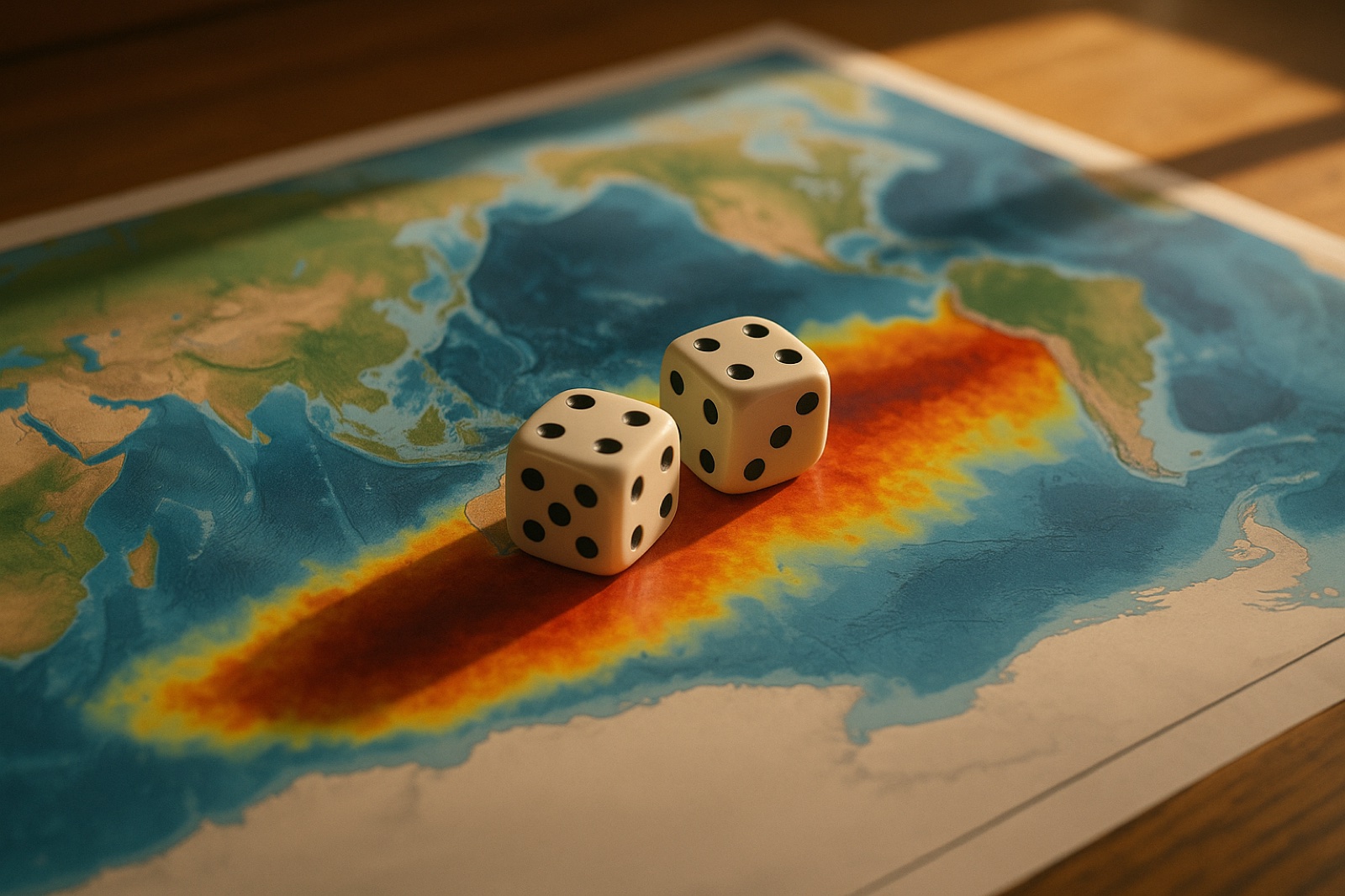
So what happens next? One climate scientist answered with four words that deserve a slow read. He said El Niño is “like loading the dice.”
Loaded dice don’t tell you what the next roll will be. They only tell you which way things lean. Ten years ago, a place that was told to expect a flood of rain found that out the hard way. That story is the best guide we have to this one.
What Is a Super El Niño, and How Strong Is This One?
El Niño is a natural warming of the tropical Pacific Ocean. It comes back every two to seven years. When it does, it shifts rain and heat around much of the world for months.
“Super El Niño” is a nickname, not an official label. The official scale tops out at “very strong,” which means the water in a key part of the Pacific is more than 2°C warmer than average. As NPR reported on October 5, 2026, forecasters at NOAA, the United States weather and ocean agency, now put this El Niño in that top group.
Here is what the forecasters themselves have said:
- In its September 10 update, NOAA’s Climate Prediction Center gave a greater than 90% chance of a very strong El Niño through the northern autumn and winter.
- The same update gave a 75% chance that October to December 2026 will beat every El Niño on record going back to 1950.
- El Niño usually peaks in November and December. This one is expected to last into early 2027.
One careful note. “Strongest for this time of year” is not the same as “strongest ever.” An analysis published on October 1 by the Union of Concerned Scientists used a measure that takes out the general warming of the oceans. By that measure, this El Niño ranks first for early October, but so far third for any time of year, behind 1982 and 2015. It is still growing, so that may change.
If you want the basics of how El Niño works, and the surprising story of where its name came from, we covered that in our earlier piece on El Niño 2026.
What “Loading the Dice” Means
Daniel Vimont is a professor of atmospheric and oceanic sciences at the University of Wisconsin-Madison. He gave NPR two pictures to explain El Niño.
The first is a rock dropped in a pond. “Even though you’re not where the rock hit, you still may feel the effects of those waves,” he said. El Niño is “an enormous rock in our entire Earth’s system.”
The second picture is the one worth keeping:
“El Niño is like loading the dice. While we’re loading the dice for a certain type of response from El Niño, we still know that in any given year, there are still natural fluctuations that may mask that or cause the response to be slightly different than what we might expect.”
Think about what a loaded die really is. Someone has put a little extra weight on one side, so a six comes up more often. More often. Not every time. Roll it once and you can still get a two.
That is what a super El Niño does to the weather. It makes dry months more likely in some parts of the world and heavy rain more likely in others. It does not promise either one to any single town.
NOAA says the same thing in plainer words. With an El Niño this big, its forecasters wrote, the chances of the usual El Niño effects “are larger, though not guaranteed.”
The Year the Dice Landed the Other Way
The last very strong El Niño came in the winter of 2015 to 2016. It was one of the strongest ever recorded.
Southern California, in the south-west of the United States, had been in drought for years. Big El Niños had soaked the region before, so hopes were high. As the Scripps Institution of Oceanography later put it, “It was supposed to be a wet winter for the record books in Southern California, but precipitation levels barely made it to average in several areas.” Most of the rain fell further north.
A Scripps researcher named Marty Ralph explained it this way in 2016: “It was clear that while El Niño had stacked the deck for a wet Southern California, it was still possible to draw the wrong card and that’s what happened in Southern California.”
Scientists took the miss seriously. In 2018, a team published a study in the Journal of Climate about what they called “the failed 2016 winter rains.” Their first line was honest: the failed rains “came as a surprise and a disappointment.”
What they found is the interesting part. Their computer models showed the warm ocean really had pushed toward a wet winter. The forecast was not foolish. The authors argued that the dry weather came mostly from shorter swings in the atmosphere that had nothing to do with El Niño. Those swings are the kind of thing no season-long forecast can see coming.
Here is a detail almost nobody has pointed out. One of the authors of that study was Martin Hoerling. He is the same meteorologist NPR quoted this week about the new El Niño. And what he chose to say this time was hopeful. For places that are short of water, he said, “a big El Niño, especially like the one we’re having, can really get you into recovery mode that otherwise might have taken you years.”
So the dice are not only loaded toward harm. In some places they lean toward relief. And the man saying so has studied, up close, a year when they did not land the way everyone expected.
Two scientists, ten years apart. One talked about cards and one about dice. Both were saying the same thing: we can know which way the odds lean, and we still cannot know the roll. If you are curious why weather is like this at all, the answer goes back to one rounded number in 1961, which we told in the real story of the butterfly effect.
The 49 Million Number Is Not a Weather Forecast
The most serious number in this story comes from the United Nations World Food Programme (WFP). In August 2026 it said this El Niño could push at least 49 million more people into acute food insecurity by the end of 2027.
“Acute food insecurity” means a lack of food so serious that it puts a person’s life, or their way of earning a living, in danger. The WFP looked at 45 countries where many people are already short of food. It expects the total there to rise from 225 million people to 274 million. Central America and southern Africa are expected to be hit hardest, with eastern Africa and South and Southeast Asia also at risk.
That is a heavy number, and it should be. But look at one small word in it: “could.”
The 49 million is not a forecast about rain. It is a forecast about people, and people can act on a warning. The WFP says that since May it has already set off early-action plans in six countries: South Sudan, Chad, Mauritania, Uganda, Guatemala and El Salvador. More than 14 million US dollars has reached about half a million people before the worst weather arrives. By the WFP’s own estimate, every dollar spent early saves three to seven dollars in losses and emergency aid later.
For scale, the WFP says the 2015 to 2016 El Niño affected the food security of 60 to 100 million people.
So there are really two kinds of not-knowing in this story. One is where the rain will fall. Nobody controls that. The other is what we do with months of warning. That part is ours.
What to Do When the Dice Are Loaded
You do not need money or special tools for any of this.
- Find out which way the dice lean where you live. Your national weather service will have a seasonal outlook. Look for one thing: is your area more likely to be wetter, drier or hotter than usual?
- Get ready for the likely thing, cheaply. If dry weather is likely, store some water in clean containers with lids. If heavy rain is likely, clear the drains near your home, know where the higher ground is, and keep important papers in a plastic bag.
- Don’t bet everything on the likely thing. Southern California in 2016 is the reminder. Likely is not certain. Keep a little room for the other outcome.
- Check on one person. Heat, flood and food prices are hardest on people who live alone or have the least. One visit or one phone call counts.
- Put down what was never yours to carry. You cannot make the roll come out a certain way. Worrying about it will not move it. We wrote about why not knowing is often harder to carry than bad news you are sure of, and what helps.
The Oldest Line About Throwing Dice
People have been throwing dice, or something like them, for a very long time. In the ancient world, when a choice was too close to call, people cast lots. They tossed small objects, a bit like our dice, and read the result as the answer.
There is a very old line of wisdom about that moment. It says the lot is thrown into the lap, but how it lands is for God to settle.
Notice what that line does not say. It does not say don’t throw. It does not say don’t plan, don’t store water, don’t read the forecast. The people who kept that saying were farmers. They watched the sky and saved for dry years like everyone else.
What the line does is split the moment in two, the same way the forecasters do. There is the part in your hand: the throw, the getting ready, the phone call to a neighbour. And there is the part that was never in your hand: how it lands. The old line says that second part is not loose. It is not nobody’s. It is held by God.
That is not an answer to why hard years come, and it should never be used as one. It is something smaller and more useful. It is a way to carry the not-knowing. Do your part fully. Then stop trying to hold the part no person has ever been able to hold.
A good place to start: The Beginner’s Guide to Feeling God’s Presence Every Day. A short video and guide for finding something steady in ordinary days, even when the news is not. Get the free guide. Free.
The Bottom Line
The super El Niño of 2026 is real, it is very strong, and it is still growing. It tilts the odds for weather across much of the world into 2027. It does not write the ending for any one place, and the last very strong El Niño proved it.
So check your local outlook this week. Take one small step to get ready. Look in on one person. Those are the parts in your hand.
Then let the dice be dice. You were only ever asked to make a good throw.
Discussion Question
When a forecast says something is likely but not certain, is it wiser to prepare fully for the likely outcome, or to keep your options open for a surprise? Tell us what you think in the comments below.
Share This
Post 1: A scientist says this super El Niño is “like loading the dice.” It tilts the odds. It doesn’t promise the roll. In 2016, Southern California was told to expect record rain, and most of it never came. https://bgodinspired.com/?p=118008
Post 2: The UN food agency says El Niño could push 49 million more people into hunger by the end of 2027. The word that matters is “could.” Early action is already under way in six countries, and this explains why it works. https://bgodinspired.com/?p=118008
Post 3: Best line I read today, from an article about the weather of all things: do your part fully, then stop trying to hold the part no person has ever been able to hold. https://bgodinspired.com/?p=118008
Super El Niño 2026: Common Questions Answered
What is a super El Niño?
A super El Niño is an informal name for a very strong El Niño, which is a natural warming of the tropical Pacific Ocean that shifts weather around the world. The official top category is “very strong,” used when water in a key part of the Pacific is more than 2°C warmer than average. El Niño returns every two to seven years, but very strong ones are rare. Earlier examples were 1982 to 1983, 1997 to 1998 and 2015 to 2016.
Is the 2026 El Niño the strongest ever recorded?
As of early October 2026, the 2026 El Niño is the strongest ever measured for that time of year, but it is not yet the strongest of all time. NOAA’s Climate Prediction Center said in September 2026 that there was a 75% chance the October to December 2026 period would beat every El Niño on record back to 1950. El Niño usually peaks in November and December, so the final ranking will not be known until early 2027.
What does “loading the dice” mean for El Niño?
“Loading the dice” is how climate scientist Daniel Vimont of the University of Wisconsin-Madison described El Niño’s effect on weather. A loaded die lands on one number more often, but not every time. In the same way, El Niño makes drought more likely in some regions and heavy rain more likely in others, without guaranteeing either. Natural swings in the weather can still hide or change the expected result in any single year.
How many people could face hunger because of El Niño in 2026 and 2027?
The United Nations World Food Programme estimated in August 2026 that the 2026 to 2027 El Niño could push at least 49 million more people into acute food insecurity by the end of 2027. Across 45 countries it studied, the total would rise from 225 million to 274 million people. This is an early projection, not a certainty, and the World Food Programme has already started early-action plans in six countries to reduce the harm.
Does a strong El Niño guarantee extreme weather where I live?
No. A strong El Niño raises the chances of certain weather in certain regions, but it does not guarantee it. During the very strong El Niño of 2015 to 2016, Southern California was widely expected to have an unusually wet winter, and rainfall there barely reached average in several areas. A 2018 study in the Journal of Climate argued that shorter-term weather swings unrelated to El Niño were mainly responsible. The best guide for any one place is the seasonal outlook from the national weather service.
Sources: NPR’s October 5, 2026 report; the NOAA Climate Prediction Center’s El Niño discussion; the World Food Programme’s August 2026 analysis; the Union of Concerned Scientists; Scripps Institution of Oceanography; and Zhang, Hoerling and colleagues, Journal of Climate, 2018.