 0
0
 0
0
“I am the master of my fate: I am the captain of my soul.”
You have probably seen those two lines without knowing where they come from. They are on gym walls and graduation cards. They are tattooed on arms. They have been spoken in prisons and in parliaments.
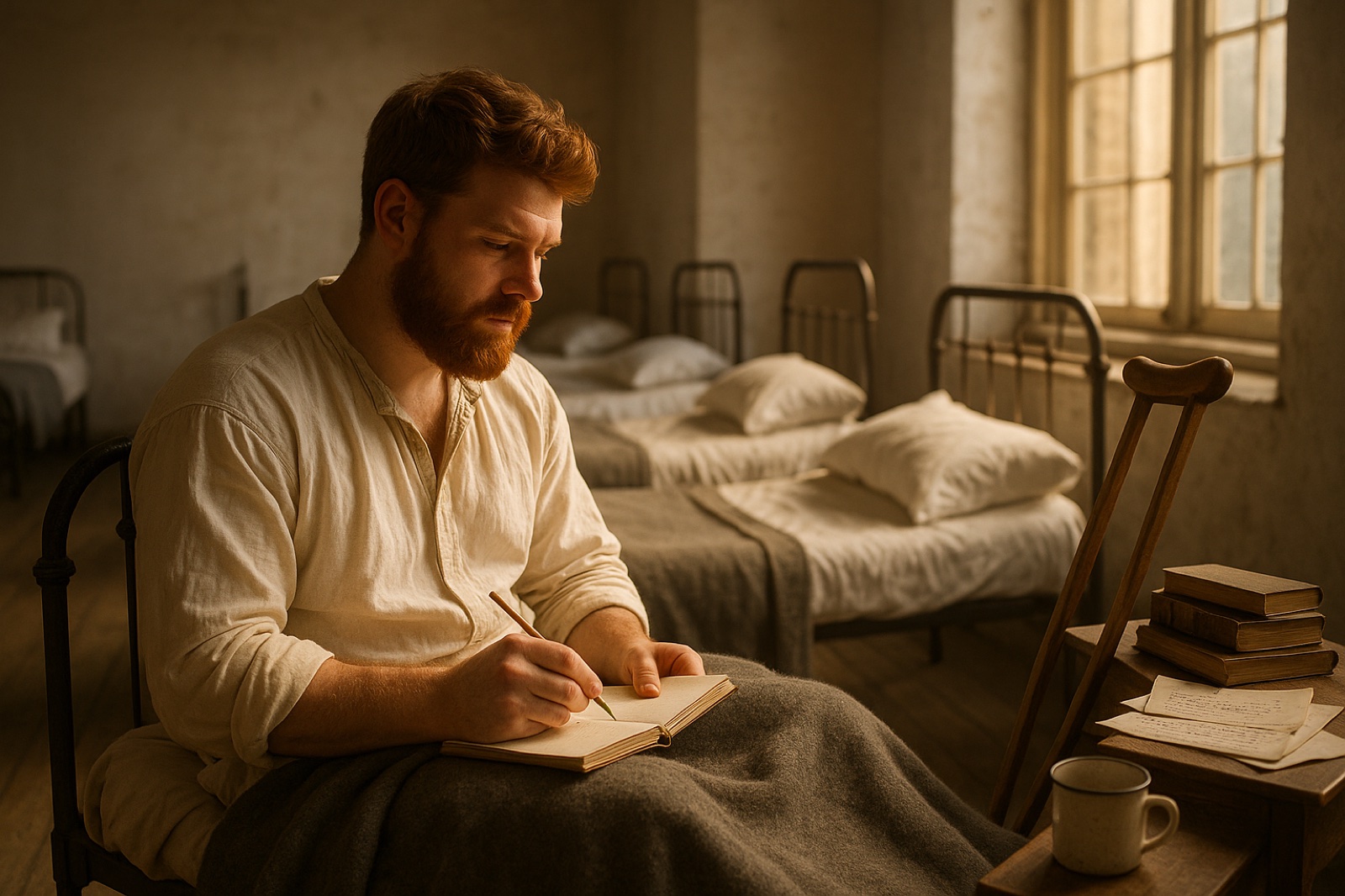
They are the last two lines of the Invictus poem: sixteen lines written in 1875 by a young man named William Ernest Henley, from a hospital bed in Scotland. If you came for the Invictus poem meaning, you’ll get it here. The full text, what each part says, and the true story behind it.
But there is something else worth knowing. Henley wrote a second poem in that same hospital. Almost nobody quotes it. And once you have read it, the famous one sounds different.
The Invictus Poem: Full Text
The poem is long out of copyright, so here it is in full, as Henley printed it.
Out of the night that covers me,
Black as the Pit from pole to pole,
I thank whatever gods may be
For my unconquerable soul.In the fell clutch of circumstance
I have not winced nor cried aloud.
Under the bludgeonings of chance
My head is bloody, but unbowed.Beyond this place of wrath and tears
Looms but the Horror of the shade,
And yet the menace of the years
Finds, and shall find, me unafraid.It matters not how strait the gate,
How charged with punishments the scroll,
I am the master of my fate:
I am the captain of my soul.
In plain words: life has hit me hard. It is dark, and it may stay dark. I did not choose any of this. But I still get to choose how I stand in it, and I choose not to bow.
What the Invictus Poem Means, Stanza by Stanza
Stanza one. The night is “black as the Pit.” Henley thanks “whatever gods may be.” He is not sure who to thank. He is very sure what he is thankful for: a soul that cannot be beaten.
Stanza two. “Fell” is an old word for cruel. “Bludgeonings” are blows from a club. Circumstance and chance have beaten him, and his head is “bloody, but unbowed.” Notice what he does not say. He does not say he is unhurt.
Stanza three. Past this life he sees only “the Horror of the shade,” which is death. He does not claim to know what comes after. He says the years ahead will find him unafraid anyway.
Stanza four. “Strait” means narrow, not straight. The narrow gate is a picture borrowed from the King James Bible, a book every reader of his day knew. The scroll is a list of charges, like a record read out in court. He is saying: however hard the way in, whatever is written against me, I am still the one steering.
Who Wrote Invictus, and Where
William Ernest Henley was born in Gloucester, England, in 1849. As a boy he caught tuberculosis of the bone. In the late 1860s, when he was about nineteen, doctors cut off his left leg below the knee.
A few years later the disease reached his right foot. He was told that leg had to go too. He said no.
In August 1873 he travelled to Edinburgh to find Joseph Lister, the surgeon who was changing medicine by keeping wounds clean. Henley stayed in the Royal Infirmary into 1875. Lister operated on the foot more than once. He saved it.
So the usual story is a little off. Invictus is often called the poem Henley wrote after losing his leg. That leg had been gone for years. He wrote it during the long fight to keep the other one. He dated it 1875 himself.
Nobody wanted it. Henley later wrote that his hospital poems had been “rejected by every editor of standing in London.” Around 1877, he said, he had “to own myself beaten in art,” and he took up newspaper work to pay his way. Invictus waited thirteen years. It was first printed in 1888.
One visitor to that hospital bed was another young writer, Robert Louis Stevenson. They became friends. Years later Stevenson told Henley where Long John Silver, the one-legged pirate of Treasure Island, had come from: “the sight of your maimed strength and masterfulness.”
Henley Never Called It “Invictus”
When the poem first appeared, it had no title at all. In Henley’s collected poems it is simply number four in a section called “Echoes.” Later he added a dedication to a friend, a Scottish flour merchant named Robert Thomas Hamilton Bruce.
Newspapers that reprinted it made up their own names. “Myself.” “Song of a Strong Soul.” “Clear Grit.” “Master of His Fate.” “Captain of My Soul.”
The name we use came from an editor. In 1900, Arthur Quiller-Couch put the poem in The Oxford Book of English Verse and gave it a title: Invictus, Latin for “unconquered.” It stuck.
Why the Invictus Poem Has Lasted
Because it works.
Nelson Mandela is widely reported to have recited it to other prisoners on Robben Island. Winston Churchill borrowed its last lines in a speech to Parliament in 1941, in the middle of a war. The Invictus Games, the sports event for wounded and sick soldiers and veterans first held in London in 2014, took its name from the poem.
When you are flat on your back and something is being taken from you, sometimes the only thing left that is yours is how you face it. Henley found sixteen lines for that. Finland has a whole word for the same thing, sisu, the strength that shows up after you think you are done.
If you are in a hard stretch right now and wonder how much you have left, our free How Resilient Am I? quiz takes a couple of minutes and shows you where you are strong and where you are running thin.
Henley’s Other Hospital Poem
The same hospital stay gave Henley a whole set of poems. He called it “In Hospital” and signed it “The Old Infirmary, Edinburgh, 1873-75.” The fourth poem is called “Before.” It is about a man waiting to be carried to surgery. Here is most of it.
Behold me waiting—waiting for the knife.
A little while, and at a leap I storm
The thick, sweet mystery of chloroform,
The drunken dark, the little death-in-life.
The gods are good to me: I have no wife,
No innocent child, to think of as I near
The fateful minute; nothing all-too dear
Unmans me for my bout of passive strife.
Yet am I tremulous and a trifle sick,
And, face to face with chance, I shrink a little:
My hopes are strong, my will is something weak.
Read that slowly. Same man. Same hospital. The same “gods” and the same “chance.” And he tells us two things Invictus leaves out.
First, he was scared. “I shrink a little.” “My will is something weak.” The man who “has not winced” admits, in another poem from the same hospital, that he did. I don’t think that makes Invictus a lie. I think it makes it a choice. Brave was never the same as not afraid. Brave is what you say back to the fear.
Second, he says why he could be so brave. He had no wife. No child. “Nothing all-too dear.” There was no face he had to picture on the way to the knife, and he calls that a gift. His courage had a condition, and he knew it. It is easier to be unconquerable when the only thing you can lose is yourself.
What Happened After the Poem
Then life gave him something dear.
In 1878 Henley married Anna Boyle. In September 1888, the same year Invictus was first printed, their daughter Margaret was born. She called a family friend, the writer J. M. Barrie, her “fwendy,” her way of saying “friendy.” Barrie turned that into a name. It is why the girl in Peter Pan is called Wendy.
Margaret died of meningitis in February 1894. She was five.
Three years later Henley gathered his poems into one book and dedicated it to his wife. He dated the preface 4 September 1897. That was the day Margaret would have turned nine. I can’t prove he picked the date on purpose. In that preface he explains why he has written almost nothing new: he has “nothing to say which is not, as yet, too personal.”
The book closes with a short poem to Anna. In it he calls his poems, the whole book, the captain-of-my-soul one included, “poor windlestraws on the great, sullen, roaring pool of Time and Chance and Change.” A windlestraw is a dry stalk of grass. Then he writes of “a little, exquisite Ghost” standing between the two of them, still calling in her clear voice: “Come, Dadsie, come!”
The bludgeonings of chance he could take. This was different. This time chance did not hit him. It hit her.
He never took Invictus back. It is in that same book, and he let it stand. He kept working until he died in 1903, at fifty-three. His ashes were buried in Margaret’s grave.
The Question the Last Two Lines Leave Open
So what do we do with “I am the captain of my soul”?
I don’t think we throw it out. A captain matters. On the day of the surgery, the bad news, the exam, the hearing, somebody has to stand at the wheel, and it has to be you.
But a captain is not the sea. Henley knew that before most of his readers did. He told us in the other poem: the unconquerable soul comes easiest to the person with nothing too dear. The moment you love someone, you can be reached. Your fate is no longer only yours to master, because part of your heart is five years old and can’t yet say the word “friend.”
That is the place Invictus does not go. Not “can I stand?” but “who holds me when I can’t? And who holds her?”
People have asked that for a very long time, and one old answer has outlasted most of the others. It says your days were never only in your own hands. They rest in bigger ones. It says God holds a person the way a parent carries a sleeping child, which is to say, without the child doing anything to help. On that view courage is still good. It just isn’t the floor. There is something underneath it.
Henley thanked “whatever gods may be.” It is an honest line. It leaves the door open instead of slamming it.
A good place to start: The Beginner’s Guide to Feeling God’s Presence Every Day. A short video guide and PDF that shows you a simple three-step rhythm for noticing God in ordinary moments, even on the hard days. Get the free guide. Free.
How to Carry Invictus Now
You don’t have to pick between the two poems. Here is how I’d hold them together.
- Keep Invictus for the hour you need it. It is a poem for the wait before the knife. Say it out loud. It still works.
- Let “bloody” be true too. Henley never said he was unhurt. You can be unbowed and still admit it hurt. He did, in his other hospital poem.
- Don’t ask it to carry your whole life. Being the captain is for steering. It is not for holding up the ocean. When the loss is bigger than your grip, letting yourself be held is not failing. Other people who wrote from a small, dark room found the same thing, like the friar behind the dark night of the soul.
Henley wrote one poem about standing. Twenty-two years later he wrote one about a small voice calling him home. Both are true. Most of us will need both before we are done.
A Question to Think About
Do you think “I am the captain of my soul” is true for everyone, or only until you love someone you could lose? Tell us in the comments. We’d really like to hear your take.
Share This
Post 1: The man who wrote “I am the captain of my soul” wrote another poem in the same hospital. In it he admits he was scared, and says why he could be brave: he had no wife or child to lose. Then he had a daughter. https://bgodinspired.com/?p=117951
Post 2: Just learned Henley never called his poem “Invictus.” It had no title. An editor added the name in 1900. The real story behind it is better than the poster version: https://bgodinspired.com/?p=117951
Post 3: I’ve loved Invictus for years and never knew what came after it. The poet’s little girl is the reason Wendy in Peter Pan is called Wendy. She died at five. What he wrote next changed how I read the famous lines. https://bgodinspired.com/?p=117951
Questions People Ask About the Invictus Poem
What is the meaning of the Invictus poem?
The Invictus poem by William Ernest Henley is about refusing to be broken by suffering. The speaker admits that life has beaten him bloody and that he did not choose his circumstances, but he insists that he still controls how he faces them. The famous last lines, “I am the master of my fate: I am the captain of my soul,” mean that a person’s inner response belongs to them even when everything else is out of their hands.
Who wrote Invictus, and when was it written?
Invictus was written by the English poet William Ernest Henley in 1875, while he was a patient at the Royal Infirmary of Edinburgh in Scotland. Henley had already lost his left leg to tuberculosis of the bone, and the surgeon Joseph Lister was working to save his right foot. The poem was first published in 1888 in Henley’s collection A Book of Verses.
What does the word Invictus mean?
Invictus is Latin for “unconquered.” William Ernest Henley did not choose the title. His poem was first printed in 1888 with no title, and the editor Arthur Quiller-Couch added the name Invictus when he included the poem in The Oxford Book of English Verse in 1900.
What does “it matters not how strait the gate” mean?
In the Invictus poem, “strait” is an old word meaning narrow, not straight. The line “It matters not how strait the gate, how charged with punishments the scroll” borrows the picture of a narrow gate from the King James Bible and adds a scroll listing charges against the speaker. Henley is saying that no matter how hard the way ahead is, or what is written against him, he will still be the one who steers his own soul.
Did Nelson Mandela recite Invictus in prison?
Nelson Mandela is widely reported to have recited William Ernest Henley’s poem Invictus to fellow prisoners during his years on Robben Island in South Africa. The 2009 film Invictus is named after the poem. Winston Churchill also echoed its closing lines in a 1941 speech to the British Parliament, and the Invictus Games for wounded service members took their name from it in 2014.
What happened to William Ernest Henley’s daughter?
William Ernest Henley’s daughter, Margaret, was born in September 1888 and died of meningitis in February 1894, aged five. She called the writer J. M. Barrie her “fwendy,” which inspired the name Wendy in Peter Pan. In 1897 Henley closed his collected poems with a poem to his wife about “a little, exquisite Ghost” still calling “Come, Dadsie, come!” When Henley died in 1903, his ashes were buried in Margaret’s grave.