 0
0
 0
0
Most kindness happens when someone walks into our path. A neighbour drops a bag of shopping, and we help pick it up. A friend calls in tears, and we listen. That is good, and it matters.
But have you ever noticed how rarely we go looking for someone to be kind to? We wait to be asked. We wait for the need to knock on our door.
If you have been searching for Bible verses about kindness, you will find plenty of short ones below. But one story in the Bible shows a kind of kindness that does not wait at all. A king stops in the middle of his busy life and asks a question nobody else was asking: Is anyone left that I can be kind to?
Bible Verses About Kindness to Keep Close
Here are some of the clearest verses on kindness in the King James Version. Read them slowly. A few of them say more than we usually notice.
“And be ye kind one to another, tenderhearted, forgiving one another, even as God for Christ’s sake hath forgiven you.” (Ephesians 4:32, KJV)
“Put on therefore, as the elect of God, holy and beloved, bowels of mercies, kindness, humbleness of mind, meekness, longsuffering;” (Colossians 3:12, KJV)
“Charity suffereth long, and is kind; charity envieth not; charity vaunteth not itself, is not puffed up,” (1 Corinthians 13:4, KJV)
“But love ye your enemies, and do good, and lend, hoping for nothing again; and your reward shall be great, and ye shall be the children of the Highest: for he is kind unto the unthankful and to the evil.” (Luke 6:35, KJV)
“For the mountains shall depart, and the hills be removed; but my kindness shall not depart from thee, neither shall the covenant of my peace be removed, saith the LORD that hath mercy on thee.” (Isaiah 54:10, KJV)
“But after that the kindness and love of God our Saviour toward man appeared, Not by works of righteousness which we have done, but according to his mercy he saved us,” (Titus 3:4-5, KJV)
“And the barbarous people shewed us no little kindness: for they kindled a fire, and received us every one, because of the present rain, and because of the cold.” (Acts 28:2, KJV)
That last one is easy to skip. Paul and the other people from a shipwreck wash up cold and soaked on the island of Malta. Strangers who owe them nothing build a fire. The Bible remembers it.
And notice Luke 6:35. Jesus says God is kind “unto the unthankful.” Not just to the grateful. Not just to the people who will repay it. That is the thread the rest of this article follows.
A Promise Made Between Two Friends
To see what Bible kindness really looks like, go back to two young men: David and Jonathan.
Jonathan was the son of King Saul. Saul had turned against David and wanted him dead. Jonathan could have sided with his father. Instead, he protected his friend. And before they parted, Jonathan asked David for one thing:
“And thou shalt not only while yet I live shew me the kindness of the LORD, that I die not: But also thou shalt not cut off thy kindness from my house for ever:” (1 Samuel 20:14-15, KJV)
In those days, when a new king came to power, the family of the old king was often in danger. Jonathan knew it. So he asked David to be kind to his family, not just to him, and to keep doing it for good.
The Hebrew word for “kindness” here is chesed. It is more than a nice feeling. It is kindness that keeps a promise. Loyal kindness. The kind that stays.
Years passed. Saul and Jonathan both died in battle. David became king. And the promise could easily have been forgotten.
The King Who Went Looking: 2 Samuel 9
Here is how the story opens:
“And David said, Is there yet any that is left of the house of Saul, that I may shew him kindness for Jonathan’s sake?” (2 Samuel 9:1, KJV)
Nobody came to David asking for help. Nobody reminded him. He went looking.
His servants find an old servant of Saul’s named Ziba, and David asks again, with one small change:
“Is there not yet any of the house of Saul, that I may shew the kindness of God unto him?” (2 Samuel 9:3, KJV)
Not just my kindness. The kindness of God. David wanted to treat someone the way God treats people.
Ziba says there is one person left. Jonathan’s son. He “is lame on his feet.”
We learn how that happened earlier in the story. When news came that Saul and Jonathan had died, this boy was five years old. His nurse picked him up and ran, and “as she made haste to flee, that he fell, and became lame” (2 Samuel 4:4). His name was Mephibosheth.
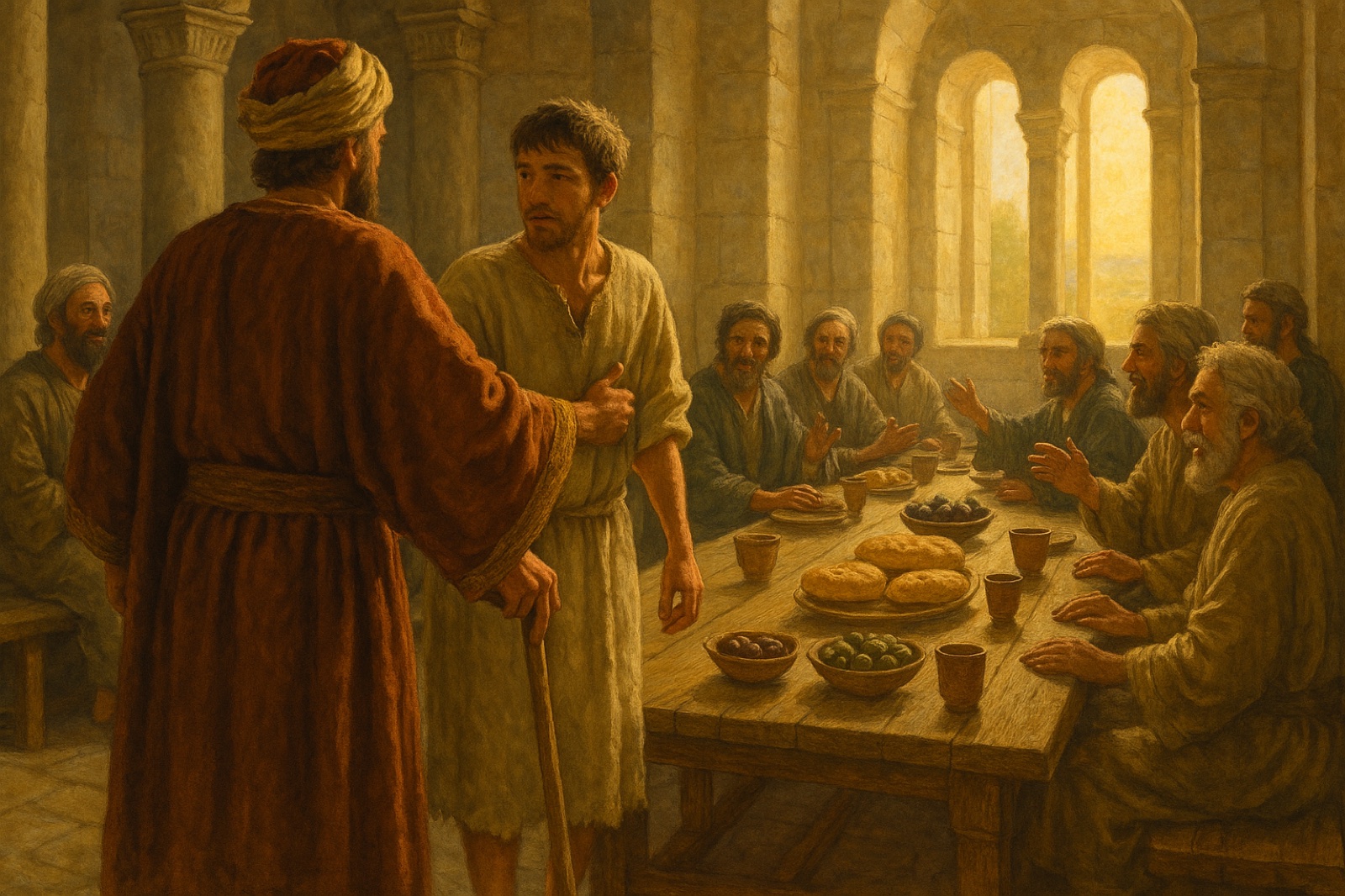
Think about his life. A prince who grew up far from the palace. Living in another man’s house, in a place called Lo-debar. Lame in both feet. And now the new king, the one his grandfather tried to kill, has sent for him.
He must have expected the worst.
“Such a Dead Dog as I Am”
Mephibosheth arrives and falls on his face. And the first words David says to him are these:
“Fear not: for I will surely shew thee kindness for Jonathan thy father’s sake, and will restore thee all the land of Saul thy father; and thou shalt eat bread at my table continually.” (2 Samuel 9:7, KJV)
Look at how Mephibosheth answers:
“What is thy servant, that thou shouldest look upon such a dead dog as I am?” (2 Samuel 9:8, KJV)
That is how he saw himself. Worthless. Forgotten. Something you step around.
David does not argue with him. He just keeps being kind. He gives back the family land. He puts Ziba and his sons to work farming it for Mephibosheth. And then the story says it plainly:
“As for Mephibosheth, said the king, he shall eat at my table, as one of the king’s sons.” (2 Samuel 9:11, KJV)
Not a guest. Not a charity case at the end of the table. One of the sons.
The chapter ends with a quiet detail that is easy to read past: “So Mephibosheth dwelt in Jerusalem: for he did eat continually at the king’s table; and was lame on both his feet” (2 Samuel 9:13).
His feet were never healed. The kindness did not fix everything. It gave him a seat, and a place, and a family. Every day.
What This Changes About Kindness
Here is the turn in this story that is easy to miss.
Mephibosheth could not repay David. He had no army, no power, and no way to give anything back. He came from the family that had been David’s enemy. By every normal rule, he was the last person a king would go looking for.
That is exactly why David called it “the kindness of God.” It is kindness to someone who cannot pay it back. It is what Jesus meant when He said God is “kind unto the unthankful and to the evil.” And it is kindness that goes looking, instead of waiting for the need to arrive.
And here is the part that may be about you. Many of us read this story and want to be David. But most of us, on some days, feel more like Mephibosheth. Hidden away. Hurt in a way that has not healed. Sure that if anyone important noticed us, it would not be good news.
The Bible says God’s kindness goes looking for people like that. “My kindness shall not depart from thee,” God says in Isaiah 54:10, even if the mountains move. You do not have to earn the seat. You are sent for.
Once that sinks in, being kind to others stops feeling like a duty. It becomes passing on what you were given. If you want to go deeper into the New Testament word for this, we unpack it in the Greek word for kindness. You can also see the same loyal kindness built into farm life in what gleaning in the Bible was, the law that led Boaz to Ruth. And for a modern picture of a promise kept to a friend’s family, read the story of the friend Walter Payton left in charge.
A good place to start: The Beginner’s Guide to Feeling God’s Presence Every Day. It is a short, simple way to notice God’s kindness in ordinary moments, including the days you feel overlooked. Get the free guide. Free.
Actions to Take
- Ask David’s question today. Take one minute and ask yourself: “Is there anyone I have forgotten that I could be kind to?” Write down the first name that comes to mind.
- Send for them. Message that person now. Not to fix anything. Just to say you thought of them and you are glad they are in your life.
- Make room at your table. This week, invite someone who cannot repay you to share a meal or a cup of tea. Someone lonely, new, or left out.
Journaling Prompts
- Who in your life is living in their own “Lo-debar,” out of sight and easy to forget?
- When have you felt like Mephibosheth, sure that being noticed would only bring bad news?
- What would change in how you treat others if you truly believed God had sent for you and given you a seat at the table?
A Prayer
God, thank You for Your kindness that goes looking for people. Some days I feel hidden and hurt, and I do not think I deserve a seat at Your table. Help me believe that You sent for me anyway. And open my eyes to the person I have forgotten, so I can pass on the kindness You have shown me. Amen.
Discussion Question
Why do you think it is so much easier to be kind to people who can pay us back than to people who cannot? Share your thoughts in the comments below.
Share This
- King David didn’t wait for someone to ask for help. He asked, “Is there anyone left that I can be kind to?” Then he went looking. (2 Samuel 9)
- Mephibosheth called himself “a dead dog.” The king answered by giving him a seat at the table “as one of the king’s sons.” That’s what the kindness of God looks like.
- His feet were never healed. But he ate at the king’s table every day. Kindness doesn’t always fix everything. It gives people a place.
Questions People Ask About Bible Verses About Kindness
What does the Bible say about kindness?
The Bible teaches that kindness comes from God and should be passed on to others. Ephesians 4:32 says, “And be ye kind one to another, tenderhearted, forgiving one another, even as God for Christ’s sake hath forgiven you.” Luke 6:35 says God “is kind unto the unthankful and to the evil,” which means biblical kindness is shown even to people who cannot or will not repay it. Colossians 3:12 lists kindness among the qualities believers are told to “put on.”
What is the best Bible story about kindness?
One of the clearest Bible stories about kindness is 2 Samuel 9, where King David asks, “Is there not yet any of the house of Saul, that I may shew the kindness of God unto him?” David finds Mephibosheth, the disabled son of his late friend Jonathan, restores his family land, and seats him at the royal table “as one of the king’s sons.” David did it to keep a promise he had made to Jonathan in 1 Samuel 20:14-15.
What is the Hebrew word for kindness in the Bible?
The main Hebrew word translated “kindness” in the Old Testament is chesed. It describes loyal, faithful kindness that keeps a promise over time, not just a passing nice feeling. Chesed is the word used when Jonathan asks David to show “the kindness of the LORD” in 1 Samuel 20:14 and when David shows “the kindness of God” to Mephibosheth in 2 Samuel 9:3.
Who was Mephibosheth in the Bible?
Mephibosheth was the son of Jonathan and the grandson of King Saul. According to 2 Samuel 4:4, he was five years old when news came that Saul and Jonathan had died, and his nurse dropped him while fleeing, leaving him lame in both feet. In 2 Samuel 9, King David sent for him from Lo-debar, gave him all of Saul’s land, and said he would eat at the king’s table continually, “as one of the king’s sons.”
Does the Bible say to be kind to people who are not kind back?
Yes. In Luke 6:35, Jesus says, “But love ye your enemies, and do good, and lend, hoping for nothing again,” and explains that God “is kind unto the unthankful and to the evil.” Biblical kindness does not depend on the other person deserving it or returning it. It reflects how God treats people.