 0
0
 0
0
Pick up a fridge magnet and press it against a stainless steel kitchen sink. On a lot of sinks, it barely holds. That is not a cheap magnet. It is the shape of the iron inside the steel.
Now picture the same kind of iron, grains far smaller than a speck of dust, sealed inside bits of glass on the far side of the Moon. And picture those grains doing the thing the sink can’t: holding on to magnetism, and maybe holding on to it for billions of years.
That is what scientists say they found in the Chang’e-6 moon samples, the soil China’s lander brought home from the far side of the Moon in 2024. It is a form of iron that had never been identified in natural lunar material before. Here is what they found, why it surprised them, and the honest limit they put on it themselves.
What Scientists Found in the Chang’e-6 Moon Samples
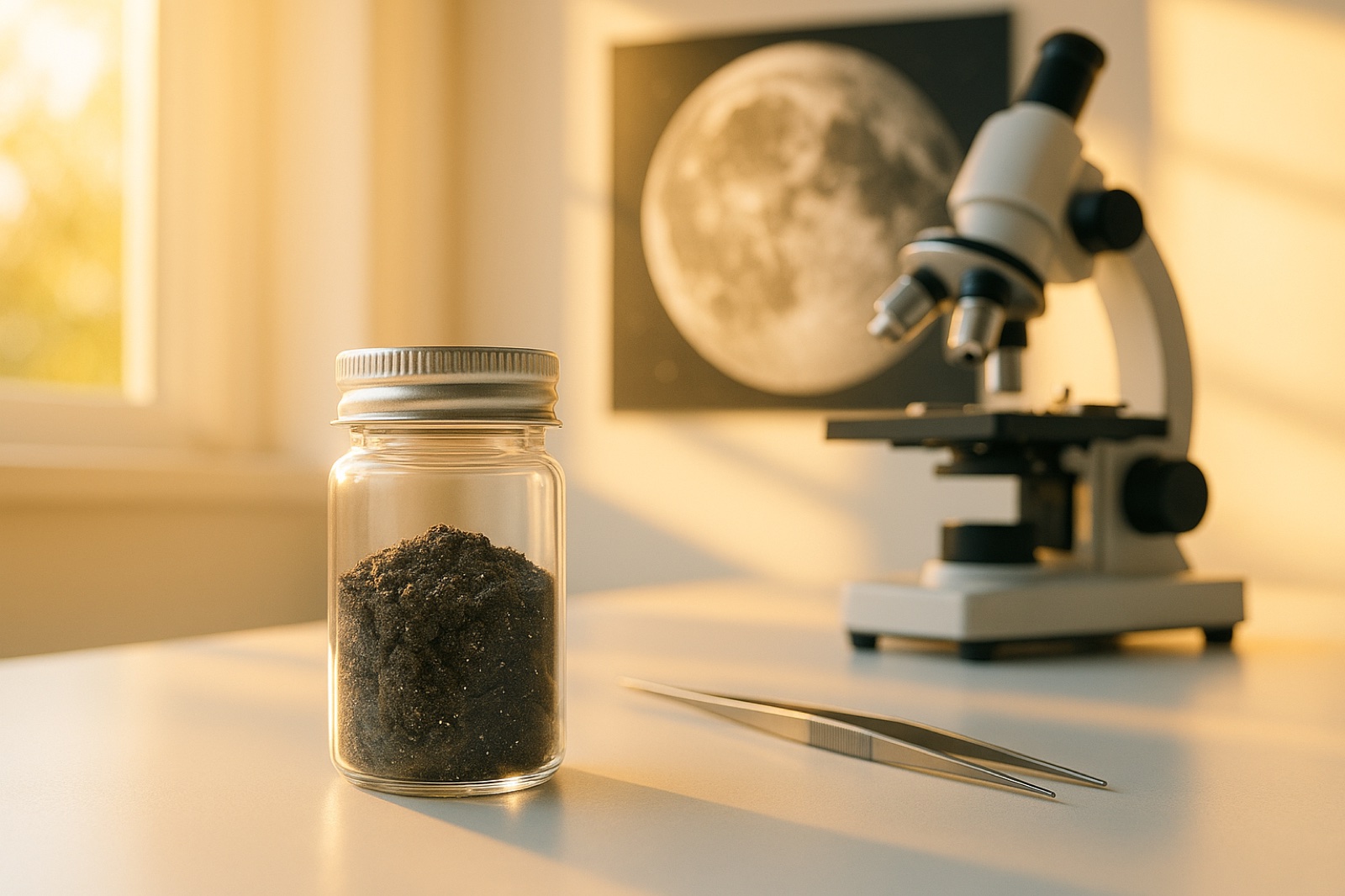
Chang’e-6 landed in Apollo crater, inside the South Pole-Aitken basin. That basin is one of the biggest and oldest impact scars in the whole solar system. The lander scooped up soil and flew it back to Earth, the first samples ever returned from the Moon’s far side.
Inside that soil are tiny beads and shards of glass. They formed when meteorites slammed into the Moon, melted rock in a flash, and splashed it out to cool.
When a team led in part by the High Magnetic Field Laboratory of the Chinese Academy of Sciences looked inside that glass, they found little nuggets of iron. Some were smaller than 10 nanometers. The biggest were around 140 nanometers. (A human hair is roughly 80,000 to 100,000 nanometers wide, so even the “big” ones are very, very small.)
The surprise was not that the Moon has iron. It was which kind of iron. The team reported it in the journal Proceedings of the National Academy of Sciences on 29 September 2026, as the first identification of this form of iron in natural lunar samples.
Gamma Iron: The Kind That Should Not Be There
Iron is not just iron. The tiny atoms inside it can stack up in different patterns, a bit like oranges stacked in a crate in two different ways. Each pattern behaves differently.
The everyday kind, the iron in a nail, is called alpha iron. The kind found in the Chang’e-6 glass is called gamma iron. Its atoms sit in a pattern scientists call face-centered cubic.
Here is the catch. Pure gamma iron normally only exists when it is extremely hot, between about 912 and 1,394 degrees Celsius. As it cools down the normal way, it rearranges itself into ordinary alpha iron. At room temperature, it should be gone.
On Earth, steelmakers keep this pattern alive on purpose by mixing in other metals like nickel. That is the iron inside many stainless steel sinks, and it is why your fridge magnet struggles to stick.
So how did it survive on the Moon, with no steel mill anywhere nearby? The researchers suggest two things worked together:
- Carbon. A little carbon in the iron helps hold the gamma pattern in place, even after it cools.
- Speed. A meteorite impact heats rock in an instant, and the splashed glass cools very fast. The iron got frozen in its hot-weather shape before it had time to change.
In other words, the Moon made a kind of steel-like iron by accident, in the split second after something hit it.
Tiny Grains That May Keep a Magnetic Record
This is the part that has scientists excited.
The team used a technique called electron holography, which lets them see the magnetism inside a single grain. In the grains larger than about 100 nanometers, they saw something called a magnetic vortex. Instead of all pointing one way, the magnetism curls around inside the grain in a little swirl, like water circling a drain.
That swirl turned out to be stubborn. When the researchers pushed on it with stronger and stronger magnetic fields, it held. A grain that holds its magnetic pattern that firmly can act like a tiny recorder. Whatever magnetic field was around when it formed may still be written inside it.
Why does that matter? Today the Moon has no global magnetic field like Earth’s. But scientists have argued for decades about whether it once did, generated by a molten core long ago, and how strong and long-lasting it was. Old Moon rocks carry magnetic signals, but there is a problem: a big impact can make its own short, sharp magnetic field. So when a rock is magnetized, it is hard to tell which one did it, the ancient core or a single crash.
The study showed that gamma iron can record the magnetism from a shock, an impact. If future work can pin down exactly how these grains behave, they might help scientists sort the two signals apart: this was the Moon’s old heart beating, that was a rock hitting it.
The Honest Limit the Researchers Put on It
Here is the detail that most headlines skip, and it is worth slowing down for.
The scientists did not claim they had built a new way to read the Moon’s magnetic past. They called that idea “a hypothesis rather than a demonstrated method.” They also wrote that the magnetic behavior of gamma iron at this tiny scale is still “poorly constrained,” and that “more experiments and micromagnetic simulations are needed.”
That is not a weakness in the work. It is the work being careful. They found something real, showed what it can do in the lab, and then drew a clear line around what they don’t know yet. That line is exactly what makes the finding worth trusting.
It also means the Moon’s magnetic story is still open. The grains are a new tool on the bench, not the final answer. If you love the idea of a far-side Moon still holding secrets, you might also enjoy the plan to listen from behind the Moon for the universe before the first star.
Why a Grain That Remembers Feels So Big
There is something quietly moving about a speck of iron that can keep a record for billions of years. It sat in the dark on the far side, through every sunrise and every hit, and it held.
People have always looked at the Moon and seen something steady. One of the oldest songs still sung today calls the moon a faithful witness in the sky. The poet was not talking about magnetism. The point was that the Moon keeps showing up, night after night, and so it became a picture of a promise that does not break. The song was really about God keeping a word, the way the Moon keeps its appointment with the dark.
It is a strange thing to learn, so many centuries later, that the Moon’s own dust may be faithful in a second way: not just showing up, but remembering.
If you want to keep looking up, the next full moon is close. Here is when to see the Hunter’s Moon in October 2026, and if you are curious how far back all of this goes, try our free How Old Is the Universe? explorer.
A good place to start:
The Beginner’s Guide to Feeling God’s Presence Every Day — a short video guide and companion PDF for noticing the steady, faithful things in ordinary days, the way you just noticed them in a speck of moon dust.
Get the free guide
Free.
What the Chang’e-6 Moon Samples Leave Us With
A lander scooped up a little soil from the far side of the Moon. Inside it were glass beads. Inside those were grains of iron that should not exist at room temperature. And inside those were tiny magnetic swirls that may still carry a message from the moment they were made.
We don’t know yet how much of that message can be read. The scientists were clear about that. But tonight, when the Moon comes up over your street, your village, or your city, it is worth remembering that part of it is still holding on to something, and has been for a very long time.
Source: research published in Proceedings of the National Academy of Sciences, 29 September 2026, as reported by The Brighter Side of News.
Discussion Question
Which do you find more amazing: that the Moon made steel-like iron by accident in the split second after an impact, or that a grain smaller than dust might keep a magnetic record for billions of years? Tell us in the comments below.
Share This
“The Moon made a kind of steel-like iron by accident, in the split second after a meteorite hit it. And the grains may still remember the magnetism from that moment. https://bgodinspired.com/?p=117923”
“Didn’t know this: the iron that makes stainless steel sinks hard for fridge magnets to stick to has now been found on the far side of the Moon, frozen in place by an impact. The scientists are honest that they don’t know yet what it can tell us. https://bgodinspired.com/?p=117923”
“Something sat in the dark on the far side of the Moon for ages and held on to its record the whole time. Science can be quietly beautiful. https://bgodinspired.com/?p=117923”
Questions People Ask About the Chang’e-6 Moon Samples
What did scientists find in the Chang’e-6 moon samples?
Scientists found gamma iron, a form of iron with a face-centered cubic atomic structure, inside tiny pieces of impact glass in the Chang’e-6 moon samples from the Moon’s far side. It was reported in Proceedings of the National Academy of Sciences on 29 September 2026 as the first identification of gamma iron in natural lunar material.
What is gamma iron and why is it unusual on the Moon?
Gamma iron is iron whose atoms are arranged in a face-centered cubic pattern. Pure gamma iron normally exists only at very high temperatures, roughly 912 to 1,394 degrees Celsius, and turns into ordinary alpha iron as it cools. Finding it preserved at lunar surface temperatures is unusual. Researchers suggest carbon and the very fast cooling after meteorite impacts kept it from changing.
Can the iron grains in the Chang’e-6 samples record the Moon’s magnetic history?
Possibly, but it is not proven. Gamma iron grains larger than about 100 nanometers in the Chang’e-6 samples showed stable magnetic vortex states, and the study showed gamma iron can record magnetism from an impact shock. The researchers call using these grains to read the Moon’s ancient magnetic field a hypothesis rather than a demonstrated method, and say more experiments are needed.
Where did Chang’e-6 collect its moon samples?
China’s Chang’e-6 mission collected its samples in 2024 from Apollo crater, inside the South Pole-Aitken basin on the far side of the Moon. They were the first samples ever returned to Earth from the lunar far side.
Does the Moon have a magnetic field today?
No, the Moon does not have a global magnetic field today the way Earth does. Scientists have long debated whether the Moon once had one, produced by a molten core, and how strong it was. Magnetic minerals in lunar samples, including the gamma iron found by Chang’e-6, are one of the main ways scientists try to answer that question.