 0
0
 0
0
You did the hard part. You went without. You put a little away, year after year, for “one day.”
Then one day comes. And you find you can’t touch it.
If you are afraid to spend retirement savings you worked your whole life to build, a new survey says you are far from alone. It asked more than 3,000 adults aged 50 and older in the United States how they feel about using their own money. 86% said they do not feel free to spend their savings on things they enjoy.
Here is the part that should make all of us stop. Among people with half a million US dollars or more put away, 61% still did not feel comfortable spending on enjoyment.
So this is not really a story about how much people have. It is about something else.
Afraid to Spend Retirement Savings: What the Survey Found
The numbers come from the 2026 Retirement Pulse survey, released on October 1, 2026 by Prudential, a large US insurance and investment company. It was run online with the research firm CloudResearch between July 27 and August 2, 2026. In all, 3,023 adults aged 50 or older took part. Some had already stopped working. Some had not yet.
Here is what stood out.
- 86% said they do not feel free to spend their savings on things they enjoy.
- 54% said they would rather leave money behind than run out. Among people with half a million dollars or more, it was 70%.
- Most people said they feel guilty when they spend on extras. 61% felt it about big trips. 63% felt it about entertainment. 86% felt it about big dream purchases.
- 67% said it is hard to justify paying someone to make life easier, like a cleaner, a gardener or a painter.
- 33% said they do not know how long their money needs to last.
The survey also asked people what would bring them more joy if cost did not matter. The answers were not wild. Travel and big adventures (43%). Hobbies (43%). Eating out (36%). Ordinary good things.
Women carried more of the weight. They were more likely than men to link retirement with not having enough (55% against 41%). And they were 33% less likely than men to feel comfortable enjoying their savings.
The Fear Is Not Silly
Before we go further, let’s be fair to the fear. It has good reasons.
People in the survey named them. 44% doubt that Social Security, the US state pension, will still be there for them. 42% pointed to rising prices. 34% pointed to the cost of health care and care in old age.
And then there is the question nobody can answer. How long will you live? In the survey, 45% of people said they want to reach at least 90. Only 30% expect to. You are being asked to make a pot of money last for a length of time that no one on earth can tell you.
Being careful with that pot is not foolish. If you have very little saved, careful is exactly right. Nothing here is telling anyone to spend money they need, and none of this is financial advice. We wrote more about the line between wise caution and the kind that freezes you in Playing It Safe With Money.
One more fair warning. The company behind this survey sells annuities. An annuity turns a lump of savings into a set payment every month for life. The survey’s own headline answer to the problem is guaranteed income for life, and the small print on the release says the company sells it. That does not make the numbers false. But when the people asking the question also sell the answer, it is fair to notice. This was also an online survey in one country, where people reported their own feelings. Read the findings. Hold the sales pitch loosely.
The Strange Part: More Money Did Not Fix It
You would expect the fear to fade as the savings grow. It did not. In some ways it got louder.
- Across everyone surveyed, 33% did not know how long their money needs to last. Among people with half a million dollars or more, it was 44%.
- Across everyone, 54% would rather leave money behind than run out. In the half-million group, it was 70%.
- Among savers, 26% said their biggest regret may turn out to be missing out on life. In the half-million group, it was 40%.
Read those three together. The people with the most were the most likely to say they would rather die with money left over. They were also the most likely to fear they are missing their own lives. More afraid to spend it. More afraid of never having lived. Pulled both ways at once.
David Blanchett, the head of retirement research at Prudential, said it plainly in the release: “What stands out in the research is that spending confidence isn’t simply a function of wealth.”
In simple words: a bigger number does not hand you the freedom to use it.
Same Money, Two Different Feelings
Blanchett had looked at this before. In 2025 he and another researcher, Michael Finke, published a paper in the journal Financial Planning Review on what retired people really do with their money. (Blanchett works for the company that ran the survey, so this is not a fully separate voice. But the paper looked at what people did, not just what they said.)
A well-known rule of thumb in financial planning says a retired person can take out about 4% of their savings each year. The paper found that married 65-year-olds with at least 100,000 dollars saved were taking out about 2.1% a year. Single people took about 1.9%. That is roughly half of what the rule allows.
Now the surprising part. The same paper found that retired people spend about 80% of their regular income, the money that arrives every month no matter what. But they spend only about half of what their savings could give them.
Think about that. Money is money. A coin from a monthly payment buys the same loaf as a coin from a savings pot. But the two do not feel the same. Money that arrives feels like something to use. Money taken from a pile feels like something lost. The researchers named it: people have a “tendency to view a withdrawal from savings as a loss.”
Barbara Pietrangelo, a financial planner quoted in the survey release, sees the same thing across the table from real people. “Spending money you worked so long to save can feel like a loss,” she said.
This is why the number on its own never brings peace. Every time you take from the pile, the pile is smaller, and the fear comes back. What changed how people felt was not the size of the pile. It was knowing the basics would keep coming. In the survey, 58% said they would feel more comfortable spending if they knew their basic needs were covered. And 66% said they would choose a check every month for life over one big lump sum.
People do not relax when the pile is big. They relax when they trust that tomorrow’s bread is on its way.
Someone Noticed This a Very Long Time Ago
There is an old book of wisdom, well over two thousand years old, by a writer who describes having had great wealth. Partway through, the writer stops to describe one sad thing they had seen.
It is a person who has been given riches, wealth and honour. They lack nothing they could want. But they have not been given the power to enjoy any of it. In the end, a stranger enjoys it for them.
And the writer adds that this is not rare. In the old wording, it is “common among men.”
Look at how the writer splits it in two. Having enough is one thing. Being able to enjoy it is a second thing, and it does not come in the same box. A few lines earlier, the same writer says that when a person has both, enough to live on and the freedom to take their share and be glad in their work, that freedom is a gift of God.
A gift. Not a prize that unlocks when your savings pass a certain line. That fits the survey better than any spreadsheet does. The number went up and the freedom did not come with it, because the freedom was never inside the number.
And that old line about a stranger enjoying it? More than half the people in this survey said they would rather leave their money behind than risk using it. There is nothing wrong with leaving something for the people you love. That is a real kindness. But leaving it out of love and leaving it out of fear are two different things, even when the sum is the same.
A good place to start: The Beginner’s Guide to Feeling God’s Presence Every Day. A short video guide and companion PDF for noticing God in the ordinary moments of a normal day. Get the free guide. Free.
What Helps When You Are Afraid to Spend
None of this needs a planner or spare money. And if you have very little saved, the first and fourth ideas still work.
- Find out what your basics really cost. Fear grows in fog. In the survey, people with a pension or other guaranteed income were 43% more likely to feel they had permission to enjoy their savings. Knowing your basics are covered starts with knowing what your basics are. Our free budget calculator turns the fog into a real figure.
- Split the pile in two, on paper. One part is for needs and for the long road. The other part, however small, is named ahead of time as money for enjoying. Decide it once, on a calm day. Then using it is not a fresh fight every time. In the survey, savers with a plan for taking money out were 52% more likely to feel comfortable spending on enjoyment. Only 16% of people had one.
- Make it arrive, not leave. If money that arrives feels fine to use, and money you take out feels like a loss, change how it reaches you. Move the same small amount on the same day each month from your savings to your everyday purse or account. It is the same money. But now it arrives. This is our own idea drawn from the research, not something the survey tested.
- Use what you already own. The good plates. The coat kept for best. The tea saved for visitors. This costs nothing, and it is practice. Enjoying is a skill, and many careful people have gone years without using it.
- Ask the question out loud. “What am I saving this for?” If there is a clear answer, like an illness, a grandchild or a long old age, good. That is a plan. If there is no answer, that is worth knowing too. A 43-year-old athlete asked the same thing about his own arm this year, and we wrote about it in “What Are We Saving My Arm For?”
Back at the Kitchen Table
The fear of running out is real, and it deserves respect. Keep what you need. Be careful with it.
But notice what the people in this survey were really asking for. Not palaces. A trip. A hobby. A meal out with someone they love. Most of them did not feel free to say yes.
Enough is one thing. Being free to enjoy it is another. You can spend a whole lifetime building the first and still be waiting for the second.
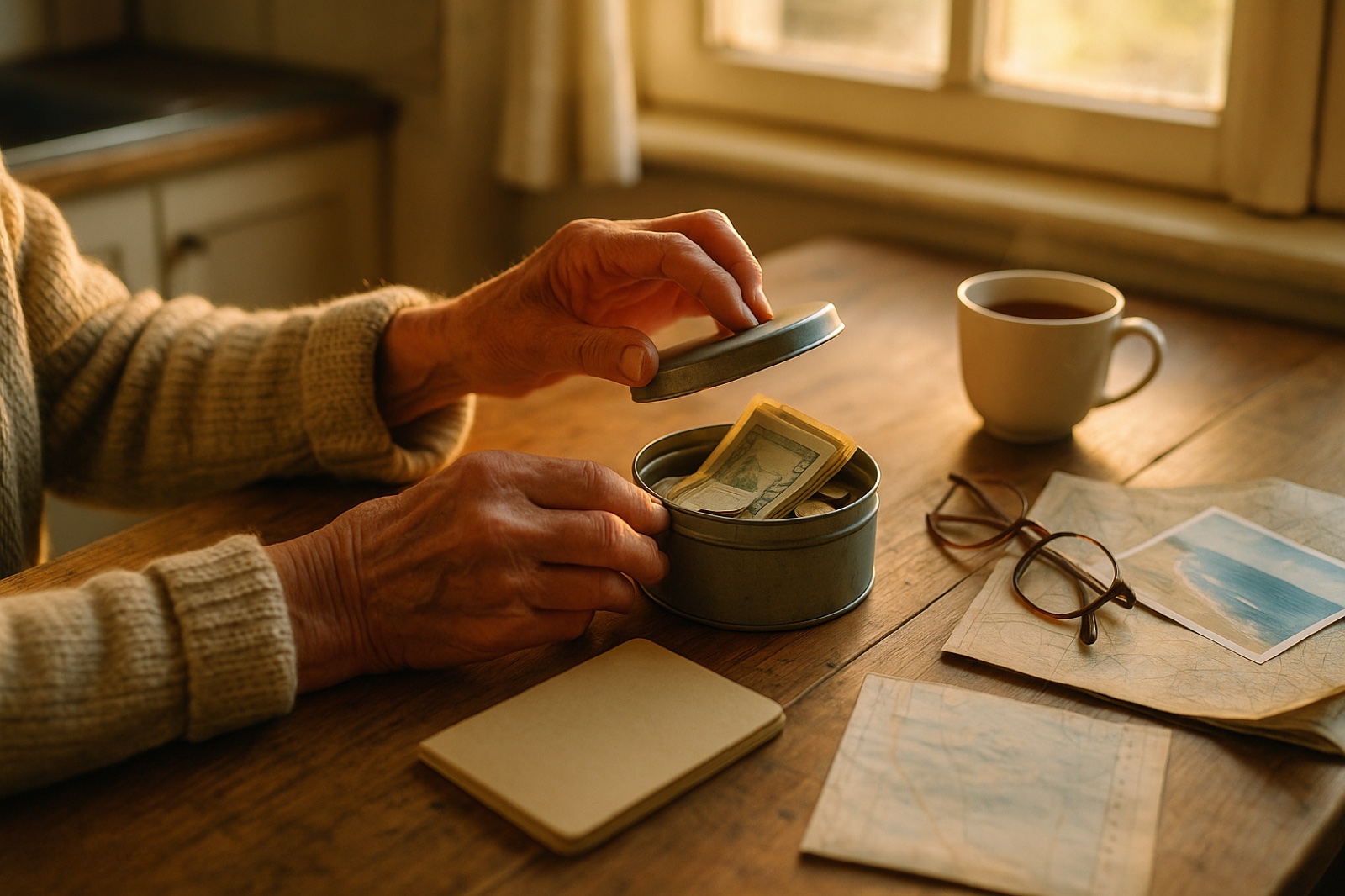
So maybe start small, and start today. Open the tin. Use the good plates. Take your share of what your own work made, and be glad of it.
Questions People Ask About Spending Retirement Savings
Why am I afraid to spend my retirement savings?
Being afraid to spend retirement savings is very common. In a 2026 Prudential survey of 3,023 US adults aged 50 and older, people named doubts about the state pension, rising prices, and health and care costs as their main reasons. Research by David Blanchett and Michael Finke also found that people tend to see taking money out of savings as a loss, even when they can afford it.
How many people are afraid to spend their retirement savings?
In Prudential’s 2026 Retirement Pulse survey of 3,023 US adults aged 50 and older, 86% said they do not feel free to spend their savings on things they enjoy. Among people with 500,000 US dollars or more in investable assets, 61% still did not feel comfortable spending for enjoyment. The survey was run online from July 27 to August 2, 2026.
Does having more money make people more comfortable spending in retirement?
Not by itself. In a 2026 Prudential survey, 61% of people with 500,000 US dollars or more in investable assets still did not feel comfortable spending on enjoyment, and 70% of that group said they would rather leave money behind than run out. People were more likely to feel comfortable spending when they had a clear plan for taking money out, or a pension or other guaranteed income.
How much of their savings do retired people actually spend?
Less than most planning rules allow. A 2025 paper by David Blanchett and Michael Finke in Financial Planning Review found that married 65-year-olds with at least 100,000 US dollars in savings took out about 2.1% a year, and single people about 1.9%. A common rule of thumb allows about 4%. The paper found retired people spend about 80% of their regular income but only about half of what their savings could provide.
What does ancient wisdom say about having wealth but not enjoying it?
One of the oldest wisdom writings in the world describes a person who is given riches, wealth and honour but not the power to enjoy them, so that a stranger enjoys them in the end. The writer calls this common. The same writer says that having enough and being free to enjoy it are two separate things, and calls the freedom to enjoy your share a gift of God.
Let’s Talk About It
Which is wiser: leaving as much as you can for your family, or enjoying more of it while you are here? Where would you draw the line? Tell us in the comments. We read every one.
Share This
86% of people over 50 in a new survey said they don’t feel free to spend their own savings on things they enjoy. Even 61% of those with half a million put away. This one made me think of my parents. https://bgodinspired.com/?p=117902
“Enough is one thing. Being free to enjoy it is another.” A good read on why so many people save all their lives and then can’t touch it: https://bgodinspired.com/?p=117902
Retired people spend about 80% of their monthly income but only about half of what their savings could give them. Same money, two different feelings. I’m going to go use the good plates. https://bgodinspired.com/?p=117902