 0
0
 0
0
Maybe you know the feeling. Someone offers you a reward, a promotion, a move, a big “you deserve this” – and something in you quietly says, that’s not for me anymore. Not because you’re ungrateful. Because you know what season you’re in.
If that’s you, you have a friend in the Bible you’ve probably never met. Who was Barzillai? He was an 80-year-old farmer from Gilead who fed King David’s hungry army on the worst night of David’s life. When the crisis was over, David offered him a seat at the royal table in Jerusalem for the rest of his life. Barzillai said no.
What he said instead is one of the most honest things an old person says anywhere in Scripture. And what David did about it, years later on his deathbed, may be the most surprising part of the whole story.
Who Was Barzillai in the Bible?
Barzillai shows up in 2 Samuel during the darkest stretch of David’s reign. David’s own son Absalom had led a revolt. David fled Jerusalem with his household and loyal soldiers, crossed the Jordan River, and ended up at a town called Mahanaim, on the east side of the river in Gilead.
They arrived with almost nothing. And three men came out to meet them. One of them was Barzillai:
“Barzillai the Gileadite of Rogelim, brought beds, and basons, and earthen vessels, and wheat, and barley, and flour, and parched corn, and beans, and lentiles, and parched pulse, and honey, and butter, and sheep, and cheese of kine, for David, and for the people that were with him, to eat: for they said, The people is hungry, and weary, and thirsty, in the wilderness.”
– 2 Samuel 17:27-29 (KJV)
Read that list slowly. Beds. Bowls. Flour. Lentils. Honey. Cheese. This isn’t a speech of support. It’s a kitchen and a bedroom, carried out to a tired crowd of strangers.
And notice when it happened. Nobody knew yet who would win. Absalom’s army was coming. Feeding the losing side of a civil war was a good way to lose everything you owned. Barzillai gave anyway. He saw hungry, weary, thirsty people, and he fed them.
The Bible adds one more detail: “he was a very great man” (2 Samuel 19:32). In other words, he was wealthy. But the text doesn’t praise his money. It praises what he did with it on the night it was risky to do anything at all.
The Offer at the Jordan River
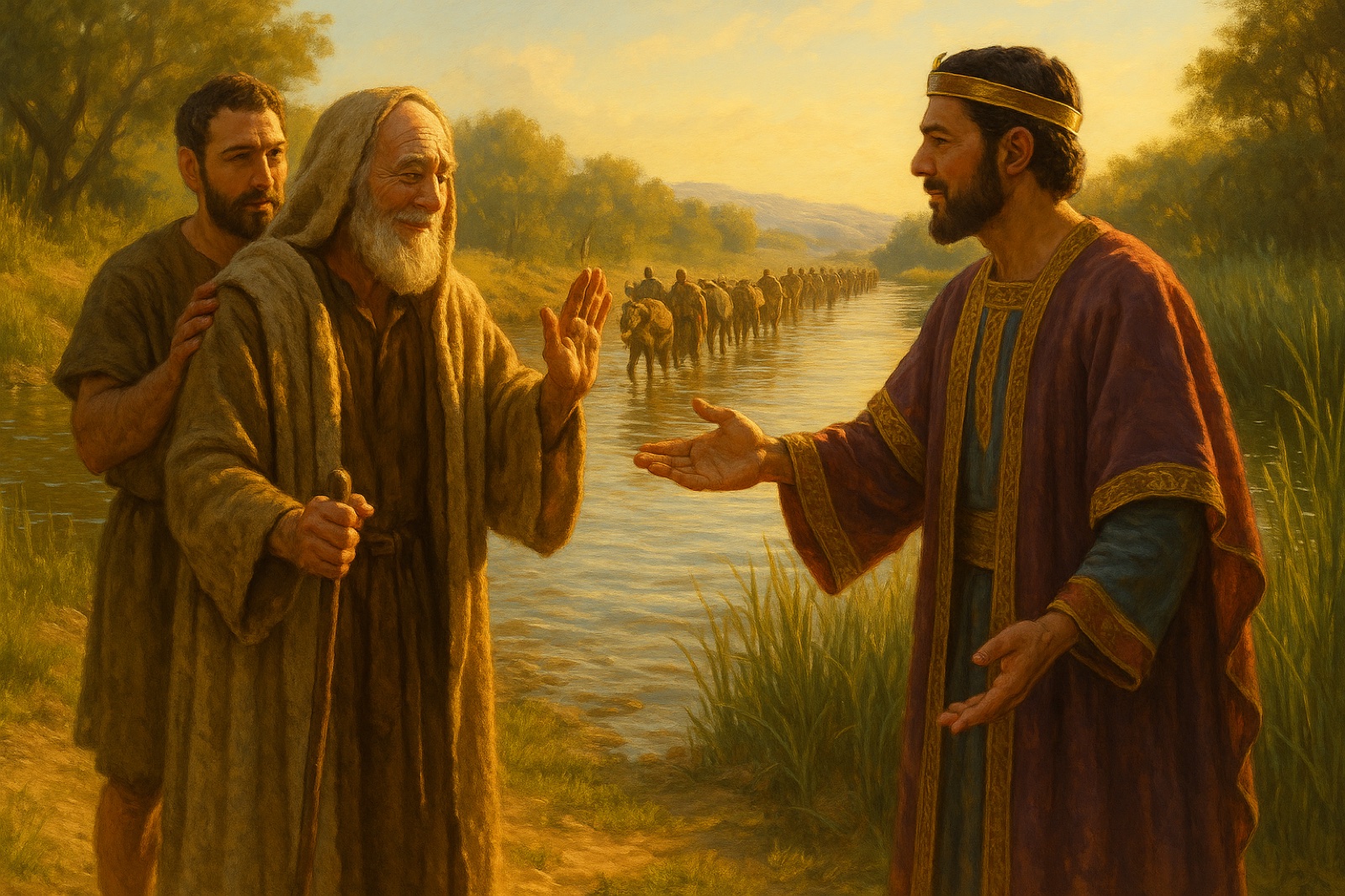
Absalom’s revolt failed. David was heading home to Jerusalem. And there, at the Jordan, the old man who had fed him came down to walk him across the river.
David wanted to repay him properly:
“And the king said unto Barzillai, Come thou over with me, and I will feed thee with me in Jerusalem.”
– 2 Samuel 19:33 (KJV)
It’s a beautiful offer. Barzillai fed the king, so now the king will feed Barzillai. Palace food, palace comfort, a place of honor for as long as he lives.
Here is his answer:
“How long have I to live, that I should go up with the king unto Jerusalem? I am this day fourscore years old: and can I discern between good and evil? can thy servant taste what I eat or what I drink? can I hear any more the voice of singing men and singing women? wherefore then should thy servant be yet a burden unto my lord the king?”
– 2 Samuel 19:34-35 (KJV)
“Fourscore” is 80. And what he says is almost funny in its honesty. Can I even taste the food anymore? Can I hear the singers? Why would I take up a seat at the best table in the land when I can’t enjoy what’s on it?
This isn’t false modesty. It’s a man who knows his body, knows his years, and isn’t pretending otherwise. He doesn’t say “I’m not worthy.” He says, in effect, “I know what this season is for, and it isn’t this.”
What Barzillai Asked For Instead
He didn’t just say no. He asked for two things.
The first was to go home:
“Let thy servant, I pray thee, turn back again, that I may die in mine own city, and be buried by the grave of my father and of my mother.”
– 2 Samuel 19:37 (KJV)
Think about that. The palace was on offer, and what he wanted was his own town and his parents’ graves. At 80, he knew what he actually loved.
The second request was for someone else:
“But behold thy servant Chimham; let him go over with my lord the king; and do to him what shall seem good unto thee.”
– 2 Samuel 19:37 (KJV)
Barzillai didn’t throw the reward away. He handed it forward. The text simply calls Chimham “thy servant,” but most readers take him to be Barzillai’s son, because when David later speaks of this family he talks about “the sons of Barzillai.” Either way, the old man looked at a seat he couldn’t use and put a younger man in it.
David agreed on the spot: “Chimham shall go over with me, and I will do to him that which shall seem good unto thee.” Then “the king kissed Barzillai, and blessed him; and he returned unto his own place” (2 Samuel 19:38-39).
That’s where most people stop reading. But the story isn’t over.
The Kindness David Never Forgot
Years later, David was dying. In 1 Kings 2 he gives his son Solomon his final instructions. And they’re hard to read.
First, David tells Solomon to deal with Joab, the general who had murdered two men in peacetime: “let not his hoar head go down to the grave in peace” (1 Kings 2:6). Then he tells him to deal with Shimei, the man who had cursed David as he fled: “his hoar head bring thou down to the grave with blood” (1 Kings 2:9).
Two old scores, settled at the end of a long, rough life. And sitting right between them, verse 7:
“But shew kindness unto the sons of Barzillai the Gileadite, and let them be of those that eat at thy table: for so they came to me when I fled because of Absalom thy brother.”
– 1 Kings 2:7 (KJV)
This is the part most retellings of this story leave out. Of all the people David could have named on his deathbed, he named two enemies and one friend. The friend was an old farmer who had brought him beds and cheese on the worst night of his life. Decades later, David still remembered. And the seat Barzillai turned down for himself went to his sons, just as he had asked.
And it keeps going. Hundreds of years later, in the time of the prophet Jeremiah, the Bible mentions a place called “the habitation of Chimham, which is by Bethlehem” (Jeremiah 41:17). Bethlehem was David’s hometown. The Bible never says how that place got Chimham’s name. Many readers suspect David gave Chimham land near his own family home. We can’t know for certain. But a place near Bethlehem still carried the name of the young man Barzillai put forward, long after everyone at that river crossing was gone.
There’s even an echo in Ezra 2:61, after the exile, where a priestly family is described as the descendants of a man who “took a wife of the daughters of Barzillai the Gileadite, and was called after their name.” Generations on, the name Barzillai was still one worth carrying.
(A quick note if you’re studying this: the Bible also mentions a different Barzillai, “the Meholathite,” in 2 Samuel 21:8. That’s the same chapter as the story of Rizpah, the mother who kept watch until King David moved. Same name, different man.)
What Barzillai Teaches Us About Aging Well
Here is what surprised me about Barzillai. We usually think aging well means holding on – staying in the game, keeping your seat, proving you’ve still got it. Barzillai shows a different kind of strength.
He gave when giving was risky. He took no payment when payment was offered – “why should the king recompense it me with such a reward?” (2 Samuel 19:36). He was honest about his limits without being bitter about them. And he turned his own reward into someone else’s beginning.
That’s a lot like what Jesus later taught: give, “hoping for nothing again” (Luke 6:35). We looked at what that looks like in real family life in Should I Lend Money to Family? What Luke 6:35 Says. Barzillai lived it a thousand years before Jesus said it.
And here’s the part that should give you peace. Barzillai went home. He didn’t stay near the king to make sure he got credit. He trusted that what he’d done was enough. And God was faithful to that quiet trust. The kindness was remembered – by a king, on a deathbed, in writing – without Barzillai ever having to remind anyone.
Maybe you’re 80. Maybe you’re 40 and just realizing some things aren’t for you anymore. Either way, this story says: you don’t have to take every seat you’re offered. You’re allowed to go home. And the good you did doesn’t disappear when you step back. It gets handed forward.
And if you’re younger, there’s a second lesson here, the one David learned. Somebody fed you when you had nothing to give back. Don’t wait until your deathbed to remember them.
If you’d like to explore more stories like this one, you can talk it through with our free Bible Stories AI assistant (it opens in ChatGPT).
Actions to Take Today
- Name your Barzillai. Think of one person who showed up for you when you had nothing to give back. Send them a short message today – even two lines – telling them you remember.
- Find your Chimham. Is there something you’ve been offered – a role, a chance, an invitation – that would do more good in a younger person’s hands? Write down one name you could put forward instead of yourself.
- Ask what they actually want. If there’s an older person in your life, ask them one simple question this week: “What matters most to you right now?” Barzillai didn’t want the palace. He wanted home. Listen for their answer.
Journaling Prompts
- What are you still holding on to that you honestly can’t “taste” anymore – and why is it hard to let go?
- Where have you given something quietly and wondered if anyone noticed? What would it look like to trust that it was enough?
- What does “going home” mean for you in this season of life?
A Prayer for Knowing Your Season
God, I don’t always know what season I’m in, and sometimes I grab for things that aren’t for me anymore. Give me Barzillai’s honesty – to see my limits without shame and my years without fear. Help me give when it’s risky and let go of the reward when it’s time. Show me who I can put forward, and help me trust that the good I’ve done is held by You, even when I step back. Amen.
Discussion Question
Do you think Barzillai was right to turn down the king’s table, or should he have accepted the honor he’d earned? Share your thoughts in the comments below – we’d love to hear from you.
Share This
- “Can I taste what I eat?” An 80-year-old turned down a seat at the king’s table and gave it to a younger man instead. I’m still thinking about Barzillai. (2 Samuel 19)
- On his deathbed, King David named two enemies and one friend. The friend was an old farmer who brought him beds and cheese on the worst night of his life. Kindness gets remembered.
- You don’t have to take every seat you’re offered. Sometimes the most faithful thing is to go home and hand the chance to someone else.
Questions About Barzillai
Who was Barzillai in the Bible?
Barzillai was a wealthy 80-year-old man from Rogelim in Gilead who brought food, beds and supplies to King David and his followers at Mahanaim when David fled from his son Absalom’s revolt (2 Samuel 17:27-29). When the revolt ended, David offered him a lifelong place at the royal table in Jerusalem, and Barzillai declined (2 Samuel 19:31-39).
Why did Barzillai refuse to go to Jerusalem with King David?
Barzillai said he was 80 years old, could no longer taste his food or hear singers, and did not want to be a burden to King David (2 Samuel 19:34-35). He asked to return to his own city to die and be buried near his father and mother, and asked David to take Chimham to Jerusalem in his place.
Who was Chimham in the Bible?
Chimham was the younger man Barzillai asked King David to take to Jerusalem in his place (2 Samuel 19:37-40). The text calls him Barzillai’s servant, and many readers take him to be Barzillai’s son. A place called “the habitation of Chimham, which is by Bethlehem” is mentioned centuries later in Jeremiah 41:17.
What did King David say about Barzillai before he died?
In 1 Kings 2:7, the dying King David told Solomon to “shew kindness unto the sons of Barzillai the Gileadite” and let them eat at the royal table, because they had helped David when he fled from Absalom. The instruction sits between David’s orders concerning Joab and Shimei.
What is the lesson of Barzillai’s story?
The story of Barzillai in 2 Samuel 19 is often read as a picture of aging well: giving generously when it is risky, refusing payment for kindness, being honest about one’s limits, and handing opportunity to the next generation. King David’s deathbed instruction in 1 Kings 2:7 shows that this kindness was remembered for decades.