 0
0
 0
0
Have you ever prayed and then felt a little silly about what you actually asked for? Maybe you wanted to ask for something big and specific, but it felt greedy, or too small, or too obvious. So you prayed something vague and polite instead. “Just be with me today.”
There is a man in the Gospel of Mark who did not do that. His name was blind Bartimaeus. The crowd told him to be quiet. He got louder. And when he finally stood in front of Jesus, Jesus asked him a question that sounds, at first, like it has an obvious answer.
But that question is not as simple as it looks. Jesus had asked the exact same question just a few verses earlier, to two of His closest friends. They answered it very differently. Put the two answers side by side, and the story of blind Bartimaeus becomes one of the most honest lessons on prayer in the whole Bible.
Who Was Blind Bartimaeus?
Blind Bartimaeus was a beggar who sat beside the road outside Jericho. His story is told in Mark 10:46-52. Here is how it opens:
“And they came to Jericho: and as he went out of Jericho with his disciples and a great number of people, blind Bartimaeus, the son of Timaeus, sat by the highway side begging.” (Mark 10:46, KJV)
Notice something small. Mark gives us his name. That is rare. Almost every person Jesus heals in Mark’s Gospel has no name at all. There is “a leper,” “a man with a withered hand,” “a woman,” “a blind man” in Bethsaida. Bartimaeus is the exception. Mark even explains the name: “Bar” is the Aramaic word for “son of,” so Bartimaeus simply means “son of Timaeus.”
Why would Mark keep his name? We are not told. But many readers think it is because people in the early church knew him. He may have been someone you could go and ask: “Is it true? Were you really blind?”
Matthew and Luke tell this story too. Matthew mentions two blind men (Matthew 20:29-34). Luke tells of one blind man and does not name him (Luke 18:35-43). Only Mark gives us Bartimaeus by name.
The Crowd Told Him to Be Quiet
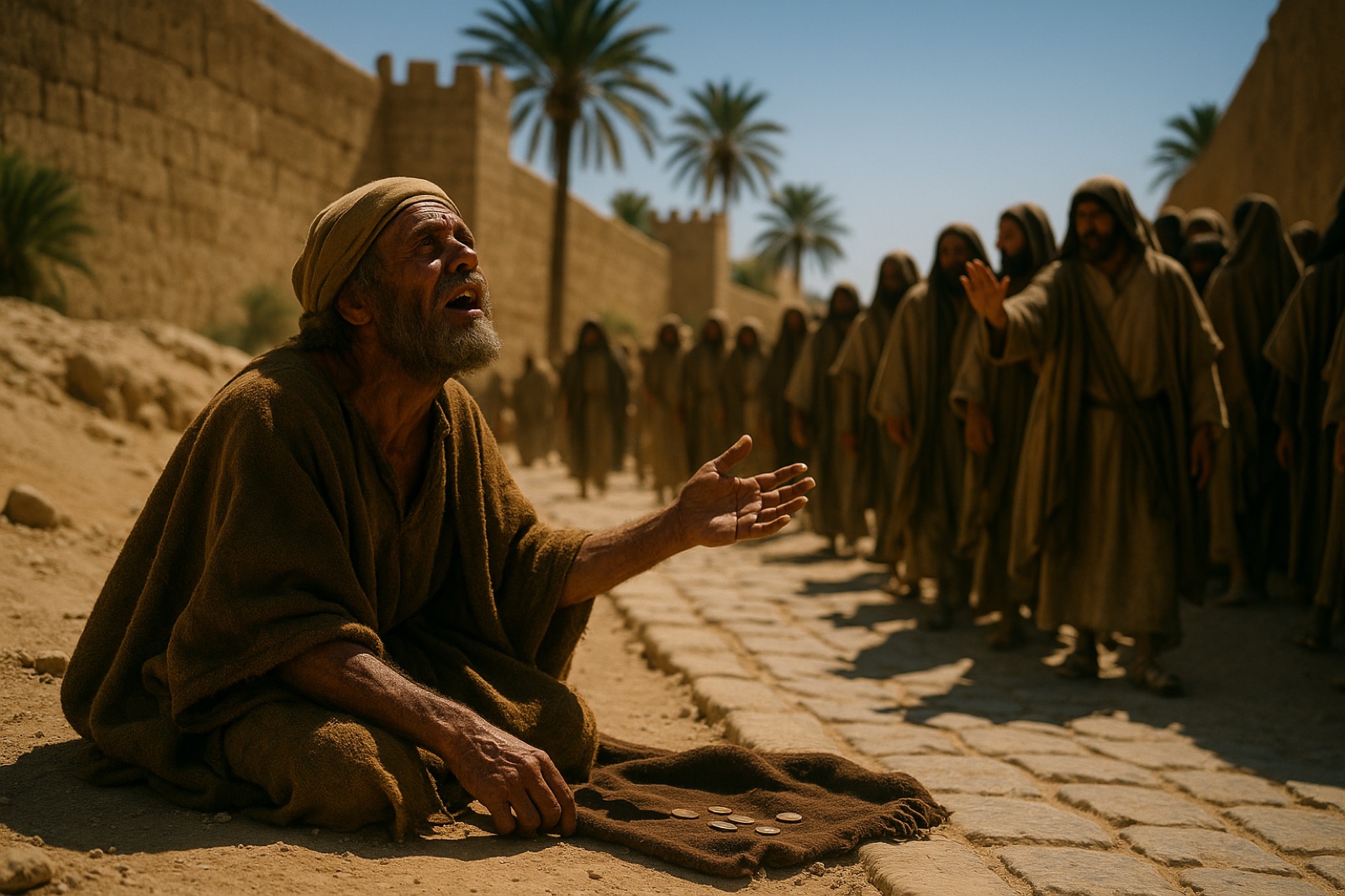
Bartimaeus could not see Jesus. But he could hear the crowd. When he learned who was passing by, he started shouting:
“And when he heard that it was Jesus of Nazareth, he began to cry out, and say, Jesus, thou Son of David, have mercy on me. And many charged him that he should hold his peace: but he cried the more a great deal, Thou Son of David, have mercy on me.” (Mark 10:47-48, KJV)
“Hold his peace” means “be quiet.” Lots of people told him to stop. Maybe he was embarrassing. Maybe they thought Jesus was too busy for a beggar. Jesus was on His way to Jerusalem, after all, and a large crowd was following Him.
Bartimaeus did the opposite of what they said. He “cried the more a great deal.” He got louder.
Look at what he called Jesus, too: “Son of David.” That was a title for the promised king from David’s family line. As far as Mark tells the story, Bartimaeus is the first person in the whole Gospel to call Jesus by that name out loud. The blind man on the side of the road saw who Jesus was before most of the crowd did.
Jesus Stood Still
Then comes one of the most beautiful lines in the story:
“And Jesus stood still, and commanded him to be called. And they call the blind man, saying unto him, Be of good comfort, rise; he calleth thee.” (Mark 10:49, KJV)
Jesus stopped walking. He was heading to Jerusalem, where He had just told His disciples He would be killed (Mark 10:33-34). And still, He stood still for one man that everybody else wanted gone.
And watch the crowd. A moment ago they were telling Bartimaeus to be quiet. Now the same people say, “Be of good comfort, rise; he calleth thee.” When Jesus pays attention to someone, the crowd changes its mind fast.
He Threw Away His Cloak
“And he, casting away his garment, rose, and came to Jesus.” (Mark 10:50, KJV)
This detail is easy to read past. It should not be.
For a very poor person in that time, a cloak was not just clothing. It was a blanket at night. The Law of Moses actually protected it. If you took a poor person’s cloak as a guarantee for a loan, you had to give it back before sunset:
“If thou at all take thy neighbour’s raiment to pledge, thou shalt deliver it unto him by that the sun goeth down: For that is his covering only, it is his raiment for his skin: wherein shall he sleep?” (Exodus 22:26-27, KJV)
So a beggar’s cloak may have been close to everything he owned. Some people think he spread it out on the ground to catch coins. Mark does not say that, so we cannot be sure. But we can be sure of this: a blind man threw away the one thing he would have needed to find again, and he did it without a second thought. He was not planning to go back to that spot.
The Question Jesus Asked Twice
Now we reach the heart of the story.
“And Jesus answered and said unto him, What wilt thou that I should do unto thee? The blind man said unto him, Lord, that I might receive my sight.” (Mark 10:51, KJV)
It sounds like a strange question. The man is blind. Isn’t it obvious what he wants?
But scroll back up the same chapter. Just a few verses earlier, two of Jesus’s own disciples, James and John, came to Him. And look at how they started:
“And James and John, the sons of Zebedee, come unto him, saying, Master, we would that thou shouldest do for us whatsoever we shall desire. And he said unto them, What would ye that I should do for you? They said unto him, Grant unto us that we may sit, one on thy right hand, and the other on thy left hand, in thy glory.” (Mark 10:35-37, KJV)
Same question. Almost word for word. “What would ye that I should do for you?” and “What wilt thou that I should do unto thee?”
But look at the two answers.
- James and John first asked Jesus to agree to anything they wanted before they even said what it was. Then they asked for the best seats in His kingdom. Power. Status. A place above everyone else.
- Bartimaeus asked for one thing. “Lord, that I might receive my sight.” He named his real need, plainly, with nothing extra.
The disciples had spent years walking with Jesus. The beggar had spent years sitting by the road. And the beggar asked the better question.
There is one more thing. Earlier in Mark, in chapter 8, Jesus healed a different blind man in two stages. We looked at that strange two-stage miracle here. Many Bible readers have noticed that these two blind men sit like bookends around a long section where the disciples keep missing the point. In between, Jesus tells them three times that He is going to suffer and die, and three times they misunderstand. The blind men get their sight. The disciples, for now, stay blind.
What Happened After Bartimaeus Could See
“And Jesus said unto him, Go thy way; thy faith hath made thee whole. And immediately he received his sight, and followed Jesus in the way.” (Mark 10:52, KJV)
“Made thee whole” is a rich phrase. The Greek word behind it is the same word the New Testament uses for being saved. That word, sozo, means healing and saving all at once. For Bartimaeus, getting his eyes back and being made whole were the same event.
And then, notice. Jesus told him, “Go thy way.” He was free to go anywhere. He chose Jesus’s way instead. He “followed Jesus in the way.”
Where was that road going? The very next verse, Mark 11:1, says they “came nigh to Jerusalem.” The next scene is Jesus riding into the city, the week that ends at the cross. The first thing Bartimaeus did with his new eyes was follow Jesus toward Jerusalem. Earlier in the chapter, the disciples following on that same road “were afraid” (Mark 10:32). Bartimaeus walked it with his eyes wide open.
Walking with Jesus has always happened on the road. In Mark, some of the most important moments happen while people are walking, and this is one of them.
What Blind Bartimaeus Teaches Us About Prayer
Here is the part that surprised me. We usually read this story as a lesson about being loud and not giving up. That is true. But the question in the middle might be the bigger lesson.
Jesus asked, “What do you want me to do for you?” even though He could see what the man needed. Why ask?
Maybe because saying it out loud matters. Naming what you actually want is an act of trust. It is not greedy, and it is not rude. It is honest.
Many of us pray a lot like James and John did, without meaning to. We come to God with a vague “please bless whatever I’m doing.” We want the answer to be yes before we are willing to say what we are asking. Or we ask for things that are really about looking good, being safe, or being ahead of other people.
Bartimaeus shows another way. Know what you need. Say it plainly. Leave the cloak behind if you have to. And when the answer comes, follow.
The crowd may tell you your need is too small, or too loud, or not important enough. Jesus did not think so. He stood still.
Actions to Take Today
- Write one sentence. Finish this: “If Jesus asked me today, ‘What do you want me to do for you?’, I would say…” Keep it to one line. No extra words.
- Say it out loud. Find a quiet spot, even a bathroom or a walk to the shop, and pray that one sentence out loud. Not in your head. Out loud, the way Bartimaeus did.
- Name your “cloak.” Think of one thing you keep holding onto that you would need to put down to follow where God is leading. A habit, a grudge, a safe excuse. Write it next to your sentence.
Journaling Prompts
- When have you gone quiet about something you needed because other people made you feel it was too much?
- If you are honest, which of your recent prayers sound more like James and John, and which sound more like Bartimaeus?
- What would change about the way you pray if you believed Jesus actually wants to hear the specific answer?
A Prayer
Jesus, I have been praying around the real thing instead of just saying it. Today I want to answer Your question honestly. Here is what I actually need: [say it]. Help me throw off whatever I am clinging to, and when You answer, help me follow You in the way, even when I don’t know where the road goes. Amen.
Discussion Question
Why do you think Jesus asked Bartimaeus what he wanted, when his need seemed so obvious? Share your thoughts in the comments below. We’d love to hear from you.
Share This
- “Jesus asked two disciples and one blind beggar the same question. The beggar gave the better answer. Mark 10.”
- “The crowd told Bartimaeus to be quiet. He got louder. And Jesus stood still. Don’t let anyone tell you your need is too small.”
- “‘What wilt thou that I should do unto thee?’ I’ve been praying vague prayers. Today I’m saying the real thing.”
Quote to remember: “Say what you actually need. Jesus already stopped to listen.”
Questions About Blind Bartimaeus
Who was blind Bartimaeus in the Bible?
Blind Bartimaeus was a blind beggar who sat by the road outside Jericho. His story is in Mark 10:46-52. When Jesus passed by, Bartimaeus shouted “Jesus, thou Son of David, have mercy on me,” kept shouting when the crowd told him to stop, and was healed. Afterward he followed Jesus on the road toward Jerusalem.
What does the name Bartimaeus mean?
The name Bartimaeus means “son of Timaeus.” “Bar” is the Aramaic word for “son of.” Mark’s Gospel explains this by calling him “blind Bartimaeus, the son of Timaeus” in Mark 10:46.
Why did Jesus ask Bartimaeus what he wanted?
In Mark 10:51, Jesus asked blind Bartimaeus, “What wilt thou that I should do unto thee?” A few verses earlier, in Mark 10:36, Jesus asked James and John almost the same question, and they asked for seats of honor in His kingdom. Bartimaeus simply asked to see. The question invites a person to name their real need honestly, and the two answers show the difference between asking for status and asking for what you truly need.
Why did Bartimaeus throw away his cloak?
Mark 10:50 says Bartimaeus cast away his garment when Jesus called him. For a poor person in Bible times, a cloak also served as a blanket at night, and Exodus 22:26-27 required that a poor person’s pledged cloak be returned before sunset. Throwing it aside suggests Bartimaeus left behind something valuable without hesitation, fully expecting not to return to his old place by the road.
Is Bartimaeus the same as the blind men in Matthew and Luke?
The healing of blind Bartimaeus in Mark 10:46-52 is usually read alongside Matthew 20:29-34 and Luke 18:35-43, which describe a healing of the blind near Jericho. Matthew mentions two blind men, and Luke mentions one blind man without a name. Only Mark gives the name Bartimaeus.