 0
0
 0
0
Somewhere under the Atlantic, about a kilometre down, there is a river bigger than every river on land put together. It is cold, it is dark, and it is moving south. Nobody has ever seen it. But for more than twenty years, people have been quietly measuring it.
This month, the headlines came back around: the Atlantic Ocean current is slowing down. Then, almost the same week, a different team said: we are not so sure.
So which is it? If you have seen the scary version of this story and felt your stomach drop, this is for you. Let’s look at what was actually measured, what was not, and why two careful groups of scientists can look at the same ocean and come away with different answers.
What Is the Atlantic Ocean Current, and Why Does It Matter?
Scientists call it the AMOC. That stands for the Atlantic Meridional Overturning Circulation. It is a mouthful, so think of it as a giant conveyor belt.
Warm, salty water flows north near the surface. The famous Gulf Stream is part of that. Up near Greenland and Iceland, the water cools, gets heavy, and sinks. Then it creeps back south, deep underground, along the bottom of the ocean. Round and round.
That loop carries heat. It helps shape rain patterns, sea levels along coasts, and how mild or harsh winters are in places far from the Atlantic. That is why people pay attention when someone says it might be weakening.
The Case for Yes: Twenty Years of Direct Measurements
In April 2026, a team led by Shane Elipot at the University of Miami’s Rosenstiel School published a study in the journal Science Advances. Science news sites picked it up again in September, which is why you may be seeing it now.
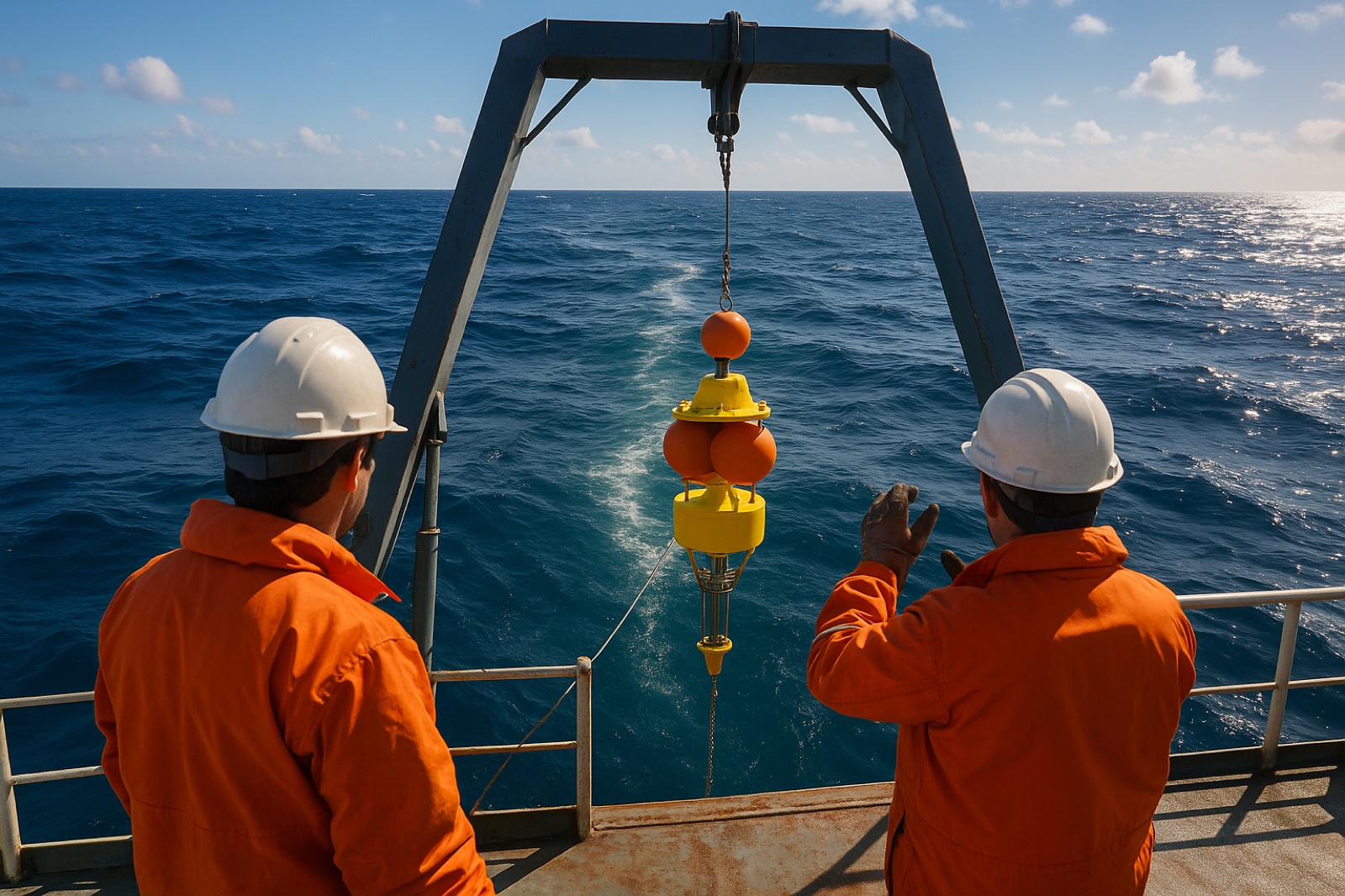
What makes this study different is that it did not rely on a computer model. It used real instruments. The team looked at four lines of moorings, which are strings of sensors anchored to the sea floor. They sit along the western edge of the North Atlantic, roughly from the latitude of the Caribbean up to the latitude of Nova Scotia.
Those sensors measure pressure, temperature and currents in the deep water, below 1,000 metres. That is the part of the conveyor belt flowing back south.
Their finding: across all those latitudes, the deep flow along the western edge has been getting weaker over the past two decades. The researchers wrote that most earlier claims of a slowdown came from models, and that “robust, long-term evidence from multilatitudinal in situ observations remains limited.” This study was an attempt to fill that gap. You can read the full paper here.
The Part the Headlines Skipped
Here is where it gets interesting. If you open the paper itself, not the news story about it, the picture is more careful than the headlines.
- Not all four records are twenty years long. The two southern arrays run from the early 2000s into the 2020s. The two northern ones only cover about 2004 to 2014 and 2008 to 2014. That is closer to ten years, or less.
- One of the four trends is not statistically significant. At the northernmost array, off Nova Scotia, the decline is small enough that it could be noise.
- The other side of the ocean moved the other way. At the one latitude where scientists can measure the whole width of the Atlantic, the eastern side actually strengthened while the western side weakened. The authors say plainly that looking only at the western edge overstates the size of the trend.
- The title is precise for a reason. The paper is about the “western boundary contribution” to the AMOC. It is one piece of the conveyor belt, not the whole thing. The authors say it “may serve as an effective indicator” of overall weakening. May. That is an honest word, and it matters.
None of this makes the study wrong. It is good, careful science. It just means the finding is smaller and more cautious than “the ocean is shutting down.”
The Case for Not So Fast: A New Analysis
In September 2026, a team including Niklas Boers posted a new paper on arXiv, a site where scientists share research before formal peer review. Its title says it all: Disentangled Fingerprints suggest no historical weakening of Atlantic Overturning and Subpolar Gyre.
Their argument is about method. Because we only have a few decades of direct measurements, many past studies used “fingerprints” instead. These are patterns in sea surface temperature that are supposed to reveal what the deep current is doing. The trouble, this team says, is that the old fingerprints mix up two different systems: the big conveyor belt and a separate swirl of water south of Greenland called the subpolar gyre.
So they built new fingerprints designed to tell the two apart. When they applied them to real ocean temperature records, their fingerprints did “not confirm the substantial AMOC weakening in the recent decades as suggested by traditional fingerprints.” The abstract is public here.
But read their very next words. The new fingerprints also “do not rule out a loss of stability.” In other words: we do not see the big slowdown others claimed, and we are not saying everything is fine either.
So, Is the Atlantic Ocean Current Slowing Down?
The honest answer is: probably somewhat, in some places, and nobody knows yet how much or what it means for the future.
Here is where things stand as simply as I can put it:
- Direct instruments show the deep flow along the western Atlantic weakening, most clearly in the south, over roughly two decades.
- The eastern side partly pushed back the other way, so the total change is smaller than the western number alone suggests.
- A newer method using surface temperatures finds no clear sign of the large slowdown older methods reported.
- The newer paper has not yet been through peer review.
- Both teams agree the records are short, and both leave room for real change ahead.
For the bigger picture, the UN’s climate science panel, the IPCC, said in its 2021 report that the AMOC is very likely to weaken this century, and that there is medium confidence it will not collapse suddenly before 2100. That is the grown-up middle. Not doom. Not denial.
Why Honest Uncertainty Is Good News
It is easy to read a story like this and feel worse. One headline says the ocean is failing. Another says it is not. You are left holding the anxiety and none of the answers.
But look at what actually happened here. People spent twenty years dropping sensors to the bottom of the sea and hauling them back up, in storms, to measure water they will never see. Then other people checked their work and pushed back. That is not chaos. That is care. A world where scientists argue openly about a deep current is a world where someone is paying attention. If you tend to jump straight to the worst case, this piece on catastrophizing might help you notice when your mind is doing it.
And there is something older underneath all this. Thousands of years ago, long before anyone could measure a current, an ancient writer sat and watched the world. They noticed the wind goes south, then swings back north, circling on its rounds. They noticed every river runs into the sea, and the sea never fills, because the water finds its way back to where the rivers began. They did not have moorings or satellites. They just saw that the world runs on loops, and that the loops were held by Someone bigger than the person watching. God built a planet that circulates, and it is still circulating while we learn to read it.
That does not mean nothing can change. It means we get to study the change with curiosity instead of dread. Oceans are more connected than they look, too. Just last week we wrote about how the Indian and Pacific Oceans have stopped moving in step, and about this year’s El Niño, another ocean loop that shapes weather far from where it starts.
What You Can Do With This
You do not need a research ship to be a good steward of this story. A few simple things help:
- Read past the headline. When a science story scares you, look for words like “may”, “suggests” and “one component”. They are there for a reason.
- Hold two things at once. “This is worth taking seriously” and “this is not the end of the world” can both be true.
- Watch the next few years. Every year of measurement makes the record longer and the answer clearer. This is a story still being written.
The deep river is still flowing south tonight, a kilometre down, in the dark. Maybe a little slower than it used to. Maybe not. Either way, people are listening to it, and the loop keeps turning.
Discussion Question
When two groups of scientists disagree about something as big as an ocean current, does it make you trust science more or less? Tell us in the comments. We read every one.
Share This
“Twenty years of sensors on the sea floor say the Atlantic’s deep current is weakening. A new analysis says not so fast. Turns out the honest answer is more interesting than the scary one. https://bgodinspired.com/?p=116606”
“I didn’t know there’s a river a kilometre under the Atlantic bigger than every river on land combined. Or that scientists are still arguing about whether it’s slowing down. This explained both sides without the doom: https://bgodinspired.com/?p=116606”
“An ancient writer noticed the wind and rivers run in loops long before anyone could measure an ocean current. Loved this calm, clear look at the Atlantic slowdown debate. https://bgodinspired.com/?p=116606”
Questions People Ask About the Atlantic Ocean Current
Is the Atlantic Ocean current slowing down?
The evidence is mixed. A 2026 study in Science Advances using four lines of deep-sea moorings found the deep flow along the western edge of the North Atlantic has weakened over roughly two decades. A September 2026 preprint using new sea surface temperature fingerprints found no clear sign of the large slowdown earlier methods suggested, though it did not rule out a loss of stability.
What is the AMOC?
The AMOC, or Atlantic Meridional Overturning Circulation, is a large system of ocean currents in the Atlantic. Warm, salty surface water flows north, cools and sinks near Greenland and Iceland, and returns south in the deep ocean. It moves heat around the planet and helps shape weather, rainfall and sea levels.
Is the Gulf Stream the same as the AMOC?
No. The Gulf Stream is a fast surface current off the east coast of North America that forms part of the northward-flowing upper branch of the AMOC. The AMOC is the whole overturning loop, including the deep cold water flowing back south, so the Gulf Stream is one piece of a much larger system.
Will the Atlantic Ocean current collapse soon?
Most scientists do not expect a sudden collapse soon. The IPCC’s 2021 assessment said the AMOC is very likely to weaken during the 21st century, and that there is medium confidence it will not collapse abruptly before 2100. Researchers continue to study the question because direct measurement records are only a few decades long.
Why do scientists disagree about the AMOC slowing down?
Scientists disagree mainly because direct measurements of the deep Atlantic only go back about twenty years, and they cover only certain locations. Other studies rely on indirect signals such as sea surface temperature patterns, and different methods can mix up the AMOC with nearby currents like the subpolar gyre, leading to different conclusions.