 0
0
 0
0
Maybe someone said it to you in a youth group. Maybe you heard it in an argument online. “All sin is sin. A lie is the same as a murder in God’s eyes.”
And something in you pushed back. Because you know that stealing a pen from work is not the same as hurting a child. You know it in your bones.
Or maybe it went the other way. Maybe you did something you can’t stop thinking about, and you’re asking are all sins equal because you’re quietly hoping the answer is yes. Because if it’s all the same, then maybe yours isn’t as bad as it feels.
Either way, you’re not asking a trivia question. You’re asking where you stand. So let’s look at what the Bible actually says. There are two verses at the center of this, and they seem to disagree. They don’t. They’re just answering two different questions.
Are All Sins Equal? The Verse Everyone Quotes
The “yes, all sins are equal” answer almost always comes from one verse:
“For whosoever shall keep the whole law, and yet offend in one point, he is guilty of all.” (James 2:10, KJV)
Read on its own, that sounds like a flat answer. One sin, any sin, and you’re guilty of everything. Case closed.
But here’s the part that almost never gets quoted with it. Go back to the start of the chapter. James isn’t writing about how to measure sins at all. He’s writing about church seating.
He describes a rich man walking into a gathering in fine clothes and getting the good seat, while a poor man in shabby clothes is told to stand or sit on the floor. That’s the problem James is solving. He opens with:
“My brethren, have not the faith of our Lord Jesus Christ, the Lord of glory, with respect of persons.” (James 2:1, KJV)
“Respect of persons” is old English for favoritism. Ranking people. Deciding who matters more. And just before our famous verse, James says it plainly:
“But if ye have respect to persons, ye commit sin, and are convinced of the law as transgressors.” (James 2:9, KJV)
So James 2:10 was written to people who thought they were above someone else. People who kept most of the rules and felt good about it, while treating the poor man like he was less. James is telling them: you don’t get to stand on a higher step. If you’ve broken the law in one place, you’re a lawbreaker too. You’re on the same floor as everyone else.
That’s a verse against ranking people. It was never a chart saying every wrong does the same damage.
And look where James lands just three verses later: “mercy rejoiceth against judgment” (James 2:13, KJV). The whole passage is pushing toward mercy, not toward fear.
What Jesus Told Pilate About the “Greater Sin”
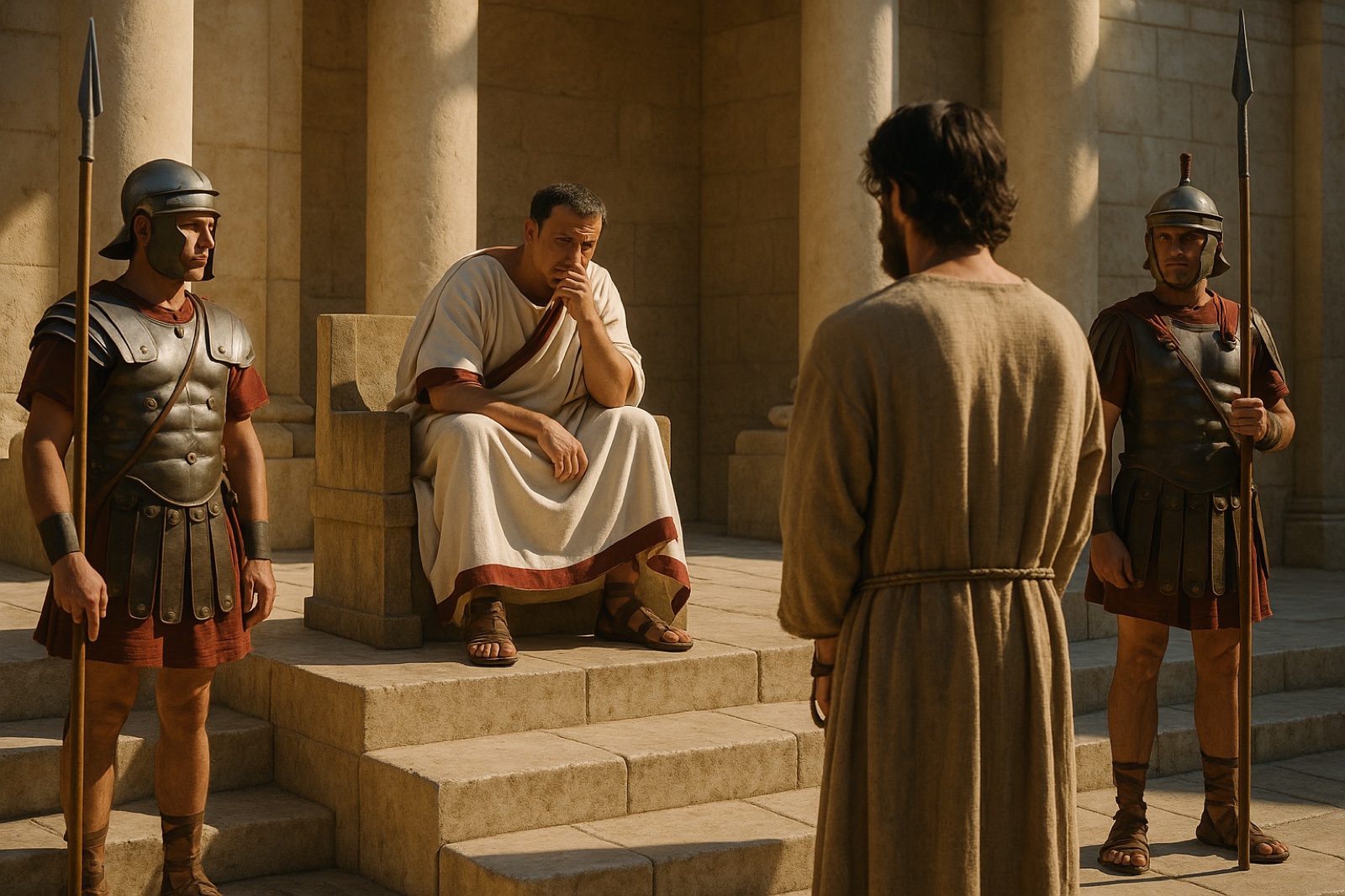
Now go to the other verse. It’s early morning, the day Jesus will be crucified. Jesus has been led from the high priest Caiaphas to the Roman governor’s hall of judgment (John 18:28). Pilate is frustrated that Jesus won’t answer him, and he pulls rank:
“Then saith Pilate unto him, Speakest thou not unto me? knowest thou not that I have power to crucify thee, and have power to release thee?” (John 19:10, KJV)
And Jesus answers:
“Thou couldest have no power at all against me, except it were given thee from above: therefore he that delivered me unto thee hath the greater sin.” (John 19:11, KJV)
Stop on those words. The greater sin. Jesus Himself, in one of the most serious moments of His life, says that one wrong is heavier than another.
Notice two quiet details in that sentence.
First, “greater” means Pilate still has sin. Jesus doesn’t let him off the hook. Pilate is about to hand an innocent man over to be killed, and that is wrong. But the one who “delivered” Jesus to Pilate carries more.
Second, who is “he that delivered me”? John doesn’t name him in that verse. Many readers think it points to Caiaphas, the high priest. Pilate himself had just said, “Thine own nation and the chief priests have delivered thee unto me” (John 18:35, KJV). Others think it means Judas. Christians have landed on both, and the text doesn’t settle it. But either way, the “greater” sin belongs to someone who knew more and chose it anyway. Caiaphas knew the Scriptures. Judas had walked with Jesus for years. Pilate was a Roman governor trying to keep the peace and keep his job.
That lines up with something Jesus taught elsewhere. In Luke 12, He tells a story about two servants. The one “which knew his lord’s will, and prepared not himself” is “beaten with many stripes.” The one who “knew not” is “beaten with few stripes.” Then He adds: “For unto whomsoever much is given, of him shall be much required” (Luke 12:47-48, KJV).
And to the religious leaders, Jesus said they had “omitted the weightier matters of the law, judgment, mercy, and faith” (Matthew 23:23, KJV). Weightier. Some things weigh more. Jesus said so.
So Which Is It? Both, Because They Answer Different Questions
Here’s where it comes together.
James answers the question “Am I better than them?” And the answer is no. Every sin breaks the same relationship. Nobody gets to look down from a higher step. The person who gossips doesn’t get to sneer at the person who drinks too much. The rule-keeper doesn’t get the better seat.
Jesus answers the question “Do all wrongs do the same damage?” And the answer is also no. A lie that saves face is not the same as a lie that sends an innocent man to his death. Knowing better makes it heavier. Harm makes it heavier. Jesus weighed sins honestly, even while standing in front of the man who was about to condemn Him.
Both are true at the same time. You can’t rank yourself above anyone. And not every wrong is the same size.
The trouble starts when we use one verse to answer the other verse’s question. When “all sin is equal” gets used to say abuse is no worse than impatience, that is using James to erase what Jesus said. And when “my sin isn’t as bad as theirs” gets used to feel superior, that is using Jesus’s words to erase what James said.
The Question Underneath the Question
But let’s be honest about why most people search this.
Very few people wake up curious about sin categories. Most of the time, the real question is closer to this: Is what I did too big? Am I past the point where God will take me back?
If that’s you, here’s the thing. Neither verse says that. James 2:10 says everyone is on the same floor, which means you’re not alone down there. John 19:11 says some sins are heavier, but it never says any sin is too heavy to be forgiven.
In fact, look at what happened a few hours after Jesus spoke to Pilate. Hanging on the cross, He prayed:
“Father, forgive them; for they know not what they do.” (Luke 23:34, KJV)
He prayed that over the people who were, at that very moment, carrying out His death. That is not the prayer of someone keeping a list of which sins are too big.
And the promise is not graded by size: “If we confess our sins, he is faithful and just to forgive us our sins, and to cleanse us from all unrighteousness” (1 John 1:9, KJV). All unrighteousness. Not the small ones. All of it.
So yes, sins have different weight. That’s why your conscience hurts more over some things than others, and that’s a good sign, not a bad one. It means you can still feel. But the weight of a sin is about the harm it does. It is never a measure of whether God’s mercy can reach it.
If this has you thinking about something you’re carrying, you might want to read Think You’re Beyond Help? Matthew 8:3 Says Otherwise. And if the hard part is forgiving someone else for a heavy wrong they did to you, What Does the Bible Say About Forgiveness? walks through what forgiveness does and doesn’t mean.
Actions to Take Today
- Name it in one sentence. If there’s a specific thing that made you search this, write it down in one plain sentence. No excuses, no extra words. Then write 1 John 1:9 under it. Seeing both on the same page matters.
- Check who you’ve been ranking. Think of one person you’ve quietly put “below” you because of what they did. Send them a kind message today, or just pray for them by name. That is James 2 in real life.
- Make the one repair you can. If your “heavier” wrong hurt a real person, pick one small step toward making it right: an honest apology, returning something, telling the truth you held back. Do the first step, not the whole thing.
Journaling Prompts
- When you hear “all sins are equal,” what do you feel first: relief or resistance? What might that tell you about what you’re carrying?
- Where have you been standing on a “higher step” than someone else, even just in your head?
- If you truly believed no sin was too heavy for God’s mercy, what would you stop doing, or start doing, this week?
Some sins weigh more. None of them weigh more than mercy.
A Prayer for Today
God, I’ve been trying to figure out how bad I really am, and I think I’ve been scared of the answer. I don’t want to pretend my wrongs are small, and I don’t want to look down on anyone else either. I bring You the thing I keep coming back to, the one that feels heaviest. Thank You that Jesus prayed forgiveness over the worst thing ever done, and that Your mercy is bigger than what I carry. Help me put it down and walk forward. Amen.
Discussion Question
Do you think people use “all sins are equal” more often to make others feel humble, or to make themselves feel better? Share what you’ve seen in the comments below.
Share This
- “All sins are equal” was written to stop people from looking down on others. Jesus still said one sin was greater. Both are true. Neither one says I’m beyond forgiveness.
- I always heard James 2:10 as “every sin is the same.” Turns out James was talking about a church giving the rich guy the best seat. It’s a verse against ranking people, not against weighing sins.
- Standing before Pilate, Jesus said “he that delivered me unto thee hath the greater sin.” A few hours later, He prayed “Father, forgive them.” Some sins weigh more. None weigh more than mercy.
Questions and Answers About Whether All Sins Are Equal
Are all sins equal in God’s eyes?
The Bible gives two answers that fit together. James 2:10 teaches that breaking any part of God’s law makes a person a lawbreaker, so no one can rank themselves above anyone else. But Jesus told Pilate in John 19:11 that the one who handed Him over had “the greater sin,” which shows that sins differ in weight. So every sin separates a person from God, but not every sin does the same harm.
What does James 2:10 actually mean?
James 2:10 says, “For whosoever shall keep the whole law, and yet offend in one point, he is guilty of all.” In context, James was writing about favoritism, where a church gave a rich visitor the best seat and made a poor visitor stand. The verse tells people who keep most rules that they cannot look down on others. It is a warning against ranking people, not a statement that every sin does equal damage.
What did Jesus mean by “the greater sin” in John 19:11?
In John 19:11, Jesus told Pilate that Pilate’s power came “from above” and that “he that delivered me unto thee hath the greater sin.” Jesus did not call Pilate innocent, but said the person who handed Jesus over carried more guilt. The Gospel of John does not name that person in the verse, and Christians have understood it as Caiaphas the high priest or Judas. In both cases, the heavier guilt belonged to someone who knew more.
Does the Bible say some sins are worse than others?
Yes. Besides John 19:11, Jesus spoke of “the weightier matters of the law, judgment, mercy, and faith” in Matthew 23:23, and in Luke 12:47-48 He taught that a servant who knew his master’s will and ignored it would receive “many stripes,” while one who did not know would receive “few stripes.” These passages show that knowledge and harm affect how heavy a sin is.
Can God forgive a big sin?
Yes. 1 John 1:9 says, “If we confess our sins, he is faithful and just to forgive us our sins, and to cleanse us from all unrighteousness.” The promise covers all unrighteousness, not only small sins. On the cross, Jesus also prayed “Father, forgive them; for they know not what they do” (Luke 23:34) over the people carrying out His death, showing that the weight of a sin does not put it beyond God’s mercy.
Have another question about what the Bible says? You can explore it with our free Bible Answers AI assistant (it opens in ChatGPT).