 0
0
 0
0
Imagine a calendar where your birthday falls on the same day of the week every single year. Not most years. Every year. No leap day nudging things sideways, no counting forward to work out whether a date lands on a working day. You would know, decades ahead, exactly which day any date was going to be.
Somebody built that calendar. The Dead Sea Scrolls calendar ran on 364 days, and a community living near the northwestern shore of the Dead Sea kept it a little over two thousand years ago.
Scholars have argued for decades about whether anyone actually lived by it, or whether it only ever existed on parchment as an idea of how time ought to work. A study published this year makes the case that they really did live by it. That turns out to be the more interesting answer, because of what it cost them.
How the Dead Sea Scrolls calendar worked
The arithmetic is the whole trick. 364 divides by seven exactly. Fifty-two weeks, nothing left over.
That single property does something no calendar in use today can manage. Because the year holds a whole number of weeks, every date keeps its weekday forever. A festival set for the fifteenth of a given month falls on the same weekday this year, next year and a century from now. Nobody has to decide anything. Nobody has to watch the sky and announce a result. The calendar runs itself.
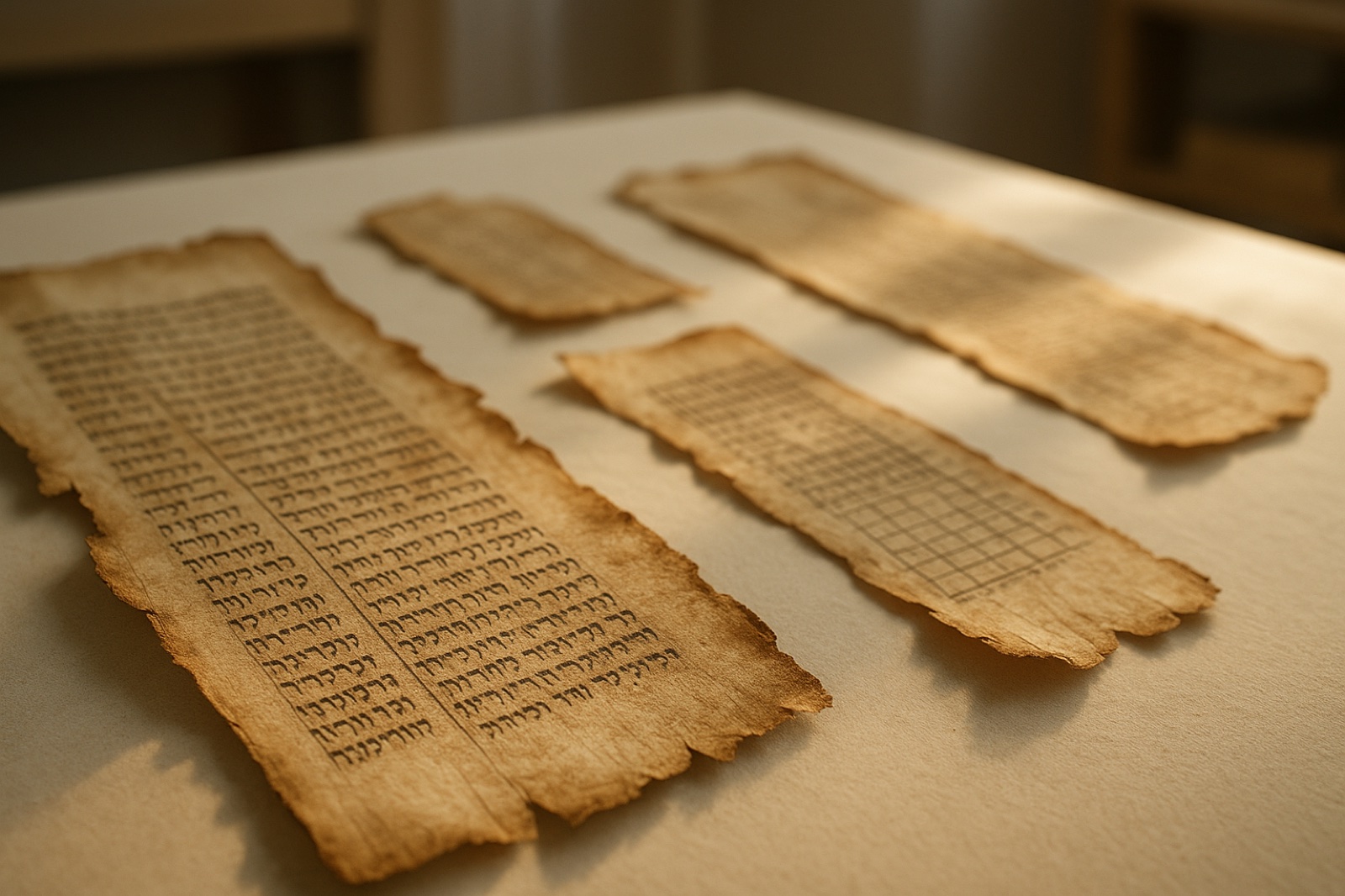
The people who kept it are the same community that left behind the Dead Sea Scrolls, found in caves near Qumran. Out of that whole library, Tel Aviv University counts nearly twenty scrolls that deal with calendars and astronomy. For a group that size, that is not a passing interest. That is a preoccupation.
We know some of the detail because of painstaking reconstruction work. In 2017, Eshbal Ratzon and Jonathan Ben-Dov pieced together a badly broken scroll known as 4Q324d from sixty-two fragments written in a cryptic script. It described festivals not recorded anywhere else — a celebration of New Wine and another of New Oil — alongside the wheat festival, and a set of transition days marking the turn of each season.
Why a 364-day year was also a political act
Jerusalem ran on a different clock. The Temple authorities used a calendar that tracked the moon, which meant somebody had to observe, judge and announce when a new month began — and therefore when each festival fell. Those decisions belonged to whoever held the Temple.
Keeping your own calendar was a way of saying that authority stopped short of you. The Book of Jubilees, one of the texts this community valued, argued directly against the lunar calendar and described the 364-day system as the original one, given to Moses at Sinai. A fixed, arithmetic year was not just tidier. It was a claim that the order of time came from God rather than from a committee in a city.
And the festivals mattered. These were not dates on a wall chart; they were the harvests, the gatherings, the days the whole year was built around. Anyone who has read about the Feast of Trumpets knows how much weight a single day could carry.
The problem they could see coming
The Earth takes roughly 365 and a quarter days to go round the sun. A 364-day year is short by about a day and a quarter.
That is a small error over one year and an enormous one over a working life. Prof. Ratzon puts the figure plainly: twenty years without correction shifts the festivals nearly four weeks out of step with the seasons. She compares it to a clock that loses a minute a day — perfectly fine this morning, and no longer describing reality after a few years of it.
This is not a subtle astronomical drift you would need instruments to catch. These were agricultural festivals. A harvest celebration slides away from the harvest. A spring feast creeps toward summer. Within a generation, anybody standing in a field could see it.
What the new study argues
Prof. Eshbal Ratzon, of Tel Aviv University, published her case this year in the journal Tarbiz. Her argument is that the community genuinely used the calendar during its formative decades in the second century BCE — the same period when its quarrel with the Jerusalem authorities was sharpest. Later, as the drift piled up and as relations with the Hasmonean king Alexander Jannaeus improved, they let the practical use go.
What they did not let go of was the calendar itself. In her words, it is “quite possible that the calendar was in fact used for a certain period of time, but then, losing its practical role due to both inherent problems and political changes, became a religious ideal and a symbol of identity.”
That is the sentence worth sitting with. The thing stopped working and stayed anyway.
The part nobody wrote down
Here is the detail that took me by surprise, and it is the reason this story is worth more than its headline.
Earlier scholars mostly assumed there had to be a repair mechanism. Every long-lived calendar has one — our own leap day is exactly that. The obvious guess was that the community periodically added days or a whole extra week to pull the festivals back into season. Ratzon’s argument is that no such mechanism shows up in the scrolls.
Nearly twenty documents about calendars and astronomy. Festival lists, cycles, seasonal markers, the turn of each quarter written out in detail. And, on her reading, not one of them sets out how to fix the error everyone could see.
It is worth saying clearly that this is an argument rather than a settled fact — the question of how, or whether, the drift was corrected has no scholarly consensus behind it, and the scrolls are incomplete. But the shape of the evidence is striking. They wrote the system down with enormous care. They did not write down how to keep it true.
Scripture itself has a comparable case: the year of Jubilee, a debt reset scheduled every fifty years in exacting detail, which the record never actually shows being kept. A beautifully designed schedule can survive a long time on paper.
When a system outlives its job
Set the astronomy aside for a moment, because the human part of this is not ancient at all.
The calendar began as a servant. It existed to tell people when to plant, when to gather, when to stop working and eat together. Somewhere along the way it stopped doing that and started doing something else: it told them who they were, and who they were not. And a thing that tells you who you are is very hard to put down, even after it has quietly stopped being useful.
Most of us have one. The routine that genuinely helped for a season and is now just a rule you obey. The standard you set for yourself at twenty-five that you have never once revisited. The way your family has always done a certain thing, kept going long after anyone could say what it was for.
There is an old line from that same corner of the world, from a couple of centuries later, about the day of rest: that it was made for people, and not people for it. It is easy to read past. It is also, more or less exactly, the test the Qumran calendar failed. Made for them. Not the other way round.
The people who kept those scrolls were not fools. They were careful, literate, deeply serious — serious enough to write out the heavens in a cipher and count the weeks for generations. That is what makes it instructive rather than funny. This is not what happens to careless people. It is what happens to devoted ones.
Nobody chooses the day a system stops serving them. It happens by a day and a quarter a year, which is to say invisibly, which is to say you only find out much later, standing in a field in the wrong month.
The useful question is not whether something in your life has drifted. Something almost certainly has. The question is whether you would notice — and whether you would be willing to say so out loud, the way a community that loved a calendar so much apparently never quite could.
One Thing to Think About
Was the Qumran community wrong to hold on to a calendar that had stopped keeping time — or is there real value in keeping something that no longer works, just because of what it means to you? Tell us where you land in the comments; both answers have something going for them.
Share This
- A community near the Dead Sea built a calendar with 364 days so every festival would land on the same weekday forever. It drifted almost a month out of season every twenty years. They kept it anyway. https://bgodinspired.com/index.php/bible-resources/dead-sea-scrolls-calendar/
- Nearly twenty of the Dead Sea Scrolls are about calendars and astronomy. According to a new study, not one of them explains how to fix the error everyone could see. https://bgodinspired.com/index.php/bible-resources/dead-sea-scrolls-calendar/
- Reading about a 2,000-year-old calendar that stopped working and got kept anyway, and thinking about every rule I still follow for reasons I can no longer explain. https://bgodinspired.com/index.php/bible-resources/dead-sea-scrolls-calendar/
Questions People Ask About the Dead Sea Scrolls Calendar
What was the Dead Sea Scrolls calendar?
It was a 364-day solar calendar kept by the community at Qumran, the group associated with the Dead Sea Scrolls. Because 364 divides evenly by seven, the year contained exactly fifty-two weeks, so every date fell on the same day of the week every year and festivals never shifted weekday. Nearly twenty of the scrolls deal with calendars and astronomy, which shows how central the system was to the community.
Why did the Qumran community use a 364-day calendar instead of the Temple calendar?
The Jerusalem Temple authorities used a calendar that tracked the moon, which required human observation and official announcements to fix the start of each month and each festival. The Qumran community’s fixed 364-day system needed no announcements at all, which made it both a statement about divine order and a rejection of the Temple leadership’s authority over sacred time. The Book of Jubilees, valued by the community, argued against the lunar calendar and presented the 364-day year as the original calendar given to Moses at Sinai.
What is wrong with a 364-day year?
A solar year is roughly 365 and a quarter days long, so a 364-day calendar falls short by about a day and a quarter every year. Prof. Eshbal Ratzon of Tel Aviv University notes that twenty years without correction would move the festivals nearly four weeks against the seasons — enough to push a harvest festival well outside the actual harvest.
Did the Qumran sect actually use the 364-day calendar, or was it only theoretical?
A study by Prof. Eshbal Ratzon, published in the journal Tarbiz in 2026, argues that the sect really did use it in practice during the second century BCE, when its conflict with the Jerusalem authorities was at its sharpest. She proposes that as the seasonal drift accumulated and political relations improved under the Hasmonean king Alexander Jannaeus, the community stopped using it for practical timekeeping while keeping it as a religious ideal and a symbol of identity.
How did the Qumran community correct the calendar drift?
There is no scholarly consensus on this, and it is the heart of the puzzle. Earlier scholars generally assumed the community must have added extra days or weeks periodically, the way a leap day works. Prof. Ratzon argues that no such correction mechanism is supported by the Dead Sea Scrolls themselves — that despite extensive writing about calendars and astronomy, the scrolls do not set out a repair for an error the community could see happening.