 0
0
 0
0
Today, 21 September, is the International Day of Peace. At United Nations headquarters in New York, someone will ring the Peace Bell, a bell the UN says was cast from coins donated by people from 60 countries. Money melted down and made into something new.
That idea of melting something down and making it into something better is older than the UN. It goes back more than 2,700 years, to one line from a Hebrew prophet: “they shall beat their swords into plowshares.”
You have probably heard the phrase. Maybe you have even said it. But have you ever read the whole verse it comes from? Most people haven’t, including the people who carved it into stone. And the part they left off is the part that makes the rest of it possible.
What Does “Swords Into Plowshares” Mean?
A plowshare is the metal blade at the front of a plow. It cuts the soil open so seed can go in. A pruninghook is a small curved knife for cutting back vines. Both are farm tools. Both are about food.
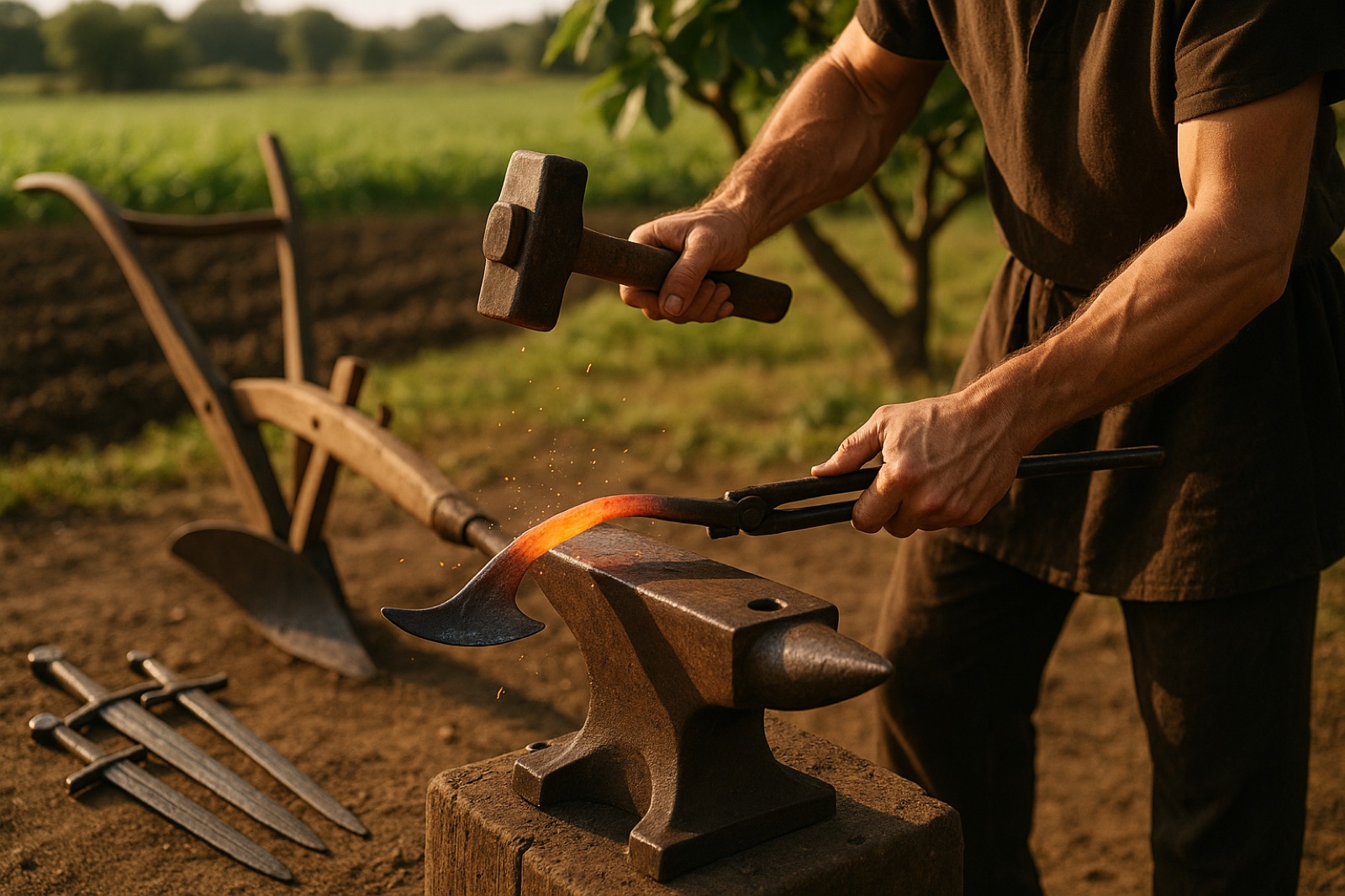
In the ancient world iron was precious. You didn’t throw a sword away. A blacksmith could heat it and hammer it into a different shape. So “beat their swords into plowshares” paints a very physical picture: the same metal that was made to end lives gets reshaped to feed them.
Notice what does not happen. The swords are not buried or thrown in the sea. They are changed. Nothing is wasted. The thing that did harm becomes the thing that does good.
The line appears twice in the Bible, almost word for word, in Isaiah 2:4 and Micah 4:3. Isaiah’s version reads, in the King James Version:
“And he shall judge among the nations, and shall rebuke many people: and they shall beat their swords into plowshares, and their spears into pruninghooks: nation shall not lift up sword against nation, neither shall they learn war any more.” (Isaiah 2:4, KJV)
Read that first line again. We’ll come back to it.
A Bronze Man in the United Nations Garden
In the north garden of UN headquarters stands a bronze man, well over two metres tall. In one hand he raises a hammer. In the other he holds a sword, and he is bending its blade into a plowshare. The statue is called Let Us Beat Swords into Plowshares.
Here is the surprising part. According to the UN’s own record of the gift, it came from the Soviet Union, presented on 4 December 1959. At the time the Soviet Union was an officially atheist state. Yet when it gave a gift about peace to the whole world, it reached for the words of an Old Testament prophet.
There’s a second surprise. The sculptor, Yevgeny Vuchetich, is best known for something very different. He was the main designer of The Motherland Calls in Volgograd, a giant woman lifting a sword high over her head. When it was finished in 1967, it was the tallest statue in the world.
So the same artist gave the world its biggest raised sword and its best-known sword being beaten into a plow. That isn’t a gotcha. It’s just very human. Most of us carry both of those statues inside us. We long for peace, and we keep our sword close anyway.
The Words on the Wall Across the Street
Across First Avenue from the UN is a small park named for Ralph Bunche. A granite stairway there, built in 1948 while the UN was going up, carries Isaiah’s words in large letters. People call it the Isaiah Wall.
For years the quotation stood there without saying who wrote it. The prophet’s name was carved underneath only later.
But look at where the carving begins: “They shall beat their swords into plowshares…” The statue’s title starts in the same place. So does almost every poster, speech and song that uses the line.
Every one of them starts in the middle of the sentence.
The Half of Isaiah 2:4 Nobody Carves
Isaiah’s picture doesn’t start with swords. It starts two verses earlier, with people walking up a mountain:
“And it shall come to pass in the last days, that the mountain of the LORD’S house shall be established in the top of the mountains, and shall be exalted above the hills; and all nations shall flow unto it. And many people shall go and say, Come ye, and let us go up to the mountain of the LORD, to the house of the God of Jacob; and he will teach us of his ways, and we will walk in his paths: for out of Zion shall go forth the law, and the word of the LORD from Jerusalem.” (Isaiah 2:2-3, KJV)
Now read the order of events:
- The nations come. Nobody drags them. They say to each other, “Come ye, let us go up.”
- They come to learn. “He will teach us of his ways, and we will walk in his paths.”
- God judges between them. The fights that used to be settled by force get settled by a judge everyone trusts.
- Then the swords get beaten into plowshares.
The swords are the last step, not the first. The hammering happens because there is finally nothing left to defend. When the arguments have been fairly settled, a sword is just heavy iron you’re tired of carrying.
That is the difference between Isaiah’s peace and a peace treaty. A treaty asks people to put their swords down while the quarrel is still alive. Isaiah describes people who put them down because the quarrel is over. Peace, in this verse, isn’t a decision. It’s a fruit. It grows from being taught by God and walking in God’s paths.
And look at the very last words: “neither shall they learn war any more.” War is something people learn. It has to be taught, practised and handed down. In Isaiah’s picture, the nations go up the mountain to learn something else, and simply stop taking the old lessons.
Micah Adds a Fig Tree. Joel Runs It Backwards.
The prophet Micah repeats the line almost exactly, then adds a picture of what peace looks like on an ordinary day:
“But they shall sit every man under his vine and under his fig tree; and none shall make them afraid: for the mouth of the LORD of hosts hath spoken it.” (Micah 4:4, KJV)
No parade. No monument. Just a person sitting in the shade of their own garden, and nobody making them afraid. If you’ve ever lain awake worried about what tomorrow might bring, you know how precious that simple picture is. Biblical peace isn’t only the absence of war. It’s the absence of fear.
Then there’s the prophet Joel, who turns the whole image upside down:
“Beat your plowshares into swords, and your pruninghooks into spears: let the weak say, I am strong.” (Joel 3:10, KJV)
Joel is describing the nations gathering for battle before God’s judgment. The Bible knows the metal can go both ways. Too often, human history has run in Joel’s direction. Isaiah’s direction is the one we have to be taught.
Isaiah Turned It on His Own People First
Here is the verse almost nobody quotes. Right after the great vision of the nations and their plowshares, Isaiah says this:
“O house of Jacob, come ye, and let us walk in the light of the LORD.” (Isaiah 2:5, KJV)
Isaiah doesn’t wait for the rest of the world. He doesn’t say, “When the other nations change, we’ll change.” He turns straight to his own people and says, in effect: Let’s start. Us. Now.
And that is exactly where Jesus picks it up. In the Sermon on the Mount He says:
“Blessed are the peacemakers: for they shall be called the children of God.” (Matthew 5:9, KJV)
The Greek word is eirenopoioi. It’s made of two parts: eirene, peace, and poieo, to make or to do. It’s an active word. Jesus didn’t bless the peace-wishers, or the peace-lovers, or even the people who keep their heads down and stay out of trouble. He blessed the people who make it. The ones holding the hammer.
There’s something quietly beautiful in this year’s UN theme. It honours what it calls “everyday architects of peace”: ordinary people building peace from the ground up. Whether they meant to or not, that’s very close to what Jesus was pointing at. You can’t hammer every sword in the world into a plow. But you have a sword of your own. Everybody does.
Maybe your sword is the sharp comment you keep ready for one particular family member. Maybe it’s the silent treatment. Maybe it’s the argument you rehearse in the shower, the one where you finally win. We keep these things close because they feel like protection. The trouble is, they’re heavy, and they don’t grow anything.
If you’re not sure what your sword looks like, our free What Is My Conflict Style? quiz can show you how you tend to fight, and what that pattern might be protecting. It takes a few minutes. And if the thing you carry is an old hurt you can’t put down, what the Bible says about being offended is worth reading next. The word Jesus used for it is the trigger of a trap.
Remember the order in Isaiah, though. The hammering comes after the learning. You don’t make peace with someone by gritting your teeth and forcing yourself to be nice. You go up the mountain first. You let God teach you. The plowshare comes out of that. As Isaiah might put it: first the walking, then the hammer.
Actions to Take Today
- Read Isaiah 2:1-5 out loud, all five verses. It takes about two minutes. Notice that you’re reading the part the wall leaves off.
- Name your sword. Write down one habit you use to win, hurt or hold someone at a distance. A tone of voice, a topic you bring up, a message you don’t answer. Just name it, honestly, on paper.
- Beat one sword into one plowshare. Pick the person that sword is usually pointed at. Send them one message today that builds something instead: a thank-you, a memory, a “thinking of you”. Something that feeds instead of cuts.
Journaling Prompts
- Where in your life are you waiting for the other side to put their sword down first?
- Think about the fight you rehearse most often in your head. What would God have to teach you before you could let it go?
- Micah pictured peace as sitting under your own fig tree with no one to make you afraid. What is making you afraid right now, and what would your “fig tree” look like?
A Prayer
God, I talk about wanting peace, but I keep my sword close. Show me the one I’m holding, the words I sharpen and the distance I keep. Teach me your ways before I try to fix anyone else, the way Isaiah said: let me walk in your light first. Give me the courage to be a peacemaker, not just someone who wishes things were calmer. And take whatever I’ve used to hurt people and make it into something that helps them grow. Amen.
Let’s Talk
Why do you think the statue, the wall and nearly every speech quote only the second half of Isaiah 2:4, and leave off the part about being taught and judged by God? Tell us what you think in the comments below.
Share This
- “Everybody quotes ‘swords into plowshares.’ Almost nobody quotes the line before it: first the nations come to be taught by God. The swords are the LAST step, not the first. #PeaceDay”
- “Jesus didn’t bless the peace-wishers. The Greek word means peace-MAKERS. It’s got a hammer in it.”
- “Today I’m naming one sword I carry, and beating it into something that grows. Isaiah 2:4, Matthew 5:9.”
Questions About Swords Into Plowshares
What does “swords into plowshares” mean?
“Swords into plowshares” means turning the tools of war into tools that feed people. A plowshare is the metal blade of a plow that cuts the soil for planting. The phrase comes from Isaiah 2:4 and Micah 4:3 in the Bible, which picture a future where nations reshape their weapons into farming tools because they no longer need to fight.
Where is “swords into plowshares” in the Bible?
The phrase “swords into plowshares” appears in Isaiah 2:4 and Micah 4:3, which are almost identical. In the King James Version, Isaiah 2:4 reads: “they shall beat their swords into plowshares, and their spears into pruninghooks: nation shall not lift up sword against nation, neither shall they learn war any more.” Joel 3:10 uses the same image in reverse: “Beat your plowshares into swords.”
What comes before “swords into plowshares” in Isaiah 2:4?
The first half of Isaiah 2:4 says that God “shall judge among the nations, and shall rebuke many people.” Isaiah 2:3 says the nations come to God’s house saying “he will teach us of his ways, and we will walk in his paths.” In the passage, the swords are beaten into plowshares only after the nations are taught by God and their disputes are judged, so peace is the result of that teaching rather than the starting point.
Who gave the “swords into plowshares” statue to the United Nations?
The bronze statue “Let Us Beat Swords into Plowshares” at United Nations headquarters in New York was a gift from the Soviet Union, presented on 4 December 1959. It was made by the Soviet sculptor Yevgeny Vuchetich and shows a man hammering a sword into a plowshare. The Soviet Union was an officially atheist state at the time, yet the statue’s title comes from the Bible’s Book of Isaiah.
What does “Blessed are the peacemakers” mean?
“Blessed are the peacemakers: for they shall be called the children of God” is from Matthew 5:9, part of Jesus’ Sermon on the Mount. The Greek word for peacemakers, eirenopoioi, joins the words for “peace” and “to make,” so it describes people who actively create peace rather than people who only wish for it or avoid conflict.