 0
0
 0
0
Maybe it happened in a Bible study. Someone reads Job 39 out loud, gets to verse 9, and stops. “Will the unicorn be willing to serve thee?” A few people smile. Somebody laughs. And a quiet question sits in the room afterwards: if the Bible talks about unicorns, how much of the rest can I trust?
So, are there unicorns in the Bible? In the King James Version, yes. The word appears nine times. But the animal the Hebrew actually names was not a white horse with a horn. It was real. It had two horns. It was one of the strongest animals people in the ancient world ever faced. And the very last one died in a forest in Poland in 1627.
The verse people laugh at turns out to be one of the most accurate animal descriptions in the Old Testament. The strange part was never the text. It was the translation.
Where the Unicorns in the Bible Actually Are
Here are all nine places the King James Version uses “unicorn” or “unicorns”:
- Numbers 23:22 – “God brought them out of Egypt; he hath as it were the strength of an unicorn.” (Balaam, speaking over Israel.)
- Numbers 24:8 – Balaam repeats the same picture of strength.
- Deuteronomy 33:17 – Moses blesses Joseph: “his horns are like the horns of unicorns.”
- Job 39:9 – “Will the unicorn be willing to serve thee, or abide by thy crib?”
- Job 39:10 – “Canst thou bind the unicorn with his band in the furrow?”
- Psalm 22:21 – “Save me from the lion’s mouth: for thou hast heard me from the horns of the unicorns.”
- Psalm 29:6 – The mountains skip “like a young unicorn.”
- Psalm 92:10 – “But my horn shalt thou exalt like the horn of an unicorn.”
- Isaiah 34:7 – “And the unicorns shall come down with them, and the bullocks with the bulls.”
Notice something. Not one of these verses is magical. There is no rainbow, no sparkle, no fairy tale. Every single time, the animal stands for one thing: raw, dangerous strength. It is mentioned next to lions, bulls and bullocks. It pushes with its horns. It refuses to be tied to a plough. That is not how anyone describes a fantasy creature. That is how you describe a farm animal’s terrifying wild cousin.
One of those verses sits inside Psalm 22, the psalm Jesus prayed from the cross. We will come back to that, because it matters more than it first seems.
If you love reading the Bible slowly enough to catch details like this, you might enjoy the Gospel of Matthew the same way – the whole book, chapter by chapter, as an immersive PDF and audiobook you can listen to on a walk. It is free:
What the Hebrew Word Re’em Really Means
The Hebrew word behind every one of those nine verses is re’em. Nobody in the Bible stops to describe it, because nobody needed to. Everyone listening knew exactly what it was.
The trouble started centuries later. When Jewish scholars translated the Hebrew Scriptures into Greek (the translation called the Septuagint), they rendered re’em as monokeros – “one horn.” Latin translations followed with unicornis. When the King James translators did their work in the early 1600s, they followed that long tradition and wrote “unicorn.” In their day the word still carried a sense of a real, if mysterious, strong beast rather than a children’s story.
Then archaeology gave us a clue the translators never had. In the languages of ancient Assyria and Babylon, there is a word from the same family: rimu. It names the wild bull – the animal Assyrian kings boasted about hunting. The match between rimu and re’em is one of the main reasons most scholars today believe the re’em was almost certainly the aurochs, the great wild ox. That is why many modern translations simply say “wild ox.”
And here is the detail that settles more than people expect. Look again at Deuteronomy 33:17. In Hebrew, Moses says Joseph’s horns are like the horns of a re’em – one animal, more than one horn. The King James reads “horns of unicorns,” which blurs it, but the Hebrew is plain: a single re’em had horns, plural. Whatever this animal was, the Bible itself tells us it was not one-horned. The Bible never had a unicorn problem. The translation did.
Meet the Aurochs: The Animal Behind the Word
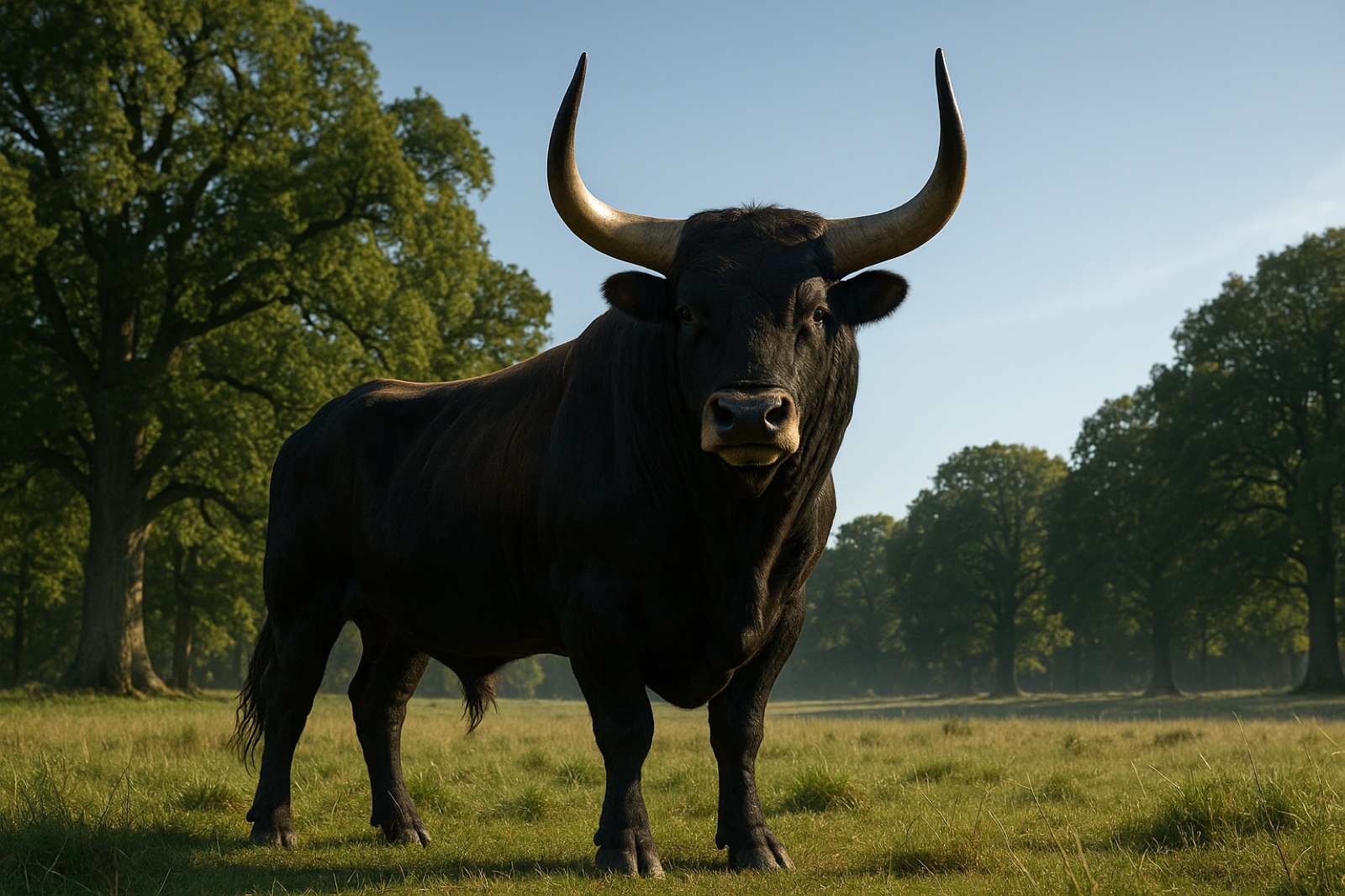
The aurochs was the wild ancestor of the cattle that live on farms all over the world today. But do not picture a dairy cow. Remains of aurochs bulls from Denmark and Germany show them standing up to around 1.8 metres tall at the shoulder – taller than most grown men – with long, forward-curving horns built for fighting.
That detail changes how Job 39 reads. Thousands of years ago, people in the Near East tamed some of these animals, and over many generations that line became the patient ox that pulled a plough. So when God asked Job, “Canst thou bind the unicorn with his band in the furrow? or will he harrow the valleys after thee?” Job knew the tame ox very well. On the day his troubles began, a messenger ran to him with the words “The oxen were plowing” (Job 1:14). The question is sharp precisely because the two animals were related. You have the gentle one in your field. Can you do the same with the wild one?
The answer everyone knew was no.
Why God Asked Job About the Unicorn
The unicorn verses in Job do not appear out of nowhere. They sit near the end of a very long book about suffering. Job has lost his children, his health and his wealth. He has argued with his friends for chapter after chapter. He has asked God for an answer.
Then, in chapter 38, God finally speaks – and the answer is not an explanation. It is a tour. “Where wast thou when I laid the foundations of the earth?” (Job 38:4). From there God walks Job through the sea, the stars, the storehouses of snow, lions, ravens and “the wild goats of the rock” (Job 39:1). If you want the bigger picture of what Job actually receives in those chapters, we explored it in Why Does God Allow Suffering? What Job Actually Got.
And in the middle of that tour comes the re’em:
“Will the unicorn be willing to serve thee, or abide by thy crib? Canst thou bind the unicorn with his band in the furrow? or will he harrow the valleys after thee? Wilt thou trust him, because his strength is great? or wilt thou leave thy labour to him? Wilt thou believe him, that he will bring home thy seed, and gather it into thy barn?” – Job 39:9–12
Read it slowly. Four questions. Will it serve you? Can you tie it down? Will you trust its strength with your work? Will it bring your harvest home? Every answer is no. This strength exists, it is magnificent, and it was never made for Job to use.
It is easy to hear those questions as a put-down. They are not. God is showing Job a world full of wild, strong, beautiful things that are cared for without Job’s help. Just a few chapters later comes Leviathan, the great sea creature – which we looked at in What Does the Bible Say About Leviathan? The point of the tour is not “you are small.” It is “you do not have to hold all of this.”
The Last Aurochs Died in a Polish Forest in 1627
For most of history, people answered God’s question about the wild ox the same way Job did. They could not make it serve. So over the centuries they cleared the great forests it lived in, hunted it, and filled its grazing land with their own cattle. Herd by herd, country by country, the aurochs disappeared.
By the 1500s, the last known herd lived in one marshy woodland: the Jaktorów Forest in Poland. And here is the part the popular version of the story usually leaves out. At the very end, people were not trying to wipe the aurochs out. They were trying to keep it. The Polish crown had the herd guarded by gamekeepers.
It did not work. The herd went from around 50 animals in the middle of the 1500s to just four by 1601. Accounts of the decline point to a mix of causes: shrinking habitat, hard winters, poor grazing, poaching, and diseases passed on from domestic cattle. The last bull died in 1620. The last aurochs of all, a cow, died in 1627 – and she was not shot. She appears to have died of natural causes.
Think about that for a moment. People could not make the wild ox serve them. And when they finally wanted to protect it, they could not keep it alive either. The strength that would not be harnessed also could not be saved by human effort alone.
What the Unicorn Question Means for Your Life
This is where an old verse about a wild animal walks straight into your Monday.
Most of us are carrying at least one “wild ox.” Something strong and important that we keep trying to harness or protect by effort. A grown child who is making their own choices. A health problem that will not follow the plan. A marriage, a business, a temper, a fear, a loss. We tie ropes to it. We try to steer it into the furrow. We lie awake trying to keep it safe.
And God asks the same gentle question God asked Job: Can you bind it? Will it serve you? Will you trust your harvest to your own grip on it?
The honest answer is no – and that answer is not a defeat. It is a release. Some things were never yours to control, and some things cannot be kept safe by your strength alone. That does not mean you stop caring or stop working. It means you stop pretending the whole weight is yours.
Now go back to Psalm 22. It opens with the cry Jesus prayed on the cross: “My God, my God, why hast thou forsaken me?” (Psalm 22:1; Matthew 27:46). That psalm begins in total abandonment. But by verse 21, surrounded by lions and wild oxen, the same voice says: “thou hast heard me from the horns of the unicorns.” Not after the danger was gone. From between the horns. Right in the middle of the strength that could not be controlled, the prayer was heard.
And there is one more gift here, especially if you have ever doubted. The unicorn verses are often held up as proof the Bible is a book of myths. But when you look closely, the text describes a real animal accurately, with the right number of horns, the right strength, and the right refusal to be tamed. When something in scripture looks absurd, it is worth checking the word before closing the book. Often the Bible is more careful than we were. (If a question like this ever keeps you up, you can ask it of our free Bible Answers AI assistant – it opens in ChatGPT.)
The same goes for other “strange” creatures people point to. We looked at another one in What Does the Bible Actually Say About Dinosaurs?
Actions to Take
- Read Job 39:9–12 out loud, swapping “unicorn” for “wild ox.” Notice how different it sounds. It takes two minutes, and you will never hear that passage the same way again.
- Next time a verse sounds strange, look up the original word before deciding what you think. Many free Bible apps and websites let you tap a word and see the Hebrew or Greek behind it. Try it with one verse today.
- Name your wild ox. On a scrap of paper or in your phone’s notes, write down one strong thing you have been trying to control or keep safe by effort alone. Under it, write one sentence handing it to God. Keep the note somewhere you will see it tomorrow.
Journaling Prompts
- Where in your life are you still trying to tie a rope to something that was never made to be tied?
- What would change in your body and your sleep if you believed God could hear you “from the horns” – before the danger is gone?
A Prayer
God, I have been trying to hold things that are too strong for me. I keep reaching for the rope, trying to make this situation go where I want it, trying to keep it safe with my own hands. I am tired, and I cannot do it. Hear me from right here, in the middle of it, the way You heard the one in Psalm 22. Help me work hard at what is mine, and let go of what was always Yours. Amen.
Discussion Question
Why do you think so many of the Bible’s “strangest” verses turn out, when you look closer, to be translation puzzles rather than mistakes? Share your thoughts in the comments below – we would love to hear from you.
Share This
- “Turns out the unicorns in the Bible were real – a massive two-horned wild ox called the aurochs. The last one died in Poland in 1627. The Bible was more accurate than the translation.”
- “Job 39 asks: can you bind the wild ox? Can you make it serve you? I needed that question today. Some things were never mine to control.”
- “Psalm 22:21 – ‘thou hast heard me from the horns of the unicorns.’ Not after the danger passed. From right in the middle of it.”
Questions People Ask About Unicorns in the Bible
Are there unicorns in the Bible?
The King James Version of the Bible uses the word “unicorn” or “unicorns” nine times, in Numbers, Deuteronomy, Job, Psalms and Isaiah. The Hebrew word in every case is re’em, which most scholars today identify as the aurochs, a large and powerful wild ox with two horns. Modern translations usually render it “wild ox.”
Why does the King James Bible say unicorn?
The King James translators in the early 1600s followed an older tradition. The Greek Septuagint had translated the Hebrew word re’em as monokeros, meaning “one horn,” and Latin versions used unicornis. The translators kept “unicorn,” a word that in their time was associated with a real but little-known strong beast.
What animal is the re’em in the Bible?
The re’em is almost certainly the aurochs, the extinct wild ancestor of domestic cattle. The strongest evidence is the related Assyrian and Babylonian word rimu, which refers to the wild bull, and Deuteronomy 33:17, where the Hebrew gives a single re’em more than one horn. The Bible describes the re’em as very strong, horned and impossible to tame.
When did the last aurochs die?
The last known aurochs, a female, died in 1627 in the Jaktorów Forest in Poland. The final herd had been guarded by royal gamekeepers, but it still shrank from around 50 animals in the mid-1500s to four by 1601. The last aurochs appears to have died of natural causes rather than being hunted.
What does Job 39:9 mean?
Job 39:9 asks, “Will the unicorn be willing to serve thee, or abide by thy crib?” In context, God is answering Job by describing creatures that humans cannot control. The “unicorn” is the wild ox, a close relative of the tame ox used for ploughing, and the question shows that some strength in creation is cared for by God and was never made for human use.