 0
0
 0
0
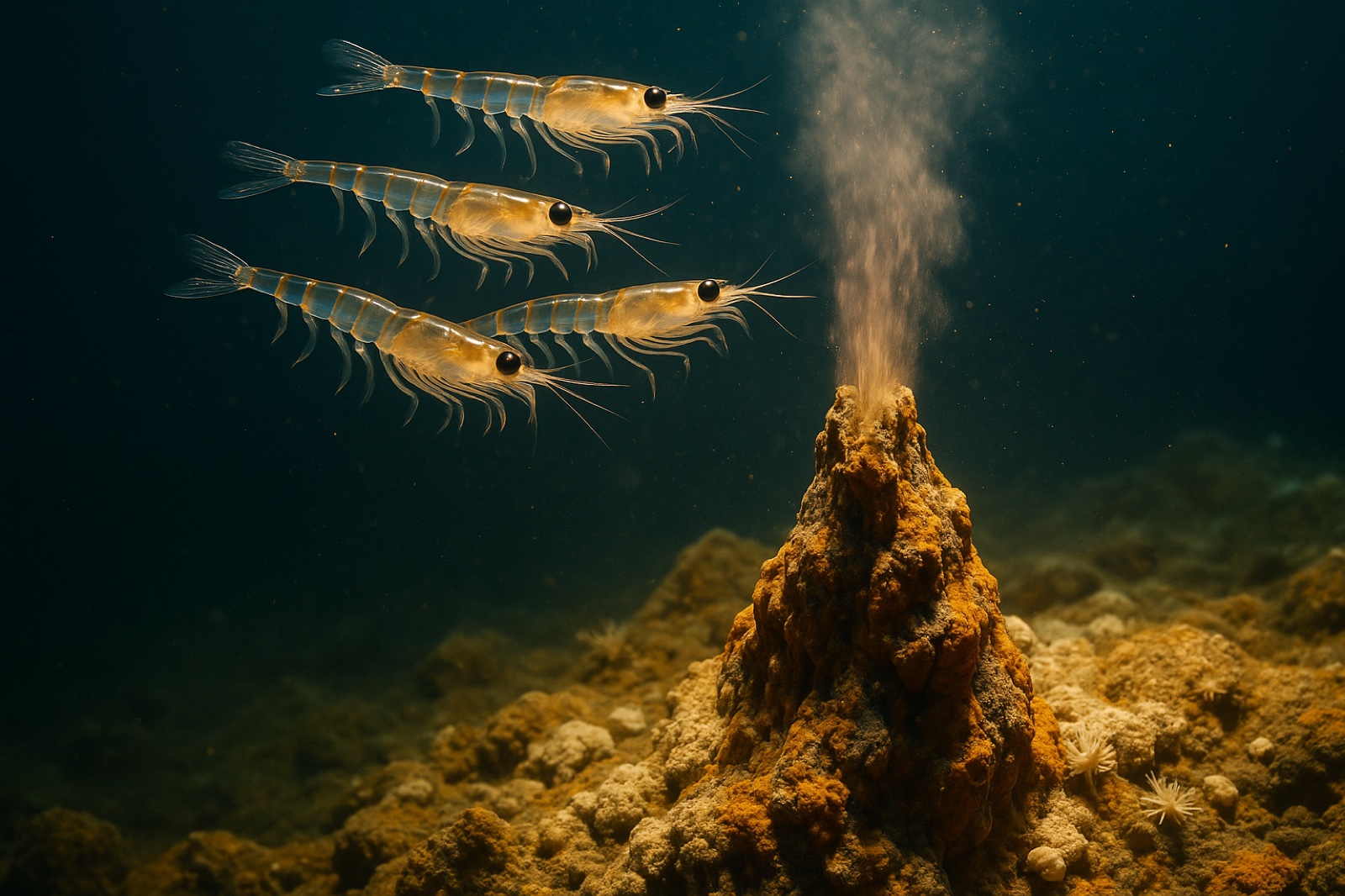
The video feed was coming from a trough on the floor of the Southern Ocean, about 1,100 metres down — roughly 3,600 feet. It was late 2024. A remotely operated vehicle was hovering over a hydrothermal vent off the Antarctic Peninsula, in a stretch of water called the Bransfield Strait, watching hot water push up out of the Earth’s crust into near-freezing sea. Nobody was looking for Antarctic krill down there. Antarctic krill are not supposed to be down there.
Andrew Thurber, a benthic ecologist at UCLA, was running the vehicle. Kim Bernard, a biological oceanographer, was watching the screen over his shoulder. She studies Antarctic krill — small, shrimp-like animals that live near the surface in swarms so large, as she puts it, that “you can photograph them from airplanes.”
Then something small and familiar crossed the frame. Then another.
“There’s krill, there’s krill!” Bernard remembers saying.
Her next thought became a scientific paper: “Why on earth are they down there?”
What the team found at the Antarctic krill hydrothermal vents
The find was published on 15 September 2026 in the journal Communications Biology. The dive was part of the National Geographic and Rolex Perpetual Planet Southern Ocean Expedition, working with the Schmidt Ocean Institute.
The team collected four krill from the vent site. That is a small number, and the researchers say so. But all four were the same thing: reproductive females, heavily laden with eggs, and — in Bernard’s description — about to release them at any moment.
Then the expedition found a second vent site, roughly 1,600 kilometres away — about a thousand miles. Egg-laden females there too.
Two sites, an ocean apart, and the krill showing up at both were mothers at the very end of carrying.
Why Antarctic krill matter more than almost any other animal in the sea
It is worth knowing what a krill actually is before deciding whether four of them are interesting.
Antarctic krill are small crustaceans, a few centimetres long, and they hold up nearly the entire food web at the bottom of the world. Penguins, seals, whales, seabirds, fish. Bernard describes it plainly: “Most of them feed on Antarctic krill. And if they don’t, they feed on something else that feeds directly on Antarctic krill.”
Take krill out of the Southern Ocean and almost nothing else there stands up.
So the question of where krill go, and when, and why, is not a small natural-history curiosity. It is a question about whether the ecosystem keeps working. And it is being asked in a place Bernard calls “one of the most rapidly warming areas on the planet” — the same corner of the world where Antarctica’s record ice gain turned out to be driven by a warm ocean thousands of kilometres away.
Which is the uncomfortable part. We are watching the animal everything depends on, in the water that is changing fastest, and we have just discovered it does something we did not know it did.
Three guesses, and nobody is sure
The paper does not claim to know why the krill were there. It offers possibilities.
The first is food. Up at the surface, krill eat phytoplankton, and phytoplankton is seasonal — it blooms and it goes. Vents run on chemistry instead of sunlight, so the microbial life around them is there all year. A vent is a kitchen that never closes.
The second is stranger, and it is the detail that stays with you. Vents pump up manganese from inside the Earth. Manganese is scarce in open seawater. It is also, in Bernard’s words, “an important nutrient or mineral for embryo development in crustaceans.”
Read that twice. The mineral coming out of a crack in the seabed is the mineral an egg needs to become an animal.
The third possibility is simply warmth. Vent water is hot. Warmer water may move embryos along faster.
None of those is proven. Any of them would mean the same thing: that a krill about to lay eggs might have a reason to go down into the dark, and that the reason is the eggs.
What a krill does before it can eat
Here is the part that did not make the headlines, and it reframes everything above.
Antarctic krill spawn near the surface in the southern summer. A female releases thousands of eggs at a time. And then the eggs do something that sounds made up: they sink.
They fall for days. Descriptions in the research literature vary — from a few hundred metres to as much as a couple of kilometres, over roughly ten days — and the embryo develops the whole way down. The egg hatches in total darkness, at depth, into a larva with no working mouth. It cannot feed. It has nothing but what its mother packed into the egg.
And then it climbs.
Biologists call it the developmental ascent. The larva swims up, for days, through water it cannot see, toward a surface it has never been to, looking for food it has never eaten, burning a fuel supply it cannot replace. If it hatched too deep, the reserves run out before the light arrives.
Every krill in every swarm you could photograph from a plane made that climb first. Every one.
So when four egg-heavy females turn up 1,100 metres down at a vent, the obvious reading is that they got lost. But krill have always had business in the deep. The deep is where they begin. It is only where the species starts that nobody ever thought to look — the same way nobody had actually watched a whale shark feed until a camera finally went where the feeding happens.
What the researchers are careful not to say
This matters, and it is the reason to trust the work.
Simeon Hill, a marine ecologist who was not part of the study, drew the line clearly: “The study shows that krill can make use of hydrothermal vent habitats, but it doesn’t provide enough evidence to suggest that they are dependent on these habitats.”
Can, not must. Four animals is four animals.
Hill’s practical conclusion was about protection — that it would be sensible to have a way of adding newly discovered vulnerable habitats to marine protected areas as they are found, rather than after the argument is settled.
Bernard’s own conclusion is a request for more looking: “It’s really critical that we put our efforts into trying to understand the role of the deep sea environment for reproductive krill.” She does not think this was a fluke. “It was incredible. So I am sure that this is something that is not just a once-off.”
She also described the way the krill moved down there, which is the only sentence in any of this that sounds like joy: “It’s like underwater ballet. It just looks like pirouetting.”
The part that stays with you
Strip away the vents and the expedition and the journal, and what is left is this.
The animal that holds up an entire ocean does the most important thing it will ever do somewhere no one has ever been able to watch. Its young are assembled in the dark, in the lowest parts of the earth, out of minerals that come up from inside the planet. And the first act of a krill’s life — before eyes are any use, before it can eat — is to climb toward a light it has no evidence exists.
People have been saying something like that for about three thousand years. That a life gets put together in a hidden place, deep down, unseen and unphotographed, and that being unwitnessed is not the same as being unattended — that God is present in the part of the story nobody records. It was written long before anyone had a submersible, which is what makes it strange to read now, with the video footage finally in hand.
Where that leaves the rest of us
Most of what holds a life up is not the part anyone sees.
The work you did at 5 a.m. that no one will ever know about. The year you spent on something that has not surfaced yet. The care you gave someone in a room with no audience in it. Nobody photographs that from a plane. It still runs the whole system.
And every so often, someone points a camera somewhere nobody thought to point one, and finds the thing that was there the entire time — doing the work, in the dark, where it always was.
If you have ever wondered what your own hidden work is actually adding up to, we built a free What Is My Purpose? assessment — no sign-up, just a few honest questions.
Questions people ask about Antarctic krill and hydrothermal vents
What did scientists find at the Antarctic hydrothermal vents?
Researchers on the National Geographic and Rolex Perpetual Planet Southern Ocean Expedition found Antarctic krill living at a deep-sea hydrothermal vent in the Bransfield Strait, off the Antarctic Peninsula, about 1,100 metres (3,600 feet) down. Four krill were collected, and all four were reproductive females heavily laden with eggs. A second vent site roughly 1,600 kilometres away also held egg-laden females. The work was published in the journal Communications Biology on 15 September 2026.
Why would Antarctic krill go down to a hydrothermal vent?
Nobody knows yet. The researchers offer three possibilities. Hydrothermal vents support microbial life all year round, unlike the seasonal phytoplankton krill eat at the surface. Vents also release manganese, a mineral that is scarce in open seawater and is important for embryo development in crustaceans. And vent water is warmer, which may speed embryo development along. None of these has been demonstrated — they are hypotheses raised by the discovery, not conclusions from it.
Do Antarctic krill need hydrothermal vents to survive?
No — and the researchers are careful about this. Marine ecologist Simeon Hill, who was not involved in the study, said the work shows krill can make use of hydrothermal vent habitats but does not provide enough evidence to suggest they depend on them. Only four krill were collected at the first site. The finding opens a question about how reproductive krill use the deep sea; it does not answer it.
What happens to Antarctic krill eggs after they are laid?
Antarctic krill spawn near the surface in the southern summer, and the eggs sink. Descriptions in the research literature range from a few hundred metres to around two kilometres, over roughly ten days, with the embryo developing during the fall. The egg hatches in darkness into a larva that cannot yet feed, and the larva then swims upward toward the surface to find food — a journey biologists call the developmental ascent. Larvae that hatch too deep can exhaust their reserves before they reach food.
Why do Antarctic krill matter so much?
Antarctic krill are the foundation of the Southern Ocean food web. Penguins, seals, whales, seabirds and fish either eat krill directly or eat something that does. Biological oceanographer Kim Bernard describes it this way: most animals there feed on Antarctic krill, and if they do not, they feed on something else that feeds directly on Antarctic krill. That is also why changes in krill behaviour matter — the Antarctic Peninsula is one of the fastest-warming regions on the planet.
A question worth sitting with
The team found four krill and published a paper that mostly asks a question. Some people think that is exactly how science should work; others think four animals is too thin to build on. Which side are you on — is “we found something we cannot explain yet” worth publishing, or should it wait until someone can explain it? Tell us what you think in the comments.
Worth passing on
If any of this is worth sharing, here are three ways to say it:
- Scientists just found Antarctic krill living at a hydrothermal vent 1,100 metres down. All four they collected were mothers about to lay. Nobody knows why they were there. https://bgodinspired.com/index.php/nature-and-creation/antarctic-krill-hydrothermal-vents/
- A baby krill hatches in total darkness a kilometre down, with no working mouth, and then swims up for days toward a surface it has never seen, on fuel it cannot replace. Every krill in every swarm did that first. https://bgodinspired.com/index.php/nature-and-creation/antarctic-krill-hydrothermal-vents/
- The mineral coming out of a crack in the Antarctic seabed happens to be the mineral a crustacean egg needs to become an animal. Researchers noticed. They are not claiming it is the answer — just that it is a strange thing to be true. https://bgodinspired.com/index.php/nature-and-creation/antarctic-krill-hydrothermal-vents/