 0
0
 0
0
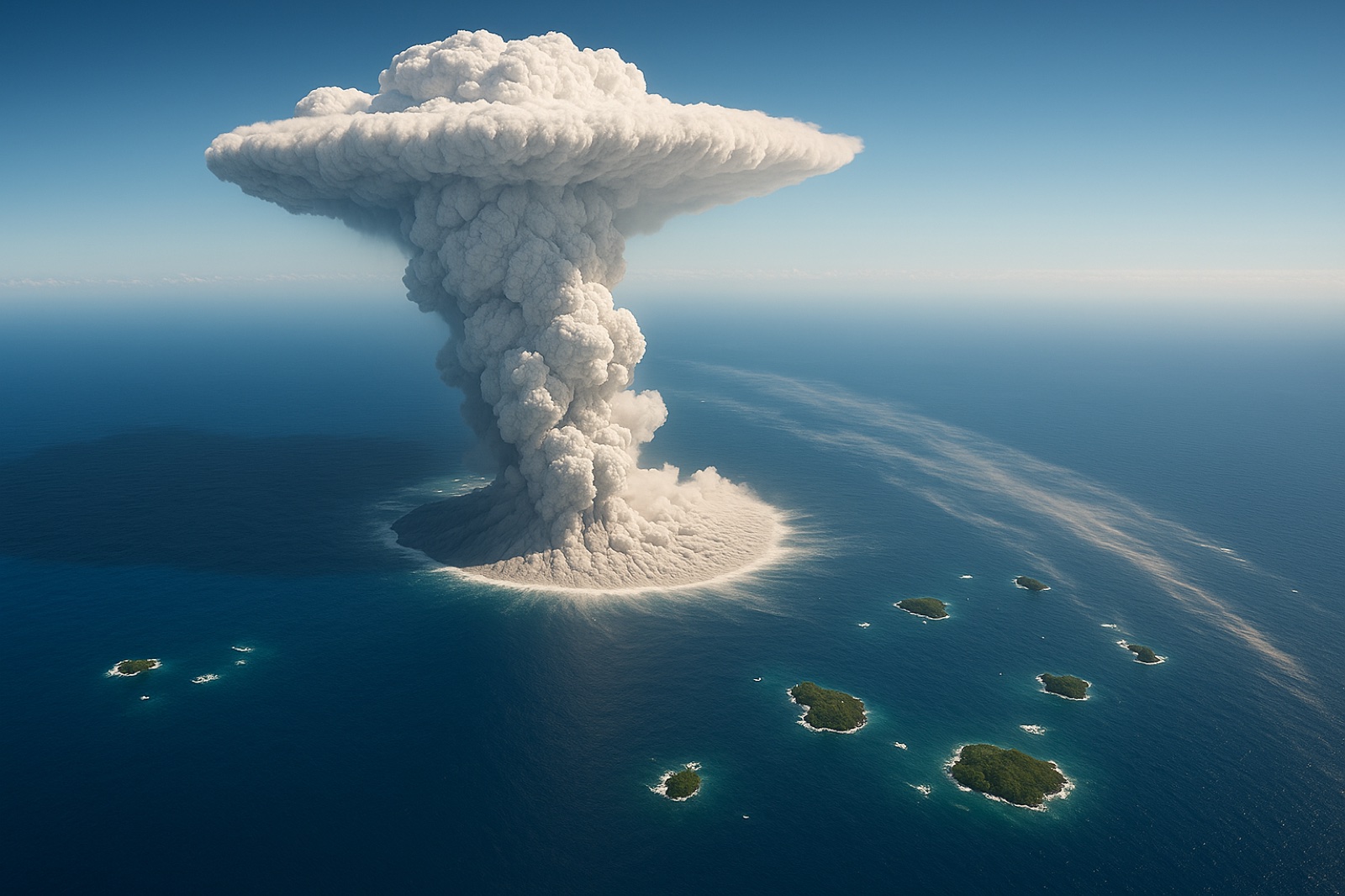
On 15 January 2022, a volcano in the South Pacific exploded with a force that modern instruments had never measured before. Hunga Tonga–Hunga Ha’apai sat mostly beneath the sea, a little north of Tonga’s main island. When it went, the shockwave travelled around the planet, a tsunami crossed the Pacific, and people in Tonga died.
It also threw an enormous amount of pollution into the sky. And then, high above the ocean, something started quietly taking a piece of that pollution back apart. Satellites caught it happening. The Tonga volcano methane story is still the strangest thing anyone has found in the stratosphere — because the chemistry that did the cleaning is chemistry nobody has fully accounted for.
What the Tonga volcano threw into the sky
Volcanoes are not clean. Along with ash and steam, they release gases, and one of those gases is methane.
Methane matters more than most people realise. The University of Copenhagen, whose chemists worked on this research, puts it plainly in their own summary: methane is responsible for about a third of global warming, and over a twenty-year window it traps heat roughly 80 times more effectively than carbon dioxide. It does not linger in the air as long as carbon dioxide does. While it is up there, it does far more damage.
Hunga Tonga was an unusual eruption even by volcanic standards. The vent was underwater, so the explosion did not only launch ash — it launched seawater. Huge volumes of it, salt and all, straight up into the stratosphere, higher than any eruption plume recorded before it. (If you have ever wondered why some volcanoes blow apart like this while others simply ooze, the answer turns out to be hiding in the heat of the rising magma. Undersea volcanoes are strange in other ways too — NASA satellites have spent weeks watching one near Papua New Guinea try to push a whole new island out of the water.)
So the plume that drifted away from Tonga that January carried a mixture you almost never get: volcanic ash, salty seawater, and a large slug of methane, all sitting around 30 km up in bright, unfiltered sunlight.
How satellites found the Tonga volcano methane cleanup
Here is the part worth slowing down for.
The researchers never watched the methane disappear. They could not. Methane is hard to track from orbit at that altitude, and one instrument they checked did not register a methane increase in the plume at all.
So they went looking for the wreckage instead.
When methane breaks down, it does not vanish in one step. It passes through formaldehyde — a short-lived middle stage that exists for a moment and then breaks down too. Formaldehyde high in the stratosphere is a footprint. Find a lot of it where it has no business being, and something has been destroying methane there.
A satellite instrument called TROPOMI found a lot of it. The team measured formaldehyde at up to 12 parts per billion at 30 km altitude. “When we analysed the satellite images, we were surprised to see a cloud with a record-high concentration of formaldehyde,” said Maarten van Herpen, the study’s first author.
The footprint was first picked up over New Caledonia on 16 January, the day after the eruption, and tracked across the South Pacific through 25 January, stretching and thinning into long ribbons as it drifted. The university’s summary of the work says the signature was followed as far as South America. It lasted ten days or more.
The part nobody can explain yet
Something had to be doing the breaking. The team’s candidate is chlorine.
Chlorine atoms are aggressive. Set them loose near methane and they tear it apart. The proposed route is that sunlight, striking iron compounds inside ash particles that had been coated in sulfate and mixed with sea salt, kept generating fresh reactive chlorine. The eruption supplied plenty of iron for that — the paper notes up to 32,000 tonnes of it released into the South Pacific.
The trouble is the bookkeeping. To account for the methane destruction they measured, the researchers calculate that something had to be producing roughly 2,000 to 5,000 tonnes of chlorine atoms every single day. In their own words, that rate is unexplained by known mechanisms. They tested whether bromine chemistry could close the gap and concluded it could not — if bromine were doing this work, the ozone above the plume would have been damaged far more than it actually was.
So they offer the iron-and-ash route as plausible, not proven. And they flag, themselves, that it may not apply to other eruptions at all, because Hunga Tonga’s particular mix of conditions was so unusual.
That is an honest place for a study to land, and it is rarer than it should be. The headline version of this finding is “volcano cleans up its own mess.” The paper itself, published in Nature Communications in May 2026, says something more careful: we measured a cleanup, we have a candidate explanation, and the numbers still do not fully close.
The cleanup was real. It was also small.
This is the part that usually gets lost, and it changes the story.
The paper puts the methane destruction at 900 megagrams a day, give or take 220 — about 900 tonnes of methane a day. That is a genuinely large number. It also estimates that the eruption injected at least 330 gigagrams of methane into the stratosphere, which is at least 330,000 tonnes.
Do the arithmetic yourself. Even if the scrubbing ran at that full rate for every one of the ten-plus days the footprint was visible, you get somewhere near nine thousand tonnes removed against at least three hundred and thirty thousand released. Around three percent. (The daily rate was not steady — it was far higher on the first day than a few days later — so treat that as rough arithmetic, not a measurement.)
Which means the honest sentence is not “the volcano cleaned up after itself.” It is closer to this: the volcano made an enormous mess, and something inside the mess quietly began undoing a small corner of it.
Three percent is not nothing. It is also not absolution. The eruption still killed people, still wrecked homes, still sent a wave across an ocean. No amount of stratospheric chemistry turns that into a good trade, and nobody involved in the research suggests it does.
Why it took a disaster for anyone to see this
Here is what stays with me about the whole thing.
The repair was not added afterwards. It was sitting inside the same material that caused the damage — the ash, the salt water, the sunlight. It had presumably been available the entire time. Nobody knew, because the conditions that made it visible had never lined up while anyone happened to be watching with the right instrument.
It took the most violent eruption in modern measurement for a quiet, built-in repair process to show itself at all. And even then, no one saw the repair directly. They only saw the residue it left behind, drifting across the Pacific for ten days.
There is an old idea, much older than satellites, that God tends to work in ruined places the same way — not by preventing the wreck, and not by announcing the rescue, but by leaving something already folded into the wreckage that starts, quietly, to work against it. You usually find out afterwards. You usually find out by the traces.
That is a very different claim from “everything happens for a reason.” Nobody is saying the eruption was secretly a gift. The claim is smaller, and harder: that the repair was already present in the thing that broke.
What the satellites are watching for next
The study has a practical afterlife that is easy to miss.
People are seriously proposing to remove methane from the atmosphere on purpose — seeding the air with something that speeds up this same kind of breakdown. The obvious problem with any such plan is verification. If you did it, how would you know it had worked?
That is what the researchers seem most excited about. They showed that a satellite already in orbit can detect a methane-destruction signature from space, simply by watching for the formaldehyde left behind. “Our satellite method could offer a way to help figure out how humans might slow global warming,” said Jos de Laat of the Royal Netherlands Meteorological Institute, one of the study’s senior authors. Matthew Johnson, the Copenhagen chemist on the team, has been careful to add that anything like this would need to be proven safe and effective before anyone scaled it up.
An accidental catastrophe, in other words, became the first real-world test of a measuring tool we may end up needing. (If you enjoy this sort of question — how we work out things we can never observe directly — our free How Old Is the Universe? explorer runs on exactly the same kind of detective logic.)
The volcano is quiet now. Most of the methane it threw up there went on doing what methane does. But for ten days in January, in a thin band of air 30 km above the sea, something was pushing back — and the only reason anyone knows is that a satellite happened to be looking at the right molecule.
Q&A: The Tonga Volcano Methane Finding
Did the Tonga volcano remove methane from the atmosphere?
Partly. A study published in Nature Communications in May 2026 found that the January 2022 Hunga Tonga–Hunga Ha’apai eruption in the South Pacific was associated with the destruction of roughly 900 tonnes of methane a day in the stratosphere, over a period of ten days or more. The same eruption injected at least 330,000 tonnes of methane up there, so the destruction accounted for only a small fraction of what was released.
How did scientists detect methane being destroyed in the Tonga plume?
They did not measure the methane directly. They used a satellite instrument called TROPOMI to look for formaldehyde, a short-lived byproduct produced when methane breaks down. Formaldehyde reached up to 12 parts per billion at about 30 km altitude in the Hunga Tonga plume, which the researchers described as a record-high concentration, and that signature is what revealed methane was being destroyed there.
What chemical broke down the methane after the Tonga eruption?
The researchers propose reactive chlorine. Their suggested route is that sunlight acting on iron compounds in sulfate-coated volcanic ash, mixed with the salty seawater the underwater eruption blasted skyward, kept producing chlorine atoms that attack methane. The team calls this a plausible mechanism rather than a confirmed one, and notes that the rate of chlorine production their data requires — roughly 2,000 to 5,000 tonnes a day — is not explained by known chemistry.
Was the Hunga Tonga eruption good for the climate?
No. The eruption released far more methane than the observed chemistry removed, and methane traps heat roughly 80 times more effectively than carbon dioxide over a twenty-year window. The eruption also caused real destruction in Tonga and sent a tsunami across the Pacific. The value of the finding is scientific: it revealed a previously unknown methane-destroying process, not that the disaster was beneficial.
Could this process be used to remove methane from the air on purpose?
It is being studied. The researchers say their satellite method could be used to verify whether deliberate methane-removal efforts actually work, because it can detect the formaldehyde signature from orbit. Any real-world use would first have to be shown to be safe and effective. The authors also caution that Hunga Tonga’s particular mix of conditions was unusual, so the same chemistry may not occur in other eruptions.
A Question Worth Sitting With
If a process like this could be triggered deliberately, should we do it — or is deliberately reaching up and altering the chemistry of the upper atmosphere a line worth not crossing, even for a good reason? There is a real case on both sides. Tell us where you land in the comments.
Share This
- A volcano threw methane into the stratosphere, then partly destroyed it — by chemistry nobody can fully explain. Scientists only spotted it by the wreckage it left behind. https://bgodinspired.com/index.php/nature-and-creation/tonga-volcano-methane-cleanup-nobody-could-explain/
- Everyone is running the headline “volcano cleans up its own mess.” Read the actual numbers and it is more like three percent of its own mess — which is somehow a better story, not a worse one. https://bgodinspired.com/index.php/nature-and-creation/tonga-volcano-methane-cleanup-nobody-could-explain/
- They never saw the methane vanish. They found the formaldehyde it left behind, 30 km above the Pacific, and worked backwards. Ten days of evidence for something nobody knew existed: https://bgodinspired.com/index.php/nature-and-creation/tonga-volcano-methane-cleanup-nobody-could-explain/