 0
0
 0
0
The music drops out. The room goes quiet. You know something is coming.
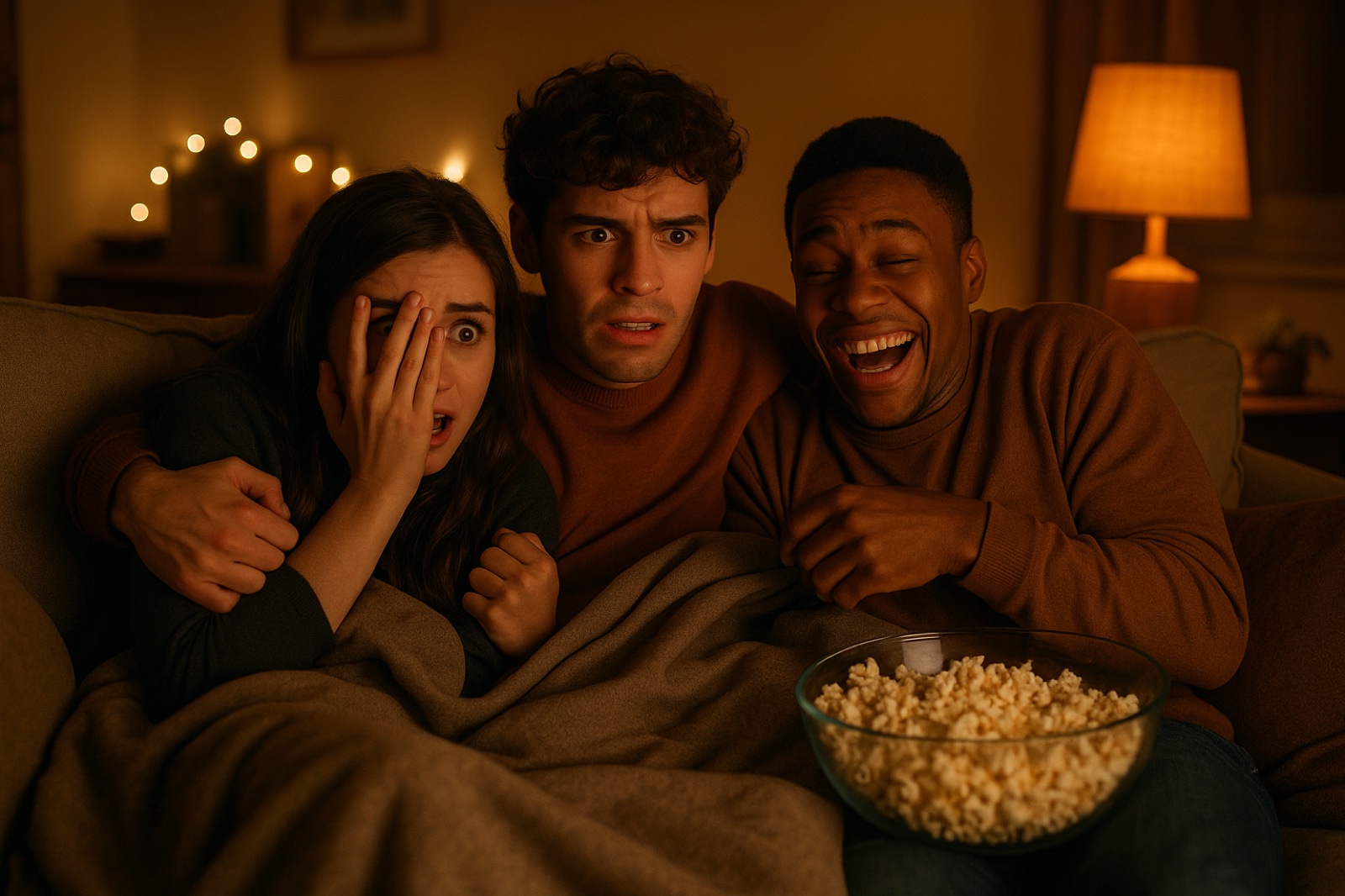
So you do the strange thing almost everyone does. You cover your eyes. And then you open two fingers, just a crack, so you can still see.
Why would anyone do that on purpose? Why do people like scary movies at all? Fear is supposed to be the feeling that makes us run away. Yet millions of people pay to feel it, pick it on a Friday night, and invite friends along.
Scientists have actually measured this. The answer they found is simple, and a little surprising. The fun is not in being as scared as possible. It lives in a sweet spot: scared, but not too scared.
Why Do People Like Scary Movies? The Short Answer
Researchers who study this call it recreational fear. It means getting enjoyment out of an experience that frightens you.
The best-known idea is that scary entertainment is a kind of play. Your body reacts as if the danger were real. Your heart races. You jump. But part of you knows there is no real danger. That knowing is what turns the fear into something you can enjoy instead of something you have to escape.
Think of a small child being chased around the kitchen by a parent pretending to be a monster. The child shrieks. The child also begs for more. The researchers behind the most detailed study on this used almost exactly that picture to explain what a horror fan is doing.
And horror is not a small niche. Even this year, a tiny-budget horror film became the biggest release in its studio’s history. People keep choosing to be scared. The question is why it feels good.
Inside the Haunted House Where Scientists Measured Fear
In Vejle, Denmark, there is a commercial horror attraction called Dystopia Haunted House. Visitors walk through 42 connected rooms in small groups while actors in costume chase them.
A team from Aarhus University’s Recreational Fear Lab, led by Marc Malmdorf Andersen with horror researcher Mathias Clasen, turned it into a science experiment. They published the results in the journal Psychological Science in 2020.
Here is what they did:
- They recruited 110 visitors, aged 12 to 57.
- Each person wore a heart-rate monitor the whole way through.
- Cameras filmed faces at three big scares: a zombie bursting out of a table, a man in a pig mask chasing people with a roaring chainsaw, and a crowd of zombies jumping from a staircase near the exit.
- Afterward, visitors rated how frightened they were and how much they enjoyed each of those scares.
When the researchers put fear and enjoyment side by side, they did not get a straight line. They got a hill.
With a little fear, enjoyment was low. More fear, and enjoyment climbed. But past a certain point, more fear made the fun go down. Scientists call that shape an inverted U. The researchers called the top of the hill “just right.”
The Surprise: Big Heartbeats Meant Fear, Small Ones Meant Fun
This is the part most summaries skip, and it may be the most interesting finding in the whole study.
The heart-rate data split in two. The big swings in heart rate tracked with fear. The bigger the jolt, the more scared people said they were. Simple enough.
But enjoyment did not follow the big swings. It followed the smaller ups and downs. And those showed the same hill shape: enjoyment was highest in the middle, and lower at both ends.
In plain words: the fun is not in the single biggest scream. It is in the rhythm. Tension, release. Tension, release. A heart that keeps getting pushed a little off balance and then finds its feet again.
There was one more quiet finding. Across the whole visit, people who were more scared overall were not simply having more fun. Being terrified did not guarantee a good time. Being scared the right amount did.
What the Study Did Not Prove
It is worth being honest here, because the researchers were.
It was a haunted house, not a movie. The team wrote plainly that it was unclear whether their findings carry over to horror movies, books, extreme sports or roller coasters. A film on your couch is not the same as a chainsaw in a dark hallway. The sweet-spot idea seems to fit movies well, but this study itself measured a haunted house, and nobody should pretend otherwise.
You cannot always see fun on a face. The people coding the videos could spot fear on faces fairly well. Enjoyment was much harder to read. The researchers pointed to “masking smiles,” where a smile covers a different feeling underneath. If you have ever grinned or giggled at the worst possible moment, you know how that works. (We dug into that odd reaction in why we laugh in serious situations.)
Children were not studied. No young children took part, so the results say nothing about what is right for kids.
Choosing It Changes Everything
Here is a detail almost nobody mentions.
Before going in, the researchers asked each visitor one question: did you come because you wanted to, or because your friends or family wanted to? A bit over four in ten said they came mostly because someone else wanted them to.
The people who chose to come for themselves reported more enjoyment than the ones who had been talked into it.
That matches what most of us know from real life. The same film can be a great night for the person who picked it and a miserable one for the friend who got dragged along. Fear you choose feels different from fear that is pushed on you.
Scary Movies as Practice for Real Life
So why would enjoying fear make any sense at all? One leading idea is that scary stories are a safe rehearsal. You get to feel fear, notice what it does to your body, and practise staying steady, all without real danger.
A few studies point in that direction:
- People often feel better afterward. A University of Pittsburgh team surveyed 262 adults before and after an “extreme” haunted attraction, published in the journal Emotion in 2019. Their mood tended to improve, especially among people who had arrived tired, bored or stressed. In a group of 100 who also had their brain activity recorded, the people whose mood lifted showed calmer brain reactions to tasks afterward.
- Horror fans coped a little better in a crisis. A 2021 study of 310 people, run during the COVID-19 pandemic by researchers including Coltan Scrivner and Mathias Clasen, found that horror fans showed more psychological resilience. Fans of zombie, alien-invasion and end-of-the-world films also felt more prepared. This shows a link, not proof that horror films caused the resilience.
- Not every fan wants the same thing. The same research group has described three types. “Adrenaline junkies” want the biggest rush. “White-knucklers” want to get through it with their nerves intact and often feel they grew from it. “Dark copers” say scary stories help them handle anxiety or low moods.
The takeaway is not “horror is good for everyone.” It is that fear, in the right dose and the right setting, can be something you learn from rather than something that only harms you.
How to Find Your Own Sweet Spot
Everyone’s sweet spot sits in a different place. None of this costs anything.
- Pick it yourself. Choosing the film, or at least agreeing to it freely, seems to make the experience more enjoyable.
- Adjust the dose. Lights on, sound down, daytime instead of midnight. These are not cheating. They are ways of moving yourself back to the top of the hill.
- Watch with someone. The haunted-house visitors went through in groups, never alone. Grabbing a friend’s arm is part of how the fear stays fun.
- Pause if you need to. If a film tips from thrilling into genuinely upsetting, you have left your sweet spot. Stopping is allowed.
- Notice how you feel the next day. Buzzing and a bit proud? You were in the zone. Lingering dread or bad sleep? Next time, choose something milder. Your sweet spot is telling you something.
The Part of You That Knows You’re Safe
Go back to that child being chased around the kitchen.
The chase only works because of who is doing the chasing. The child can scream and run and feel the thrill of danger precisely because the “monster” is someone who loves them. Take away that person, and the same chase stops being play. It becomes terror.
That is what the sweet spot really needs. Not the absence of fear, but something underneath it that holds. A couch. A friend’s arm. A voice you trust.
People have known this for a very long time. An ancient song, traditionally credited to a shepherd, talks about walking through the darkest valley. It never pretends the valley is bright. It simply says the walker will not be afraid, because God is walking there too.
Maybe that is part of what a horror fan is practising without knowing it. Not how to avoid the dark. How to stay steady inside it, because you are not alone in it.
So the next time the music drops out and you open two fingers to peek, notice who is sitting next to you. Notice the hand you reach for. That grip is the whole secret. The fear is real enough to feel. The safety is real enough to hold.
Let’s Talk
Do you think scary movies are better watched alone or with other people, and does it change how scared you actually get? Tell us what you think in the comments.
Share This
- Scientists put heart-rate monitors on 110 people in a haunted house. The fun peaked when people were scared, but not too scared. Past that point, more fear meant less fun. https://bgodinspired.com/
- Weird finding: big heart-rate jumps tracked how SCARED people were. The smaller ups and downs tracked how much FUN they had. The thrill is in the rhythm, not the biggest scream. https://bgodinspired.com/
- A child being chased by a “monster” only laughs because the monster is someone who loves them. Maybe that’s the real reason scary movies feel good. https://bgodinspired.com/
Questions People Ask About Scary Movies
Why do people like scary movies?
People like scary movies because fear felt in a safe setting can be enjoyable, a pattern researchers call recreational fear. The body reacts as if danger were real, with a racing heart and jumps, while part of the mind knows there is no real threat, which lets the fear work like play. A 2020 field study at Dystopia Haunted House in Denmark, published in Psychological Science, found that enjoyment peaks at a moderate level of fear and falls when fear becomes too intense.
What is the sweet spot of fear?
The sweet spot of fear is the level of fright that feels most enjoyable, where an experience is neither too boring nor too frightening. In a 2020 study of 110 haunted house visitors, researchers from Aarhus University found an inverted-U relationship between fear and enjoyment: enjoyment rose with fear up to a point, then declined. Each person’s sweet spot sits at a different level.
Why do some people hate horror movies?
One likely reason some people dislike horror movies is that their personal sweet spot of fear sits lower, so ordinary horror pushes them past enjoyment into genuine distress. Research on haunted house visitors also found that people who chose to attend for themselves enjoyed it more than people who went mainly because friends or family wanted them to, so being pressured into watching can make horror less enjoyable.
Are scary movies good for your mental health?
Scary movies may offer some benefits for some people, but the evidence is limited. A 2019 University of Pittsburgh study of 262 adults found that mood tended to improve after an intense haunted attraction, especially for people who arrived tired, bored or stressed. A 2021 study of 310 people found horror fans showed greater psychological resilience during the COVID-19 pandemic, though that study shows an association rather than proof that horror causes resilience. Horror that leaves someone with lasting dread or poor sleep is likely beyond that person’s comfortable level.
Is it better to watch scary movies with other people?
Watching scary movies with other people can help keep the fear enjoyable, because company can add a sense of safety that helps fear feel like play rather than danger. In the 2020 Danish haunted house study on recreational fear, visitors went through the attraction in groups of two to six people. That study did not directly compare watching alone with watching in a group, so the effect of company has not been precisely measured there.