 0
0
 0
0
Some help comes before the hard thing. The loan comes through. The test result is clear. The phone call never comes.
And some help doesn’t come that way. You still get the diagnosis. You still lose the job. You still sit in the hospital corridor at 3 a.m. And you are left asking a quiet question: if God is real, why am I still in here?
That question sits at the center of one of the oldest stories in the Bible. A new live-action film, Daniel and the Fiery Furnace, opens in cinemas on September 18, and it is sending a lot of people back to the same line: “the form of the fourth is like the Son of God.” So who was the fourth man in the fire? The honest answer is more surprising than most sermons make it, and it has more to say about your 3 a.m. corridor than you might expect.
Who Was the Fourth Man in the Fire?
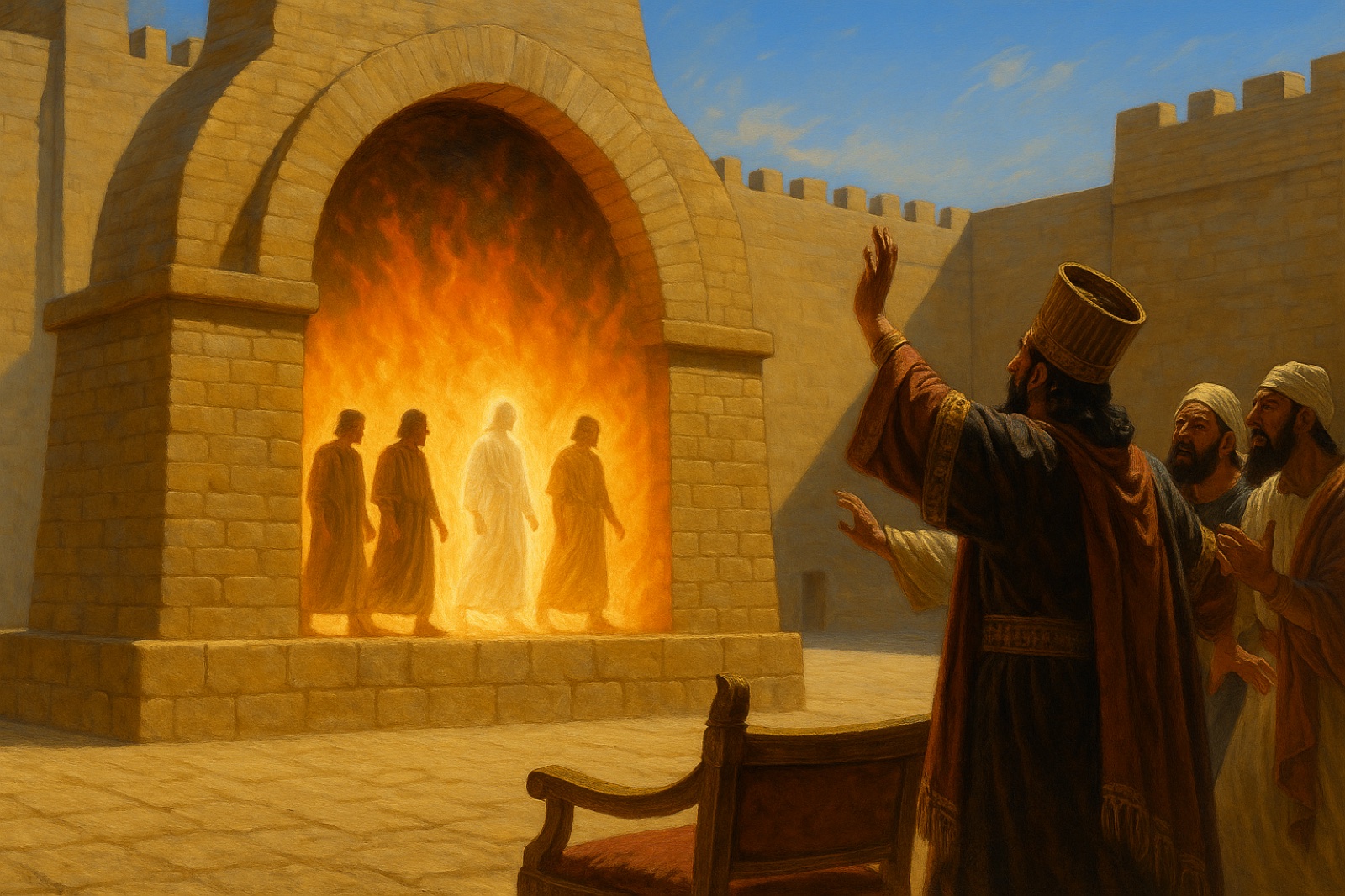
The short answer: Daniel 3 never names him. Three young Jewish men, Shadrach, Meshach, and Abed-nego, refuse to bow to a giant golden statue. King Nebuchadnezzar of Babylon has them tied up and thrown into a blazing furnace. Then the king looks in, and sees something no one expected.
“He answered and said, Lo, I see four men loose, walking in the midst of the fire, and they have no hurt; and the form of the fourth is like the Son of God.” (Daniel 3:25, KJV)
That is all we are told. There is no name, no speech, and no description beyond “like.” Christians have wondered about this figure for centuries, and we will look at the main answers below. But notice first who is doing the seeing. In the text, the only person who reports seeing a fourth figure is the king who lit the fire.
The man who shouted “who is that God that shall deliver you out of my hands?” (Daniel 3:15) is the one who ends up staring into the flames with his answer walking around inside them.
Wait, Where Is Daniel?
Here is a detail almost everyone reads past. The film puts Daniel front and center; he is played by Mena Massoud, and his name is in the title. But read Daniel chapter 3 from start to finish and you will not find Daniel in it at all. Not once. The whole chapter is about his three friends.
The last time we see Daniel is the final verse of the chapter before:
“Then Daniel requested of the king, and he set Shadrach, Meshach, and Abed-nego, over the affairs of the province of Babylon: but Daniel sat in the gate of the king.” (Daniel 2:49, KJV)
So where was he when the statue went up? The Bible does not say. People have guessed for a long time, that he was travelling, or that his rank protected him, but those are guesses. Nobody knows. (We haven’t seen the film, so this isn’t a review; a movie telling Daniel’s story is free to widen the frame.)
Why does this matter? Because it means the three men faced the furnace without the famous one. No Daniel to speak for them. No friend at the king’s gate stepping in. Just three ordinary people and a choice. If you have ever felt like the “strong one” in your life wasn’t there when your moment came, this chapter was written with you in the room.
“But If Not”: What They Said Before Anyone Joined Them
Before the furnace, the king gives them one more chance. Their answer is one of the bravest things anyone says in the Bible:
“If it be so, our God whom we serve is able to deliver us from the burning fiery furnace, and he will deliver us out of thine hand, O king. But if not, be it known unto thee, O king, that we will not serve thy gods, nor worship the golden image which thou hast set up.” (Daniel 3:17-18, KJV)
Read those two words again: but if not.
They are not saying God can’t. They are saying, “We believe God can. We don’t know if God will. Either way, our answer is the same.” They said this before they knew anyone would be in the fire with them. They had no vision. No promise. No fourth man yet. Only trust.
That is a very different kind of faith than “if I believe hard enough, nothing bad will happen.” It is faith that has already made peace with the fire.
What the King Actually Saw
The furnace was so hot that the soldiers who threw the men in died from the flames (Daniel 3:22). Then:
“And these three men, Shadrach, Meshach, and Abed-nego, fell down bound into the midst of the burning fiery furnace.” (Daniel 3:23, KJV)
Look at the words the king uses a moment later. He asks his advisers, “Did not we cast three men bound into the midst of the fire?” (Daniel 3:24). Then he says, “I see four men loose.”
They went in bound. They were walking around loose. And when they came out, “the fire had no power” on their bodies, “nor was an hair of their head singed, neither were their coats changed, nor the smell of fire had passed on them” (Daniel 3:27). The text never explains how the ropes came off. It just puts “bound” and “loose” side by side and lets you notice that the only thing the fire seems to have taken was the thing holding them.
And here is the detail stated once and never repeated: when the king calls them out, only three come out. “Then Shadrach, Meshach, and Abed-nego, came forth of the midst of the fire” (Daniel 3:26). The fourth figure is never mentioned leaving. The story simply lets that presence stay in the fire.
“Like the Son of God” or “A Son of the Gods”?
This is where honesty matters, because it is easy to overclaim.
This part of Daniel was written in Aramaic, not Hebrew. The phrase the King James translates “like the Son of God” can also be read “like a son of the gods.” That is how many modern translations render it. And it fits the speaker: Nebuchadnezzar worshipped many gods. He was describing something that looked more than human, in the only words he had.
Three verses later, the king gives his own label:
“Then Nebuchadnezzar spake, and said, Blessed be the God of Shadrach, Meshach, and Abed-nego, who hath sent his angel, and delivered his servants that trusted in him, and have changed the king’s word, and yielded their bodies, that they might not serve nor worship any god, except their own God.” (Daniel 3:28, KJV)
There is another ancient witness too. An old Greek version of Daniel adds a long passage in the middle of this scene, between verses 23 and 24. It is still printed in Catholic and Orthodox Bibles, and it sat in the Apocrypha section of the 1611 King James Bible as the Song of the Three Holy Children. That passage says plainly that “the angel of the Lord came down into the oven.”
So what are the main answers?
- An angel. This is what the king himself says, and it is how Jewish tradition has generally read the scene.
- Jesus, before Bethlehem. Many Christians have long read the fourth figure as an appearance of the Son of God before He was born as a man. The King James wording has made this reading especially loved.
The text doesn’t settle it, and it is fine to hold that honestly. But notice that both answers agree on the thing that matters most: God did not stay outside the furnace. Whoever the fourth figure was, that presence was sent by God, into the fire, to the people in it.
If you would like to keep exploring what the Bible actually promises about being protected (and what it doesn’t), our piece on Bible verses about protection and what they actually promise goes further.
The Rescue Didn’t Keep Them Out of the Fire
This is the part that is easy to miss, even if you have known this story since childhood.
God could have stopped the statue. God could have changed the king’s mind before the furnace was lit. God could have let the soldiers trip on the way. None of that happened. The three men went all the way in.
The rescue didn’t keep them out of the fire. It met them inside it.
That changes how we read our own hard seasons. Most of us pray “keep me out of the fire.” That’s a good prayer, and sometimes God answers it. But when the answer is “not this time,” this chapter says you have not been left alone. You may be in the place where you’d least expect company, and that is exactly where the fourth figure appeared.
And look who saw it. Not the three men’s friends. Not Daniel. The man who ordered the furnace heated. Sometimes the clearest proof that God is with you is seen by the people who expected you to burn. Your calm in the hospital corridor, your kindness while the job falls apart, may be the thing someone else can’t explain.
The prophet Isaiah put the same promise into words: “when thou walkest through the fire, thou shalt not be burned; neither shall the flame kindle upon thee” (Isaiah 43:2, KJV). Notice the word through. Not around. Through.
If you’re wondering whether a fire you’re in right now is a test, our article Is God Testing Me? What James 1 Really Means is a gentle next read.
Actions to Take
- Write your own “but if not” sentence. On paper or in your phone, finish this: “God is able to ______. But if not, I will still ______.” Keep it somewhere you’ll see it tonight.
- Name what has come loose. Think of a hard season you have already walked through. Write down one thing that used to hold you (a fear, a habit, someone’s opinion of you) that doesn’t hold you the same way anymore.
- Be present in someone else’s fire. Send one short message to someone going through something hard. Don’t fix it. Just say, “I’m thinking of you and I’m here.” You can’t be the fourth figure, but you can refuse to let them feel alone.
Not sure which verse speaks to where you are right now? Try our free Bible Verse for How I Feel tool.
Journaling Prompts
- Where in your life are you still praying “keep me out of the fire,” and what would it feel like to also pray “meet me in it”?
- When have you felt like the “Daniel” in your life, the strong one you counted on, wasn’t there? What did you find out about God in that gap?
- Who might be watching how you walk through this season, and what might they be seeing?
The rescue didn’t keep them out of the fire. It met them inside it.
A Prayer for When You’re Still in the Fire
God, I asked You to keep me out of this, and here I am anyway. I don’t understand it, and I’m tired of pretending I do. I believe You are able to get me out. But if not, I still choose You. Please meet me in here, loosen what’s been holding me, and let someone see that I am not alone. Amen.
Discussion Question
Do you think the fourth man in the fire was an angel or an appearance of Jesus, and does the answer change what the story means to you? Share your thoughts in the comments below.
Share This
“They went into the furnace bound and were seen walking loose. The only thing the fire took was what was holding them. Daniel 3:25”
“‘But if not.’ Three words that say: I believe God can. I don’t know if God will. My answer is the same either way. Daniel 3:18”
“I always prayed to be kept out of the fire. Daniel 3 reminded me that sometimes God meets you inside it instead. I’m not alone in here.”
Questions and Answers (Q&A)
Who was the fourth man in the fire in Daniel 3?
Daniel 3:25 never names the fourth man in the fire. King Nebuchadnezzar said the fourth figure looked “like the Son of God” (King James Version), which can also be translated “like a son of the gods.” In Daniel 3:28 the king calls the figure God’s “angel.” Jewish tradition has generally read the figure as an angel, while many Christians have read it as an appearance of Jesus before His birth. The Bible itself does not settle the question.
Is Daniel in the story of the fiery furnace?
No. Daniel is not mentioned anywhere in Daniel chapter 3. The fiery furnace story is about his three friends, Shadrach, Meshach, and Abed-nego. The last mention of Daniel before the story is Daniel 2:49, which says he “sat in the gate of the king.” The Bible does not say where Daniel was during the events of chapter 3.
What does “but if not” mean in Daniel 3:18?
In Daniel 3:17-18, Shadrach, Meshach, and Abed-nego told King Nebuchadnezzar that God was able to rescue them from the furnace, “but if not,” they still would not worship his golden statue. The phrase shows faith that trusts God’s power without demanding a guaranteed outcome. They made this commitment before they knew anyone would appear with them in the fire.
Who saw the fourth man in the fiery furnace?
In the text of Daniel 3, the only person who reports seeing a fourth figure in the fiery furnace is King Nebuchadnezzar, the ruler who ordered the three men thrown in. He asked his advisers whether they had thrown in three bound men, then said he saw four men loose, walking in the fire. After the three men came out, the king’s officials saw that the fire had not harmed them.
What is the new Daniel fiery furnace movie?
Daniel and the Fiery Furnace is a live-action film directed by Matthew and Daniel Kooman, opening in cinemas on September 18, 2026, with Mena Massoud playing Daniel and Elijah Alexander playing King Nebuchadnezzar. The biblical account it draws on is found in Daniel chapter 3, where Daniel himself does not appear.