 0
0
 0
0
A good forger can copy almost everything about an ancient clay pot. The shape. The colour of the clay. The chips around the rim. Even the grime, rubbed into the cracks so it looks like it spent three thousand years underground.
What a forger cannot copy is the three thousand years.
That is the idea behind a new way to spot fake ancient pottery, published at the end of August 2026 in the journal PNAS. It reads a faint magnetic signal that builds up inside fired clay slowly, over centuries, just from lying still. And the first time the team pointed it at real suspects from the antiquities black market, the result was not the one you might expect. All three “suspicious” pieces came back looking genuinely ancient.
How Scientists Spot Fake Ancient Pottery Now
Fake antiquities are an old and stubborn problem. They turn up wherever there are dig sites and buyers, from Israel to China to Mexico. Some fakes end up in private collections. Some end up in museums. And proving a piece is fake, or real, is harder than it sounds. In Israel, a recent prosecution over the sale of fake artifacts reportedly failed because there was not enough conclusive evidence either way.
The usual tests have a weakness too. Scientists publish how their methods work, which is how science is supposed to go. But forgers can read those papers. The lead researcher on the new study, Yoav Vaknin, put the problem plainly: scientists publish their findings in the open, while forgers work in secret.
So the team, working at the Scripps Institution of Oceanography at UC San Diego with geoscientists Lisa Tauxe and Jeff Gee and former Scripps PhD student Brendan Cych, went looking for something no one could fake on purpose. They found it in the Earth’s magnetic field.
The Magnetic Memory Inside Fired Clay
Clay has tiny grains of iron-bearing minerals in it. Each grain acts a bit like a very small compass needle.
When a potter fires a pot in a kiln, those grains heat up and loosen. As the pot cools, they settle and lock in place, lined up with the Earth’s magnetic field at that exact moment and place. Scientists call this thermal remanent magnetization. You can think of it as a snapshot. The pot quietly records which way “magnetic north” was on the day it was made.
That snapshot is not a new discovery. Archaeologists have used it for years to help date ancient sites, because the Earth’s magnetic field is not fixed. It drifts and changes over time, driven by the churning molten iron deep inside the planet, which never quite sits still.
But the snapshot alone does not stop a forger. A modern pot fired last year has a snapshot too.
The Second Signal Only Time Can Write
Here is the part that makes this study different.
Not every grain in the clay locks in equally hard. The smallest, least stable grains can still move a little. If a pot lies in the ground for centuries, those small grains slowly turn to follow the Earth’s magnetic field as it drifts. No new fire. No heat. Just time, and a field you cannot see, gently pulling on them year after year.
This creates a second, weaker signal called viscous remanent magnetization, or VRM. And it has one very useful property: the longer it has been building, the more stubborn it gets.
If you gently reheat a piece of clay, you can wipe that second signal away. A young pot gives it up easily. An old pot holds on. So the temperature it takes to erase the signal works like a clock that tells you, roughly, whether a piece has had centuries to build it up.
The 112°C Test: How the Experiment Worked
To check whether this really works, the team needed pottery they already knew the truth about. They tested 45 samples, including:
- ancient pottery shards from excavations
- 15 ancient royal storage jars excavated from the old Kingdom of Judah
- modern pots fired in traditional kilns
- modern clay seal impressions
- souvenir pottery bought from shops in Jerusalem
That last group is the best detail in the whole study. To get a set of guaranteed modern fakes, the researchers simply went shopping.
They heated small samples step by step, starting at 50°C and climbing in 10-degree steps, and measured when the second signal disappeared. They also used computer models, now possible thanks to far more computing power, to simulate what happens to clay’s magnetism over long stretches of time.
The results split cleanly. In the modern pottery, the time-built signal vanished at low temperatures, in the range of about 50 to 70°C. In pottery more than 1,000 years old, it survived until the clay was heated above about 112°C (roughly 234°F).
That is not very hot. It is only a little above the boiling point of water. But no amount of skill in a workshop can give a new pot a thousand years of slow magnetic drift.
The Twist: The Suspects Were Real
Then came the first real-world test.
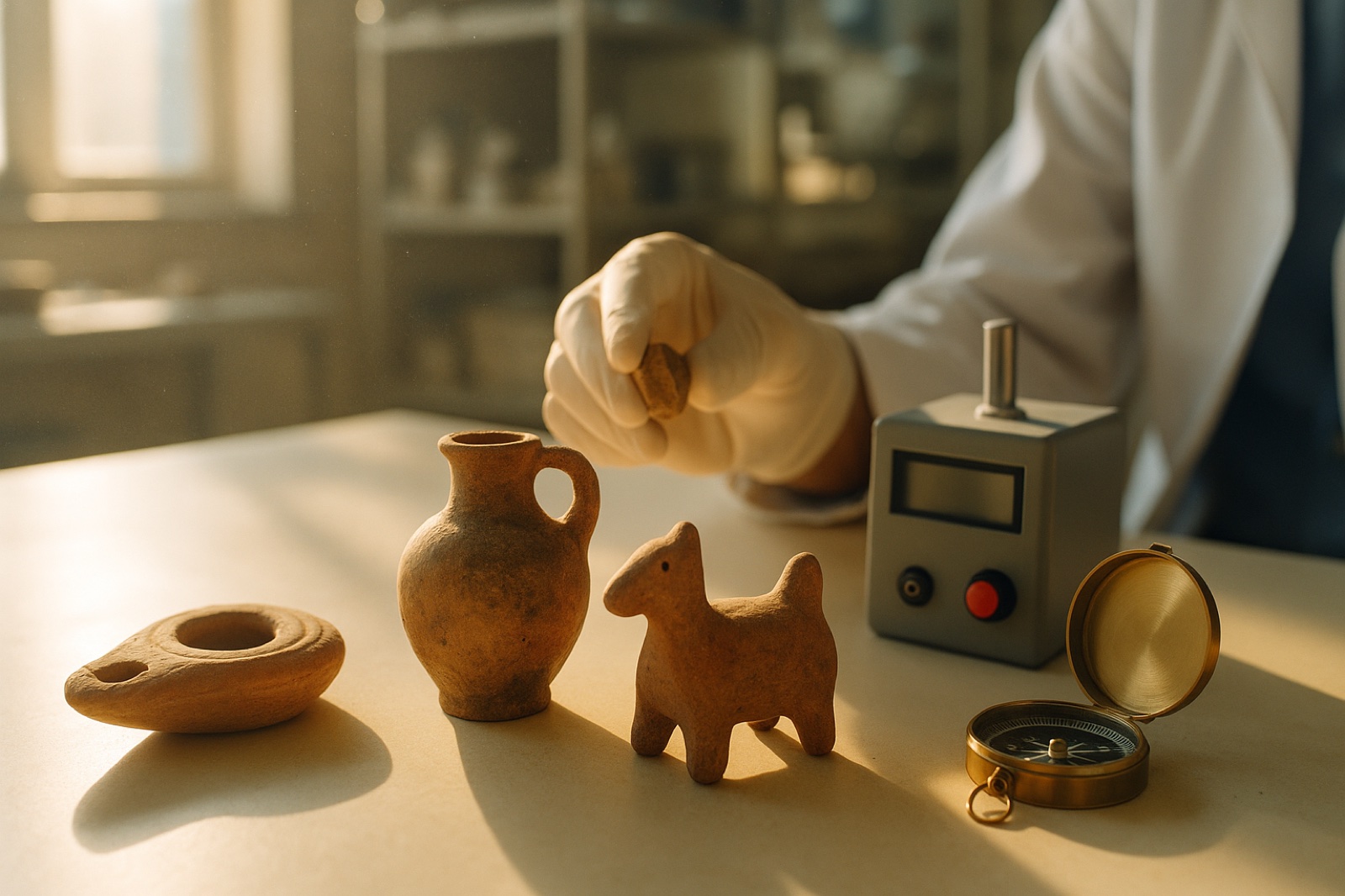
The Israel Antiquities Authority had recovered three pieces from the illegal antiquities market. They looked like they came from the Iron Age, but nobody could be sure. They were a small juglet with burn marks from a fire, a vessel shaped like an animal that was probably used in worship, and an oil lamp.
All three passed. Their results were consistent with clay fired in ancient times.
It would have made a neater headline if the test had caught three fakes. But this result may matter more. A method that only ever condemns things is just a sharper accusation. A method that can also say “no, this one is real” protects the genuine pieces, and the history they carry, from being thrown out with the forgeries.
It is worth being careful about what “passed” means, though. The researchers describe the three objects as seemingly authentic. The test shows the clay was fired long ago. It is strong evidence, not a certificate.
What the Magnetic Test Can’t Do
Like any good tool, this one has limits, and the researchers are open about them.
- It only works on fired clay. It was built for pottery and other fired clay objects, not for every kind of antiquity.
- It needs a small sample. A little piece of material has to be taken and heated, so it is not completely hands-off.
- It cannot give an exact date. It can separate a 2,000-year-old artifact from a modern fake, but it cannot tell 2,000 years from 2,500.
- The clear line is about 1,000 years. The study’s threshold separates objects older than that from modern ones, so pottery from more recent centuries falls outside what it can confidently judge.
- The arms race continues. Skilled forgers have learned to game older methods once they were published. Nobody is claiming this one is forever safe.
Science has been quietly getting better at reading ancient clay without destroying what matters. Not long ago, researchers read a 4,000-year-old letter still sealed inside its clay envelope using a portable scanner. This new test fits the same pattern: letting old objects tell us what they are, instead of guessing from the surface.
The One Thing You Can’t Counterfeit
What stays with me is where the proof actually lives.
Not in the glaze. Not in the shape. Not in anything you could see or polish. The proof is hidden inside, in the smallest grains of the clay, and it was put there by something nobody could see either: a field that is everywhere, all the time, patiently pulling on anything that stays put long enough.
The grains did not do anything dramatic. They just stayed in place, century after century, and slowly turned.
There is a very old idea that people are like this. Ancient writings about faith describe us as ordinary clay jars carrying something precious, and describe God a lot like scientists describe that magnetic field: unseen, all around us, and patient. If that is true, then what is real in a person is not the polished outside, and it is not proven in a single bright moment. It shows up the slow way. Years of quietly turning toward something you cannot see, until it is part of what you are made of.
A forger can fake the surface of an old pot in an afternoon. Nobody can fake the time.
And maybe that is good news, for pottery and for the rest of us. If you feel ordinary, a bit chipped, not much to look at, the part that counts was never going to be on the surface anyway. It is the part that only time can write.
Questions People Ask About Fake Ancient Pottery
How can scientists tell if ancient pottery is fake?
One new method, published in the journal PNAS in August 2026, measures a weak magnetic signal called viscous remanent magnetization (VRM) inside fired clay. Over centuries, the smallest magnetic grains in buried pottery slowly realign with the Earth’s changing magnetic field, and the longer this goes on, the more heat it takes to erase the signal. In the study, pottery older than about 1,000 years kept this signal until heated above roughly 112°C (about 234°F), while modern pottery lost it at lower temperatures, often around 50 to 70°C. That difference helps separate genuinely ancient clay from modern forgeries.
What is viscous remanent magnetization in pottery?
Viscous remanent magnetization, or VRM, is a secondary magnetic signal that builds up slowly in materials such as fired clay without any new heating. When pottery is first fired, iron-bearing grains lock in the direction of the Earth’s magnetic field, which is called thermal remanent magnetization. Afterward, the smallest and least stable grains gradually shift to follow the Earth’s magnetic field as it changes over time. Because this slow shift needs long periods of time to become stable, it can act as evidence of an object’s age.
Who developed the magnetic test for fake antiquities?
The method was developed by a team led by Israeli researcher Yoav Vaknin at the Scripps Institution of Oceanography, UC San Diego, working with geoscientists Lisa Tauxe and Jeff Gee and former Scripps PhD student Brendan Cych. The study was published in the Proceedings of the National Academy of Sciences (PNAS) at the end of August 2026.
Were the suspected fake artifacts tested with the magnetic method real?
In its first practical test, the magnetic method was used on three suspect Iron Age artifacts recovered from the illegal antiquities market by the Israel Antiquities Authority: a juglet with fire burn marks, an animal-shaped vessel probably used for worship, and an oil lamp. All three passed the test, with results consistent with clay fired in ancient times, so the researchers described them as seemingly authentic.
What are the limits of the magnetic pottery authentication test?
The magnetic authentication test based on viscous remanent magnetization works only on fired clay objects and requires a small sample to be taken and heated. It can distinguish pottery more than about 1,000 years old from modern pieces, but it cannot give a precise date, such as telling a 2,000-year-old object from a 2,500-year-old one. Researchers also note that forgers have learned to defeat earlier authentication methods after they were published, so no single test is considered permanently foolproof.
A Question Worth Talking About
If a test showed a museum piece everyone loved was a clever fake, should the museum take it down, or keep it on display with the truth written next to it? Tell us in the comments what you would do.
Share This
- Forgers can copy the shape, the colour and even the dirt of ancient pottery. What they can’t copy is centuries of slow magnetic drift inside the clay. Scientists just learned to read it. https://bgodinspired.com/index.php/bible-resources/bible-history/fake-ancient-pottery-magnetic-test/
- To get guaranteed fake “ancient” pottery for their experiment, researchers went souvenir shopping in Jerusalem. Then the new test’s first real suspects turned out to be genuine. https://bgodinspired.com/index.php/bible-resources/bible-history/fake-ancient-pottery-magnetic-test/
- The proof that something is truly old isn’t on the surface. It’s hidden in the tiniest grains of the clay, written there by a force nobody can see, one slow century at a time. https://bgodinspired.com/index.php/bible-resources/bible-history/fake-ancient-pottery-magnetic-test/