 0
0
 0
0
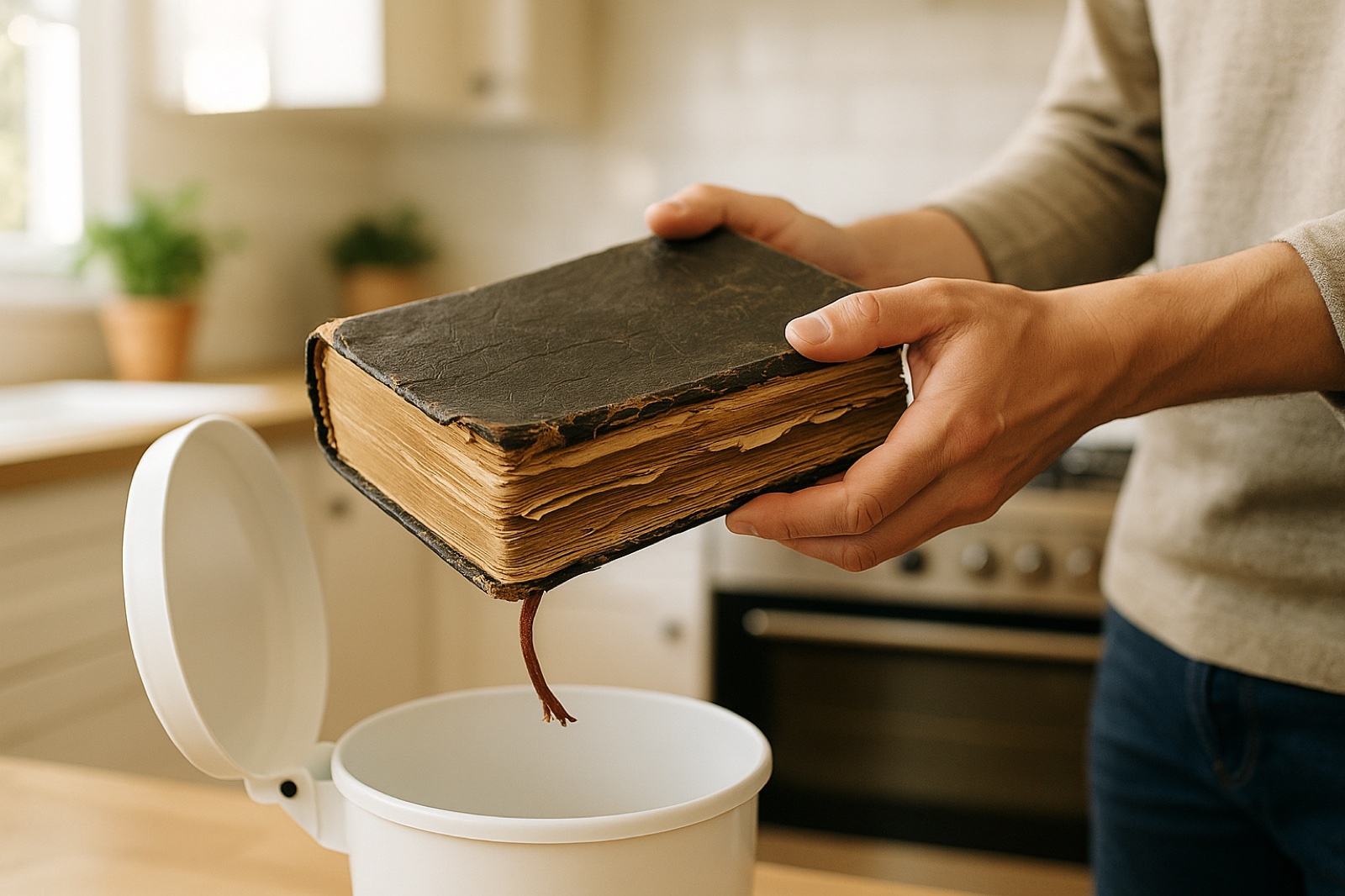
It is on the shelf, or in a box you have been meaning to sort. The cover is cracked. The spine has split. Pages slide out when you pick it up. Maybe it was your grandmother’s. Maybe it is just the one you wore out years ago.
You want the space back. But your hand stops over the bin, and a small knot forms in your stomach. Is it a sin to throw away a Bible? Could God be upset with you for it?
If that question has made you hold on to a book you can’t even read anymore, you are in good company. And the Bible has a surprising story about exactly this. A king once destroyed a copy of God’s words on purpose, page by page. What God did next may take the fear right out of your hands.
Is It a Sin to Throw Away a Bible? The Short Answer
No verse in the Bible tells you how to get rid of a printed Bible. There is no command about it and no warning about it. Nothing in Scripture says that letting go of a worn-out copy is a sin.
That doesn’t mean it doesn’t matter. Respect is a good instinct, and we will get to some gentle ways to do it. But the fear itself, the idea that you might offend God by recycling paper and glue, rests on a belief the Bible never teaches: that God’s word lives inside the paper.
And if you already threw one out years ago and have felt bad about it ever since, you can set that down too. Keep reading.
If your old Bible is too worn to read, that doesn’t mean the words have to leave your life with it. We made the whole Book of Matthew into an easy-to-read PDF and a 28-chapter audiobook, free, so you can keep the story of Jesus close in a form that won’t fall apart.
The Night a King Cut Up the Word of God
The story is in Jeremiah 36. God told the prophet Jeremiah to write down every warning God had given the nation:
“Take thee a roll of a book, and write therein all the words that I have spoken unto thee against Israel, and against Judah, and against all the nations, from the day I spake unto thee, from the days of Josiah, even into this day.” (Jeremiah 36:2, KJV)
Jeremiah called his friend Baruch, a scribe. Jeremiah spoke, and Baruch wrote every word by hand onto a scroll (Jeremiah 36:4). That took a long time. There was only one copy.
Baruch read the scroll aloud at the temple. When the royal officials heard it, “they were afraid both one and other” (Jeremiah 36:16). They knew the king had to hear it.
So the scroll was brought to King Jehoiakim. It was winter. The king “sat in the winterhouse in the ninth month: and there was a fire on the hearth burning before him” (Jeremiah 36:22). A man named Jehudi began to read. Then this happened:
“And it came to pass, that when Jehudi had read three or four leaves, he cut it with the penknife, and cast it into the fire that was on the hearth, until all the roll was consumed in the fire that was on the hearth.” (Jeremiah 36:23, KJV)
Picture it. A few columns are read. Slice. Into the fire. A few more. Slice. Into the fire. On and on, until the only copy of those words was ash.
Three of his own officials begged him to stop. Jeremiah 36:25 names them: Elnathan, Delaiah and Gemariah. “But he would not hear them.”
The Detail Most People Read Past
The very next verse says something quiet but sharp:
“Yet they were not afraid, nor rent their garments, neither the king, nor any of his servants that heard all these words.” (Jeremiah 36:24, KJV)
In Bible times, tearing your clothes was what you did when you heard terrible news or knew you had done wrong. And the Hebrew word for tearing clothes, qara, is the same word used for what the king did to the scroll. He tore the scroll instead of tearing his clothes.
Now here is why that stings. This king’s father was Josiah. Years earlier, a lost book of God’s law was found in the temple and read to Josiah. His reaction?
“And it came to pass, when the king had heard the words of the book of the law, that he rent his clothes.” (2 Kings 22:11, KJV)
Father and son both heard God’s words read aloud. One tore his clothes. The other tore the book.
So what was Jehoiakim’s real sin? It wasn’t damaging paper. God’s message to him names it plainly: “Thou hast burned this roll, saying, Why hast thou written therein…” (Jeremiah 36:29). The king didn’t want what it said. Burning it was just his way of refusing to listen.
That is a very different thing from you, standing in your kitchen, gently worrying about a book you have loved.
God’s Response: Write It Again
You might expect lightning. Instead, God gave Jeremiah a simple instruction:
“Take thee again another roll, and write in it all the former words that were in the first roll, which Jehoiakim the king of Judah hath burned.” (Jeremiah 36:28, KJV)
The king had also ordered Jeremiah and Baruch arrested, “but the LORD hid them” (Jeremiah 36:26). So they sat down and did the whole job again. And the last verse of the chapter holds a small, wonderful surprise:
“Then took Jeremiah another roll, and gave it to Baruch the scribe, the son of Neriah; who wrote therein from the mouth of Jeremiah all the words of the book which Jehoiakim king of Judah had burned in the fire: and there were added besides unto them many like words.” (Jeremiah 36:32, KJV)
Many like words. The king burned the scroll, and the new scroll came back longer.
Think about what that means. The king had the only copy. He destroyed all of it. And it made no difference at all to whether God’s words survived. The fire could reach the scroll. It could not reach the word.
There is even a quiet joke in it. The chapter describing that fire is still here. You can read it today, in almost any language on earth. Baruch shows up again later, too, standing with Jeremiah when Jeremiah bought a field while the army was at the gate, another moment when God’s promises outlasted the things that should have ended them.
Where God’s Word Actually Lives
The prophet Isaiah said it long before Jeremiah’s scroll was burned:
“The grass withereth, the flower fadeth: but the word of our God shall stand for ever.” (Isaiah 40:8, KJV)
Peter later quoted that verse and told believers they had been born again “by the word of God, which liveth and abideth for ever” (1 Peter 1:23, KJV). And Jesus said it in the simplest way of all: “Heaven and earth shall pass away, but my words shall not pass away” (Matthew 24:35, KJV).
None of these verses are about ink. Paper yellows. Glue dries out. Leather cracks. That is what paper does. The word of God was never stored in the paper to begin with. It lives in God, and it lives in the people who carry it. “Thy word have I hid in mine heart,” says Psalm 119:11.
That is also why honoring God has always been more about how you live than about how you handle objects. Even the command about God’s name is less about a word on a page than about how you carry it through your life, as we explored in what taking the Lord’s name in vain really means.
What Jewish Tradition Does With Worn-Out Scripture
Many people are surprised to learn that this question has an old and beautiful answer in Jewish practice. Jewish tradition does not destroy writings that may carry the name of God. Instead, worn-out pages are stored in a place called a genizah, a kind of resting room for old sacred texts, and are often buried later.
The most famous one was in the Ben Ezra Synagogue in Cairo, Egypt. For hundreds of years, worn pages were placed there and left alone. The dry air kept them. In 1896, a Cambridge scholar named Solomon Schechter climbed into that dusty room and began bringing its contents out.
Scholars now describe the Cairo Geniza as a collection of roughly 400,000 manuscript pages, according to Princeton’s Geniza Lab. Among them were pieces of writings that had been thought lost for a thousand years.
Here is the part worth sitting with. A room built to let old pages rest ended up saving history. Respect didn’t mean clinging to every copy forever. It meant letting worn things go gently, with care, and trusting that nothing important would be lost.
Christians are not bound by that custom. But it shows a way of letting go that is full of honor and empty of fear.
What This Means for the Bible on Your Shelf
The fear about throwing away a Bible usually hides a small, sad idea: that God’s word is fragile. That it needs you to guard every copy or something will be lost.
Jeremiah 36 says the opposite. The worst possible thing happened to that scroll. A powerful king cut it up and burned every piece on purpose. And God’s word came back with more in it than before.
If God’s word could survive a king’s fire, it can survive you recycling a copy that has fallen apart from being read. The thing God cares about in that story is not the scroll. It is the heart that hears the words. The king’s sin was refusing to listen. Your worry about treating a Bible with respect is the opposite of that. It shows you already care.
So you are free to hold your old Bible with respect instead of dread. Keep it if it means something. Let it go if it doesn’t. Either way, the word is not going anywhere.
How to Respectfully Get Rid of an Old Bible
None of these cost anything. Pick whatever feels right to you.
- Save the pages that are yours. Family Bibles often hold birth dates, marriages and names in the front. Old study Bibles hold notes and underlines. Cut those pages out or take a photo of them before anything else.
- Give it away if it can still be read. A church, a second-hand shop, a prison ministry or a neighbor may be glad to have it.
- Recycle it. If it is falling apart, putting the paper in recycling is fine. You can say a short thank-you prayer first if that helps you.
- Bury it. Some people like the old custom of burying a worn-out Bible, much like the genizah tradition.
- Burn it quietly and with care. Some Christians choose this as a respectful ending. The difference between this and Jehoiakim’s fire is the heart, not the flame.
Actions to Take
- Open the old Bible one last time. Flip to the most underlined page. Read what someone once found worth marking. (2 minutes)
- Take a photo of any handwriting. Names, dates, notes in the margin. Save it somewhere safe on your phone so the personal part stays with you. (3 minutes)
- Choose one verse from it to keep “in your heart.” Write it on a scrap of paper or in your phone’s notes and read it out loud before you let the book go. That is Psalm 119:11 done in real life. (5 minutes)
Journaling Prompts
- Where did the fear about throwing away a Bible first come from for you?
- If God’s word lives in people and not in paper, what words from Scripture are already living in you?
A Prayer for Letting Go
God, I have been holding on to this old book because I was scared of getting it wrong. Thank You that Your word is not trapped in paper and can’t be burned away. Help me keep what matters from it in my heart, and let go of the rest without guilt. And if I have carried shame about a Bible I threw out long ago, I give that to You now. Amen.
Discussion Question
When a family Bible gets too worn to use, do you think it should be kept, passed on, or respectfully let go? Share what you would do in the comments.
Share This
Post 1: I was scared to throw out my falling-apart Bible. Then I read Jeremiah 36. A king burned the only copy of God’s words, and God just had them written again, with more added. The word was never in the paper.
Post 2: “The grass withereth, the flower fadeth: but the word of our God shall stand for ever.” Isaiah 40:8. Paper wears out. God’s word doesn’t.
Post 3: King Jehoiakim tore up God’s words instead of tearing his clothes. His father Josiah did the opposite. Same words, two very different hearts. It was never about the scroll.
Questions People Ask About Throwing Away a Bible
Is it a sin to throw away a Bible?
No. The Bible does not contain any command about how to dispose of a printed Bible, and nothing in Scripture calls it a sin to throw away a worn-out copy. What matters in the Bible is how a person responds to God’s words, not what happens to paper and ink. Many Christians recycle, bury, give away, or respectfully burn Bibles that can no longer be used.
What happened when King Jehoiakim burned the scroll in Jeremiah 36?
In Jeremiah 36, King Jehoiakim of Judah cut up the scroll of Jeremiah’s prophecies a few columns at a time and burned it in a fire on the hearth. God then told Jeremiah to write the same words on a new scroll. Jeremiah 36:32 says the scribe Baruch wrote it all again, “and there were added besides unto them many like words.” The destroyed scroll was replaced with a longer one.
What is the respectful way to get rid of an old Bible?
A respectful way to get rid of an old Bible is to first save any family records, notes or handwriting, then give it away if it is still readable. If it is falling apart, recycling it, burying it, or burning it quietly are all options Christians use. No method is required by Scripture. Many people say a short prayer of thanks before letting a Bible go.
What is a genizah?
A genizah is a storage place in Jewish tradition for worn-out sacred texts that may contain the name of God, which are not destroyed but set aside and often buried later. The best-known example is the Cairo Geniza in the Ben Ezra Synagogue in Egypt, which held roughly 400,000 manuscript pages. Solomon Schechter of Cambridge began bringing its contents out in 1896.
Does the Bible say God’s word lasts forever?
Yes. Isaiah 40:8 says, “The grass withereth, the flower fadeth: but the word of our God shall stand for ever,” and 1 Peter 1:25 repeats that “the word of the Lord endureth for ever.” Jesus said in Matthew 24:35, “Heaven and earth shall pass away, but my words shall not pass away.” These verses describe God’s message, not any single printed copy of it.
Have another question about Scripture that is nagging at you? You can ask our free Bible Answers assistant any time. It opens in ChatGPT.