
 0
0
 0
0
Twice in 2025, the news said we might not be alone.
In April, a team of astronomers said they had spotted a chemical in the air of a faraway planet called K2-18b. On Earth, that chemical is made mostly by living things. In September, NASA said a rock on Mars was covered in strange spots, the kind that tiny living things often leave behind here on Earth.
The headlines were huge. And they left most of us with one plain question: have we found alien life?
A group of researchers did something smart. Within days of each announcement, they asked the people who study this for a living. Hundreds of them. The answers they got back were quieter than the headlines. They were also far more interesting.
Have We Found Alien Life? The Two Big Claims of 2025
The planet. K2-18b circles a small star more than 120 light-years away. That is so far that its light takes over a century to reach us. In April 2025, a team led by Cambridge astronomer Nikku Madhusudhan used the James Webb Space Telescope to study starlight passing through the planet’s air. They reported possible signs of two gases, called DMS and DMDS. On Earth, DMS comes mainly from tiny life in the ocean, like plankton.
It was presented as one of the strongest hints yet of life beyond our solar system, and it made headlines around the world.
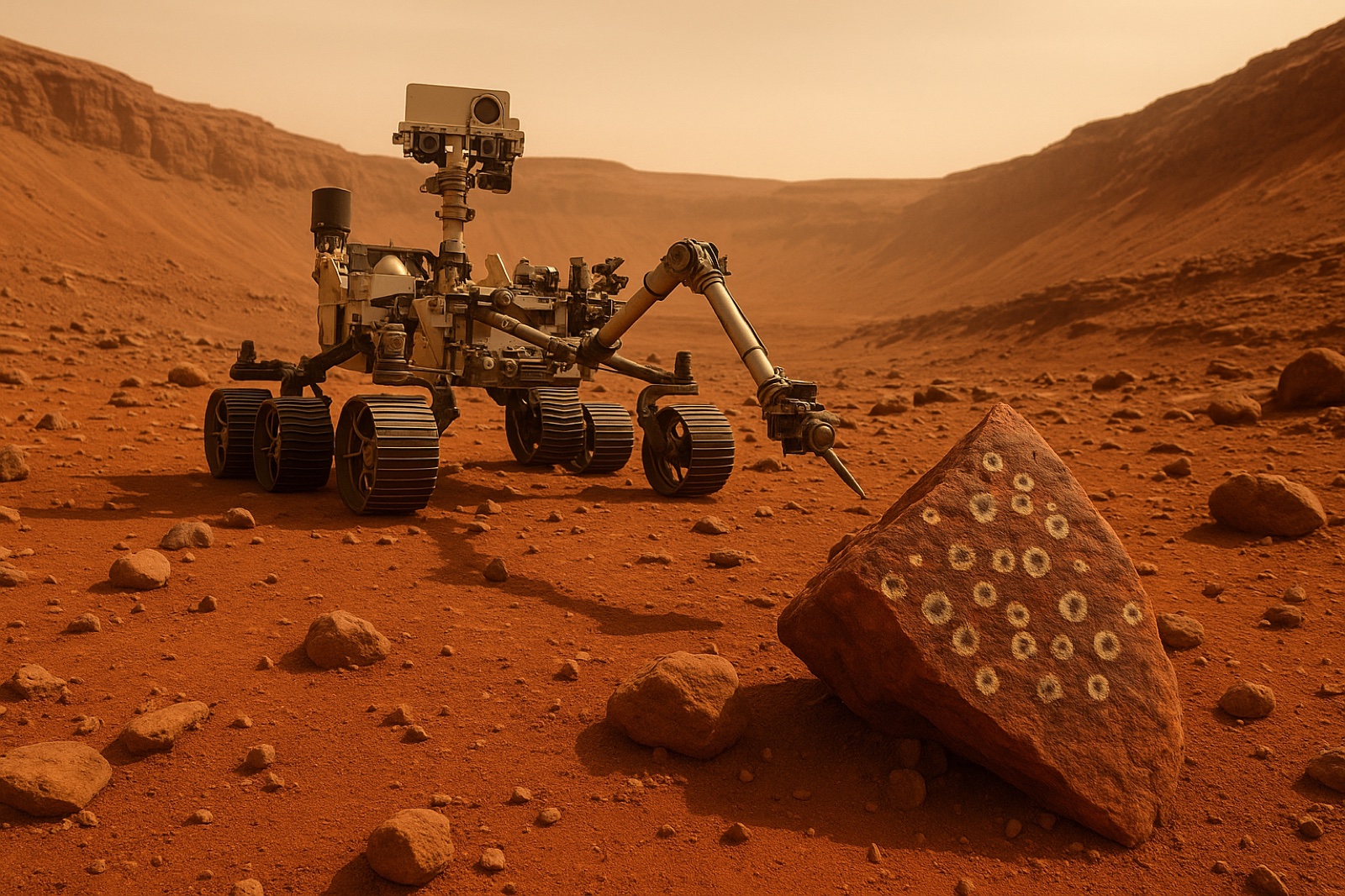
The rock. On Mars, NASA’s Perseverance rover had drilled into an arrowhead-shaped rock nicknamed Cheyava Falls in July 2024. The rock is dotted with small pale spots with dark rims. Scientists call them “leopard spots.” On Earth, patterns like these are often made by microbes. In September 2025, NASA announced that the rock held a “potential biosignature,” a possible sign of ancient life, and called it the closest we have ever come to finding life on Mars.
Two claims. Two very different kinds of evidence. So what did the experts actually think?
What Hundreds of Astrobiologists Actually Said
A team led by Peter Vickers, a philosopher of science at Durham University in England, ran a simple survey. Right after each announcement, they asked hundreds of astrobiologists around the world one question: do you think alien life has probably been found?
People could answer on a five-step scale, from strongly agree to strongly disagree, with neutral in the middle. The results were published in the journal Nature Astronomy in June 2026.
For the planet K2-18b:
- Only 6.6% agreed that life had probably been found.
- 28% stayed neutral.
- Nearly two-thirds disagreed, and more than a third (35.1%) disagreed strongly.
For the Mars rock:
- 15.1% agreed.
- 40.3% stayed neutral.
- 44.6% disagreed, but only 11.1% disagreed strongly.
Read those two lists side by side and something jumps out. The experts did not give one answer. They gave two very different answers to two very different pieces of evidence.
Why the Mars Rock Did Better
Vickers points to the kind of evidence in each case. For K2-18b, scientists were reading faint patterns in light that had crossed more than 120 light-years of space. For Mars, they had a real rock that a rover could study up close, with cameras and instruments right beside it.
One is like hearing a rumour from a friend of a friend of a friend. The other is like holding the thing in your hand. Both can turn out to be wrong. But you know which one you would trust more.
There was a reason for caution in both cases, too. As the researchers put it, “apparently lifelike features can sometimes arise through non-biological processes.” In plain words, rocks and chemistry can fake it. Spots can form without life. Gases can come from chemistry that has nothing to do with living things.
The Most Honest Answer in the Survey
Here is the number worth sitting with. On the Mars rock, 40.3% of the experts picked neutral. Four in ten of the people who study this for a living looked at the best evidence yet and said, in effect, “I don’t know yet.”
That is not a shrug. Vickers notes that a neutral answer can mean different things. It can mean the evidence really is unclear. It can mean someone is partly convinced but not all the way. Or it can mean the claim is simply too early to back or reject. All three are honest places to stand.
We almost never get to see that middle ground. A headline wants a yes or a no. A yes-or-no question hides everyone who is still weighing it. This survey showed them, and there were a lot of them.
What Happened Next
A survey like this is a snapshot of one moment. So it is fair to ask: how did those answers hold up?
On K2-18b, the doubters have had a good run. Other teams went back over the same telescope data. One study in the journal Astronomy & Astrophysics was titled, very plainly, “Insufficient evidence for DMS and DMDS in the atmosphere of K2-18 b.” Another paper, in The Astronomical Journal, went further: “K2-18b Does Not Meet the Standards of Evidence for Life.” The faint signal sat close to the noise, and other molecules fit the data about as well.
That does not prove there is no life on K2-18b. It means this signal cannot carry that claim. (Astronomers have tried other ways in, too. We wrote about the time they listened to K2-18b for 33 days straight and heard only silence.)
On Mars, the answer is sitting in a tube. Perseverance drilled a sample from Cheyava Falls, named Sapphire Canyon, and stored it inside the rover. Many scientists say the best way to settle the question is to study that rock in labs on Earth, with machines far too big to send to Mars. But in January 2026, a US spending bill removed almost all the funding for NASA’s Mars Sample Return, the mission meant to bring those samples home. Right now there is no approved mission to fetch them.
So on Mars, the most honest answer may stay “not yet” for a long time.
How to Read the Next “We Found Aliens” Headline
There will be another one. The search keeps widening, like the team that recently scanned a completely new radio frequency for alien signals. When the next big claim lands, here are five simple checks the experts’ answers suggest:
- Ask how close the evidence is. Light from a distant planet is weaker evidence than a rock studied up close. And a rock in a lab beats a rock seen through a rover’s camera.
- Ask what else could explain it. The key question is not “could this be life?” It is “has everything that isn’t life been ruled out?”
- Wait for the second team. One team’s result is a start. The real test comes when other teams check the same data.
- Notice the small words. “Potential,” “possible” and “hint” mean exactly that. None of them means “found.”
- Let “not yet” be an answer. You don’t have to pick a side the day a story breaks. Four in ten experts didn’t.
The Oldest Kind of Honesty
There is something quietly beautiful about a room full of experts who will not say more than they know.
It brings to mind a story nearly two thousand years old. A travelling teacher arrived in a small Greek town with an extraordinary claim about God. The people there didn’t laugh him off, and they didn’t just swallow it either. They listened carefully, then went back to their old writings every day to check whether it was true. They were remembered as the more noble ones, not for believing fast, but for checking well.
That is what faith looks like at its best. Not belief that skipped the evidence, but trust that has weighed it. Some questions are too big to rush: whether we are alone out there, whether there is a God behind all of it. The honest way to hold them is the same way those astrobiologists did. Look closely. Stay open. Say “not yet” when the evidence isn’t in, without closing the door.
Somewhere on Mars, inside a rover, a small tube of rock is waiting. Maybe one day a spacecraft will carry it home, and someone in a lab will finally look inside. Maybe the spots will turn out to be chemistry. Maybe they won’t.
Until then, the experts have handed us a good way to live with a big question. Don’t pretend to know. Don’t stop looking. Keep the door open. And if you want a little more of that wonder, our free How Old Is the Universe? explorer is a good place to lose ten minutes.
What Do You Think?
If someone had asked you on the day NASA announced the Mars rock, which box would you have ticked: probably life, probably not, or not sure yet? And what would it take to change your mind? Tell us in the comments below.
Share This
“Hundreds of astrobiologists were asked if we’d found alien life after the 2025 K2-18b and Mars claims. Only 6.6% said yes to K2-18b. On the Mars rock, 4 in 10 said ‘not sure yet.’ https://bgodinspired.com/?p=107620”
“The most honest answer in science might be ‘not yet.’ 40% of experts stayed neutral on the Mars leopard-spot rock. https://bgodinspired.com/?p=107620”
“Before you share the next ‘scientists found aliens’ headline, ask two things: how close is the evidence, and has everything else been ruled out? This breakdown of what experts really thought about K2-18b and the Mars rock is worth a read: https://bgodinspired.com/?p=107620”
Questions People Ask About Alien Life
Have scientists found alien life?
No. Scientists have not confirmed alien life. In 2025, two claims drew worldwide attention: possible signs of the gas dimethyl sulfide (DMS) in the atmosphere of the exoplanet K2-18b, and “leopard spot” patterns in a Mars rock called Cheyava Falls. When hundreds of astrobiologists were surveyed right after each announcement, only 6.6% thought K2-18b showed probable life, and 15.1% thought the same about the Mars rock.
What did astrobiologists think of the K2-18b life claim?
Most astrobiologists were not convinced by the April 2025 claim of possible DMS and DMDS gases on the exoplanet K2-18b. In a survey published in Nature Astronomy in 2026, only 6.6% agreed that life had probably been found, 28% were neutral, and nearly two-thirds disagreed, with 35.1% disagreeing strongly. Later reanalyses of the James Webb Space Telescope data found insufficient evidence for DMS or DMDS in the planet’s atmosphere.
What are the leopard spots on the Mars rock Cheyava Falls?
The leopard spots are small pale patches with dark rims found on Cheyava Falls, an arrowhead-shaped rock in Mars’s Jezero Crater that NASA’s Perseverance rover sampled in July 2024. On Earth, similar patterns are often made by microbes, so NASA described them as a potential biosignature in September 2025. Patterns like these can also form without life, so the rock would need to be studied in laboratories on Earth to settle the question.
Why were scientists more convinced by the Mars rock than by K2-18b?
Scientists were more persuaded by the Mars rock Cheyava Falls than by the exoplanet K2-18b mainly because of the type of evidence. The K2-18b claim relied on faint signals in starlight that crossed more than 120 light-years of space, while the Mars rock could be studied directly and in close detail by the Perseverance rover. In a 2026 survey, 15.1% of astrobiologists thought the Mars rock probably showed life, compared with 6.6% for K2-18b, and only 11.1% strongly rejected the Mars claim compared with 35.1% for K2-18b.
Will the Cheyava Falls sample be brought back to Earth?
There is currently no approved mission to bring the Cheyava Falls sample, called Sapphire Canyon, back to Earth. The sample is stored inside NASA’s Perseverance rover on Mars. In January 2026, a US spending bill removed almost all funding for NASA’s Mars Sample Return mission, which had been designed to retrieve Perseverance’s samples. Many scientists say studying the rock in Earth laboratories is the best way to learn whether its spots were made by ancient life.



